That gap exists largely because ERP pricing is poorly understood. Costs vary enormously depending on deployment model, number of users, modules selected, and how much customisation the business requires. Businesses either underbudget by looking only at the licence fee, or overspend by choosing enterprise-grade software built for companies ten times their size.
This guide breaks down realistic ERP pricing for Indian businesses in ₹, explains what drives costs up or down, and helps you build a budget that fits your actual operational needs — not what a vendor recommends.
Key Takeaways
- Entry-level cloud ERP for Indian MSMEs starts from ₹999–₹9,999 per year; mid-range suites cost tens of thousands annually
- Heavy customisation, on-premise deployment, extra users, and separately billed modules all push costs higher
- Listed prices usually exclude 18% GST — factor this into your budget from day one
- Don't fixate on the subscription fee alone — implementation, training, and support costs add up quickly
- Purpose-built Indian ERP usually costs less than adapting a global platform for GST compliance
How Much Does ERP Software Cost in India?
ERP does not have a single fixed price. The final number depends on your deployment model, how many users need access, which modules you activate, and how much setup the vendor handles before launch.
Two budgeting mistakes cost businesses the most:
- Underbuying — focusing only on the licence fee and overlooking implementation costs
- Overbuying — choosing an enterprise platform built for 5,000 employees when your team has 50
The ranges below are based on publicly verified Indian vendor pricing:
Entry-Level Cloud ERP (Micro and Small Businesses)
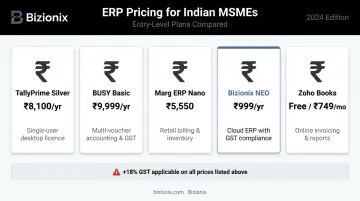
Typical range: ₹750–₹9,999 per year (plus 18% GST)
Examples from verified vendor pages:
- TallyPrime Silver: ₹8,100/year rental, or ₹22,500 lifetime (+18% GST)
- BUSY Basic: ₹9,999/year single-user (+GST)
- Marg ERP Nano: ₹5,550 (+18% GST)
- Bizionix NEO: ₹999/year (discounted from ₹2,999), includes a 14-day free trial
- Zoho Books Free Plan: available for businesses with turnover up to ₹25 lakh; paid plans from ₹749/month billed annually
What's typically included: basic accounting, GST filing, inventory, billing, and limited users
Best for: freelancers, small traders, and single-location businesses just beginning to replace manual processes
Mid-Range Cloud or Hybrid ERP (Growing MSMEs)
Typical range: ₹15,000–₹1,80,000 per year (plus GST)
Examples:
- BUSY Standard: ₹14,999/year; Enterprise: ₹19,999/year
- Marg ERP Gold: ₹26,000 (+18% GST), includes unlimited users
- Zoho One All-Employee: ₹1,500/user/month billed annually (₹18,000/user/year)
- TallyPrime Gold: ₹24,300/year rental or ₹67,500 lifetime (+18% GST)
What's typically included: multi-module access (finance, HR, CRM, procurement), multi-user support, GST e-invoicing, and reporting dashboards
Best for: businesses with 10–200 employees managing multiple departments
High-End or Enterprise ERP
Typical range: ₹5 lakh+ per year, or a large upfront licence fee (quote required)
Platforms like SAP Business One, Oracle NetSuite, and large-scale Odoo implementations don't publish standard INR pricing. Costs vary by user count, modules selected, customisation scope, and implementation complexity. Request a formal quote that breaks out localisation, SLA terms, and implementation fees as separate line items.
Best for: large enterprises, manufacturing groups, and multi-entity businesses with complex operations
Note on GST: TallyPrime, BUSY, and Marg ERP explicitly add 18% GST on top of listed prices. Zoho Books states prices exclude local taxes. Always confirm whether the quoted price is inclusive or exclusive of GST before comparing vendors.
Key Factors That Affect ERP Software Cost
Four factors drive most of the variation in ERP pricing: deployment model, user count, modules selected, and customisation depth. Getting clear on each one before you start vendor conversations prevents the expensive surprises that show up mid-contract.
Deployment Model
Cloud ERP uses a monthly or annual subscription with low upfront cost. There is no server to buy, no IT team needed for maintenance, and upgrades are handled by the vendor.
On-premise ERP requires a larger one-time capital investment in software licences plus server infrastructure. Vendors typically charge annual maintenance contracts (AMC) separately.
For most Indian MSMEs, cloud ERP is the more accessible starting point. However, cumulative subscription costs over 7–10 years can approach or exceed a one-time on-premise licence. Calculate total cost of ownership (TCO) over at least three years before deciding — not just the first-year monthly fee.
Number of Users and Access Levels
Most ERP vendors price by named users (fixed login accounts for specific people) or concurrent users (more employees have accounts, but only a limited number can be online simultaneously). The right model depends on how many staff actively use the system each day.
Two practical rules before you commit:
- Count users for the next two to three years, not just today
- Underestimating at purchase almost always means expensive mid-contract upgrades
Modules Selected
ERP platforms are modular. A business paying for accounting and inventory pays far less than one that also activates HR, CRM, procurement, and production planning.
Key add-on costs to verify from Indian vendors:
- Zoho Books: extra users at ₹150–₹180/user/month; additional locations at ₹600–₹720/month
- Marg ERP: extra users or companies at ₹3,000 each (Basic/Silver editions)
- greytHR: HR add-ons range from ₹20–₹140/user/month depending on feature
Before signing, map your must-have vs. nice-to-have modules. Also confirm that GST compliance, e-invoicing, and TDS/TCS tracking are included in the base plan — not charged as extras.
Level of Customisation
Off-the-shelf ERP with standard configuration costs considerably less than custom-built workflows or source code modifications. Marg ERP's pricing page states customisation is charged separately; Odoo explicitly separates implementation services and custom code maintenance from its subscription.
Businesses that choose ERP built specifically for Indian MSMEs — with GST compliance, e-invoicing, and local tax logic built in — typically need far less customisation than those forcing a global enterprise platform to fit Indian requirements. That gap in customisation cost is often where the real price difference lies.
ERP Cost Breakdown: What You're Actually Paying For
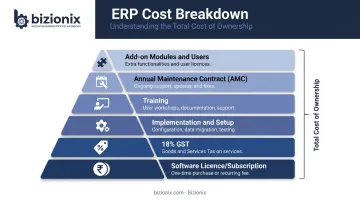
The licence fee is just one line on the invoice. Most businesses are surprised by what comes after it:
| Cost Component | Type | Notes |
|---|---|---|
| Software licence / subscription | Recurring (or one-time for perpetual) | Base cost of using the platform; cloud = monthly or annual; on-premise = lump sum |
| 18% GST on software | Added to listed price | Required under SAC 997331; TallyPrime, BUSY, and Marg explicitly add this |
| Implementation and setup | One-time | Data migration, workflow configuration, go-live support; complexity determines cost |
| Training | One-time (with periodic updates) | Some vendors include training hours; others bill separately |
| Annual Maintenance Contract (AMC) | Recurring | For cloud ERP, often bundled in subscription; for on-premise, typically a separate annual fee |
| Add-on modules and users | Recurring | Scales with business growth; verify before signing |
Here is what annual renewal actually costs across popular Indian on-premise vendors:
- Marg ERP ARC (Annual Renewal Contract): Nano ₹2,400 / Basic ₹3,990 / Silver ₹4,780 / Gold ₹9,550 — all plus 18% GST
- BUSY renewal: Basic Single User from ₹3,499/year
- TallyPrime: lifetime licences include one year of Tally Software Services (TSS)
Cloud ERP platforms like Bizionix bundle ongoing support and compliance updates into the subscription itself, so there is no separate AMC to budget for. That difference adds up when you are projecting total cost of ownership over two or three years.
How to Estimate the Right ERP Budget for Your Business
The right ERP budget is defined by what your business actually needs, not by what a vendor recommends or what a competitor is spending.
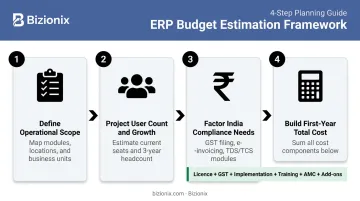
Step 1 — Define your operational scope
List every department and process that needs to be covered: accounts, inventory, HR, procurement, GST compliance. This dictates which modules you actually need and prevents overspending on features that sit unused.
Step 2 — Project user count and growth
Estimate how many staff will actively use the system today and in the next two to three years. If that number grows quickly, per-user pricing may become expensive — a flat-fee or usage-based model might make more sense at scale.
Step 3 — Factor in India-specific compliance needs
Any ERP you shortlist must handle current GST rules, e-invoicing mandates, and ideally TDS/TCS tracking. Verify with each vendor whether these are included in the base plan or billed as add-ons, then calculate that cost into your total budget.
Step 4 — Build a first-year total cost, not just a monthly fee
A simple first-year budget framework:
- Subscription/licence (12 months)
- + 18% GST on software
- + Implementation and data migration
- + Training
- + AMC or renewal (if on-premise)
- + Any add-on modules or extra users
When evaluating vendors, confirm that GST compliance and e-invoicing are included in the base price, not sold as extras. Bizionix, for example, bundles GST-ready accounting, direct IRP API integration for instant IRN generation, and multi-company management into its standard plans. The NEO plan starts at ₹999/year with a 14-day free trial, a practical starting point for businesses moving off spreadsheets.
What Most Businesses Miss When Budgeting for ERP
According to Panorama Consulting's 2023 ERP Report, only slightly more than half of organisations stayed within their expected ERP budget — with underestimating internal staffing as a leading cause of overruns.
Indian MSMEs tend to repeat the same three budgeting mistakes — and each one is avoidable:
- The licence fee trap: First-year ERP costs — implementation, training, AMC, and the go-live productivity dip — are consistently higher than the headline subscription price. Budget for the full picture, not just the SaaS fee.
- Paying to adapt a global platform: Many MSMEs spend heavily customising SAP or Oracle for GST compliance when purpose-built Indian ERP platforms already include these features as standard.
- Choosing cheap over scalable: An ERP that cannot handle growth in users, locations, or entities will force a costly re-implementation within two to three years. The real price of the "cheap" option is often what it costs to switch away from it.
Conclusion
ERP software cost in India spans a wide range: from a few hundred rupees per year for a basic cloud subscription to multi-lakh implementations for complex enterprises. The right answer depends on your business size, operational complexity, and compliance requirements — not on what a competitor chose or what a vendor recommends.
Before talking to any vendor, build your evaluation around three things:
- A clear list of your operational needs (modules, user count, integrations)
- A realistic first-year total cost — licence, implementation, training, and AMC
- GST compliance requirements specific to your industry and transaction volume
The ERP that pays for itself fastest matches your actual complexity, handles GST compliance without add-on fees, and scales as your business grows — without forcing a full replacement in three years.
Frequently Asked Questions
How much does ERP software cost in India?
ERP software in India ranges from under ₹1,000/year for entry-level cloud solutions to several lakhs for full enterprise implementations. The final cost depends on deployment model, number of users, modules selected, and customisation scope — all plus 18% GST on top of listed prices.
Is ERP software free?
Some vendors offer free trials or limited free tiers (Zoho Books offers a free plan for businesses under ₹25 lakh turnover; Bizionix includes a free trial period). No fully functional ERP is free — "free" tools typically carry hidden costs in customisation, support gaps, and limited scalability.
How much does ERP implementation cost in India for a small business?
Cloud ERP for Indian MSMEs typically has lower implementation costs than on-premise — many platforms bundle onboarding support with no separate fee for standard configurations. For data migration from legacy systems or complex setups, expect additional charges. Confirm the full scope with your vendor before signing.
What is the difference between cloud ERP and on-premise ERP cost?
Cloud ERP has a lower upfront cost (subscription-based) but accumulates over time. On-premise ERP requires a larger one-time investment but can be more cost-effective over 7–10 years for larger businesses. For most Indian MSMEs, cloud ERP is the more practical entry point — it eliminates hardware costs and AMC is typically bundled into the subscription.
What hidden costs should I watch for when buying ERP software?
Build these into your first-year budget — not just the monthly subscription:
- Implementation and data migration fees
- Employee training time and cost
- Annual Maintenance Contracts (AMC, for on-premise)
- GST compliance module add-ons
- Extra users or locations billed separately
- Productivity loss during go-live
Can Indian MSMEs afford enterprise-grade ERP software?
Indian MSMEs do not need to pay enterprise prices to get enterprise-grade features. Purpose-built cloud ERP platforms designed for the Indian market — like Bizionix — offer GST compliance, multi-department management, and real-time reporting at MSME-appropriate pricing, without the complexity or cost of global systems like SAP or Oracle.