The challenge? Dozens of ERP options exist, and choosing the wrong one can mean years of inefficiency, missed compliance deadlines, and wasted implementation costs. Most comparison guides don't account for India-specific requirements — GST e-invoicing, e-way bills, multi-GSTIN support, and MSME-friendly pricing.
This guide cuts through the noise with a practical breakdown of the top 10 ERP solutions for Indian businesses in 2026.
Key Takeaways
- ERP software unifies finance, inventory, sales, HR, and compliance into one system — eliminating data silos and manual processes
- Indian businesses need native GST e-invoicing, e-way bill support, and multi-GSTIN management — not patched-in add-ons
- Right-fit ERP varies by your size, industry, budget, and whether you need cloud or on-premise deployment
- Evaluates 10 platforms on GST compliance depth, MSME suitability, pricing transparency, and Indian market fit
ERP Software in India: Why Businesses Are Adopting It in 2026
Gartner defines ERP as an integrated suite of business applications sharing a common process and data model — covering end-to-end operations from finance and procurement to production and HR. In practice, it replaces the disconnected spreadsheets, standalone accounting tools, and manual workflows that slow growing businesses down.
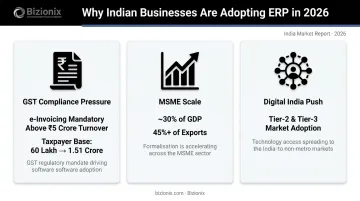
For Indian businesses, three forces are pushing ERP adoption from "nice to have" to urgent in 2026:
- GST registered taxpayers grew from 60 lakh to approximately 1.51 crore, and e-invoicing is now mandatory for businesses with aggregate turnover above ₹5 crore — manual compliance workflows simply can't keep up
- India's MSME sector contributes ~30% of GDP and over 45% of exports; as these businesses formalise and scale, disconnected tools break down fast
- Government-led digitisation under Digital India is accelerating technology adoption across tier-2 and tier-3 markets, reaching businesses that previously ran entirely on paper
What sets the shortlist below apart is specificity to this environment: each solution was evaluated for native GST support, e-invoicing readiness, and pricing that makes sense for MSME budgets — not enterprise contracts designed for multinational rollouts.
Top 10 Best ERP Software in India 2026
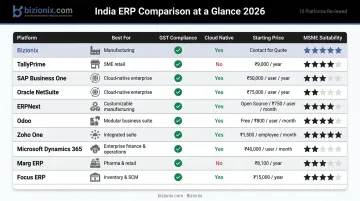
Each platform below was evaluated on GST compliance depth, module breadth, pricing transparency, MSME suitability, cloud readiness, and quality of India-specific support.
1. Bizionix
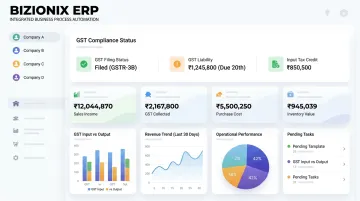
Bizionix is a 100% cloud-based ERP developed by IIS-LLP — a subsidiary of Protocol India Private Limited — backed by over two decades of industry experience. It's purpose-built for Indian MSMEs across manufacturing, distribution, hospitality, service sectors, and multi-entity business groups.
Its direct API integration with the GST Invoice Registration Portal (IRP) generates IRNs and QR codes in real time, with no manual steps or third-party tools required. The multi-company module lets holding companies, CA firms, and franchise networks manage multiple GST-registered entities from one login, with independent books per entity and consolidated dashboards. GST compliance updates happen automatically — no manual upgrades when e-invoicing rules change.
Bizionix NEO starts at ₹999/year with a 14-day free trial, making it one of the most accessible entry points for smaller MSMEs. Enterprise pricing is custom, covering the full 12+ module suite.
| Attribute | Details |
|---|---|
| Best For | Growing MSMEs, multi-location enterprises, manufacturing, distribution, CA firms, franchise networks, and hospitality businesses across India |
| Key Features | Multi-company management, real-time IRN generation via direct IRP API, GST-ready accounting, inventory & warehouse management, CRM, HRMS & payroll, hotel management (HotelEase), real-time dashboards |
| Pricing | NEO plan from ₹999/year (14-day free trial); Enterprise plan — custom pricing |
2. TallyPrime
TallyPrime by Tally Solutions is the dominant accounting and business management platform among Indian SMEs, used by nearly 2.5 million businesses worldwide. Its familiarity among Indian accountants makes adoption straightforward, and its GST compliance features — e-invoicing, e-way bill, GSTR filing — are built into the core product.
The key limitation: TallyPrime is accounting-first, not a full ERP. It handles inventory and payroll well, but lacks manufacturing planning, CRM, or HR management depth that growing businesses eventually need.
| Attribute | Details |
|---|---|
| Best For | Small businesses and SMEs focused on accounting, GST compliance, and basic inventory management |
| Key Features | GST filing, e-invoicing, e-way bill, inventory tracking, payroll, multi-currency billing, financial reporting |
| Pricing | Silver: ₹750/month or ₹22,500 lifetime (+18% GST); Gold: ₹2,250/month or ₹67,500 lifetime (+18% GST) |
3. SAP Business One
SAP Business One targets growing mid-sized businesses that need enterprise-grade depth across finance, procurement, production, and supply chain. The India 10.0 localization covers GSTIN, HSN/SAC codes, e-invoicing in government JSON formats, and Indian supply types, covering the major compliance requirements.
The barrier is cost and complexity. Based on partner-indicative pricing, India implementations typically range from ₹10 lakh for 5 users to ₹50 lakh for 100 users — well beyond most MSME budgets.
| Attribute | Details |
|---|---|
| Best For | Mid-to-large enterprises and manufacturing companies needing scalable, enterprise-grade ERP |
| Key Features | Financial management, procurement, production planning, inventory, CRM, advanced analytics, India GST localization |
| Pricing | Partner-quoted; indicative range ₹10 lakh–₹50 lakh for India projects depending on user count |
4. Oracle NetSuite
NetSuite is a globally recognized cloud ERP used by over 43,000 customers, particularly suited for multi-subsidiary operations with its OneWorld product. Each subsidiary can maintain a separate base currency, and the platform handles multi-language, multi-entity reporting without manual consolidation.
For typical Indian MSMEs, NetSuite is over-engineered and over-priced. It fits best where international operations, complex financial consolidation, or multi-country compliance are actual requirements.
| Attribute | Details |
|---|---|
| Best For | Mid-to-large companies with international operations, financial services, and e-commerce |
| Key Features | Financial management, order management, inventory, CRM, advanced analytics, multi-currency, multi-subsidiary |
| Pricing | Custom quote required — contact NetSuite India directly |
5. ERPNext
ERPNext by Frappe Technologies is the go-to open-source ERP for Indian SMEs and startups that want comprehensive module coverage without licensing fees. The India Compliance app supports GST regulations, pre-configured ledgers, HSN/SAC codes, GSTR-1, GSTR-3B, and e-invoicing for Frappe Cloud subscribers.
The trade-off: self-hosted deployment requires technical resources for setup and maintenance, and official support is limited on the free version.
| Attribute | Details |
|---|---|
| Best For | Budget-conscious SMEs, startups, and manufacturing businesses comfortable with open-source platforms |
| Key Features | Inventory, manufacturing, HR, accounting, CRM, GST compliance, e-invoicing, multi-currency |
| Pricing | Free (self-hosted, GPL v3 license); Frappe Cloud from ~₹410/month (shared) or ~₹1,800/month (server); ERPNext Small Business from ~USD 50/month |
6. Odoo
Odoo's modular structure gives it unusual flexibility — businesses pay only for the apps they use, from a catalogue of 48 distinct applications covering finance, sales, inventory, manufacturing, HR, and e-commerce. The India 19.0 localization includes GST e-invoice and e-way bill support through dedicated modules.
Costs scale quickly as user counts and module counts grow, and implementation often requires technical support for customisation.
| Attribute | Details |
|---|---|
| Best For | Diverse business types looking for modular customisation — retail, manufacturing, services, e-commerce |
| Key Features | 48 apps including CRM, inventory, manufacturing, HR, accounting, e-commerce, GST e-invoicing |
| Pricing | One app free; Standard ~₹1,000/user/month; Custom ~₹1,500/user/month (verify current India pricing on Odoo's site) |
7. Zoho One
Zoho One bundles 50+ integrated cloud applications — CRM, accounting (Zoho Books), HR, marketing automation, project management, and analytics — under a single all-employee pricing model. Being an Indian company, Zoho's local support infrastructure and GST compliance coverage via Zoho Books are real advantages for India-based businesses.
The gap: no verified dedicated manufacturing or MRP module exists in the Zoho One suite, making it less suitable for production-heavy businesses.
| Attribute | Details |
|---|---|
| Best For | Service businesses, D2C brands, and SMEs needing a broad cloud suite beyond core ERP functions |
| Key Features | CRM, inventory, accounting (Zoho Books), HR, marketing automation, project management, analytics, 50+ apps |
| Pricing | All-employee annual plan: ₹1,800/employee/month; monthly billing: ₹2,700/employee/month |
8. Microsoft Dynamics 365 Business Central
Business Central integrates ERP and CRM capabilities within the Microsoft ecosystem — Office 365, Teams, Power BI, and Azure all connect natively. The India localization covers GST e-invoicing with IRN hash, QR code, and e-way bill number fields exported in GSTIN JSON schema.
Per-module pricing adds up fast. At ₹6,655/user/month for Essentials and ₹9,150/user/month for Premium, it's realistically a mid-to-large enterprise tool.
| Attribute | Details |
|---|---|
| Best For | Mid-to-large enterprises already using Microsoft tools (Office 365, Teams, Azure) |
| Key Features | Finance, supply chain, sales, CRM, HR, AI-driven analytics (Copilot), Power BI integration, India GST e-invoicing |
| Pricing | Essentials: ₹6,655/user/month; Premium: ₹9,150/user/month; Team Members: ₹665/user/month (yearly) |
9. Marg ERP
Marg ERP has served Indian traders and distributors for 30+ years, with deep specialisation in pharma, FMCG, and retail. Its compliance features — GST billing, e-invoicing, e-way bill — are solid, and the perpetual licensing model keeps long-term costs predictable.
The interface is dated, and Marg lacks a cloud-native architecture. This limits remote access and scalability as businesses expand beyond a single location.
| Attribute | Details |
|---|---|
| Best For | Pharma distributors, FMCG businesses, retailers, and trade-focused SMEs |
| Key Features | GST compliance, e-invoicing, e-way bills, batch-wise inventory, expiry management, billing, payroll, pharma-specific modules |
| Pricing | One-time: Basic ₹8,991 / Silver ₹12,600 / Gold ₹25,200; Rental: Basic ₹1,000/yr / Silver ₹1,500/yr / Gold ₹3,000/yr |
10. Focus ERP (Focus X)
Focus Softnet, established in 1992, positions its Focus X product as a "Fourth-Era ERP" with AI-powered analytics, ML-based cash flow forecasting, reorder prediction, and voice UI capabilities. Module coverage spans finance, HR, warehouse management, supply chain, MRP II, and CRM — with broad industry coverage across automotive, construction, FMCG, and retail.
Pricing is not publicly disclosed. Businesses will need a direct quote from Focus Softnet India, which can slow down the evaluation process for budget-conscious buyers.
| Attribute | Details |
|---|---|
| Best For | Mid-sized businesses in manufacturing, distribution, construction, and FMCG |
| Key Features | MRP II, production planning, finance, inventory, HR, AI-driven analytics, cash flow forecasting, GST compliance |
| Pricing | Custom quote — contact Focus Softnet India for pricing |
How to Choose the Right ERP Software for Your Indian Business
GST Compliance Is Non-Negotiable
Any ERP for Indian businesses must natively support GST e-invoicing and e-way bill generation. The current e-invoicing mandate applies to businesses with aggregate turnover above ₹5 crore, and e-way bills are required whenever goods movement value exceeds ₹50,000. Non-compliance carries penalties of ₹10,000 or the tax amount sought to be evaded — whichever is higher.
The key distinction: native integration vs. workarounds. Platforms with direct IRP API connections (like Bizionix) generate IRNs automatically at invoice creation. Others require manual JSON exports or third-party intermediaries — each a potential compliance gap.
Cloud vs. On-Premise for Indian MSMEs
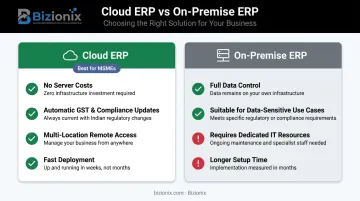
For most growing Indian MSMEs, cloud ERP is the practical choice:
- Eliminates server and IT maintenance costs entirely
- Keeps you compliant automatically — when GST rules change (e-invoicing thresholds, new return formats), updates roll out centrally without any action on your end
- Enables remote access across multiple locations and cities
- Deploys in weeks, not months
On-premise offers data control, but requires dedicated IT resources that most MSMEs don't have. If data control is a priority, discuss hybrid options with vendors directly.
Avoid the Feature Trap
Many MSMEs overspend on enterprise-grade platforms like SAP or Oracle NetSuite when their actual needs come down to billing, inventory, and GST compliance.
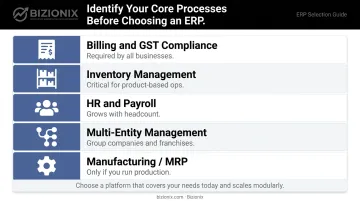
Before evaluating platforms, identify your 3–5 core processes:
- Billing and GST compliance (required by virtually every business)
- Inventory management (critical for product-based operations)
- HR and payroll (increasingly important as headcount grows)
- Multi-entity management (essential for group companies and franchises)
- Manufacturing/MRP (only relevant if you run production operations)
Choose a platform that covers your immediate needs and can expand modularly. A ₹999/year MSME cloud ERP that covers 80% of your operations is more valuable than a ₹50 lakh SAP implementation that covers 100% but takes 18 months to deploy.
Localization and Support Matter
Getting the feature set right is only half the battle. How well a platform handles India-specific requirements — and how quickly support responds when something breaks — determines real-world adoption.
Look specifically for:
- Multi-GSTIN support for businesses operating across states
- Indian accounting standards, not just generic IFRS frameworks
- Local implementation partners — global products without India-specific support create significant adoption delays
- Phone and email responsiveness during IST business hours
Conclusion
There is no single best ERP for Indian businesses — the right choice depends on your size, industry, compliance requirements, and growth trajectory. A pharma distributor in Hyderabad has different needs than a manufacturing company in Pune or a franchise network managing 50 outlets across India.
What's consistent across all good ERP decisions: prioritise GST compliance depth, match platform complexity to your actual operational needs, and choose a vendor with genuine India-specific support.
For Indian MSMEs that need a cloud ERP built for GST compliance and local business processes, without enterprise-level complexity or cost, Bizionix by IIS-LLP is worth a close look. Starting at ₹999/year, the platform includes:
- Direct IRP API integration for real-time IRN generation
- Multi-company management under a single login
- Real-time operational visibility across departments
Request a demo or reach the team at info@bizionix.com / +91 91779 99277 to schedule a walkthrough.
Frequently Asked Questions
What are the most used ERP software in India?
TallyPrime dominates among Indian SMEs due to its accounting depth and GST compliance features. SAP Business One and Oracle NetSuite are common among mid-to-large enterprises. ERPNext, Odoo, and Zoho One are popular among startups and growing businesses looking for cost-effective, modular options.
Is Zoho a CRM or ERP?
Zoho is both. Zoho CRM is a standalone customer management tool, while Zoho One combines 50+ apps (including Zoho Books for accounting and inventory) into an ERP-like suite. It lacks a dedicated manufacturing module, so it's better suited for service businesses than production-heavy operations.
What is the best ERP software for small businesses in India?
ERPNext (open-source), TallyPrime (accounting-first), Zoho One, and MSME-focused platforms like Bizionix are commonly shortlisted. Bizionix NEO at ₹999/year is one of the most accessible entry points for businesses just getting started with GST compliance and integrated management.
How much does ERP software cost in India?
ERP costs range from free (ERPNext self-hosted) to several lakhs annually for SAP or Oracle. Cloud-based MSME solutions typically fall between ₹999/year (Bizionix NEO) and ₹1,800/employee/month (Zoho One). Microsoft Business Central runs ₹6,655–₹9,150/user/month, while SAP partner-indicative pricing starts around ₹10 lakh for 5 users.
Is TallyPrime considered ERP software?
TallyPrime is best described as accounting software with ERP-like capabilities: strong on GST, inventory, and payroll, but short on manufacturing planning, CRM, and full HR management. It fills many ERP roles for SMEs but doesn't qualify as a full-suite ERP by Gartner's definition.
Which ERP software offers the best GST compliance for Indian businesses?
TallyPrime, Marg ERP, and Bizionix offer the deepest native GST support, with e-invoicing, e-way bill generation, and GSTR filing built into core workflows. ERPNext, Odoo, and Microsoft Business Central cover GST through India localization modules, while SAP and Oracle rely on partner-configured setups.