The challenge? Dozens of vendors are competing for attention, and not all of them understand the operational reality of an Indian MSME. A global ERP with Indian localisation "bolted on" is a very different thing from a platform built with GST, e-invoicing, and multi-location management at its core.
This guide cuts through the noise with a curated ranking of the top ERP software companies in India for 2026 — built specifically to help MSMEs and growing enterprises choose with confidence.
Key Takeaways
- ERP unifies accounting, inventory, sales, procurement, HR, and compliance into one platform — replacing fragmented tools and manual processes
- India's ERP market is growing at 16%+ CAGR, driven by GST mandates, Digital India initiatives, and MSME scaling needs
- Any ERP shortlist for Indian businesses must include native GST, e-invoicing (with IRN generation), and e-way bill support
- Rankings factor in India-market fit, GST compliance depth, module breadth, pricing accessibility, and deployment ease for growing businesses
- Pricing ranges from free tiers for micro-businesses to enterprise plans — each entry includes deployment type, ideal business size, and GST readiness
ERP Software in India: Why 2026 Is a Key Year for MSMEs
An ERP — Enterprise Resource Planning — is a unified software platform that connects finance, inventory, procurement, sales, HR, and compliance into one system. It replaces the spreadsheets, standalone accounting tools, and WhatsApp-based coordination that most MSMEs still rely on.
The adoption gap is striking. Research from RIS shows that while over 94% of surveyed MSMEs use the internet, only 12% have adopted ERP. That's an underserved segment — and the pressure to close that gap is building fast.
What's Driving Urgency Right Now
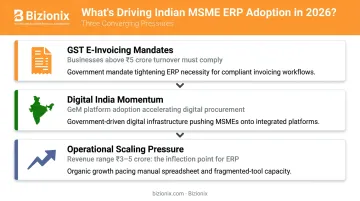
Several converging pressures are pushing Indian MSMEs toward ERP adoption in 2026:
- GST e-invoicing mandates — Since August 2023, businesses with aggregate turnover above ₹5 crore must generate e-invoices with IRN through the government's Invoice Registration Portal. Non-compliance under CBIC Section 122 can attract penalties of ₹10,000 or the tax evaded (whichever is higher)
- Digital India momentum — Government programmes and procurement platforms like GeM (which now has 22.5 lakh MSME sellers) reward digitally capable businesses with faster processing and access
- Operational scaling pressure — Multi-location operations, supplier coordination, and cash flow management become unmanageable without a centralised system once a business crosses ₹3–5 crore in revenue
Global ERP platforms with Indian add-ons often fall short on GST compliance depth, local language support, and MSME-scale pricing. The rankings below focus specifically on vendors built — or well-adapted — for the Indian market.
Top ERP Software Companies in India (2026 Rankings)
Each company on this list is evaluated across six criteria:
- India-market relevance and local business context
- Native GST and e-invoicing compliance (IRN, QR codes, e-way bills)
- Module breadth and operational depth
- MSME pricing accessibility
- Cloud readiness and deployment flexibility
- Real-world usability for Indian businesses
1. Bizionix (by IIS-LLP)
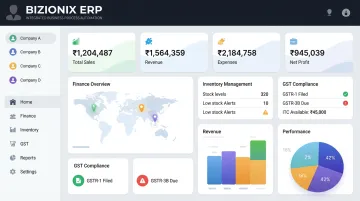
Bizionix is a cloud ERP built specifically for Indian MSMEs by IIS-LLP — a subsidiary of Protocol India Private Limited, headquartered in Hyderabad. GST compliance, e-invoicing, and multi-entity management are built directly into the platform architecture, not added as configuration layers after the fact.
The platform connects finance, inventory, sales, procurement, HRMS, production planning, and document workflows under a single login. Multi-company management supports holding groups, franchise networks, CA firms managing multiple clients, and businesses operating across multiple GST-registered entities.
What sets it apart for Indian MSMEs:
- Direct API integration with the IRP for instant IRN generation and automatic QR code embedding on every invoice — no third-party tools required
- Multi-company management with independent books of accounts per entity, role-based access controls, and consolidated group-level dashboards
- 100% cloud-based with real-time visibility across sales, finance, warehouse, and procurement
- Flat-rate annual pricing makes costs predictable — no per-user billing surprises as the team grows
| Category | Details |
|---|---|
| Key Features | GST-ready accounting, automated e-invoicing (IRN + QR code), multi-company management, inventory control, warehouse management, production planning, HRMS & payroll, sales & CRM, advanced reporting, and real-time dashboards |
| Pricing | NEO plan at ₹999/year (14-day free trial); Enterprise plan with custom pricing — contact sales for details |
| Best For | Indian MSMEs, manufacturing companies, distribution networks, CA firms managing multiple clients, multi-location enterprises, and hospitality businesses seeking an affordable India-first ERP |
2. TallyPrime
TallyPrime has been a staple of Indian small business accounting for over three decades. Its offline capability, familiar interface, and wide network of local resellers make it one of the most installed business software products in the country.
For businesses whose primary need is accounting, billing, and GST compliance, TallyPrime delivers reliably. It supports e-invoicing with IRN generation, QR code printing, and e-way bill workflows. The Silver plan covers single-user needs; Gold supports multi-user environments.
The key limitation: TallyPrime is accounting-first, not operations-first. Users looking for production planning, advanced warehouse management, or multi-company consolidation will find the platform's depth falls short — a gap noted consistently in user reviews across Software Advice and Capterra.
| Category | Details |
|---|---|
| Key Features | Accounting, GST, inventory (basic), payroll, e-invoicing, e-way bill; limited production and warehousing modules |
| Pricing | Silver lifetime: ₹22,500 + 18% GST; Gold lifetime: ₹67,500 + 18% GST; annual TSS renewal: ₹4,500 (Silver) / ₹13,500 (Gold) |
| Best For | Small businesses and traders primarily needing robust accounting, billing, and GST compliance with basic inventory tracking |
3. SAP Business One
Mid-sized Indian companies that have outgrown accounting tools and need structured operations management across finance, supply chain, and manufacturing will find SAP Business One a credible fit. India GST localisation covers e-invoicing through ClearTax's IRP integration, IRN generation, and e-way bill workflows — documented in SAP's India localization guide, version 16.0.
The trade-offs are real. SAP Business One requires a certified implementation partner, carries setup costs typically ranging from ₹5,00,000 to ₹15,00,000 based on partner estimates, and demands dedicated IT support. It is not a self-serve option for micro or small businesses.
| Category | Details |
|---|---|
| Key Features | Financial management, production planning, inventory, CRM, procurement, analytics, multi-currency, local GST compliance via partner configuration |
| Pricing | Partner-indicative: Professional subscription ~₹4,605/user/month; perpetual licenses from ~₹55,803 per user; implementation costs additional |
| Best For | Mid-sized manufacturing, trading, and distribution companies ready for a structured, partner-led ERP implementation with dedicated IT support |
4. ERPNext (by Frappe Technologies)
ERPNext is an open-source ERP developed in India by Frappe Technologies, covering accounting, inventory, HR, manufacturing, CRM, and more. Self-hosted deployments carry zero licensing fees — a practical fit for cost-sensitive businesses with in-house technical capacity. The platform supports Indian e-invoicing with IRN and QR code generation, plus e-way bill workflows.
Frappe Cloud hosted plans start at USD 5 (approximately ₹410) per month for a single site. For larger deployments, managed server options and dedicated AWS instances are available at higher tiers. The caveat: deeper customisation requires developer resources, and support on the free tier is community-based rather than dedicated.
| Category | Details |
|---|---|
| Key Features | Accounting, inventory, manufacturing, HR, CRM, project management, GST compliance, multi-currency, e-invoicing support |
| Pricing | Self-hosted: free (open-source); Frappe Cloud: from ~₹410/month; managed and dedicated tiers available at higher cost |
| Best For | Tech-forward startups and SMEs comfortable managing implementation and customisation, or firms working with Frappe implementation partners |
5. Zoho One
From India-headquartered Zoho Corporation, Zoho One bundles 40+ integrated applications covering CRM, finance, HR, inventory, helpdesk, and marketing. For service businesses and companies where customer-facing operations drive revenue, it's a strong contender. Zoho Books handles GST compliance natively — including IRN generation, QR codes, and e-way bill workflows.
The gap for production-heavy businesses: Zoho One does not include a dedicated manufacturing or production planning module in the traditional ERP sense. Zoho Creator can be used to build custom manufacturing workflows, but that requires additional configuration effort. Pricing scales per employee, which can become expensive at larger team sizes.
| Category | Details |
|---|---|
| Key Features | CRM, finance and accounting (GST-compliant), inventory, HR, marketing automation, helpdesk, analytics; no dedicated manufacturing module |
| Pricing | All Employee and Flexible User plans available — verify current India INR pricing directly on Zoho's pricing page |
| Best For | Service businesses, retail companies, and teams prioritising CRM, marketing, and a broad application suite over deep operational ERP functionality |
6. Odoo
Odoo's modular architecture has built a growing Indian user base, with 30+ business apps spanning inventory, manufacturing, sales, accounting, HR, and e-commerce. India localization in version 19.0 covers GST, e-invoicing, e-way bills, GSTR-1, GSTR-2B, and GSTR-3B workflows through BVM IT Consulting Services as the designated GSP.
The modular "start with one app and scale" approach suits businesses with evolving needs. One practical caveat: per-user pricing can escalate with additional apps and users, and India-specific GST configuration requires proper GSP setup rather than being instant out of the box.
| Category | Details |
|---|---|
| Key Features | Inventory, manufacturing (BOM, MRP), sales, accounting, CRM, HR, e-commerce, and 30+ modules; API-based integrations |
| Pricing | One App Free plan available; Standard and Custom plans — verify current India INR pricing on Odoo's live pricing page |
| Best For | Growing businesses across manufacturing, retail, and distribution that need a highly modular, scalable ERP with strong integration capabilities |
How We Chose the Best ERP Software Companies in India
The Primary Filter: India-Market Fit
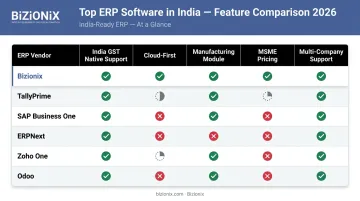
Every company on this list was assessed first on whether it natively supports GST compliance, e-invoicing with IRN generation, and e-way bill creation — without requiring expensive workarounds. For any Indian business above ₹5 crore in turnover, e-invoicing is a legal requirement — not a workaround you patch in later.
Additional Criteria
Beyond compliance, the evaluation covered:
- Pricing is visible upfront — opaque, contact-only models create friction for MSMEs making budget decisions
- Cloud-first deployment with minimal IT setup required — on-premise suits some large enterprises, but MSMEs need accessible, low-overhead systems
- Local support covering time zone alignment, language accessibility, and domain knowledge for when something breaks
- Module depth across inventory, multi-company management, manufacturing, and procurement — relevant to Indian operational realities
- Scalability that grows with the business without requiring a platform migration
Common Mistakes to Avoid
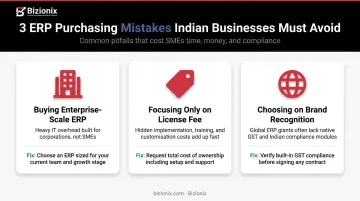
These criteria exist because Indian buyers consistently fall into the same traps. Three patterns come up most often:
- Buying an enterprise ERP built for 500-person companies — then discovering it needs a dedicated IT team and a six-month rollout
- Stopping at the license fee — implementation, training, customisation, and annual renewals can double or triple what you actually pay
- Choosing on brand recognition rather than India-specific operational fit — a globally recognised ERP with Indian compliance "bolted on" is structurally different from one built with Indian compliance at its core
Conclusion
The best ERP for an Indian business in 2026 is not the most globally recognised one. It's the one that handles GST and e-invoicing without manual workarounds, fits your team's actual operational complexity, and scales without requiring a platform overhaul every few years.
Before committing, shortlist two or three options and evaluate them specifically on:
- GST compliance depth — can it generate IRN and e-way bills natively?
- Onboarding support quality — is there a real team available in your time zone?
- Pricing transparency — what does the total annual cost actually look like?
Features on a brochure are easy. Operational fit is harder to fake in a live demo.
For Indian MSMEs that need an affordable, GST-native cloud ERP built for growing businesses, Bizionix is worth a close look. Explore the platform or request a walkthrough by reaching out at info@bizionix.com or +91 91779 99277.
Frequently Asked Questions
What are the top ERP software companies in India?
The leading options in 2026 include Bizionix, TallyPrime, SAP Business One, ERPNext, Zoho One, and Odoo. The right choice depends on your business size, industry, budget, and how critical native GST and e-invoicing compliance is to your operations.
Which ERP software is best for small businesses in India?
Affordable, cloud-based ERPs with built-in GST compliance are the best fit for small businesses. Bizionix and ERPNext cover operations management broadly; TallyPrime suits businesses focused primarily on accounting and billing.
Is GST compliance important when selecting an ERP in India?
Yes — any ERP for an Indian business must natively support e-invoicing with IRN generation, e-way bills, GST returns, and real-time tax reconciliation. Businesses above ₹5 crore turnover are legally required to generate e-invoices, and penalties for non-compliance under CBIC Section 122 can be significant.
What is the difference between cloud ERP and on-premise ERP?
Cloud ERP is hosted online and accessible from any device without local IT infrastructure — lower upfront cost, faster to deploy, and ideal for MSMEs. On-premise ERP is installed on company servers, offering more data control but requiring higher capital investment and ongoing IT maintenance.
How much does ERP software cost in India?
Costs range widely — from open-source options like ERPNext (minimal licensing fees) to enterprise implementations like SAP Business One that can exceed ₹5,00,000 in setup alone. Always factor in implementation, training, customisation, and annual renewal beyond the base price.
What modules are most important in an ERP for Indian MSMEs?
Prioritise GST-compliant accounting, inventory management, procurement, and sales order management. Multi-company or multi-location support is essential for franchise networks and business groups. Manufacturing businesses should also confirm BOM (bill of materials) and production planning module availability.