Introduction
Every hotelier knows the operational reality: managing reservations across OTAs and direct bookings, coordinating housekeeping via WhatsApp, reconciling F&B charges manually, tracking guest preferences in Excel, and keeping GST-compliant billing accurate—all while maintaining the guest experience that drives reviews and repeat bookings.
When these functions run on fragmented tools or manual processes, the cost is real. Revenue leaks through unbilled charges, guest satisfaction drops due to slow check-ins, and staff lose hours to coordination tasks instead of service.
A hotel management system (HMS) consolidates all these functions into one platform, replacing operational chaos with real-time visibility and automated workflows. This guide walks through everything a hotelier needs to know—from what an HMS is and how it works, to what to look for when choosing one, and where the technology is headed.
Key Takeaways
- An HMS is a unified software platform that centralizes reservations, front desk, housekeeping, billing, CRM, and analytics in one system
- Core modules include reservations, front office, housekeeping, POS integration, guest CRM, revenue management, and reporting
- Top benefits are operational efficiency (most hoteliers report saving several hours per week on routine tasks), improved guest experience, and revenue optimization
- Choose cloud-based systems with GST compliance, OTA integration, and open APIs to avoid vendor lock-in and on-premise complexity
- Future trends include AI-driven dynamic pricing, IoT smart rooms, and API-first ecosystems for flexible tech stacks
What Is a Hotel Management System?
A hotel management system (HMS) is a software platform built for the hospitality industry, serving as a central hub where all hotel data—reservations, guest profiles, room status, and billing—is accessible to management and staff in one place.
Modern HMS solutions are cloud-based, eliminating the need for on-premise servers and enabling access from any device, anywhere.
The system functions as the operational backbone of a hotel. Data flows continuously between departments (front desk, housekeeping, F&B, finance), keeping all teams in sync without manual coordination. When a guest checks in, the HMS updates room availability across booking channels, assigns housekeeping tasks, opens a folio for billing, and logs guest preferences — automatically, in real time.
HMS vs PMS: What's the Difference?
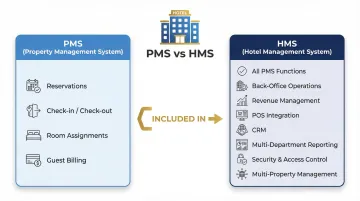
A Property Management System (PMS) is a subset of a broader HMS. The PMS focuses on front-office functions like reservations, check-in/check-out, room assignment, and billing. An HMS includes PMS capabilities but extends further to cover back-office operations, revenue management, POS integration, CRM, and more.
Put simply: the PMS manages the front desk; the HMS manages the entire hotel. Key differences at a glance:
- PMS: Reservations, check-in/check-out, room assignments, guest billing
- HMS: All PMS functions, plus back-office operations, revenue management, POS integration, CRM, and multi-department reporting
How Does a Hotel Management System Work?
An HMS operates on an integration-first architecture: it connects multiple modules—reservations, front desk, housekeeping, POS, CRM, accounting—so that a single action triggers updates across the entire system. When a guest checks out, the HMS automatically updates housekeeping status, finalizes billing, and refreshes room availability on all booking channels in real time.
That instant synchronization is what separates a true HMS from a collection of disconnected tools. Cloud-based HMS platforms take this further by making data accessible from any device, so updates happen where the work actually happens. Key operational capabilities this enables:
- Instant room status changes pushed to housekeeping the moment checkout is confirmed
- Live availability synced across all booking channels, eliminating double bookings
- Mobile access for housekeeping staff to update room readiness without returning to a desk
- Remote management visibility so owners and GMs can monitor property operations from anywhere
Key Modules of a Hotel Management System
Reservations and Front Desk Management
Booking creation, modification, and cancellation flow through a single interface—covering the hotel website, OTAs, and phone—alongside guest check-in/check-out, room assignment, and real-time availability updates. Integration with a channel manager is critical to prevent overbooking by synchronising inventory across all distribution channels.
Housekeeping and Room Management
Housekeeping tools assign cleaning tasks, track room status (dirty, clean, inspected, out of order) in real time, and let staff update room readiness from mobile devices. This cuts the gap between checkout and the next check-in—a difference that shows up directly in occupancy numbers.
Point-of-Sale (POS) Integration
Hotels with restaurants, spas, gyms, or in-room services use an integrated POS to capture charges from multiple revenue points and post them directly to the guest's folio—ensuring accurate billing without manual reconciliation. This integration prevents revenue leakage from missed or misposted charges.
CRM and Guest Profile Management
The CRM captures guest preferences, stay history, and loyalty data to enable personalised service: room upgrade offers for returning guests, tailored pre-stay communication, and targeted post-stay follow-ups. Over time, this data helps hotels increase repeat bookings without additional acquisition spend.
Revenue Management
Occupancy data, seasonality, local events, and demand signals feed into dynamic rate adjustments across channels—optimising RevPAR and ADR. A 2022 study published in ScienceDirect found that implementing open pricing produced an 8.5% increase in RevPAR, a 4.9% increase in ADR, and 3.4% occupancy growth—outcomes that apply directly to Indian hotels managing peak-season and off-season demand cycles.
Reporting and Analytics
Automated reports cover night audit, occupancy, revenue, and housekeeping performance, giving management real-time visibility into the KPIs that drive daily decisions. When all data flows through one system, managers spend less time chasing numbers across spreadsheets and more time acting on them.
Benefits of Using a Hotel Management System
Operational Efficiency
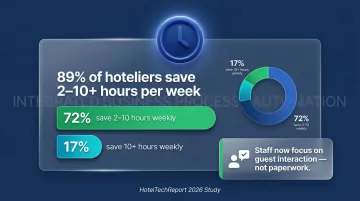
Automating manual tasks—room status updates, billing reconciliation, and reservation logging—reduces staff workload, minimises human error, and frees front-desk teams to focus on guest interaction rather than paperwork. According to the 2026 HotelTechReport PMS Impact Study, 89% of hoteliers report their PMS saves their team 2–10+ hours per week, with 17% saving more than 10 hours weekly.
Improved Guest Experience
Faster check-ins, personalised service based on guest history, and proactive communication—pre-arrival messages, in-stay requests, and post-checkout follow-ups—directly raise guest satisfaction scores and encourage repeat bookings. The J.D. Power 2025 North America Hotel Guest Satisfaction Index Study found that guests using a hotel's mobile app scored their satisfaction 68 points higher (on a 1,000-point scale) than non-users — a benchmark that reflects broader global trends in digital guest engagement.
Revenue Optimisation
With real-time occupancy data and dynamic pricing tools, hotels can maximise revenue per available room (RevPAR) instead of settling for fixed rates that ignore demand fluctuations. Integrated channel management drives higher booking volumes by maintaining rate parity and preventing overbookings across OTAs and direct channels.
Reduced Financial Leakage
Integrated billing—linking POS charges, room charges, and ancillary services to a single folio—eliminates unbilled or misposted charges, a common source of revenue loss. Research from Expedia Group found that hotels lose an average of 6% of revenue to rate leakage, with incidents occurring an average of 8 times per month.
Better Decision-Making Through Data
Consolidated reporting gives owners and managers a single source of truth—enabling them to track performance trends, compare period-over-period data, and make confident operational and marketing decisions without reconciling data from multiple systems.
Key benefits at a glance:
- Operational efficiency: Automates repetitive tasks, saving teams 2–10+ hours weekly
- Guest satisfaction: Personalised, proactive communication drives repeat bookings
- Revenue optimisation: Dynamic pricing and channel management maximise RevPAR
- Financial accuracy: Integrated billing closes revenue leakage from misposted charges
- Smarter decisions: Unified reporting replaces fragmented, multi-system data
How to Choose the Right Hotel Management System
Assess Your Property's Size and Complexity
A boutique hotel with 20 rooms has very different needs from a multi-property chain. Before shortlisting any system, clarify your requirements across:
- Property type and total room count
- Service offerings (F&B, spa, banquets, events)
- Multi-location or single-property operations
- Expected growth in the next 2–3 years
Systems built for large chains often carry unnecessary complexity for independent properties, while basic PMS tools can fall short for mid-sized resorts that need depth.
Why Cloud-Based Deployment Makes Sense
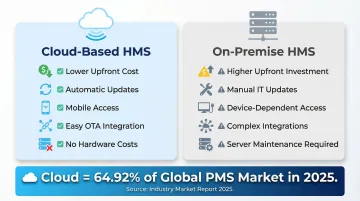
Cloud-native HMS platforms offer clear practical advantages over on-premises installations:
- Lower upfront cost with subscription pricing
- Automatic updates without IT intervention
- Mobile access for staff from any device
- Easier integration with third-party OTAs and booking platforms
- No hardware maintenance or server costs
Mordor Intelligence reports that cloud deployments captured 64.92% of the global PMS market in 2025, with the Asia-Pacific region growing at 12.18% CAGR.
Check Integration Capabilities
Verify that the HMS connects with your existing tools—OTA channel managers, payment gateways, accounting software—via open APIs. Gaps here force staff into manual workarounds that cost time and introduce errors. Oracle research found that 93% of hoteliers consider technology platform interoperability a key success factor for performance improvement.
Evaluate Compliance and Localization
For Indian hoteliers especially, GST-compliant billing, e-invoicing support, and local tax structures are mandatory. Effective September 2025, India's GST on hotel rooms is 5% (without Input Tax Credit) for tariffs up to ₹7,500, and 18% (with ITC) for tariffs above ₹7,500.
Bizionix's hotel module is built specifically for this environment—covering e-invoicing integration, GST billing, and local tax handling for Indian hotels and resorts that need an integrated system without SAP-level complexity or cost.
Ease of Use and Vendor Support
Evaluate the vendor's onboarding process, training resources, and availability of customer support. A system with poor UX or slow support can disrupt hotel operations during peak seasons. 92% of hoteliers report that modern PMS interfaces dramatically reduce staff training time, shrinking onboarding from weeks to days.
The Future of Hotel Management Technology
AI and Predictive Analytics
AI is reshaping revenue management through automated dynamic pricing, demand forecasting, and guest communication via chatbots and concierge tools. Hotel systems are shifting fast — from rule-based logic to real-time intelligence.
Deloitte's 2026 insights found that 49% of hoteliers list AI-powered solutions as a top tech priority, and 81% are focused on increasing employee productivity through technology.
AI multi-variable models can generate daily and weekly demand predictions with 92% accuracy, compared to just 62% for manual spreadsheet methods, driving an estimated 8-12% increase in RevPAR.
IoT and Connected Guest Experiences
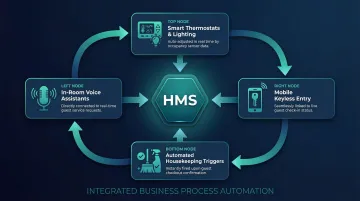
IoT is enabling smart room controls, keyless entry, and sensor-based housekeeping triggers — all feeding directly into the HMS to automate operations and personalize each guest's stay. The global smart hospitality market was valued at $29.55 billion in 2025 and is projected to reach $92.37 billion by 2030.
That growth is visible at the property level too. In the hotel lock market, RFID and mobile-based locks accounted for over 55% of deployments in 2024, with mobile key usage climbing 58% year over year.
Key IoT use cases already integrated with modern HMS platforms include:
- Smart thermostats and lighting adjusted by occupancy sensors
- Mobile keyless entry linked to check-in status
- Housekeeping triggers fired automatically at checkout
- In-room voice assistants connected to guest service requests
Open API Ecosystems
Hotels are rejecting closed, legacy systems in favor of API-first architectures that allow seamless integration with third-party tools. This shift enables hotels to plug in best-of-breed tools—reputation management, loyalty platforms, revenue tools—without replacing their entire system, giving properties the flexibility to evolve their tech stack incrementally.
Frequently Asked Questions
What is the hotel management system?
An HMS is software designed to centralize and automate hotel operations—covering reservations, front desk, housekeeping, billing, and guest management—in a single platform accessible to all departments. Modern systems are cloud-based, providing real-time visibility and mobile access.
What is the difference between PMS and HMS?
A PMS focuses on front-office functions—reservations, check-in/check-out, billing—while an HMS is broader, encompassing PMS functions plus back-office operations, revenue management, POS, CRM, and more. In short, a PMS handles the front desk; an HMS runs the entire property.
What are the 5 P's of hotel management?
The 5 P's are People, Product, Price, Place, and Promotion—the core pillars that guide hotel management strategy. Together they address staffing, property quality, pricing, distribution channels, and guest acquisition.
What is the 80/20 rule in hotels?
The 80/20 rule (Pareto Principle) in hotels typically means that roughly 80% of revenue comes from 20% of guests—loyal or high-value customers.
How much does a hotel management system cost?
Pricing depends on property size, number of modules, and whether you choose cloud-based or on-premise deployment. Cloud-based HMS solutions use subscription pricing with lower upfront costs, while on-premise models require higher initial investment. The best way to get an accurate figure is to request a quote based on your property type and feature requirements.