Introduction
Growing Indian businesses face a familiar operational nightmare: finance tracked in one spreadsheet, customer data scattered across another tool, HR managed through a third system, and inventory monitored via WhatsApp messages. This fragmentation creates costly blind spots. When your accounts team doesn't know what inventory actually moved last week, or when sales closes deals without checking real-time stock availability, the result is lost revenue through preventable errors and missed opportunities.
The operational drag is measurable. With 94% of business spreadsheets containing errors and the average small business juggling 253 separate applications, MSMEs waste significant time reconciling conflicting data instead of growing their business.
India's strict GST compliance requirements compound the problem further. Mandatory e-invoicing for businesses over ₹5 crore and a 30-day reporting window mean fragmented systems aren't just an operational headache—they're a regulatory liability.
This guide covers what cloud-based business software actually is, the key categories available in 2026, concrete benefits for Indian MSMEs, and what to evaluate when choosing between standalone tools and unified platforms.
TLDR: Key Takeaways
- Cloud software eliminates fragmented systems by centralizing operations on internet-accessed platforms
- Core categories include ERP, CRM, accounting, HR, and project management tools
- Benefits include ₹14,000+ annual savings, real-time visibility, automatic GST compliance, and hardware-free scaling
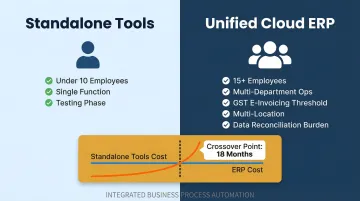
- For businesses over 15 employees, unified platforms outperform standalone tools after 18 months
- India-specific compliance (GST, e-invoicing) requires purpose-built solutions, not generic global platforms
What Is Cloud-Based Business Software?
Cloud-based business software refers to applications hosted on remote servers and accessed via the internet, rather than installed on local computers or maintained on on-premise servers. Users log in from any device—laptop, tablet, or smartphone—without managing physical hardware, server rooms, or IT infrastructure. The vendor handles everything: software updates, security patches, server maintenance, and system uptime.
The Shift from On-Premise to Cloud
Traditional on-premise software demanded heavy upfront investment—servers, perpetual licenses, dedicated IT staff, and hardware replacements every 3–5 years. Cloud software replaces that with a monthly or annual subscription. The vendor manages all infrastructure, rolling out updates automatically and maintaining security without burdening your internal team.
This shift moves IT spending from CAPEX (capital expenditure) to OPEX (operational expenditure), making enterprise-grade tools accessible to MSMEs that previously couldn't afford them.
Three Cloud Delivery Models
| Model | What It Means | Who Uses It |
|---|---|---|
| SaaS (Software as a Service) | Ready-to-use apps via browser—no servers, no storage to manage | MSMEs using ERP, CRM, accounting tools (e.g., Bizionix, HubSpot) |
| PaaS (Platform as a Service) | Cloud environment for building and deploying custom apps | Developers and tech teams needing custom solutions |
| IaaS (Infrastructure as a Service) | Rented computing resources—servers, storage, networks | IT teams managing disaster recovery or scalable hosting (AWS, Azure) |
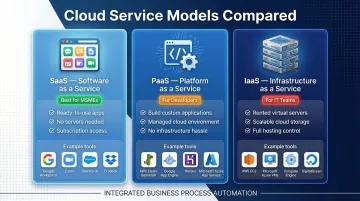
For MSMEs, SaaS is the practical choice—it removes infrastructure management entirely, letting you focus on running your business rather than maintaining servers.
Business Continuity Advantages
SaaS also changes how businesses handle continuity. Because your data lives in the cloud—not on an office server that can crash—operations stay stable even during local outages or hardware failures.
Key continuity benefits include:
- Real-time data sync across all users and locations, so your Mumbai sales team, Pune warehouse, and Hyderabad finance team always work from the same live information
- Automatic backups running continuously without manual intervention
- Redundant servers in geographically dispersed locations that take over instantly if one fails
- No single point of failure tied to physical office infrastructure
Key Types of Cloud-Based Business Software
Cloud business software spans multiple functional areas. Most MSMEs start with one category—typically accounting or ERP—before expanding. The trend in 2026 is toward unified platforms that combine multiple functions rather than managing 5-7 disconnected tools.
Cloud ERP (Enterprise Resource Planning)
Cloud ERP represents the most comprehensive category: a single platform integrating finance, inventory, procurement, sales, operations, and HR into one unified system. Instead of reconciling data from separate tools, leadership gets a unified view of all operations through real-time dashboards showing cash flow, inventory levels, sales performance, and operational KPIs across all departments.
For example, when a sales order is created, the system automatically updates inventory, triggers purchase requirements if stock is low, affects financial reporting, and maintains complete traceability. This eliminates the manual data transfers and version conflicts that plague spreadsheet-based operations.
The India accounting software market reached ₹698.87 million in 2025 and is projected to hit ₹1,496.95 million by 2034, with small and medium enterprises holding a 65% market share. Cloud ERP dominates this space with a 33% share, driven by real-time reporting needs and simplified tax compliance.
Cloud CRM (Customer Relationship Management)
Cloud CRM software manages customer interactions, sales pipelines, and after-sales support from a centralized platform. Sales and support teams work from the same customer data, reducing missed follow-ups and lost opportunities. The system tracks leads, manages deal progression, schedules follow-ups, and maintains complete customer history.
While only 13% of Indian MSMEs currently use CRM software, the financial impact is substantial: 91% of companies with more than 11 employees use a CRM system, with an average ROI of ₹725 for every ₹100 spent. On the revenue side, 45% of companies report that CRM software directly increased their sales.
Cloud Accounting and Finance Software
Cloud accounting tools handle the core financial workload for Indian businesses:
- Invoicing and expense tracking
- GST filing and bank reconciliation
- Financial reporting and audit trails
- E-invoicing with direct portal integration
The critical differentiator for Indian businesses is built-in GST compliance.
Generic accounting software requires manual JSON uploads to government portals and constant reconciliation between your system and GST returns. India-specific platforms like Bizionix connect directly with the GST Invoice Registration Portal via API, generating Invoice Reference Numbers (IRNs) instantly and auto-populating GSTR-1 returns without manual intervention. This eliminates the compliance errors that result in penalties and audit notices.
Cloud HR and Payroll Management
Cloud HR software manages employee records, attendance, leave, payroll processing, and compliance with labor regulations including PF, ESI, and TDS calculations. By 2025, over 90% of large IT firms in India adopted cloud-based HR systems, with adoption reaching 70% across manufacturing, BFSI, healthcare, and retail.
The operational impact is significant: the average cost of a single payroll error is ₹24,000, and companies spend an average of 91 hours resolving a single payroll compliance issue. Cloud HR systems eliminate these risks through automated calculations and statutory compliance tracking.
Cloud Project Management and Collaboration Tools
This category covers task assignment, progress tracking, team communication, and document sharing. Tools like Asana, Trello, and Monday.com keep remote or multi-location teams aligned without endless email chains. A few things to keep in mind about this category:
- Useful for project coordination and team communication
- Does not replace core systems like ERP or accounting software
- Works best as a complement to your primary business platform
Why Cloud-Based Software Is a Game-Changer for Growing Businesses
Why Cloud-Based Software Gives Growing Businesses a Measurable Edge
Cost Efficiency and Predictable Spending
Cloud software eliminates expensive on-premise server infrastructure, IT maintenance teams, and large upfront software license fees. Businesses pay a subscription that scales with usage, making enterprise-grade tools accessible to MSMEs.
A 2026 Forrester study on midmarket cloud ERP adoption revealed a payback period of just 16 months and a Net Present Value of ₹27.5 crore over three years. Savings come from offloading legacy costs: IT support, disaster recovery, data center hosting, hardware purchases, and maintenance contracts.
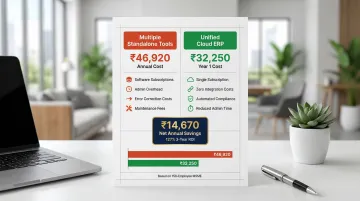
For a 150-employee MSME, the difference is significant: multiple standalone systems cost approximately ₹46,920 annually when you factor in subscriptions, administrative overhead, error correction, and system maintenance. A unified cloud platform costs ₹32,250 in Year 1, generating net savings of ₹14,670 and delivering a 3-year ROI of 127%.
Real-Time Visibility and Better Decision-Making
Cloud platforms give business owners live dashboards showing inventory levels, cash flow, sales performance, and operational KPIs across departments. This eliminates the lag of weekly reports compiled manually from multiple sources.
Fragmented legacy systems tell a different story:
- Finance pulls numbers from one spreadsheet, sales from another, inventory from a third
- By the time someone consolidates it all, the data is already outdated
- Decisions get made on yesterday's information — or last week's
With cloud ERP, every department works from the same live data. When inventory moves, warehouse, sales, finance, and procurement all see it immediately.
Gartner predicts that finance organizations using cloud ERP with embedded AI assistants will see a 30% faster financial close by 2028, driven by real-time visibility and enhanced decision-making capabilities.
Scalability Without Disruption
Cloud software scales with your business—add new users, open new locations, or activate new modules without replacing the entire system or investing in new hardware. This is particularly relevant for Indian MSMEs expanding to multiple locations or adding new product lines.
Because cloud ERP runs on vendor-managed servers accessed via the internet, there's no need to purchase additional servers, hire specialized IT staff, or plan lengthy hardware procurement cycles. You simply adjust your subscription to match current needs.
Compliance Automation for Indian Businesses
Cloud-based accounting and ERP tools built for the Indian market automate GST filing, generate e-invoices with IRN numbers directly from the system, and maintain audit trails—reducing the risk of compliance penalties.
GST compliance requirements have tightened significantly. E-invoicing is currently mandatory for taxpayers with annual turnover over ₹5 crore. Effective April 1, 2025, taxpayers with ₹10 crore+ turnover cannot report e-invoices older than 30 days from the date of reporting on IRP portals. On March 2, 2026 alone, the GST system generated 11 million Invoice Reference Numbers—no manual process can handle that volume accurately.
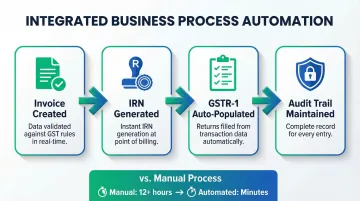
Platforms like Bizionix offer direct API integration with the GST e-Invoice system, eliminating the manual reconciliation that most small businesses still rely on. The system:
- Validates invoice data against GST rules in real-time
- Generates IRNs instantly at the point of billing
- Auto-populates GSTR-1 returns from transaction data
- Maintains complete audit trails for every entry
Remote Access and Business Continuity
Cloud software allows teams to work from anywhere—branch offices, client sites, home, or during disruptions like lockdowns. Data is always up-to-date regardless of where users access from, eliminating version-control issues common with file-based systems.
India's digital infrastructure supports this capability. By late 2024, India recorded 1.03 billion internet users representing 70% online penetration, with broadband connections reaching 995.6 million. The government's BharatNet project has connected over 2.14 lakh gram panchayats, ensuring MSMEs outside major metros have the connectivity required to run cloud applications.
Cloud ERP vs. Standalone SaaS Tools: What MSMEs Need to Know
The Integration Problem
Standalone SaaS tools solve one problem well: a CRM handles customers, a separate tool handles invoicing, another manages HR. Each works fine individually, but together they create new integration headaches and data silos.
Cloud ERP takes a different approach: all functions integrate into a single system with a shared data layer. When you create a sales order, it automatically updates inventory, triggers finance entries, and notifies the warehouse—no manual transfers, no duplicate data entry, no version conflicts.
The "best of breed" approach—buying the best standalone tool for each function—looks attractive on paper, but the hidden costs add up fast. Small businesses use an average of 253 SaaS applications, with the average employee toggling between 11-13 applications daily. This results in a 51% license waste rate and an average of 4.3 duplicate tools per business function.
The Hidden Cost of Fragmentation
When businesses run 5-7 separate tools, they pay multiple subscriptions, burn time on manual data transfers, and still lack a unified view of operations. More than 40% of workers spend at least a quarter of their week on tasks that could be automated—not because they're inefficient, but because fragmented systems force it.
The financial cost of holding these tools together is just as real:
- Integration middleware: Zapier costs ₹1,665–₹49,916/month; enterprise connectors like Boomi start at ₹4.16 lakh per connector per year
- Data quality failures: Poor data quality costs organizations an average of ₹107 crore annually, largely because disconnected tools each carry their own version of the same data
- Productivity drain: Reconciling mismatched records across systems consumes hours that should go toward actual business work
When Each Approach Makes Sense
Standalone tools work for:
- Very early-stage businesses with a single function to manage
- Companies under 10 employees with minimal cross-department coordination
- Businesses testing specific functionality before committing to a full platform
Unified cloud ERP makes sense for:
- Businesses beyond 15 employees managing multiple departments
- Companies with inventory, sales, and finance operations that need coordination
- Organizations approaching or exceeding GST e-invoicing thresholds
- MSMEs expanding to multiple locations or managing multiple entities
- Businesses tired of reconciling data across disconnected tools
Most MSMEs hit the crossover point around 18 months of growth — at that stage, the combined subscription, integration, and reconciliation costs of standalone tools routinely exceed what a unified ERP would have cost from the start.
How to Choose the Right Cloud Business Software for Your Business
Five Critical Evaluation Criteria
1. Market and Industry Fit: Is the software built for your market and industry? For Indian MSMEs, this means GST-ready accounting, e-invoicing with direct IRN generation, multi-company management for businesses with multiple entities, and support for multi-location operations. Generic global platforms typically need expensive customization to meet these requirements.
2. Total Cost of Ownership: Look beyond subscription fees. Calculate implementation costs (setup, data migration, configuration), training expenses (internal time + vendor support), ongoing administrative overhead, and integration costs if connecting to other systems. A ₹999/year platform that takes 2 weeks to implement may be far cheaper than a ₹10,000/year platform requiring 6 months of consultant time.
3. Ease of Use: Can non-technical staff use the system without extensive training? Complex interfaces slow adoption and create dependency on specific employees who "know how it works." Look for intuitive dashboards, logical workflows, and mobile access for teams working outside the office.
4. Vendor Track Record and Support: Evaluate the vendor's experience with businesses like yours, customer retention rates, support quality (response times, availability of local support), and update frequency (how often do they release improvements and compliance updates?). Check reviews and ask for customer references.
5. Scalability: Can the platform handle your growth? Consider whether you can easily add users, locations, or modules without system replacement, whether the pricing model scales reasonably as you grow, and whether the architecture supports increased transaction volumes without slowdowns as volumes grow.
Local Compliance and Integration
For Indian MSMEs specifically, any cloud business software must clear several compliance requirements that generic global platforms rarely meet out of the box:
- GST-compliant accounting with e-invoicing and direct IRN generation
- Multi-company or multi-branch operations management
- Automated GSTR filing and reconciliation
- Direct API integration with the GST Invoice Registration Portal
Bizionix is built specifically for Indian MSME operations — GST-ready accounting, automated e-invoicing, and a unified platform that replaces fragmented tools without SAP-level complexity or cost. It connects directly with the GST Invoice Registration Portal, generating IRNs instantly and auto-populating GSTR-1 returns, which eliminates manual uploads and reconciliation entirely.
Implementation Approach
Before evaluating software, map your current pain points: Where do billing delays occur? What inventory discrepancies happen most frequently? How much time does manual GST filing consume? Which processes create the most errors?
When requesting demos, use real scenarios from your operations — not generic examples. Ask vendors to demonstrate your specific workflows: multi-location inventory transfers, GST compliance at your transaction volumes, or payroll for your employee structure. The right vendor should handle these without hesitation.
Equally important: look for vendors that offer guided onboarding support rather than leaving businesses to self-implement. Historically, up to 73% of cloud ERP projects failed to meet their original objectives, but organizations that follow structured implementation approaches achieve success rates of up to 90%. SaaS models are improving success rates by eliminating on-premise infrastructure setup, reducing average project timelines from 15.5 months to 9 months.
Frequently Asked Questions
What is cloud-based business software?
Cloud-based business software refers to applications accessed via the internet rather than installed locally, covering functions like accounting, CRM, HR, and ERP. Users manage operations from any device without maintaining on-premise servers, with the vendor handling all infrastructure, updates, and security.
What are examples of cloud-based software?
Common categories include cloud ERP (NetSuite, SAP, Bizionix), CRM tools (Salesforce, HubSpot), cloud accounting (QuickBooks Online, Zoho Books), HR platforms (BambooHR, Darwinbox), and project management tools (Asana, Trello). Most business applications now offer cloud-based versions delivered as SaaS.
What is ERP vs SaaS?
SaaS (Software as a Service) is a delivery model—software hosted in the cloud and accessed via subscription—while ERP (Enterprise Resource Planning) is a type of business software that integrates multiple business functions like finance, inventory, and HR. Cloud ERP is simply ERP software delivered as SaaS rather than installed on-premise.
Is cloud-based software secure for storing business data?
Reputable cloud vendors typically offer stronger security than most MSMEs can maintain on-premise, investing in encryption, access controls, regular backups, and certifications like ISO/IEC 27001. That said, 74% of Indian SMEs experienced at least one cyberattack in the past year, most often due to weak access controls rather than cloud infrastructure failures. Verifying a vendor's compliance certifications before signing up is a sound precaution.
Can Indian MSMEs realistically adopt cloud-based business software?
Cloud ERP and business software is increasingly accessible to Indian MSMEs, with subscription pricing starting as low as ₹999/year, no hardware investment required, and India-specific features like GST automation built in. With widespread mobile and broadband connectivity now reaching over a billion users, the practical barriers to cloud adoption are low. The key is choosing a platform built for Indian business requirements rather than adapting a generic global tool.