Introduction
Growing Indian businesses today face a familiar operational reality: managing finance, inventory, compliance, and teams across departments using disconnected tools, spreadsheets, and manual follow-ups. This fragmentation creates compounding inefficiencies that slow growth and drain resources. A manufacturer in Pune might use Tally for accounting, Excel for inventory, WhatsApp for approvals, and email for purchase orders—each tool holding a piece of the truth, none talking to the other.
ERP (Enterprise Resource Planning) is widely discussed, but what actually changes when it's running? Sales orders automatically update inventory levels, invoices generate without manual entry, GST filings pull from live transaction data, and management sees real-time cash flow instead of month-end surprises. That's the operational shift this article covers.
Below are 10 specific, measurable advantages of ERP systems in 2025 — drawn from the day-to-day realities of Indian MSMEs, not vendor brochures.
Key Takeaways
- ERP unifies finance, inventory, HR, and operations in one platform—ending data silos across departments
- Key benefits include real-time visibility, process automation, GST compliance, and lower operational costs for Indian MSMEs
- Without ERP, growing businesses face duplicate data entry, manual errors, and rising operational costs
- Cloud-based ERP delivers enterprise-grade capability without complexity or high upfront investment
- ERP delivers compounding returns: consistent use drives deeper efficiency, cleaner data, and faster decisions over time
What Is an ERP System?
An ERP system is a unified software platform that connects all departments—finance, purchase, inventory, sales, HR, compliance—so every function works from the same data, in real time. Unlike standalone accounting tools or billing software, ERP replaces the fragmented combination of spreadsheets, siloed apps, and manual coordination that most growing businesses still rely on.
When a sales order is raised, inventory levels update automatically. A purchase approval reflects in finance records instantly, and attendance entries feed directly into payroll — no manual steps, no follow-up calls between departments.
The goal isn't just to implement software. It's to replace reactive, fragmented operations with a single system where every function stays in sync.
For Indian MSMEs, modern cloud-based ERP systems deliver this capability without the infrastructure burden or cost traditionally associated with enterprise solutions. According to TechSci Research, over 40% of new ERP implementations in India during the past two years have been cloud-based or SaaS-driven, a significant increase from just 20% five years ago.
10 Key Advantages of ERP Systems
The advantages below are tied to operational and financial outcomes businesses actually track—not general technology claims. Each benefit is most powerful when ERP is adopted consistently across departments.
Centralized Data: One Source of Truth Across All Departments
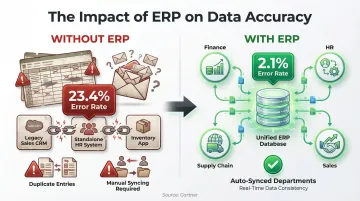
ERP consolidates data from every department—sales, purchase, finance, inventory, HR—into a single, shared database. This eliminates the version conflicts and data gaps that occur when teams use separate tools or spreadsheets.
How this works in practice:
- When a sales order is raised, inventory levels update automatically
- When a purchase is approved, finance records reflect it instantly
- When stock is issued, warehouse records and accounting entries sync without manual intervention
- No manual syncing, no duplicate entries, no chasing colleagues for updated figures
Why this matters:
Poor data quality costs organizations an average of $12.9 million annually, according to Gartner research. For Indian MSMEs operating on tighter margins, even a fraction of this impact can be devastating. Organizations relying on manual processes spend approximately 143.5 hours monthly on administrative tasks, suffering a 23.7% error rate in compliance documentation.
Centralized data reduces error rates from 23.4% to just 2.1% after ERP implementation—a difference that compounds across every downstream process.
Process Automation: Eliminating Manual Work and Repetitive Tasks
ERP automates routine, high-volume processes—invoicing, purchase order creation, stock reorder alerts, approval workflows, GST filing preparation—reducing the manual effort required to keep operations running.
Real-world impact:
Tasks that previously required multiple follow-ups, data re-entry, or manual handoffs between departments are triggered automatically based on predefined rules. A Forrester Total Economic Impact study found that key personnel in finance, accounting, supply chain, and logistics save between 7 and 15 hours per week due to ERP-driven automation.
Specific examples from Indian MSMEs:
- Purchase order creation and approval times cut by 60%, with PO approvals reduced from 2-3 days to under an hour
- Invoice processing dropped from 379 hours to 5 hours per month (98.6% time savings) in one healthcare network case study
- Vendor onboarding processing time reduced by 78.4%, with approval cycles dropping from 15.3 days to 2.1 days
In surveys, 50% of organizations cite automation as their primary tool for reducing human error; 78% report measurable productivity gains as a result. Staff hours recovered from manual tasks shift directly into customer-facing and revenue-generating work.
Real-Time Reporting and Business Visibility
ERP generates live dashboards and reports across all business functions—cash flow, stock levels, outstanding receivables, purchase orders, sales performance—so management always has an accurate, current view of the business.
What changes in practice:
Instead of waiting for month-end reports compiled manually from multiple sources, business owners and managers can act on real-time data. They can:
- Identify cash flow gaps early
- Spot slow-moving inventory
- Flag overdue payments before they become problems
- Monitor sales performance across branches instantly
Gartner predicts that finance organizations using cloud ERP with embedded AI assistants will see a 30% faster financial close by 2028. In practice, automated bank reconciliations allow tasks that previously took hours to complete in minutes, dropping monthly closing times from 7-10 days to 2-3 days or less.
Indian enterprises replacing legacy systems with modern ERP platforms have already seen up to a 35% reduction in financial closing cycles. Decision cycles that once took days now take hours—with forecasting accuracy improving in direct proportion.
Cost Reduction and Lower Operational Overhead
ERP reduces operational costs by consolidating multiple software tools into one platform, cutting administrative overhead through automation, and reducing costly errors such as duplicate payments, overstocking, or missed billing.
Measurable cost savings:
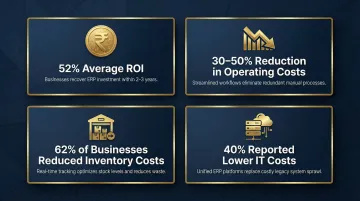
- Average ROI for ERP implementations reaches 52% (₹1.52 return for every rupee invested)
- Overall operating costs reduced by 30% to 50% in construction industry analysis
- 62% of organizations reduced purchasing and inventory costs after ERP adoption
- 40% of organizations reported reduced IT costs following ERP implementation
Instead of paying for separate CRM, accounting, inventory, HR, and compliance tools, businesses consolidate everything into one platform. For midsize companies (revenue under ₹83 crore), ERP ownership costs approximately 3% to 5% of annual revenue—a fraction of what fragmented systems cost when manual errors and inefficiencies are factored in.
66% of organizations cite cost savings from eliminating legacy systems as the primary benefit of a newly deployed ERP.
Regulatory Compliance and GST Readiness
ERP embeds compliance requirements directly into business workflows—approval hierarchies, audit trails, role-based access, and for Indian businesses, GST-ready invoicing with automated IRN generation—so compliance is built in, not bolted on.
Why this matters for Indian MSMEs:
In FY 2024-25 alone, there were 9,331 regulatory adjustments affecting Indian businesses. Compliance charges vary from ₹13-17 lakhs annually for manufacturing MSMEs, consuming 5.6% to 14.5% of the tax paid by these smaller groups. Approximately 88-90% of MSMEs are burdened by systemic filing inefficiencies.
E-invoicing mandates:
The Central Board of Indirect Taxes and Customs (CBIC) mandates e-invoicing for businesses with Annual Aggregate Turnover (AATO) over ₹5 crore. Starting April 1, 2025, businesses with AATO ≥ ₹10 crore must upload e-invoices within 30 days of invoice date, with two-factor authentication mandatory for all taxpayers.
Firms that adopted ERP systems with built-in compliance automation reported a 90% reduction in tax filing delays and penalties related to GST, TDS, and e-invoicing. Platforms like Bizionix offer direct API integration with the GST e-Invoice system for instant IRN generation, removing manual compliance effort entirely.
Improved Financial Control and Faster Billing Cycles
ERP gives finance teams precise, real-time control over accounts payable, accounts receivable, billing, and cash flow—with pre-validated, error-free invoices reducing disputes and accelerating payment collection.
KPIs impacted:
Implementing AI-driven accounts receivable automation within ERP platforms typically reduces Days Sales Outstanding (DSO) by 15-30 days within 90 days, freeing hundreds of thousands in working capital. A case study of a global brand utilizing AI-driven AR automation achieved 100% faster invoice delivery and a 30% lower DSO.
When billing connects directly with ERP, invoices appear instantly in accounting systems and payments update customer balances without delay. One accounting manager noted that automation eliminated the two full days previously spent fixing errors from the initial close.
For Indian MSMEs managing tight cash flows, cutting DSO by even 15 days can unlock enough working capital to fund the next procurement cycle.
Scalability: Built to Grow With the Business
A cloud ERP scales as the business grows—adding new users, new locations, new product lines, or new entities—without requiring a system replacement or significant rearchitecting.
Why this matters:
This advantage has the highest impact for MSMEs with active growth plans, franchise networks, or multi-location operations. When businesses outgrow Excel spreadsheets and standalone tools, they face a painful choice: continue with inefficient systems or undergo expensive, disruptive migrations.
Cloud-based ERP eliminates this dilemma. Cloud ERP costs 30-50% less than on-premise solutions over a 10-year period, according to comprehensive TCO comparisons. In India, cloud ERP systems cost between ₹1,000 to ₹3,000 per user per month with no hardware investment, whereas on-premise ERP requires an upfront implementation cost of ₹5 Lakhs to ₹1 Crore+, plus server and IT maintenance expenses.
Cloud systems deploy in three to six months, compared to up to 12 months for on-premise. A growing MSME can add a new branch or entity to the same platform without a fresh implementation—or a fresh budget.
Better Customer Service and Order Accuracy
ERP gives customer-facing teams a complete, real-time view of inventory availability, order status, dispatch timelines, and customer history—enabling faster, more accurate responses and fewer fulfillment errors.
KPIs impacted:
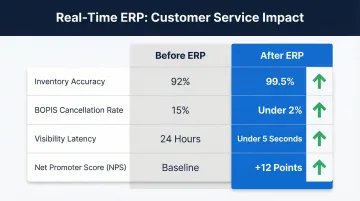
Traditional batch-oriented systems introduce delays of 12-24 hours, leaving retailers unable to meet modern service expectations. In one case study, this latency led to a 15% Buy-Online-Pickup-In-Store (BOPIS) cancellation rate and annual markdown losses exceeding ₹20.8 crore.
After implementing real-time ERP integration:
- Inventory accuracy improved from 92% to 99.5%
- BOPIS cancellation rate dropped from 15% to under 2%, leading to a 20% increase in completed orders
- Visibility latency reduced from 24 hours to under 5 seconds
- Customer satisfaction (Net Promoter Score) improved by 12 points within six months
Real-time ERP visibility reduces order processing time by 60-80%, improves order accuracy to 99%+, and cuts quote turnaround from days to minutes.
Inventory and Supply Chain Visibility
ERP tracks stock levels, purchase orders, goods receipts, and warehouse movements in real time—giving businesses the visibility needed to prevent both stockouts and overstocking, and to plan procurement more accurately.
The cost of poor inventory management:
According to the Association for Supply Chain Management, inventory carrying costs typically fall within 15-25% of inventory value. The global retail industry loses $1.73 trillion annually due to the combined costs of out-of-stocks and overstocks. Stockouts reduce annual revenue by 2% to 5%, while overstock can absorb between 20% and 30% of working capital.
In India, 81% of MSMEs faced stockouts on fast-moving goods, weakening customer trust and costing sales.
ERP-driven improvements:
- Inventory levels reduced by 38% in materials manufacturer case study
- Inventory turnover ratio increased by 30-40%
- Stockouts reduced by 60%
- Holding costs reduced by 15-35%
For manufacturers, distributors, and businesses with multi-location warehouses, freeing 20-30% of working capital from overstock isn't a reporting improvement—it's cash back in operations.
Data Security and Activity Accountability
ERP centralizes data security through role-based access controls—ensuring employees only view and edit information relevant to their function—while maintaining complete audit trails of every transaction and approval for accountability and fraud prevention.
Why this matters:
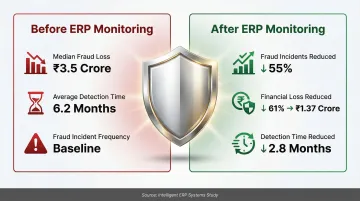
According to the ACFE 2024 Report to the Nations, small organizations (<100 employees) suffer a median fraud loss of $150,000 (approximately ₹1.25 crore), which is higher than the ₹1.16 crore median loss for large organizations. Over half of occupational frauds occur due to a lack of internal controls (32%) or an override of existing controls (19%).
Small organizations have significantly lower adoption of proactive data monitoring (19% vs 53% in large firms), making them more vulnerable to internal fraud.
ERP security features:
A study on intelligent ERP systems demonstrated that automated audit trails and real-time monitoring led to a 55% reduction in fraud incidents per year and a 61% reduction in financial loss due to fraud (from ₹3.5 crore to ₹1.37 crore). Furthermore, average detection time dropped by 55%, from 6.2 months to 2.8 months.
Role-based access controls ensure employees only access information relevant to their function, while complete audit trails track every transaction, approval, and data modification—creating accountability and reducing financial leakage through tracked expenses and approvals.
What Happens When an ERP System Is Missing or Ignored
Without ERP, growing businesses face predictable, compounding problems:
- Inconsistent data across departments leads to conflicting reports, poor decisions, and eroding confidence in the numbers
- Manual processes drive compounding errors — duplicate entries, missed invoices, delayed billing, and inventory discrepancies that are costly to reconcile
- Reactive firefighting replaces proactive management, with teams patching problems instead of preventing them
- Operational costs rise undetected through redundant tools, administrative overhead, and inefficiencies that are invisible without unified data
- Scaling hits a ceiling: more headcount gets added just to maintain existing output, not to grow it
Research consistently shows that businesses relying on disconnected manual processes spend significantly more time on administrative tasks — and carry higher error rates — than those running on integrated systems. For MSMEs with growth targets, that hidden drag compounds fast.
How to Get the Most Value from Your ERP System
ERP delivers maximum value when adopted consistently across all departments from day one. Partial or department-specific adoption limits the unified data benefits and creates new silos within the system itself.
Best practices:
- Review ERP dashboards regularly and act on what they show—pricing, procurement, staffing, and cash flow decisions should all be data-driven
- Enforce workflow discipline by requiring employees to follow defined processes rather than ad-hoc methods
- Use the audit trails to identify inefficiencies, bottlenecks, and areas where manual intervention is still occurring
Putting these practices into place is easier when your ERP is built for how your business actually operates. Bizionix by IIS-LLP is designed specifically for Indian MSMEs, with built-in GST e-invoicing, multi-location inventory tracking, and real-time financial visibility—without the complexity or cost of larger platforms.
Conclusion
The advantages of ERP systems are not theoretical—they show up in faster billing cycles, cleaner data, fewer errors, better compliance, and more confident decision-making across every level of the business.
These benefits compound over time. The longer ERP is used consistently—and the more departments it connects—the harder inefficiencies are to hide and the easier it becomes to scale with confidence. For growing MSMEs managing multiple functions, that compounding effect becomes a measurable operational advantage.
ERP works best as an ongoing operational foundation—not a one-time implementation project. Businesses that get the most from it are those that use it actively: reviewing performance data, tightening processes, staying compliant, and making decisions grounded in real numbers rather than guesswork.
Frequently Asked Questions
What are the advantages of an ERP system?
ERP systems provide unified data across departments, along with process automation, real-time reporting, and built-in compliance support. The result: better operational control, faster decisions, fewer errors, and a foundation for sustainable growth.
What are the 7 stages of implementation of ERP?
The seven stages are: planning, requirements gathering, system design, configuration, testing, deployment, and post-go-live optimization. Most mid-sized implementations move through all stages in 3–6 months depending on complexity.
Are ERP systems suitable for small businesses and MSMEs?
Yes, modern cloud-based ERP systems are purpose-built for MSMEs, offering modular, affordable deployment without infrastructure or IT complexity. With pricing starting as low as ₹999/year for basic plans, cloud ERP provides enterprise-grade capabilities without the traditional barriers of high upfront costs.
How long does it take to see the benefits of an ERP system?
Benefits like automated billing, reduced manual entry, and real-time reporting are visible within weeks of go-live. Cost reduction, improved cash flow, and scalability compound over the following months as teams build consistent usage habits.
What is the difference between ERP software and accounting software?
Accounting software handles only financial transactions, while ERP integrates finance with inventory, procurement, sales, HR, and compliance. ERP gives businesses a complete operational view rather than just a financial one, enabling cross-departmental coordination and real-time business visibility.
How does ERP help with GST compliance in India?
GST-ready ERP systems automate invoice validation, IRN generation, and filing preparation—building compliance directly into daily workflows. Bizionix integrates directly with the GST e-Invoice system via API, generating government-authenticated IRNs instantly so businesses stay audit-ready without any manual effort.