Introduction
Indian MSMEs juggle spreadsheets, disconnected tools, and manual follow-ups across departments daily. This operational chaos directly erodes profitability and growth potential—delayed invoicing costs working capital, inventory errors create dead stock, and missed GST filings trigger penalties.
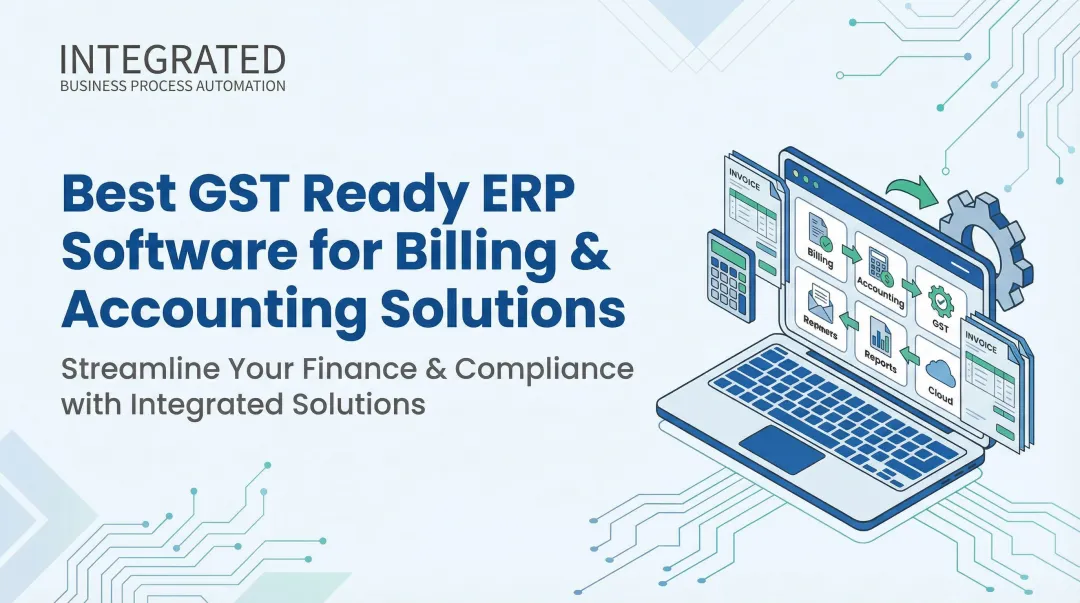
ERP software unifies finance, inventory, billing, compliance, and operations into a single platform. For small businesses navigating India's GST regime and competitive pressures, the right ERP is a direct lever on growth — not just a software upgrade.
Research shows that only 12% of Indian MSMEs have adopted full ERP systems, despite 94% having internet connectivity. This gap between digital readiness and operational automation creates real bottlenecks that affordable, cloud-based platforms can close. This guide breaks down the best ERP options available, what to look for, and how to choose the right fit for your business.
Key Takeaways
- ERP centralizes finance, inventory, billing, and compliance—eliminating data silos and manual errors
- Cloud-based MSME ERPs cost 30–50% less than on-premise systems and deploy significantly faster
- Key selection factors: GST compliance, ease of use, scalability, and India-specific integrations
- Evaluated solutions: Bizionix, Zoho One, Oracle NetSuite, SAP Business One, and Odoo—each suited to different business sizes and budgets
- The right ERP fits your industry, size, and growth trajectory—not just the most features
Why Small Businesses Need an ERP System
ERP (Enterprise Resource Planning) is a unified digital platform that replaces fragmented tools—spreadsheets, standalone accounting software, and WhatsApp coordination—with one integrated system for all departments.
The Pain Points Driving MSME Adoption
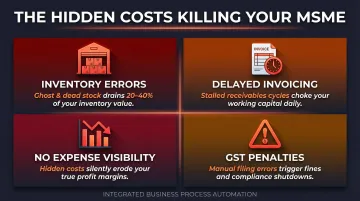
Disconnected data creates measurable financial losses. Manual tax filing leads to ITC reversals under GST law, where Input Tax Credit can only be claimed upon actual goods receipt and proper GSTR-2A/2B matching. Spreadsheet-based inventory is a known liability: 88% of all spreadsheets contain significant errors, generating "Ghost Stock" and "Dead Stock" that accounts for 20-40% of typical manufacturing inventory. With carrying costs running 18-30% annually in India, MSMEs lose over ₹50,000 monthly to spreadsheet chaos.
The downstream effects compound quickly:
- Poor inventory visibility triggers stock-outs and order delays
- Delayed invoicing stalls cash flow and receivables cycles
- No real-time expense tracking obscures true profitability
- Missed GST filings expose the business to avoidable penalties
Small Business ERP vs. Enterprise ERP
Cloud-based SMB solutions require no heavy IT infrastructure, have lower upfront costs through SaaS subscriptions, and deploy faster—typically 3 to 6 months versus up to 12 months for on-premise systems. Cloud ERP costs 30-50% less than on-premise systems over 10 years, eliminating capital expenditure on servers and maintenance staff.
Core Benefits
For Indian MSMEs, a well-implemented ERP delivers concrete operational gains:
- Fewer administrative errors through automated data validation
- Faster billing cycles with pre-validated invoices
- Real-time receivables tracking for better cash flow control
- GST compliance automation that eliminates manual filing errors
- Shared data across departments replacing siloed communication
Best ERP Solutions for Small Business in India
The following solutions were evaluated based on feature coverage, India-market relevance (including GST compliance), ease of use for non-technical teams, scalability, and cost-effectiveness for MSMEs.
Bizionix
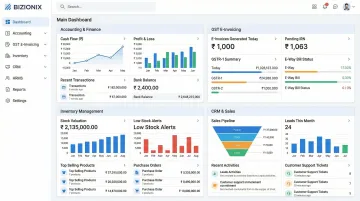
Bizionix, developed by IIS-LLP (a subsidiary of Protocol India Private Limited), is a 100% cloud-based ERP built specifically for Indian MSMEs. It covers accounting, GST e-invoicing, inventory, CRM, HR, and multi-company management under a single secure login.
Why Bizionix stands out: Engineered with GST-ready accounting, it provides direct API integration with India's e-Invoice system for instant IRN generation. The configurable architecture adapts to existing business processes without SAP-level complexity or cost. Multi-entity management makes it ideal for business groups, franchise networks, and CA firms managing multiple clients.
| Feature | Details |
|---|---|
| Key Features | GST-compliant accounting, automated e-invoicing, multi-company management, inventory tracking, CRM, HR, real-time dashboards, single secure login |
| Pricing Model | Cloud SaaS; NEO plan ₹999/year (basic modules); Enterprise plan custom pricing. Contact info@bizionix.com or +91 91779 99277 for tailored quotes |
| Best For | Indian MSMEs, manufacturing companies, distribution/warehouse operations, CA firms, hotels, franchise networks, multi-location businesses |
Zoho One
Zoho One is a comprehensive cloud suite by Zoho Corporation (India-based), offering 40+ integrated business apps covering CRM, accounting, HR, inventory, and project management in a single subscription.
Where it excels: Its modular architecture lets businesses start small and add apps as they grow. Zoho Books supports GST filing, e-way bills, and TDS compliance. Zoho is a registered GST Suvidha Provider (GSP), allowing direct e-way bill generation. The learning curve is steep — 40+ apps each require configuration before full integration.
| Feature | Details |
|---|---|
| Key Features | CRM, GST-compliant accounting (Zoho Books), inventory, HR, helpdesk, project management, 40+ apps |
| Pricing Model | All Employee: ₹1,250/employee/month (annual); Flexible User: ₹3,500/user/month (annual) (prices exclude 18% GST) |
| Best For | Service businesses, SMBs with diverse operational needs, companies already using Zoho CRM or Zoho Books |
Oracle NetSuite
Oracle NetSuite is a globally recognized cloud ERP connecting financials, inventory, order management, and CRM—suited for growing businesses with complex multi-location or international operations.
What sets it apart: NetSuite handles multi-subsidiary consolidation, multi-currency transactions, and real-time financial reporting out of the box. For India, the India Localization SuiteTax Engine automates CGST, SGST/UTGST, and IGST calculation and handles TDS/TCS compliance.
That said, base licensing starts at approximately $999/month plus $99-$199 per user—significantly higher than India-native alternatives. GST configuration also requires integration with GSPs like ClearTax and may need additional customization.
| Feature | Details |
|---|---|
| Key Features | Financial management, inventory, order management, production planning, multi-currency, built-in analytics, CRM |
| Pricing Model | Base platform ~$999/month + $99-$199/user/month; implementation typically $15,000-$35,000 for SMBs |
| Best For | Growing manufacturers, multi-location businesses, companies planning international expansion |
SAP Business One
SAP Business One is SAP's ERP for small to mid-sized companies, offering modules for finance, inventory, sales, production, and reporting—with strong brand credibility and a wide implementation partner network in India.
Key strengths: The MRP wizard, real-time inventory synchronization, and enterprise-grade reporting are standout capabilities. Licensing and implementation sit at the higher end for Indian SMBs — full pricing details are in the table below. External consultants are typically needed for deployment, but SAP's wide implementation partner network across India helps reduce that risk.
| Feature | Details |
|---|---|
| Key Features | MRP planning, financial management, inventory with lot traceability, CRM, analytics dashboards, multi-warehouse support |
| Pricing Model | Professional License ~₹1,36,620 (perpetual); Cloud ₹3,600-₹7,500/user/month; implementation ₹10L-₹50L+ |
| Best For | Manufacturing companies, businesses with complex inventory, companies transitioning from disconnected legacy systems |
Odoo
Odoo is a globally popular open-source ERP with a modular structure—businesses implement only needed apps (manufacturing, accounting, inventory, CRM, HR) and expand over time, with a growing Indian partner and user base.
Notable capabilities: Affordability and flexibility make it attractive for cost-conscious businesses. The Community (open-source) edition is free but requires internal technical resources to deploy and maintain. Odoo Enterprise (Tier 3 India pricing) costs $7.25-$9.10/user/month (Standard) or $10.90-$13.60/user/month (Custom), adding support and advanced features.
India-specific GST modules cover Indian Accounting, e-invoicing via GSP integration, e-way bills, and GSTR-1/2B reporting — though most businesses will need an implementation partner to configure these correctly.
| Feature | Details |
|---|---|
| Key Features | Modular apps (accounting, inventory, manufacturing, CRM, HR, project), open-source customization, offline shop floor capability |
| Pricing Model | Community: free (self-hosted); Enterprise: $7.25-$13.60/user/month (Tier 3 India) |
| Best For | Cost-conscious businesses, manufacturers wanting gradual ERP adoption, companies with internal technical resources |
How We Chose the Best ERP for Small Businesses
Evaluation Framework
Every solution on this list was assessed against five criteria relevant to Indian MSMEs — not just general ERP benchmarks:
- Handles GST/e-invoicing compliance, TDS/TCS, and e-way bill generation natively
- Covers core modules (finance, inventory, HR, CRM) within base pricing, not as expensive add-ons
- Deploys quickly without requiring a dedicated IT team; cloud-first preferred
- Scales to add users, modules, and locations as the business grows
- Offers local partner support, training, and managed services for non-technical teams
The criteria above also surfaced patterns in where MSME buyers consistently go wrong.
Common MSME Mistakes
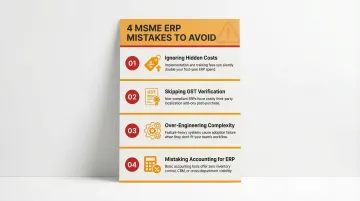
- Focusing only on sticker price — implementation fees, training costs, and annual maintenance charges often double the first-year spend
- Buying a global platform before verifying GST compliance, then discovering Indian localization requires costly third-party add-ons
- Rolling out enterprise-grade complexity when the team lacks the technical depth to use it — adoption failure is the most common ERP outcome
- Treating standalone accounting software as an ERP — you get compliance, but no inventory visibility, no CRM, no cross-department coordination
A brand name or feature count won't determine your success with an ERP. Your industry workflows, compliance requirements, and team's actual usage will.
Conclusion
Indian MSMEs no longer need to choose between affordability and capability. Cloud-based, GST-compliant ERP platforms have brought structured operations within reach of businesses that previously relied on spreadsheets, disconnected tools, or outdated software.
Evaluate ERP options not just on today's features and pricing, but on long-term scalability, vendor reliability, data security, and adaptability as business processes evolve. Gartner predicts that by 2027, over 70% of recently implemented ERP initiatives will fail to meet original business case goals—success requires disciplined implementation, not just good software.
Bizionix brings accounting, GST compliance, inventory, CRM, and multi-company management into one platform — built specifically for Indian MSMEs that need complete operational control without the complexity of enterprise-tier software. Visit bizionix.com or email info@bizionix.com to see how it fits your business.
Frequently Asked Questions
Does a small business need an ERP?
While small businesses can initially manage with spreadsheets or standalone tools, an ERP becomes essential when growth creates coordination gaps, billing delays, inventory errors, or compliance challenges. Modern cloud ERPs are now affordable enough for even micro-businesses, with entry-level plans like Bizionix starting at ₹999/year.
Will AI replace ERP systems?
No. AI is increasingly embedded within ERP platforms for anomaly detection, demand forecasting, and automation—but does not replace ERP. AI handles repetitive tasks and surfaces trends, making platforms smarter without eliminating the need for a structured operational backbone.
What features should a small business look for in an ERP?
Prioritize GST and e-invoicing compliance, inventory management, financial reporting, multi-department integration, and cloud accessibility. Real-time dashboards, role-based access controls, and ease of use for non-technical staff are equally important for day-to-day accountability.
How much does ERP software cost for a small business in India?
Cloud-based ERP solutions for Indian MSMEs typically range from a few thousand to tens of thousands of rupees per month depending on users and modules. India-native solutions like Bizionix (₹999/year for basic plans) are significantly more affordable than global platforms like SAP Business One (₹3,600–₹7,500/user/month) or NetSuite (~$999/month base fee, approximately ₹83,000+/month).
How long does ERP implementation take for a small business?
Cloud-based ERP implementations for small businesses typically take a few weeks to 3 months, depending on data migration complexity and team readiness. Traditional on-premise deployments average 9 months and often extend to 12+.
What is the difference between ERP and accounting software like Tally?
Accounting software like Tally handles financial transactions and compliance but stops there—it does not integrate inventory, CRM, HR, or production. An ERP unifies all departments in one platform, connecting operations to financials in real time.