The gap is real. According to the Research and Information System for Developing Countries (RIS), only 12% of Indian MSMEs currently use ERP software — despite the vast majority already adopting digital payments and basic digital tools. The bottleneck isn't willingness; it's finding the right fit.
This guide cuts through the noise. The 10 ERP systems below were selected to give Indian MSMEs, mid-sized enterprises, and growing businesses a clear, side-by-side view of their options — from global enterprise leaders to India-first platforms built specifically for GST compliance, multi-entity management, and cloud accessibility.
Key Takeaways
- ERP unifies finance, inventory, HR, sales, and compliance into one platform — replacing scattered tools and spreadsheets
- Only 12% of Indian MSMEs use ERP, leaving most businesses exposed to compliance gaps and operational inefficiency
- Global leaders (SAP, Oracle, Microsoft, Workday) offer enterprise depth but vary widely in cost and India-specific readiness
- For Indian MSMEs, GST compliance, e-invoicing with IRN generation, and cloud accessibility are non-negotiable criteria
- Use this side-by-side comparison of 10 ERP systems to shortlist the right fit by budget, deployment type, and GST readiness
What Is ERP Software and Why Does It Matter in 2026?
ERP (Enterprise Resource Planning) is an integrated software platform that connects core business functions — accounting, inventory, procurement, HR, sales, and reporting — through a single shared system. Instead of finance running on one tool, inventory on another, and HR on spreadsheets, every department works from the same real-time data.
The global ERP market reflects this value. Grand View Research projects the ERP software market to reach USD 157.07 billion by 2033, growing at a 9.5% CAGR. Cloud ERP already held 54.4% of deployment revenue share in 2025 and is expected to grow fastest. For Indian MSMEs, that shift is practical: enterprise-grade platforms are now accessible without on-premises infrastructure or SAP-level budgets.
For Indian businesses, 2026 raises the stakes further. Fragmented tools now carry direct regulatory risk — not just operational inefficiency. Key compliance pressures include:
- GST e-invoicing mandates requiring real-time invoice reporting to the IRP portal
- IRN (Invoice Reference Number) generation for B2B transactions above the threshold
- Multi-entity compliance obligations across group companies or branch networks
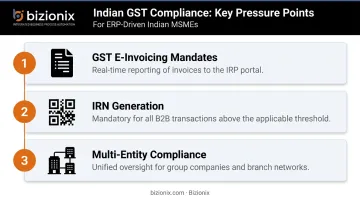
ERP consolidates these requirements into one system, making compliance a byproduct of normal operations rather than a separate burden.
Top 10 Best ERP Software Systems for 2026
These 10 ERP systems were selected based on functional depth, compliance readiness, deployment flexibility, pricing transparency, and verified user ratings.
1. Bizionix
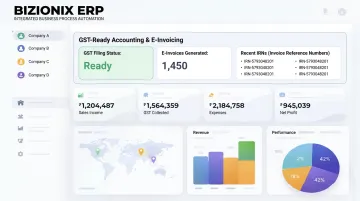
Bizionix is a 100% cloud-based ERP platform developed by IIS-LLP (a subsidiary of Protocol India Pvt. Ltd.) specifically for Indian MSMEs. It covers accounting, inventory, billing, GST compliance, multi-company management, HR, and payroll from a single secure login — without SAP-level complexity or cost.
What sets it apart for Indian businesses is its direct API integration with the GST e-Invoice system. The IRN generation process is fully automated: create a sales invoice, the system validates it against GST rules in real time, and an IRN plus QR code are generated instantly via direct IRP connection.
The invoice is ready to share within seconds — no manual JSON uploads, no portal navigation.
The multi-company management feature is particularly valuable for CA firms, business groups, and franchise networks. One login provides access to all entities, with independent books of accounts and GST compliance per entity, plus consolidated dashboards at the group level.
| Attribute | Details |
|---|---|
| Best For | Indian MSMEs, CA firms, multi-location businesses, manufacturing and distribution companies |
| Key Features | GST-ready accounting, automated e-invoicing with IRN, multi-company management, real-time inventory, cloud-based single login, HRMS & payroll, production planning |
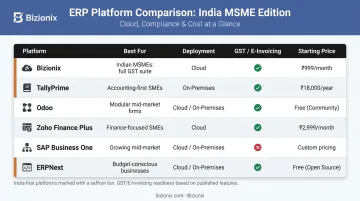
| Pricing | NEO plan: ₹999/year (14-day free trial); Enterprise: custom pricing |
| Deployment | 100% cloud (SaaS) |
2. SAP Business One
SAP Business One is SAP's ERP for small and mid-sized businesses, covering financials, CRM, inventory, sales, and procurement with real-time analytics and an implementation partner network spanning 170+ countries.
SAP's official India localization guide confirms electronic billing support for SAP Business One 10.0, including JSON export, IRP authentication, and e-invoicing workflows — making it one of the few globally established ERP platforms with verified India compliance documentation. It serves 83,000+ customers and 1.2 million users worldwide, with strong enterprise-grade depth.
Implementation is complex and partner-dependent, and pricing requires a custom quote — which typically places it beyond the reach of most small MSMEs.
| Attribute | Details |
|---|---|
| Best For | Mid-sized companies needing enterprise-grade compliance and SAP ecosystem integration |
| Key Features | Financial management, CRM, inventory, procurement, custom reporting, mobile access |
| Pricing | Custom — contact SAP or a certified partner |
| Capterra Rating | 4.3/5 (344 reviews) |
3. Oracle NetSuite
Oracle NetSuite is used by 43,000+ customers globally, offering integrated finance, supply chain, e-commerce, and HR with real-time dashboards and strong multi-entity consolidation.
It's the most popular cloud ERP among scaling mid-market companies managing multiple subsidiaries or geographies. Multi-currency, multi-language, and multi-entity reporting are native strengths. Pricing follows a component-based annual licensing model (core platform + users + optional modules + one-time implementation fee) with no fixed public price available.
India is listed as a supported market, though official sources did not confirm India-specific compliance documentation.
| Attribute | Details |
|---|---|
| Best For | Scaling businesses and enterprises managing multiple entities or geographies |
| Key Features | Financial management, supply chain, e-commerce integration, real-time analytics, multi-entity consolidation |
| Pricing | Custom annual licensing — contact Oracle NetSuite |
| Capterra Rating | 4.2/5 (2,041 reviews) |
4. Microsoft Dynamics 365 Business Central
Business Central is a modular cloud ERP for SMBs that integrates finance, sales, operations, and inventory with the Microsoft 365 ecosystem — Excel, Outlook, and Teams work natively within the platform. Microsoft Copilot AI is included at no extra cost for Business Central Online users.
Pricing is clearly structured: Essentials at USD 80/user/month covers finance, sales, and inventory; Premium at USD 110/user/month adds manufacturing and service management. For businesses already invested in Microsoft tools, the productivity overlap is a practical time-saver.
| Attribute | Details |
|---|---|
| Best For | Businesses using Microsoft 365 tools needing an integrated ERP |
| Key Features | Finance, sales, inventory, HR, Power BI dashboards, Copilot AI, Microsoft 365 integration |
| Pricing | Essentials: USD 80/user/month; Premium: USD 110/user/month (annual) |
| Capterra Rating | 4.1/5 (204 reviews) |
5. Odoo
Odoo is an open-source, modular ERP suite with 30+ applications spanning accounting, CRM, inventory, manufacturing, HR, and e-commerce. The Community edition is free; the Enterprise (hosted) plan is licensed.
Its modular structure lets resource-constrained businesses start with one app and add modules as they grow. Odoo maintains an India office in Gandhinagar and a global partner network for implementation support. Implementation complexity and the need for third-party consultants for enterprise-level customisation are the primary friction points.
| Attribute | Details |
|---|---|
| Best For | Startups and SMBs wanting modular, customisable ERP at low entry cost |
| Key Features | Accounting, CRM, inventory, HR, e-commerce, manufacturing, open-source flexibility |
| Pricing | Community edition: free; Enterprise plans from approximately USD 25/user/month |
| Capterra Rating | 4.2/5 (1,306 reviews) |
6. TallyPrime
TallyPrime (by Tally Solutions) remains one of the most widely used business management platforms in India, trusted by 2.5 million+ businesses for accounting, GST filing, e-invoicing, inventory, and payroll through a desktop-first application.
Its GST credentials are well-established: IRN generation, QR code creation, bulk e-invoice processing, and GST report integration are supported. Pricing is lifetime-license based — Silver (single-user) at ₹22,500 + 18% GST, Gold (multi-user) at ₹67,500 + 18% GST — which appeals to cost-conscious SMBs.
Its interface is increasingly dated, remote/cloud access requires additional setup, and it lacks the integrated procurement, sales, and HR depth of a full ERP.
| Attribute | Details |
|---|---|
| Best For | Indian SMBs focused on accounting, GST compliance, and inventory |
| Key Features | Accounting, GST filing, e-invoicing with IRN, inventory, payroll, 400+ reports |
| Pricing | Silver: ₹22,500 + GST (single-user); Gold: ₹67,500 + GST (multi-user) |
| Capterra Rating | 4.4/5 (226 reviews) |
7. Zoho Finance Plus
Zoho Finance Plus bundles invoicing, accounting, order management, inventory, expense tracking, subscription billing, and payroll into a unified finance suite — fully integrated with Zoho's broader CRM and productivity ecosystem.
For Indian MSMEs already using Zoho products, it's a natural consolidation. The India plan is priced at ₹8,499/organisation/month (includes 10 users), covering GST compliance, e-invoicing, and statutory payroll requirements including PF, ESI, and professional tax. The per-organisation pricing model makes costs predictable as teams grow.
| Attribute | Details |
|---|---|
| Best For | SMBs in the Zoho ecosystem needing unified finance and order management |
| Key Features | Invoicing, accounting, GST/e-invoicing, order management, inventory, payroll (PF, ESI) |
| Pricing | ₹8,499/organisation/month (India); USD 249/org/month (US) |
| Deployment | Cloud |
8. ERPNext
ERPNext is an open-source ERP (GNU GPL v3 licensed) covering accounting, CRM, HR, inventory, manufacturing, and procurement — available through Frappe Cloud or self-hosted deployment.
Entry-level hosting on Frappe Cloud starts at USD 5 (or ₹410)/month for shared sites, making it the most affordable managed option on this list. It has strong adoption in India and emerging markets. Non-technical teams typically need a certified implementation partner to get full value from the platform.
| Attribute | Details |
|---|---|
| Best For | Tech-savvy teams seeking an open-source, low-cost, customisable ERP |
| Key Features | Accounting, inventory, CRM, HR, manufacturing, multi-currency, open-source |
| Pricing | Shared hosting from USD 5/month; dedicated servers from USD 20/month |
| Capterra Rating | 4.6/5 (136 reviews) |
9. Sage Intacct
Sage Intacct is a cloud-native, finance-first platform designed for mid-market organisations — typically those with 20+ employees or USD 4M+ in annual revenue. Its core strengths are multi-dimensional financial reporting, automated accounts payable, AI-powered accounting automation, and native Salesforce integration.
It fits services firms, healthcare organisations, and nonprofits with complex financial visibility needs. Pricing is custom and enterprise-tier, with no publicly listed rates — official sources did not confirm India-specific compliance documentation.
| Attribute | Details |
|---|---|
| Best For | Mid-market organisations with complex financial reporting and services focus |
| Key Features | Multi-dimensional reporting, automated AP, real-time dashboards, Salesforce integration |
| Pricing | Custom — contact Sage for a quote |
| Capterra Rating | 4.3/5 (684 reviews) |
10. Workday
Workday is an enterprise cloud platform serving large organisations globally, with particular depth in Human Capital Management (HCM) and financial management. The Workday GO programme packages HR, payroll, finance, and AI agents specifically for midsize businesses — and can activate in as little as 8 weeks according to Workday.
Its AI-powered Skills Cloud and real-time workforce analytics are meaningful advantages for HR-heavy organisations. Workday does not publish pricing publicly. Note: verified official documentation did not confirm a dedicated manufacturing module, so it's better positioned for services and HR-intensive organisations.
| Attribute | Details |
|---|---|
| Best For | Enterprises and large organisations prioritising HR, workforce planning, and finance |
| Key Features | HCM, financial management, payroll, planning, AI-powered analytics, workforce management |
| Pricing | Not publicly disclosed — contact Workday |
| Capterra Rating | 4.4/5 (88 reviews, Financial Management module) |
How We Selected These ERP Systems
The 10 platforms above were assessed across five criteria:
- Functional depth — which core modules are included natively vs. add-on
- Compliance readiness — specifically GST, e-invoicing, and Indian regulatory requirements
- Deployment flexibility — cloud, on-premises, or hybrid options
- Pricing transparency — whether actual pricing is publicly available
- User satisfaction — Capterra and G2 ratings from verified reviews
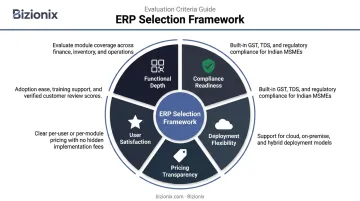
The most common mistake businesses make when choosing ERP is selecting based on brand recognition or the cheapest licence fee. Neither predicts whether the system will actually work for your workflows, team capacity, or growth trajectory.
That's why each criterion here connects directly to business outcomes. Compliance readiness affects your penalty exposure. Deployment model shapes your total cost of ownership over three to five years. User satisfaction data tells you how quickly — or slowly — teams will actually adopt the system.
Gartner research found that by 2027, more than 70% of recently implemented ERP initiatives will fail to meet their original business-case goals. That number reflects poor evaluation and poor change management — not poor technology.
Conclusion
No single ERP is right for every business. A large enterprise managing global subsidiaries has entirely different needs than a growing Indian MSME trying to automate GST compliance and replace disconnected tools.
Before finalizing your choice, evaluate beyond the feature checklist:
- Total cost of ownership — licensing, implementation, and ongoing training combined
- Post-go-live support quality — how responsive is the vendor once you're live
- Scalability — whether the platform can realistically grow with your business over the next 3–5 years
For Indian MSMEs — businesses that need GST compliance, automated e-invoicing, multi-company management, and real-time operational visibility — Bizionix addresses these requirements directly. It's 100% cloud-based, purpose-built for Indian regulatory requirements, and replaces fragmented tools with a single unified platform from day one, without SAP-level complexity or cost.
If you're at the shortlisting stage and want to see how Bizionix handles your specific workflows, the team is available to walk you through a live demo.
Reach out at info@bizionix.com or call +91 91779 99277 to get started.
Frequently Asked Questions
Which ERP system is the best?
There's no single best ERP — the right system depends on your business size, industry, compliance needs, and budget. For large enterprises, SAP Business One or Oracle NetSuite typically fits. For Indian MSMEs needing GST compliance and affordability, platforms like Bizionix or Odoo are stronger candidates.
Which is the most used ERP software?
SAP and Oracle hold the largest global enterprise ERP market share. Within India's SMB segment, TallyPrime has historically dominated accounting-focused adoption, with 2.5 million+ businesses using the platform for GST compliance and daily accounting.
What is the difference between cloud ERP and on-premises ERP?
Cloud ERP is hosted by the vendor — lower upfront cost, automatic updates, and accessible from anywhere with an internet connection. On-premises ERP is installed locally, offering greater control and customisation, but requiring IT infrastructure, maintenance, and higher capital expenditure.
How long does ERP implementation typically take?
Cloud-based SMB solutions typically go live in a few weeks to 3 months. Mid-market deployments take 6–12 months, while complex enterprise rollouts can run 18–24 months. Data migration, user training, and change management are the main variables.
What features should Indian businesses prioritise when choosing an ERP?
Prioritise GST compliance, automated e-invoicing with IRN generation, multi-entity management, cloud accessibility, and local vendor support quality. These directly affect regulatory risk, operational efficiency, and how quickly your team can adopt the system.