Introduction
Mumbai runs on speed. With thousands of MSMEs, manufacturers, traders, and multi-location enterprises packed into one of Asia's most competitive commercial environments, fragmented operations are an expensive problem. Businesses managing inventory on spreadsheets, filing GST manually, and running separate tools for finance, HR, and sales aren't just inefficient — they're bleeding time and money.
ERP software has become the practical fix. A single platform that connects finance, inventory, procurement, CRM, and compliance eliminates the chaos of disconnected systems. The choice matters, though. The wrong ERP brings its own headaches: over-engineered systems no one adopts, costs that balloon after implementation, or tools built for Western markets that don't handle Indian GST natively.
According to RIS's 2026 MSME Digitalisation report, only 12% of Indian MSMEs currently use ERP software — meaning most businesses are still running on fragmented tools. For Mumbai businesses still on patchwork systems, that's a significant competitive disadvantage.
This guide covers 10 ERP solutions relevant to Mumbai businesses in 2026, evaluated on GST compliance, module depth, deployment flexibility, pricing transparency, and local support.
Key Takeaways
- ERP connects finance, inventory, sales, HR, and compliance into one platform — eliminating disconnected tools and manual processes
- Mumbai MSMEs need native GST, e-invoicing, and multi-location support built in — not bolted on
- The right ERP depends on your business size, industry, and total budget — brand name alone isn't a reliable guide
- This list covers 10 solutions evaluated for Mumbai's specific business context
- Prioritise GST-readiness, scalability, and total cost of ownership before committing
ERP Software in Mumbai: Why It Matters in 2026
An ERP system is a centralised platform that replaces fragmented tools by integrating finance, inventory, procurement, CRM, HR, and compliance into one place. For Mumbai's dense, fast-moving business environment, that integration is an operational necessity, not a nice-to-have.
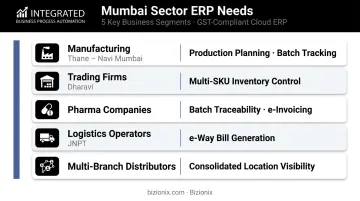
Mumbai's business landscape is remarkably varied, and each sector comes with distinct ERP requirements:
- Manufacturing (Thane, Navi Mumbai) — production planning and batch tracking
- Trading firms (Dharavi) — multi-SKU inventory control across warehouses
- Pharma companies — batch traceability and e-invoicing compliance
- Logistics operators (near JNPT) — e-way bill generation on every consignment
- Multi-branch distributors — consolidated visibility across locations
A generic solution rarely fits any of these without significant customisation.
The market numbers reflect growing urgency. Data Bridge projects India's ERP market will grow at a 12.54% CAGR from 2024 to 2032, reaching US$5.04 billion by 2032. Yet adoption remains low — only 14% of Indian MSMEs use cloud computing services, per the same RIS report. Businesses that move now gain a meaningful operational advantage over those still waiting.
That low adoption rate also means compliance risk is higher for businesses still running manual processes. GST requirements add direct pressure here. E-invoicing is now mandatory for businesses with aggregate turnover above ₹5 crore, with e-way bills required for goods movements exceeding ₹50,000 in value. Any ERP considered for a Mumbai business must handle these requirements natively, not through workarounds.
10 Best ERP Software in Mumbai for 2026
These 10 solutions were selected for Mumbai's MSME and enterprise landscape, evaluated across six criteria:
- GST compliance and e-invoicing readiness
- Module depth and functional coverage
- Cloud readiness and deployment flexibility
- Pricing transparency
- Local support availability
- Scalability for growing businesses
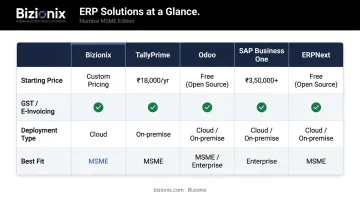
1. Bizionix by IIS-LLP
Bizionix is a cloud-based ERP built specifically for Indian MSMEs by IIS-LLP, a subsidiary of Protocol India Private Limited with over two decades of industry experience. It covers accounting, inventory, procurement, CRM, sales, HRMS, and multi-company management in one platform.
For Mumbai businesses, the standout capability is direct API integration with India's GST e-Invoice system — IRN generation happens instantly, with no manual JSON uploads or portal delays. CA firms and franchise networks can manage multiple GST entities from a single dashboard, with full data isolation per entity.
| Criteria | Details |
|---|---|
| Best For | MSMEs, CA firms, multi-location businesses, and franchise networks |
| Key Features | GST-ready accounting, automated e-invoicing with IRN generation, multi-company management, real-time dashboards, inventory and procurement modules, HRMS |
| Pricing | NEO plan at ₹999/year (14-day free trial); Enterprise pricing on request via info@bizionix.com |
2. SAP Business One
SAP Business One targets small and mid-sized businesses, with a strong implementation network across Mumbai's manufacturing, pharma, and distribution sectors. Deep industry modules, multi-currency support, and real-time analytics make it a capable option for growing operations.
Indicative pricing from Mumbai SAP partner PTS Systems puts a 5-user deployment at approximately ₹10 lakh (licenses and basic implementation). That's a significant outlay for early-stage MSMEs, but well-supported for manufacturers scaling up.
| Criteria | Details |
|---|---|
| Best For | Mid-sized manufacturers, pharma distributors, and growing enterprises |
| Key Features | Financial management, inventory control, production planning, CRM, multi-currency support |
| Pricing | Partner-quoted; indicative Professional User perpetual license ~₹1,36,620; annual maintenance 18–22% of license cost |
3. Oracle NetSuite ERP
Oracle NetSuite is a cloud-native ERP used by 43,000+ customers globally, covering finance, inventory, supply chain, and CRM in one platform. Multi-subsidiary management via NetSuite OneWorld supports 190 currencies across 100+ countries, making it a natural fit for Mumbai businesses with international operations.
Pricing is annual license-based and not publicly disclosed for India. Smaller businesses without dedicated IT resources often find the implementation complexity a barrier worth weighing upfront.
| Criteria | Details |
|---|---|
| Best For | Scaling mid-to-large enterprises with multi-entity or international operations |
| Key Features | Financial consolidation, inventory management, CRM, ecommerce integration, multi-currency, multi-subsidiary |
| Pricing | Annual license; India pricing not publicly listed — contact Oracle partners for a quote |
4. TallyPrime
Trusted by 2.7 million+ businesses, TallyPrime is the default choice for Mumbai's trading community and small MSMEs. Its GST compliance, invoicing, and minimal training requirement keep it deeply embedded in the market after decades of use.
The platform supports hybrid deployment (desktop with mobile access), GST filing, e-way bill generation, and IRN/QR code generation. It's more accounting-focused than a full-suite ERP, but for businesses prioritising billing and compliance over operational breadth, that's exactly the point.
| Criteria | Details |
|---|---|
| Best For | Small businesses, traders, accountants, and businesses prioritising billing and GST compliance |
| Key Features | GST filing, e-invoicing, inventory, banking module, payroll, multi-currency |
| Pricing | Silver (single user): ₹750/month, ₹8,100/year, or ₹22,500 lifetime + 18% GST; Gold (multi-user): ₹2,250/month, ₹24,300/year, or ₹67,500 lifetime + 18% GST |
5. Odoo ERP
Odoo is an open-source, modular ERP with apps covering CRM, inventory, manufacturing, HR, ecommerce, and point-of-sale. Businesses can start with a single free app and expand modules as needed, on cloud or on-premise.
The large app marketplace suits businesses with non-standard workflows. That said, deeper customisation requires technical expertise, which adds to total implementation cost and should factor into budget planning.
| Criteria | Details |
|---|---|
| Best For | SMEs and growing businesses needing flexible, customisable workflows across multiple functions |
| Key Features | Inventory, manufacturing, accounting, CRM, HR, ecommerce, POS |
| Pricing | Free (one app); Standard and Custom plans priced per user per month — current India rates at odoo.com |
6. Microsoft Dynamics 365 Business Central
Dynamics 365 Business Central is a natural fit for Mumbai businesses already running on Microsoft tools — Office 365, Teams, and Azure integrate without friction. India-specific localisation covers GST, e-invoicing, e-way bill, TDS, and TCS out of the box.
Copilot AI features and Power BI reporting add operational depth. Costs scale quickly as modules stack up, so lean MSMEs should evaluate whether the full suite justifies the per-user spend.
| Criteria | Details |
|---|---|
| Best For | Mid-to-large businesses using Microsoft tools; businesses needing ERP + CRM in one platform |
| Key Features | Finance, supply chain, sales, HR, Power BI integration, Copilot AI automation, India GST localisation |
| Pricing | Essentials: ₹6,655/user/month; Premium: ₹9,150/user/month; Team Members: ₹665/user/month (billed annually, GST extra) |
7. ERPNext
ERPNext, developed by Frappe Technologies, is gaining traction among Indian SMEs and startups for its low hosting cost, GST compliance support, and active developer community. Frappe Cloud starts at ₹410/month on usage-based pricing rather than per-user, with a 14-day free trial included.
E-invoicing is integrated for Frappe Cloud users. Self-hosted deployments are free but require technical resources for setup and customisation.
| Criteria | Details |
|---|---|
| Best For | Budget-conscious SMEs, startups, and manufacturing businesses needing flexible open-source ERP |
| Key Features | Accounting, inventory, manufacturing, CRM, HR, payroll, GST compliance, e-invoicing |
| Pricing | Cloud hosting from ₹410/month (usage-based); self-hosted is free; implemented through 200+ certified partners globally |
8. Zoho One
Zoho One bundles 50+ integrated apps — CRM, sales, HR, finance, inventory, and marketing automation — into one subscription. For Mumbai SMEs consolidating multiple SaaS tools, it's a practical way to reduce costs and fragmentation.
CRM usability and ease of onboarding are consistent strengths. The lack of a dedicated manufacturing module limits its fit for production-heavy businesses, but service companies, D2C brands, and retailers will find it covers most operational needs.
| Criteria | Details |
|---|---|
| Best For | Service businesses, D2C brands, retail, and businesses consolidating multiple SaaS tools |
| Key Features | CRM, sales, inventory, HR, accounting, marketing automation, 50+ integrated apps |
| Pricing | All-employee and flexible user pricing models available — current India rates at zoho.com/one |
9. Marg ERP
Marg ERP has a well-established presence in pharma, FMCG, and distribution — sectors prominent across Mumbai's trading economy. Sector-specific features, barcode integration, and GST/e-invoicing compliance come at an affordable perpetual licensing price.
The interface is considered dated compared to newer platforms, and cloud access is an add-on rather than native. For distribution-heavy businesses that prioritise compliance and affordability over modern UX, it remains a solid option.
| Criteria | Details |
|---|---|
| Best For | Pharma distributors, FMCG traders, small retailers, and distribution businesses |
| Key Features | GST compliance, e-invoicing, billing, inventory, barcode integration, supply chain tracking |
| Pricing | Perpetual: Nano ₹4,200 / Basic ₹8,400 / Silver ₹12,600 / Gold ₹25,200; Annual renewal (ARC): Nano ₹840 to Gold ₹5,040 |
10. Focus ERP
Focus ERP, developed by Focus Softnet (established 1992), serves mid-sized businesses across 17 countries. In Mumbai, it has traction in automotive, construction, logistics, and services.
The platform includes predictive reporting, an MRP module, POS system, and contract management — all configurable by user count, module set, and locations. Pricing is custom-quoted and not disclosed upfront.
| Criteria | Details |
|---|---|
| Best For | Mid-sized businesses in logistics, construction, services, and manufacturing |
| Key Features | MRP, inventory, finance, HR, POS, contract management, predictive reporting |
| Pricing | Custom pricing based on users, modules, and locations — contact Focus Softnet for a quote |
How We Chose the Best ERP Software in Mumbai
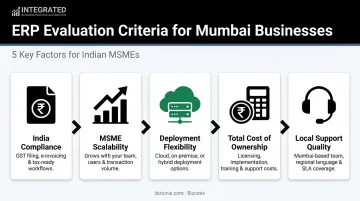
These solutions were evaluated against Mumbai's business landscape — not just global popularity rankings. Five criteria drove the assessment:
- India-specific compliance — Native GST, e-invoicing, e-way bill, and TDS/TCS support — non-negotiable for businesses above the ₹5 crore e-invoicing threshold or moving goods above ₹50,000
- Scalability for MSME growth — Can the system grow with the business without requiring a full platform switch at 50 employees?
- Deployment flexibility — Cloud vs. on-premise vs. hybrid matters depending on data sensitivity and IT infrastructure
- Total cost of ownership — Implementation, training, per-user fees, and annual support can double the sticker price — licensing is only the starting point
- Quality of local support — Response time and onboarding quality vary sharply between global vendors and India-focused providers
Brand recognition is a poor proxy for operational fit. SAP and Oracle are built for enterprises with dedicated IT teams — not for a distributor in Andheri with 20 employees and three warehouses. The right ERP depends on your size, sector, and compliance requirements, not the vendor's logo.
Conclusion
Mumbai businesses have genuine options across the price and complexity spectrum — from globally trusted platforms like SAP Business One and Oracle NetSuite to India-built solutions like Bizionix, Marg, and ERPNext. The right choice depends on operational complexity, industry requirements, and growth stage.
Before finalising any platform, check three things:
- Native GST compliance — built in, not bolted on through a plugin
- True total cost — implementation, annual support, and any per-user fees included
- Practical usability — can your team actually adopt it without months of training
Request demos or trials from your shortlist. Real-world usability often looks very different from what a sales demo shows — and that gap matters more than any feature checklist.
If those trials lead you toward a practical, GST-ready cloud ERP built specifically for Indian MSMEs — without the enterprise-grade complexity or cost — Bizionix by IIS-LLP is a strong candidate to shortlist. Start with the 14-day free trial or reach out directly at info@bizionix.com for a consultation.
Frequently Asked Questions
Which is the best ERP software?
There's no universal answer — the best ERP depends on business size, industry, and compliance requirements. For Indian MSMEs, cloud solutions with built-in GST compliance like Bizionix, ERPNext, or Zoho One typically offer the best value. Large enterprises with complex operations may need SAP Business One or Oracle NetSuite.
What is ERP software used for in a business?
ERP connects core business functions — finance, inventory, procurement, HR, CRM, and compliance — into a single platform. It reduces manual work, removes information bottlenecks between departments, and gives management a clear, real-time view of the entire business from one place.
How much does ERP software cost in India?
Costs range widely — from free open-source options like ERPNext to affordable MSME solutions starting at ₹999/year (Bizionix), to enterprise platforms like SAP and Oracle where pricing runs into lakhs. Always account for implementation, training, and ongoing support costs when budgeting, not just the license fee.
Which ERP is best for manufacturing companies in Mumbai?
Manufacturing businesses typically need production planning, BOM management, inventory tracking, and GST compliance. SAP Business One, ERPNext, Bizionix, and Focus ERP are commonly evaluated for Mumbai manufacturing operations — each with different price points and complexity levels.
Is cloud ERP better than on-premise ERP for small businesses?
Cloud ERP generally suits small businesses better — lower upfront cost, no server maintenance, automatic updates, and remote access. On-premise makes sense only when strict data control or offline access is a hard requirement, though most growing MSMEs find cloud the more practical path.
What features should I look for in ERP software for Mumbai businesses?
Prioritize these non-negotiables:
- Native GST and e-invoicing compliance
- Multi-location inventory management
- Scalable user and company management
- Real-time reporting dashboards
- Local support availability
Any ERP missing these will require workarounds that add cost and complexity over time.