ERP software used to be a luxury reserved for large enterprises. That's no longer true. According to a 2026 RIS report on MSME digitalisation, while over 95% of surveyed MSMEs use at least one digital tool, only 12% use ERP and 14% use cloud computing — a gap that affordable cloud ERP platforms are now closing rapidly.
With 5.77 crore MSMEs registered as of December 2024 (MSME Annual Report 2024-25), the scale of opportunity — and the urgency to digitise — has never been greater.
Key Takeaways
- ERP unifies accounting, inventory, CRM, and compliance into a single platform
- Affordable cloud ERPs built for Indian SMEs handle GST compliance, e-invoicing, and real-time visibility at accessible price points
- Key selection criteria: GST-readiness, cloud deployment, scalability, ease of use, and transparent pricing
- The 5 best options covered here: Bizionix, Zoho Books, Odoo, TallyPrime, and ERPNext
- Evaluate total cost of ownership: implementation time, support quality, and compliance depth matter as much as the license fee
Why Indian MSMEs Are Turning to ERP in 2026
For most small businesses, "ERP" still sounds like something SAP sells to large corporations. In practice, ERP for an Indian MSME means one thing: replacing the patchwork of Excel files, WhatsApp approvals, and disconnected accounting tools with a single platform that handles accounting, inventory, billing, and compliance together.
Two forces are accelerating ERP adoption in 2026:
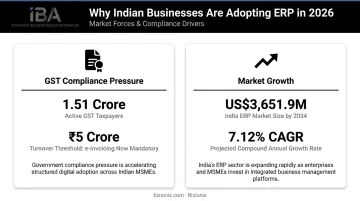
- GST compliance pressure — Active GST taxpayers crossed 1.51 crore as of April 2025, and e-invoicing is now mandatory for businesses with aggregate turnover above ₹5 crore. Manual compliance workarounds don't scale.
- Market growth — India's ERP market is projected to reach US$3,651.9 million by 2034, growing at a CAGR of 7.12% (IMARC Group).
The platforms below were evaluated against four criteria:
- Affordability — pricing accessible to small and growing businesses
- GST compliance — built-in e-invoicing, GSTR filing, and IRN support
- Ease of deployment — cloud-based setup without heavy IT overhead
- MSME relevance — designed for Indian business workflows, not adapted from enterprise tools
Best Affordable ERP Solutions for Small Businesses & SMEs in India (2026)
Each solution below was assessed on affordability, GST compliance depth, ease of use, deployment simplicity, and real-world fit for Indian business operations.
Bizionix (by IIS-LLP)
Bizionix is a 100% cloud-based ERP built specifically for Indian MSMEs by IIS-LLP — a Hyderabad-based technology company backed by over two decades of industry experience through its parent company, Protocol India Private Limited. It covers accounting, inventory, billing, CRM, HRMS, and multi-company management under a single login.
Bizionix was designed from the ground up for Indian compliance. The platform connects directly with the government's Invoice Registration Portal (IRP) via API — IRN and QR codes generate instantly when a sales invoice is created, with no manual JSON uploads or third-party tools. GSTR-1 is auto-populated from e-invoicing data, keeping sales, GST returns, and accounting aligned automatically.
For businesses managing multiple entities, the single-login multi-company dashboard stands out:
- Switch between entities without logging out
- Maintain independent books of accounts per company
- Set entity-level permissions and access controls
- Track full activity logs per entity
This covers holding companies, franchise networks, CA firms, and multi-location operations without fragmentation.
| Category | Details |
|---|---|
| Key Features | GST-ready accounting, direct API e-invoicing with instant IRN generation, GSTR-1 auto-population, multi-company management, inventory control, CRM, HRMS & payroll, real-time dashboards, 100% cloud-based |
| Best For | Manufacturing companies, distribution businesses, CA firms, hotels, and growing Indian MSMEs managing multiple entities |
| Deployment | Cloud-based SaaS; no server infrastructure required |
| Pricing | NEO plan at ₹999/year (discounted from ₹2,999) with 14-day free trial; Enterprise plan on custom pricing — contact info@bizionix.com or +91 91779 99277 |
Zoho Books / Zoho One
Zoho is an Indian-founded technology company offering a tightly integrated suite of business applications. Zoho Books handles GST compliance and e-invoicing natively, while Zoho One extends into HR, CRM, inventory, and project management — making it an affordable ERP ecosystem for small businesses.
An SME can start with Zoho Books for accounting and GST, then add Zoho Inventory or Zoho CRM without changing platforms or migrating data. E-invoicing support is available from the Standard plan upward, covering businesses above the ₹5 crore turnover threshold.
| Category | Details |
|---|---|
| Key Features | GST filing automation, e-invoicing, e-way bill, inventory tracking, CRM, HR, project management, mobile access, third-party integrations |
| Best For | Service businesses, retail, and growing SMEs that want an India-built solution with a broad application ecosystem |
| Pricing | Zoho Books: Free plan for revenue below ₹25 lakh; paid plans from ₹749/month (annual billing, per organisation); Zoho One India INR pricing — check zoho.com/one directly for current rates |
Odoo
Odoo is a modular, open-source ERP with a large global user base and a growing network of Indian implementation partners. Its modules span sales, accounting, inventory, manufacturing, and HR, with deployment options ranging from cloud-hosted to self-managed.
The appeal for budget-conscious SMEs is the Community Edition — free under LGPLv3 licensing and self-hostable. However, Indian GST configuration (e-invoicing, e-way bill, GSTR filing) typically requires either the Enterprise edition or a qualified local implementation partner. The licensing cost may be low, but implementation costs can add up quickly.
| Category | Details |
|---|---|
| Key Features | Modular architecture, accounting, inventory, manufacturing, CRM, HR, e-commerce integration, open-source community edition |
| Best For | Tech-comfortable SMEs, manufacturers, and distributors looking for a customisable ERP with flexible licensing |
| Pricing | Community Edition: free (self-hosted); Enterprise: approximately US$24.90/user/month (annual billing) — INR pricing not officially published; confirm current rates at odoo.com/pricing |
TallyPrime
TallyPrime by Tally Solutions is India's most widely used business management software, with deep penetration among small businesses and chartered accountants. It covers accounting, inventory, payroll, and GST compliance with a level of tax-law depth that few platforms match.
Its offline-first architecture suits businesses in Tier-2 and Tier-3 cities where internet connectivity is inconsistent — though the license requires online validation at least every 30 days to avoid entering Educational Mode. TallyPrime is stronger on accounting and GST than on CRM or project management, making it a better fit for compliance-focused operations than full-suite ERP needs.
| Category | Details |
|---|---|
| Key Features | GST returns (GSTR-1, GSTR-2A, GSTR-2B, GSTR-3B), e-way bill, e-invoicing with IRN generation, inventory management, payroll, MIS reports, offline and cloud-connected options |
| Best For | Small businesses and CAs prioritising GST compliance, accounting depth, and ease of use; ideal for Tier-2/3 city businesses |
| Pricing | Silver (single PC): ₹750/month + GST or ₹22,500 lifetime + GST; Gold (multi-user): ₹2,250/month + GST or ₹67,500 lifetime + GST |
ERPNext (by Frappe Technologies)
ERPNext is a fully open-source ERP developed by Frappe Technologies, a Mumbai-based Indian company. It covers accounting, inventory, manufacturing, HR, CRM, and project management in a single platform, with India-specific GST and e-invoicing support built in.
The self-hosted version is free. Frappe Cloud managed hosting starts at ₹410/month per site — among the lowest entry points for hosted ERP. The tradeoff is setup complexity: ERPNext works best when a business has internal technical capability or engages a certified Frappe implementation partner.
| Category | Details |
|---|---|
| Key Features | GST compliance, e-invoicing, accounting, inventory, manufacturing, HR, CRM, project management, open-source with an active Indian community |
| Best For | Tech-savvy SMEs, startups, and manufacturing businesses comfortable with open-source tools and prepared to invest in implementation support |
| Pricing | Self-hosted: free (open-source); Frappe Cloud managed hosting: from ₹410/month per site or ₹1,800/month for a dedicated server |
Must-Have Features in an Affordable SME ERP
GST Compliance and E-Invoicing
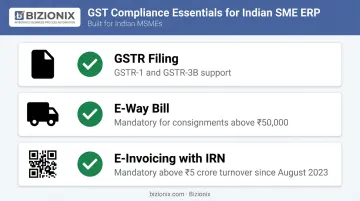
For Indian SMEs, GST-readiness is non-negotiable. The right ERP should handle:
- GST return filing — GSTR-1, GSTR-3B support at minimum
- E-way bill generation — mandatory for goods movement where consignment value exceeds ₹50,000
- E-invoicing with IRN generation — mandatory for businesses with aggregate turnover above ₹5 crore (effective from August 1, 2023 per GSTN Notification 10/2023)
An ERP that requires manual JSON uploads to the government portal or depends on third-party tools for IRN generation negates the core benefit of automation — you're still doing the compliance work manually.
Cloud Deployment and Mobile Access
Cloud-based ERPs eliminate the need for on-premise servers and dedicated IT staff — two significant cost drivers for small businesses. Key considerations:
- Access from any device, anywhere, without VPN or remote desktop setups
- Mobile visibility for owners and managers to approve transactions and review dashboards on the go
- Automatic software updates without IT involvement
On-premise alternatives add hardware costs, maintenance overhead, and IT dependency — all of which compound as your business grows and your team expands.
Scalability and Multi-Entity Support
Growing SMEs frequently outgrow accounting software because it simply can't handle additional locations, users, or business entities. Look for:
- Multi-company management under a single login — critical for business groups, franchise networks, and CA firms
- Role-based access controls that let you add users with the right permissions as the team grows
- No data migration when adding modules — new capabilities connect to existing data without rebuilding anything
How We Chose the Best ERP for Indian SMEs
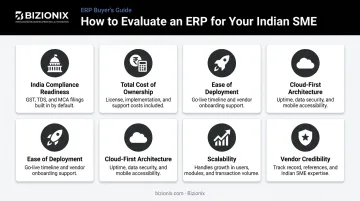
The solutions on this list were evaluated against a consistent set of criteria:
- India-specific compliance readiness — GST, e-invoicing, and e-way bill support with direct government portal integration
- Total cost of ownership — licensing + implementation + ongoing support, not just the subscription fee
- Ease of deployment for non-technical users and small teams
- Cloud-first architecture with mobile access
- Scalability for businesses that will grow beyond their starting configuration
- Vendor credibility in the Indian market, including local support availability
Two evaluation mistakes consistently trip up buyers. The first is selecting on brand name alone — SAP Business One, for example, carries implementation costs that are unsuitable for most MSMEs. The second is treating accounting software like standalone Tally or Zoho Books as a full ERP without checking whether it covers inventory, operations, and HR.
The right fit depends on your industry, team size, technical capability, and compliance requirements. Before committing, request a demo focused on the GST module and time how quickly the vendor's support team actually responds — that response speed matters far more post-implementation than it does during the sales conversation.
Conclusion
The platforms covered here — from Zoho Books and ERPNext to TallyPrime and Bizionix — offer genuine enterprise-grade functionality at price points accessible to small businesses. The right choice comes down to your operations: the size of your team, your compliance requirements, and how many disconnected tools you're currently managing.
For Indian MSMEs that want a single system built around local compliance, Bizionix is worth a close look. It includes direct API integration with the GST e-Invoice portal, instant IRN generation, multi-company management under a single login, and modules covering accounting, inventory, CRM, and HRMS — starting at ₹999/year with a 14-day free trial.
Book a demo or reach out at info@bizionix.com / +91 91779 99277 to see how it fits your operations.
Frequently Asked Questions
What is the best ERP solution?
There is no single best ERP — the right choice depends on your business size, industry, and compliance needs. For Indian SMEs, platforms like Bizionix, Zoho Books, and ERPNext offer strong value by combining affordability with GST compliance and cloud deployment.
Is SAP an ERP or MES?
SAP is primarily an ERP system, though it includes MES capabilities through modules like SAP MII. For Indian MSMEs, SAP's licensing and implementation costs typically make it unsuitable — more affordable alternatives are better-suited for this segment.
What is the cost of ERP for small businesses in India?
Pricing varies widely across platforms:
- Free — ERPNext (self-hosted)
- ₹410/month — Frappe Cloud hosting
- ₹749/month — Zoho Books Standard
- ₹750/month (excl. GST) — TallyPrime Silver
- ₹999/year — Bizionix NEO
Enterprise-tier plans with full modules are typically priced on request.
Can small businesses in India use ERP software?
Yes. Modern cloud ERPs require no dedicated IT team or server infrastructure. Indian SMEs benefit particularly from built-in GST compliance, which removes the manual burden of return filing and e-invoicing from small teams.
Which ERP is best for GST compliance in India?
Bizionix, TallyPrime, Zoho Books, and ERPNext are the strongest options for Indian GST compliance, offering return filing, e-way bill generation, and direct IRN generation through integration with the government's e-Invoice portal.
How long does ERP implementation take for a small business?
For cloud-based ERPs, basic configuration and go-live can take anywhere from a few days to several weeks, depending on data migration complexity and module count. Bizionix is built for quick deployment — e-invoicing setup takes minutes once API credentials are configured, making it one of the faster options for GST-ready go-live.