That gap is closing fast. Market Research Future values India's ERP market at USD 4.5 billion in 2024, growing at a 9.33% CAGR through 2035, with manufacturing as the dominant industry segment.
For small manufacturers specifically, ERP does one thing that no spreadsheet can: it connects production planning, BOM management, inventory, and GST-compliant invoicing into a single platform. This guide compares five ERP solutions built or adapted for Indian MSME manufacturers — so you can choose the right one for your operations.
Key Takeaways
- Manufacturing ERP connects production, inventory, GST compliance, and finance into one unified system
- Five ERPs reviewed: Bizionix, ERPNext, Odoo, TranZact, and Expand smERP — suited to different MSME profiles
- Key evaluation criteria: BOM depth, work order management, GST/e-invoicing readiness, local support, and MSME pricing
- Cloud ERP suits most small Indian manufacturers: lower upfront cost, automatic compliance updates, no server infrastructure needed
- The right fit depends on your manufacturing type (discrete, process, job-work), user count, and growth stage
Why Small Manufacturing Companies in India Need ERP Software
A manufacturing ERP is a single platform that connects production planning, BOM management, raw material tracking, quality control, and GST-compliant billing — replacing the patchwork of spreadsheets, accounting tools, and manual registers most small manufacturers rely on today.
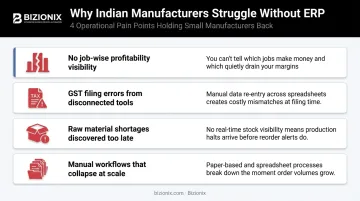
The pain points driving adoption are specific and expensive:
- No visibility into job-wise profitability — most small manufacturers can't tell which orders made money without integrated production tracking
- GST filing errors from disconnected tools — sales data in one system, invoices in another, GSTR reconciliation that never quite closes
- Raw material shortages discovered only when a work order stalls, not before
- Manual workflows that handle 50 orders per month collapse at 500
India has 11.75 million registered manufacturing MSMEs as of December 2024, contributing roughly 30% of GDP and over 45% of exports. Most of these businesses are still running without ERP — a gap that becomes harder to sustain as GST compliance demands increase and order volumes grow.
Each ERP in this comparison was evaluated on GST readiness, production module depth, pricing fit for small manufacturers, and ease of implementation — the factors that actually matter at this scale.
Best ERP Software for Small Manufacturing Businesses in India: 2026 Comparison
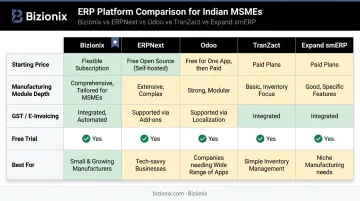
These five platforms were evaluated on manufacturing module depth, GST readiness, pricing transparency, ease of implementation, and suitability for Indian MSME operations.
Bizionix
Built specifically for Indian MSMEs, Bizionix is a 100% cloud-based ERP developed by IIS-LLP — a subsidiary of Protocol India Private Limited with over two decades of industry experience. It targets manufacturing companies, distributors, and multi-location enterprises that need real ERP functionality without the cost and complexity of enterprise-grade systems.
Its standout feature for manufacturers is direct API integration with India's GST e-Invoice system, generating IRN and QR codes instantly at the point of invoicing — no manual JSON uploads, no third-party tools, no delays. The system also supports multi-company management under a single login, making it practical for manufacturing groups or holding companies with multiple production units.
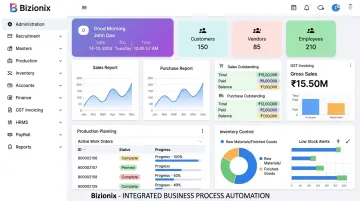
The platform includes a Production Planning module that schedules and tracks manufacturing processes, integrated with Inventory Control, Purchase Management, and Warehouse Management — connecting production, materials, and finance in a single system.
| Category | Details |
|---|---|
| Key Manufacturing Features | Production planning, inventory and warehouse management, GST-ready accounting, automated e-invoicing with instant IRN generation, multi-company management, configurable modules |
| Pricing | NEO plan at ₹999/year (14-day free trial included); Enterprise plan with custom pricing — contact info@bizionix.com or +91 91779 99277 for details |
| Best Suited For | Small and mid-sized Indian manufacturers, multi-location operations, and MSMEs prioritising GST compliance and unified business visibility |
ERPNext
ERPNext has strong traction among Indian manufacturers, and its manufacturing module delivers on what the documentation promises — multi-level BOM, work orders, job cards, production scheduling, MRP, quality control, and material traceability. Few open-source platforms cover this ground with comparable depth.
For Indian MSMEs, the cost structure is a significant draw: the software itself carries no licensing fee for self-hosted deployment. Frappe Cloud managed hosting starts at ₹410/month for a site and ₹1,800/month for a server — making it one of the lowest entry points in this comparison.
The trade-off is implementation complexity. Small manufacturers without technical resources typically need a local ERPNext implementation partner to get up and running.
| Category | Details |
|---|---|
| Key Manufacturing Features | Multi-level BOM, work order and job card management, quality control, material traceability, production planning, MRP, e-invoicing support |
| Pricing | Self-hosted: free (open-source); Frappe Cloud hosting from ₹410/month — verify current plan limits at frappe.io/erpnext/pricing |
| Best Suited For | Cost-conscious small manufacturers with technical capacity for setup, or those working with a local ERPNext implementation partner |
Odoo
Odoo's modular structure means manufacturers can start with one app at no cost, then add modules as operations grow — a practical entry point for small teams wary of committing to a full ERP. The manufacturing app covers BOM management, by-product tracking, work centres, real-time production monitoring, and a mobile shop floor application.
The One App Free tier (unlimited users, one app) gives very small manufacturers a real entry point. A 15-day free trial is available for paid plans. India has an active Odoo partner ecosystem for implementation support.
Note: Odoo's India pricing page displayed USD during research — check the Odoo checkout directly to confirm rupee billing.
| Category | Details |
|---|---|
| Key Manufacturing Features | BOM with by-product tracking, real-time production monitoring, mobile shop floor app, integrated inventory and sales, MRP capabilities |
| Pricing | One App Free: US$0; Standard and Custom plans priced per user/month — verify INR pricing at odoo.com/pricing |
| Best Suited For | Small manufacturers with limited IT resources who want affordable, modular software that can be expanded as operations grow |
TranZact
Among the five platforms here, TranZact is the most purpose-built for Indian SME manufacturers. Founded in 2017 by IIT and IIM graduates, it targets businesses with annual revenue between ₹5 Cr and ₹50 Cr. Production workflows come first — accounting and other functions are built around manufacturing, not the other way around.
Feature coverage for small manufacturers is strong: single and multi-step BOM, production costing, MRP (including order confirmation MRP and process-based MRP), WIP stage tracking, subcontracting and job-work management, and e-invoicing. There's a Free plan (INR 0) for early-stage businesses with limited transaction volumes.
Pricing correction from official pages: the Scale plan is ₹12,500/month billed annually and the Dominate plan is ₹30,000/month — verify current tiers at letstranzact.com/pricing.
| Category | Details |
|---|---|
| Key Manufacturing Features | Single and multi-step BOM, production costing, MRP, WIP and scrap tracking, subcontracting/job-work, work order management, e-invoicing, e-way bill |
| Pricing | Free: ₹0; Scale: ₹12,500/month billed annually; Dominate: ₹30,000/month — confirm at letstranzact.com/pricing |
| Best Suited For | Small Indian manufacturers needing a production-first ERP with built-in GST compliance, particularly those in job-work or subcontracting |
Expand smERP
With 25+ years building ERP for Indian manufacturers and exporters, Expand smERP brings category-specific depth that newer platforms don't yet match. Its concurrent-user pricing model — less common in India — works in favour of manufacturers where staff rotate shifts and not everyone is logged in at the same time. The platform covers inventory, BOM, MRP, production management, and GST-compliant accounting.
Official pricing tiers: Starter ₹3,900, Growth ₹3,500, Scale ₹3,100, Elite ₹2,700, and Enterprise ₹2,300 per concurrent user/month. Mobile app user licences are available at ₹650/month. A 30-day free trial is available.
| Category | Details |
|---|---|
| Key Manufacturing Features | BOM management, MRP, inventory management, GST and accounting module, production management, multi-level approvals on higher tiers |
| Pricing | Concurrent-user pricing: Starter ₹3,900 to Enterprise ₹2,300 per user/month — verify at expanderp.com/pricing |
| Best Suited For | Small to mid-sized Indian manufacturers needing a proven, structured ERP with transparent concurrent-user pricing and local vendor support |
How We Chose the Best ERP for Small Indian Manufacturers
A common mistake in ERP selection is prioritising brand name or the lowest monthly fee over manufacturing-specific functionality and India compliance readiness. These platforms were assessed on how well their actual features match the operational needs of small Indian manufacturers.
Inclusion criteria:
- Manufacturing module depth: BOM structure, production planning, work orders, and quality control — generic accounting tools with a basic inventory add-on didn't qualify
- Native GST and e-invoicing support: the GSTN system processes over 2,848 crore invoice uploads and 764 crore e-way bills; missing this creates immediate compliance risk
- MSME pricing transparency: opaque or enterprise-only pricing was deprioritised — 20% of MSME non-adopters cite financial cost as the primary barrier
- Local implementation support: active Indian user community, local partners, or a vendor team based in India
- Cloud deployment: preferred over on-premise, given most small manufacturers have limited IT infrastructure and benefit from automatic GST update rollouts
Gartner projects that by 2027, over 70% of recent ERP initiatives will fail to fully meet their original business-case goals. For small manufacturers with limited IT bandwidth, this makes implementation scope, local support quality, and phased rollout planning just as critical as the feature list.
Conclusion
Choosing an ERP for a small manufacturing business in India means committing to operational structure, GST readiness, and long-term scalability. The right platform needs to match your manufacturing type, team size, and compliance workload — not just your budget today.
Before finalising any platform, request a demo and test the GST compliance workflow specifically. Generate a sample e-invoice, run through an e-way bill, and check how GSTR-1 data populates. Evaluate how quickly the vendor's support team responds to a real question — that responsiveness defines your go-live experience.
Manufacturers looking for a cloud ERP built specifically for Indian MSMEs can explore Bizionix by IIS-LLP. The platform covers GST e-invoicing, multi-company management, and real-time production visibility. Reach out at info@bizionix.com or +91 91779 99277 to schedule a product walkthrough.
Frequently Asked Questions
Which ERP is best for manufacturing industry in India?
The best ERP depends on your business size, manufacturing type (discrete, process, or job-work), and compliance needs. Cloud ERPs with built-in GST support and dedicated manufacturing modules — covering BOM, production planning, and quality control — are generally best suited for Indian MSMEs. There's no universal answer; match the platform to your specific workflow.
Which ERP is in demand in India?
Cloud-based ERPs with native GST and e-invoicing compliance are seeing the highest demand, particularly across manufacturing, trading, and distribution. India-founded platforms (TranZact, Expand smERP, Bizionix) and global options with local partners (ERPNext, Odoo) are both widely adopted.
What features should a small manufacturing company look for in ERP software?
Focus on: BOM and work order management, production scheduling, real-time inventory tracking, GST-compliant invoicing, e-way bill generation, and job-wise profitability reporting. Ease of use and responsive local support are equally important — a feature-rich platform that your team can't navigate is no better than a spreadsheet.
How much does ERP software cost for small manufacturers in India?
Pricing ranges from free open-source options (ERPNext self-hosted) to cloud subscriptions running ₹500–₹5,000+ per user per month. Factor in implementation, data migration, and training — the subscription fee is rarely the total cost.
Is cloud ERP better than on-premise ERP for small Indian manufacturers?
Cloud ERP suits most small Indian manufacturers — lower upfront cost, no server infrastructure, remote access, and automatic GST compliance updates. On-premise may work for businesses with strict data control needs, but the IT overhead and maintenance burden is beyond what most small manufacturers can sustain.
How long does ERP implementation take for a small manufacturing business?
Timelines vary by complexity, module count, and data migration scope. Starting with core modules — inventory and production planning — reduces go-live risk and speeds adoption. Set realistic timelines with your vendor before signing; MSME-focused cloud ERPs generally deploy faster than enterprise-grade systems.