Introduction
India has over 1.17 crore registered manufacturing MSMEs, contributing 35.4% of total manufacturing output — yet most of these businesses still run on disconnected spreadsheets, manual production logs, and siloed inventory records. The result: stockouts that delay orders, billing errors that erode margins, and zero real-time visibility when decisions need to happen fast.
An ERP system for small manufacturers fixes this by unifying production planning, inventory, procurement, finance, and GST compliance into a single platform, giving every department a connected system they can actually act on.
This guide covers the five best ERP systems for small manufacturing businesses in 2026, the features that actually matter for manufacturers (not just generic businesses), and how to choose the right fit based on your production scale, GST compliance needs, and budget.
Key Takeaways
- ERP for small manufacturers replaces disconnected tools with unified production, inventory, finance, and compliance management.
- The right choice depends on your manufacturing type, team size, budget, and whether you need India-specific GST compliance.
- Top picks for 2026: Bizionix, Odoo, Microsoft Dynamics 365 Business Central, Acumatica, and ERPNext.
- Must-have features: BOM management, production scheduling, real-time inventory, GST-ready accounting, and IRN-based e-invoicing.
- Avoid overpaying for unused enterprise features, underestimating implementation costs, or picking a system not built for manufacturing.
Why Small Manufacturing Businesses Need ERP in 2026
The Operational Problem Gets Worse as You Scale
At 10 employees, a spreadsheet works. At 30, it breaks. Production delays pile up when shop floor data doesn't reach procurement in time. Inventory discrepancies cause emergency purchases at premium prices. Manual billing errors slow cash flow. Each department operates on its own version of reality.
An ERP connects these functions: shop floor data flows into procurement, which feeds accounts, which informs customer order fulfilment — in real time. Decisions stop being reactive and start being data-driven.
That shift is happening at scale. The cloud ERP market is projected to grow from USD 87.73 billion in 2024 to USD 172.74 billion by 2029 — a 14.5% annual growth rate driven largely by SME adoption as cloud-based systems become more affordable and accessible.
Why 2026 Specifically Raises the Stakes
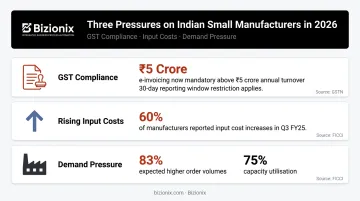
Indian small manufacturers are navigating three pressures simultaneously:
- GST compliance complexity: E-invoicing is now mandatory for businesses with aggregate turnover above ₹5 crore, with GSTN's April 2025 advisory restricting manufacturers with AATO ₹10 crore and above from reporting e-invoices older than 30 days. Manual processes can't keep up.
- Rising input costs: Nearly 60% of manufacturers saw production costs rise as a share of sales in Q3 FY25, according to FICCI's quarterly survey — driven by raw materials, labour, and freight.
- Demand pressure: 83% of manufacturers expected higher order volumes in Q3 FY25, while average capacity utilisation sat at 75%. More orders with constrained capacity means every production inefficiency hurts more.
Disconnected systems make all three harder to manage. For small manufacturers in 2026, integrated operations aren't a luxury — they're a baseline requirement.
Best ERP Systems for Small Manufacturing Businesses in 2026
These five systems were selected based on manufacturing-specific functionality, SME pricing accessibility, ease of cloud deployment, and where applicable, India-specific compliance support.
Bizionix
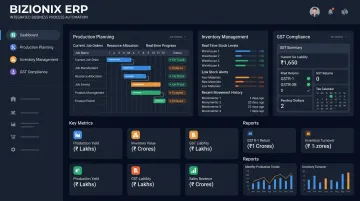
Bizionix, developed by IIS-LLP (a subsidiary of Protocol India Private Limited), is a 100% cloud-based ERP built specifically for Indian MSMEs — including manufacturing businesses, distribution operations, and multi-location enterprises. The platform integrates production planning, inventory control, procurement, GST-ready accounting, and automated e-invoicing under a single login with multi-company management.
What sets Bizionix apart for Indian manufacturers is its direct API connection to the GST e-Invoice system. The IRN generation process is fully automated: create a sales invoice, the system validates it against GST rules in real time, then generates the IRN and QR code instantly via IRP and delivers a compliant PDF.
GSTR-1 auto-population ensures sales data aligns with accounting without manual reconciliation.
For multi-location manufacturers, the multi-company management feature allows separate production entities, GST registrations, and warehouse locations to operate under a single secure login — with independent books of accounts per entity and group-level dashboards for consolidated visibility.
| Detail | Information |
|---|---|
| Key Features | Production planning, multi-location inventory tracking, GRN processing, vendor management, GST-ready accounting, automated e-invoicing with instant IRN generation, multi-company management, real-time dashboards |
| Pricing | NEO plan from ₹999/year (includes core modules); Enterprise plan with production planning, advanced warehouse management, and full compliance — contact Bizionix for pricing |
| Best For | Indian small and mid-sized manufacturers needing GST compliance, unified business management, and cloud access without enterprise-level complexity |
Odoo
Odoo is a globally adopted open-source, modular ERP that lets small manufacturers start with what they need (Inventory, Manufacturing MRP, Accounting) and expand as operations grow. Its modular structure means businesses avoid paying for features they won't use.
The platform supports multi-level BOM management, production scheduling via Master Production Schedule, barcode scanning, and a Shop Floor companion module that provides a visual interface for managing work orders.
The open-source foundation keeps total cost of ownership low and creates a large developer ecosystem for customisation.
| Detail | Information |
|---|---|
| Key Features | Multi-level BOM, Master Production Schedule, real-time inventory, barcode scanning, integrated accounting, Shop Floor module |
| Pricing | One app free; Standard at $24.90/user/month (first 12 months, yearly billing); self-hosted open-source at no licensing cost |
| Best For | Small manufacturers wanting a modular, affordable, customisable system — particularly make-to-order or batch manufacturing environments |
Microsoft Dynamics 365 Business Central
Business Central is a cloud-first ERP designed for growing SMBs, covering production orders, BOM and routing management, purchasing, inventory, and financials — all within the Microsoft ecosystem. Native integration with Excel, Teams, Outlook, and Power BI makes it practical for businesses already using Microsoft tools daily.
Manufacturing features sit in the Premium tier. The Essentials plan covers finance, sales, purchasing, and inventory; Premium unlocks manufacturing and service management. AI-driven Copilot features add cash flow insights and demand forecasting for businesses that need predictive visibility.
Note: Microsoft announced new Business Central pricing effective November 2025 — check the official pricing page for current rates before budgeting.
| Detail | Information |
|---|---|
| Key Features | Production order management, BOM and routing, demand forecasting, Microsoft 365 integration, AI-driven Copilot insights, role-based dashboards |
| Pricing | Essentials at $80/user/month; Premium (includes manufacturing) at $110/user/month |
| Best For | Small manufacturers already embedded in Microsoft tools who need scalable, cloud-based ERP with strong financial management |
Acumatica
Acumatica's defining feature is its resource-based pricing model: costs scale with transaction volume and modules used rather than per-user headcount. This makes it attractive for manufacturers with growing teams, since adding users doesn't proportionally increase the software bill.
It supports multiple manufacturing modes — make-to-order, engineer-to-order, job shop, and repetitive manufacturing — with strong MRP, shop floor control, and real-time multi-site inventory. Open API architecture supports third-party integrations without vendor lock-in.
Worth noting: consumption-based pricing can be unpredictable as transaction volumes grow. Get a detailed quote before committing.
| Detail | Information |
|---|---|
| Key Features | MRP and production scheduling, multi-mode manufacturing (MTO, ETO, job shop), real-time multi-site inventory, shop floor control, CRM integration, open API |
| Pricing | Resource-based (transaction volume) pricing; contact Acumatica directly for quotes based on modules and usage |
| Best For | Growing manufacturers with distributed teams or high user counts who need flexible, non-per-user pricing and mixed-mode manufacturing support |
ERPNext
ERPNext is a fully open-source ERP with zero licensing fees, covering BOM management, production planning, quality control, material traceability via serial and batch tracking, and automated purchase order generation. It also supports Indian GST compliance, including GST-compliant invoices and e-way bill generation.
The trade-off is setup complexity. ERPNext works best for businesses with some in-house technical capability. For those without IT resources, managed hosting plans are available through Frappe Cloud — check the live pricing page for current rates.
| Detail | Information |
|---|---|
| Key Features | BOM management, production planning, quality control, material traceability, approval workflows, GST compliance support (India), automated notifications |
| Pricing | Free (self-hosted, GPLv3 licence); managed hosting available via Frappe Cloud |
| Best For | Cost-conscious small manufacturers with technical capability who want a fully functional manufacturing ERP at minimal cost |
Key Features to Look for in a Manufacturing ERP
General-purpose accounting or business management tools often lack the shop floor and supply chain capabilities that manufacturers actually need. Here's what to evaluate before shortlisting any system:
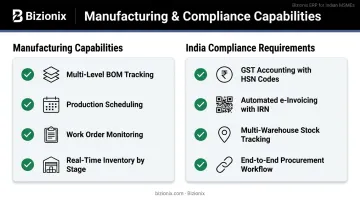
Manufacturing-Specific Capabilities
- Tracks multi-level Bills of Materials (BOM) for assemblies with nested sub-components
- Schedules production using Master Production Schedule or capacity-based planning
- Monitors work order status from release through to job completion
- Maintains separate real-time inventory views for raw materials, WIP, and finished goods
India Compliance Requirements
For Indian manufacturers, these aren't optional extras — they're operational necessities:
- GST-compliant accounting with HSN code support and GSTR filing preparation
- Automated e-invoicing with direct IRN generation — mandatory for businesses above ₹5 crore aggregate turnover
- Multi-warehouse stock tracking across all sites and locations
- End-to-end procurement workflows covering PO generation, vendor management, and GRN processing
ERP systems that lack these features built-in create a choice between costly customisation and persistent manual workarounds — both of which eat into the efficiency gains you're buying the system for.
Total Cost of Ownership — Not Just Licensing
Licensing fees are only part of what you'll spend. Factor in:
- Implementation and data migration fees
- Training requirements for shop floor and admin staff
- Scalability as SKU count, production lines, or locations grow
- Whether adding users or modules requires significant additional investment
The Panorama 2024 ERP Report found the most common cause of ERP budget overruns is the unexpected need for additional technology — a risk that's higher when businesses underestimate customisation requirements upfront.
Conclusion
Small manufacturing businesses in 2026 are navigating tighter margins, rising input costs, stronger demand, and more complex compliance requirements — all simultaneously. Disconnected spreadsheets and manual processes don't just slow things down; they actively put businesses at a disadvantage.
The right ERP shifts operations from reactive firefighting to proactive management: production plans that reflect real inventory, billing that happens without manual errors, and compliance that runs automatically in the background.
When shortlisting, base your decision on your manufacturing type, team size, compliance requirements, and realistic budget — not brand name or feature count. Request demos and test them with your actual workflows — not sanitized vendor scenarios. Involve both shop floor supervisors and finance teams in the evaluation before signing anything.
If those criteria point toward a purpose-built, GST-ready cloud ERP built specifically for Indian MSMEs — one that scales without SAP-level complexity or cost — Bizionix is a strong fit. Reach out for a consultation or demo at info@bizionix.com, call +91 91779 99277, or connect via WhatsApp.
Frequently Asked Questions
Which ERP software is best for manufacturing?
The best ERP depends on your manufacturing type, business size, and compliance needs. Odoo and ERPNext suit budget-conscious small manufacturers; Dynamics 365 Business Central works well for businesses scaling within the Microsoft ecosystem; and Bizionix is purpose-built for Indian MSMEs needing integrated GST compliance and unified business management.
Do small businesses use ERPs?
Yes, and adoption is accelerating. Cloud-based ERPs have made the technology accessible and affordable for small manufacturers — it's no longer the exclusive domain of large enterprises. The cloud ERP market is projected to reach USD 172.74 billion by 2029, reflecting how broadly SMEs are now adopting these platforms.
What features should a small manufacturing business look for in an ERP?
Prioritise BOM management, production scheduling, real-time inventory tracking across raw materials and finished goods, and integrated financial management. For Indian businesses, built-in GST compliance and automated e-invoicing with IRN generation are requirements you can't work around — they only grow more complex as your business scales.
How much does an ERP system cost for a small manufacturing business?
Costs vary widely — from free (ERPNext self-hosted) to several thousand USD annually for Acumatica or USD 110/user/month for Business Central Premium; Bizionix's NEO plan starts at ₹999/year for core modules. Always factor implementation, data migration, training, and support into the total budget — not just licensing fees.
What is the difference between cloud ERP and on-premise ERP for manufacturers?
Cloud ERP is hosted by the vendor — accessible from anywhere, updated automatically, with lower IT overhead — while on-premise ERP sits on your own servers, offering more data control but requiring dedicated internal infrastructure. For most small manufacturers in 2026, cloud deployment is the practical choice: lower upfront costs and far simpler maintenance.
How long does ERP implementation take for a small manufacturing business?
Expect 2–6 months for full implementation, though simpler deployments with limited customisation can complete in 6–12 weeks. The final timeline depends on data migration complexity, the number of modules deployed, and how actively your internal team engages throughout the process.