Introduction
India's small manufacturing sector — from auto-component makers to food processors — is under real pressure. Rising input costs, GST compliance complexity, and customer expectations for faster delivery are squeezing margins at every level. Most small manufacturers are still running on a patchwork of spreadsheets, standalone accounting software, and WhatsApp threads to coordinate production.
That combination is expensive. Disconnected tools create inventory errors, billing delays, and compliance gaps that cost money and erode customer trust.
A manufacturing ERP replaces that patchwork with one unified platform: connecting production, inventory, procurement, sales, and finance so your team works from the same data, in real time.
This guide covers the top ERP systems for small manufacturing businesses, what each one does well, and what Indian MSMEs specifically need to evaluate before making a decision.
Key Takeaways
- ERP for small manufacturing businesses unifies production, inventory, procurement, finance, and compliance — eliminating data silos and manual errors
- Indian manufacturers need a GST-ready, cloud-based, affordable ERP — most global enterprise solutions are over-engineered and overpriced for MSMEs
- Leading options for Indian MSMEs include Bizionix, ERPNext, Odoo, SAP Business One, and Microsoft Dynamics 365 Business Central
- Key selection criteria: manufacturing module depth, GST/e-invoicing compliance, total cost of ownership, ease of adoption, and local support
- Wrong-fit ERPs built for large enterprises drive up customisation costs, hurt adoption, and delay ROI
What Is ERP for Small Manufacturing Businesses?
ERP (Enterprise Resource Planning) is a software platform that connects your core business functions — production planning, inventory, procurement, sales orders, finance, and compliance — into a single, real-time system. Instead of exporting data between tools, everything updates in one place.
Small manufacturers face the same operational complexity as large ones: Bills of Materials, work orders, supply chain coordination, quality checks. The difference is they handle all of it with smaller teams and tighter budgets. An ERP closes that gap.
Why This Matters Specifically for Indian MSMEs
India currently has over 1.73 crore registered manufacturing enterprises, according to the Ministry of MSME's live dashboard. The government's own MSME Annual Report identifies access to technology and promoting digitalisation as major operational challenges for this segment.
The India ERP software market stood at US$1.12 billion in 2024, with projected growth to US$1.91 billion by 2029 — reflecting rapid adoption across the sector.
For small manufacturers specifically, a purpose-built ERP is essential — not just accounting software. The compliance requirements alone make this clear:
- GST filing and reconciliation built into daily transactions
- Automated e-invoicing with direct IRN generation
- BOM management linked to procurement and production records
A system that handles production but requires a separate tool for compliance creates gaps that cost time and invite errors.
Top ERP Systems for Small Manufacturing Businesses
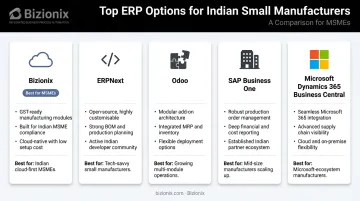
These five systems were evaluated on manufacturing module depth, ease of use for small teams, pricing suitability for MSMEs, GST/compliance readiness, scalability, and real-world deployment track record.
Bizionix by IIS-LLP
Bizionix is a purpose-built cloud ERP from Hyderabad-based IIS-LLP (a subsidiary of Protocol India Private Limited), designed specifically for Indian MSMEs — including manufacturing companies. Backed by over two decades of industry experience, it covers production planning, inventory, procurement, sales, and finance in a single unified platform.
The standout feature for Indian manufacturers is its GST compliance architecture. Bizionix connects directly to the Invoice Registration Portal via API, with IRN generation fully automated. When a sales invoice is created, the system validates it against GST rules and generates the IRN and QR code within seconds, eliminating manual JSON uploads and third-party portal workarounds entirely.
For manufacturing groups or holding companies, the multi-company management feature allows a single secure login to manage multiple GST-registered entities, branches, or subsidiaries. Each entity maintains independent books of accounts, while consolidated dashboards give ownership-level visibility.
Production Planning and advanced Warehouse Management (including multi-location stock tracking, purchase orders, GRN, and vendor management) are available on the Enterprise plan.
| Feature Category | Details |
|---|---|
| Key Manufacturing Features | Production planning, inventory control, warehouse management, procurement, GST-compliant billing, automated e-invoicing (IRN + QR), multi-company management, real-time dashboards |
| Pricing & Deployment | NEO plan: ₹999/year (14-day free trial included); Enterprise: custom pricing — contact Bizionix; 100% cloud-based SaaS |
| Best Fit | Indian small and mid-sized manufacturers, MSMEs needing GST compliance out-of-the-box, multi-entity manufacturing groups |
ERPNext
ERPNext is an open-source ERP developed by Indian company Frappe Technologies. It covers manufacturing, inventory, accounting, HR, and CRM, with strong adoption among Indian MSME manufacturers.
For cost-conscious manufacturers, self-hosted deployment carries no vendor licensing fee. The manufacturing module is genuinely deep:
- Multi-level BOM management
- Production planning that generates work orders directly from sales orders
- Quality inspection at incoming, in-process, and outgoing stages
- Material requirements planning (MRP)
Managed hosting via Frappe Cloud starts at US$5/month (approximately ₹410/month) for basic site plans, with small business plans on ERPNext starting at US$50/month. A large Indian user community means localised GST support and active implementation resources.
| Feature Category | Details |
|---|---|
| Key Manufacturing Features | Multi-level BOM, work orders, MRP/production planning, quality inspection, stock management, GST-compliant accounting, shop floor tracking |
| Pricing & Deployment | Free (self-hosted, GNU GPL v3); Frappe Cloud from US$5/month; ERPNext managed plans from US$50/month |
| Best Fit | Tech-savvy small manufacturers with limited budget and some in-house IT capability; businesses that want open-source flexibility |
Odoo ERP
Odoo is a modular, open-source ERP platform with a growing presence among Indian SMEs. Manufacturers can start with only the modules they need — say, manufacturing and inventory — and expand over time.
The manufacturing module covers a broad operational range:
- BOM and multilevel BOM management
- Manufacturing order simulation and finite capacity planning
- Gantt scheduling with work order dependencies
- Shop Floor overview and time tracking
- By-product tracking
- Barcode and RFID inventory workflows via the Barcode app
On India compliance, Odoo's localisation covers Indian e-invoicing, e-waybill, GST e-filing and matching, GST number status checks, and TDS/TCS. That combination makes it a practical choice for manufacturers who need both operational depth and full regulatory coverage.
Official India pricing (from Odoo's India pricing page): Standard plan at US$31.10/user/month (or US$24.31/user/month billed annually); Custom plan at US$61/user/month (or US$49 annually). One App Free at US$0.
| Feature Category | Details |
|---|---|
| Key Manufacturing Features | BOM management, multilevel BOM, manufacturing order simulation, capacity planning, Gantt scheduling, Shop Floor overview, barcode/RFID, by-product tracking, inventory integration |
| Pricing & Deployment | One App Free: US$0; Standard: US$24.31/user/month (annual); Custom: US$49/user/month (annual); cloud and on-premise available |
| Best Fit | Small manufacturers wanting modular, phased ERP adoption with strong India GST localisation |
SAP Business One
SAP Business One is an enterprise-grade ERP positioned for small to mid-sized manufacturers. It has a proven global track record — SAP reports over 83,000 customers globally — and a strong Indian partner ecosystem.
Manufacturing capabilities include the MRP Wizard for automated material requirements planning, production orders (which copy the Bill of Materials into the production order for tracking), and serial/batch traceability for lot-level inventory management.
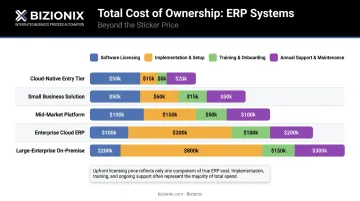
Important pricing note: SAP does not publish official India pricing for Business One on its product pages. Pricing requires direct contact with SAP or an authorised Indian partner. Factor implementation costs into your total cost of ownership before committing — they can be substantial.
| Feature Category | Details |
|---|---|
| Key Manufacturing Features | MRP Wizard, production orders, BOM integration, lot/serial traceability, multi-warehouse inventory, financial integration |
| Pricing & Deployment | Not published officially for India — contact SAP or an authorised partner; implementation cost is substantial |
| Best Fit | Small-to-mid manufacturers with complex inventory needs, willing to invest in a structured enterprise ERP; companies already in the SAP ecosystem |
Microsoft Dynamics 365 Business Central
Business Central is Microsoft's cloud-native ERP for SMBs with growing manufacturing operations. It integrates natively with Microsoft 365 tools — Excel, Outlook, Teams — and supports production orders, Production BOM management, work and machine centre capacity planning, and AI-powered sales and inventory forecasting.
Critical pricing note: Full manufacturing functionality (production orders, routings, capacity planning) requires the Premium plan at US$110/user/month, not the Essentials plan (US$80/user/month). Essentials does not include manufacturing modules.
The Microsoft ecosystem integration is the primary draw. For teams already running on Microsoft tools, Business Central reduces the learning curve significantly. Automatic cloud updates and a robust Indian partner network make implementation more accessible.
| Feature Category | Details |
|---|---|
| Key Manufacturing Features | Production orders, Production BOM management, work/machine centre capacity planning, AI-driven inventory forecasting, supply chain management, financial management |
| Pricing & Deployment | Premium (manufacturing included): US$110/user/month; Essentials: US$80/user/month (does not include manufacturing); cloud and on-premise available |
| Best Fit | Small manufacturers already using Microsoft tools; businesses planning rapid scale-up or multi-location expansion |
How to Evaluate ERP for Your Manufacturing Business
The Selection Criteria That Actually Matter
Most manufacturers shortlist ERP systems based on feature lists or brand recognition — and pay for it later. Gartner reports that by 2027, more than 70% of recently implemented ERP initiatives will fail to fully meet original business-case goals, with up to 25% failing catastrophically.
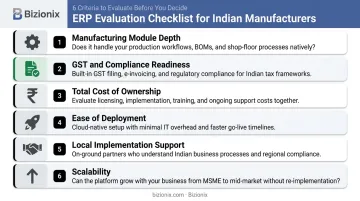
Evaluate on these criteria instead:
- Confirm the manufacturing module handles BOM, work orders, MRP, and shop floor control without expensive customisation
- GST and compliance readiness: e-invoicing and GSTR-1 support are non-negotiable for Indian manufacturers — verify these are built-in, not add-ons
- Calculate total cost of ownership upfront — software licence is only the start; factor in implementation, training, data migration, and annual support
- Ease of deployment: your team should be able to run it without dedicated IT staff on standby
- Check for local implementation partners — a system with no Indian support network is a real liability when issues arise
- Scalability: the platform should handle your next three to five years without forcing a migration
Practical Evaluation Steps
The right ERP fits your current process complexity, budget, and growth stage — not just the longest feature list.
- Request demos from 2-3 shortlisted vendors, focusing on manufacturing-specific workflows rather than just the finance module
- Involve shop floor supervisors in the evaluation — they catch usability problems that the finance team won't
- Run a pilot test with real data before signing any annual contract
- Ask about data migration support — messy master data is where many implementations stall
- Confirm India-specific compliance coverage directly with the vendor — GST readiness should be demonstrated, not assumed
Conclusion
For small manufacturers in India, the ERP decision is not about finding the most powerful software — it's about finding the right fit. A system that handles your production workflows, keeps you GST-compliant, and scales with your growth without requiring a team of consultants to maintain.
That clarity makes the total cost of ownership worth evaluating before you finalise anything. The cheapest upfront option can become the most expensive choice if it lacks the right manufacturing modules, requires heavy customisation for Indian compliance, or has no local support when something breaks.
If you're a small or mid-sized manufacturer in India looking for a cloud ERP built for your scale and compliance needs, Bizionix by IIS-LLP is worth exploring. The platform offers real-time operational visibility, automated GST e-invoicing, and end-to-end business management at a price point that works for MSMEs. Start with a 14-day free trial on the NEO plan, or contact the team at info@bizionix.com to request a demo tailored to your manufacturing workflows.
Frequently Asked Questions
What is ERP for small business?
ERP (Enterprise Resource Planning) is a unified software platform that connects inventory, production, procurement, finance, and sales into one system — replacing disconnected spreadsheets and tools. Modern cloud ERP solutions are affordable and accessible to small businesses, not just large enterprises.
What are the best ERP systems for manufacturing?
The best ERP for manufacturing depends on your business size, budget, and complexity. Strong options for small manufacturers include:
- Bizionix — built for Indian MSMEs with GST compliance
- ERPNext — open-source, low cost
- Odoo — modular with strong GST localisation
- SAP Business One — enterprise-grade
- Microsoft Dynamics 365 Business Central — ideal for the Microsoft ecosystem
Indian manufacturers should prioritise GST compliance and local implementation support.
How much does an ERP system cost for a small manufacturing business?
Costs vary widely across platforms:
- ERPNext — no licensing fee for self-hosted (hosting and implementation costs apply)
- Odoo — paid plans start at approximately US$24/user/month (billed annually)
- Microsoft Business Central Premium — approximately US$110/user/month
- SAP Business One — contact SAP India directly for pricing
Always factor in the total cost: software, implementation, training, and ongoing support.
What features should a manufacturing ERP have?
Essential features include Bill of Materials (BOM) management, production/work order tracking, Material Requirements Planning (MRP), inventory and warehouse management, quality control, procurement, and integrated financial management. For Indian businesses, GST-compliant accounting and automated e-invoicing (IRN generation) are non-negotiables.
What is the difference between cloud ERP and on-premise ERP for manufacturers?
Cloud ERP is hosted by the vendor and accessed via the internet — lower upfront cost, automatic updates, accessible from anywhere. On-premise ERP is installed on your own servers — greater data control but higher upfront cost and requires IT maintenance. For small manufacturers with limited IT staff, cloud ERP is generally the more practical and cost-effective choice.
Can a small manufacturer start with basic ERP modules and add more later?
Yes. Platforms like Odoo and Bizionix are designed for phased adoption — you can start with core modules (inventory, sales, accounting) and add production planning and advanced warehouse management as your operations grow. This approach reduces upfront cost and implementation complexity for small teams.