ERP software was once the domain of large enterprises with dedicated IT teams and multi-lakh implementation budgets. That's changed. The Indian market has shifted decisively toward cloud-first, MSME-specific solutions that deliver genuine operational integration at pricing small businesses can actually justify.
This guide covers the best budget ERP options for Indian small businesses in 2026 — with verified pricing, GST compliance capabilities, module coverage, and honest notes on where each solution falls short.
Key Takeaways
- India's ERP market is worth USD 1.93 billion in 2025 and growing — budget cloud options now make ERP viable for businesses with 5–50 employees
- GST compliance, e-invoicing with IRN generation, and e-way bill support are non-negotiable table stakes — not differentiators
- Cloud ERP eliminates upfront hardware costs and ongoing IT overhead, making it the practical default for MSMEs
- The cheapest ERP is rarely the best value — factor in implementation fees, per-user costs, add-ons, and renewals
- Bizionix is a purpose-built cloud ERP for Indian MSMEs — bundled modules, built-in GST compliance, from ₹999/year
Why Indian Small Businesses Need Budget ERP Software in 2026
According to IMARC Group, India's ERP market stood at USD 1,929.8 million in 2025 and is projected to reach USD 3,651.9 million by 2034, growing at a 7.12% CAGR. ERP adoption among Indian SMEs isn't a future trend — it's accelerating right now.
Yet a significant gap remains. The India SME Forum's META Report 2025 surveyed 7,835 MSMEs and found 46.2% were still fully offline, with ERP specifically noted as underutilised. Among businesses that had adopted digital tools, 41.4% reported 21–30% sales growth attributable to digitisation. The operational upside is real.
The Cost of Not Having ERP
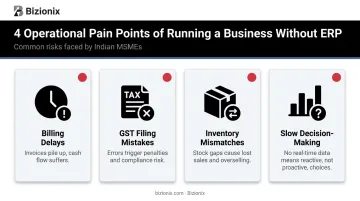
Manual operations hit small businesses harder than large ones, because lean teams have no buffer for errors:
- Billing delays from manual invoice preparation and approval loops
- GST filing mistakes caused by reconciling data across spreadsheets and accounting software
- Inventory mismatches when purchase, warehouse, and sales teams work in silos
- Slow decision-making because management data lives in three different systems
For businesses crossing ₹5 crore in annual turnover, the stakes rise further — e-invoicing with IRN generation becomes mandatory under GST regulations, and an ERP without direct IRP integration creates compliance risk on every transaction.
Why 2026 Is the Right Time to Switch
The traditional barriers that kept MSMEs away from ERP have largely disappeared with cloud delivery:
- No upfront server costs — pay a monthly or annual subscription instead
- Fast deployment — most MSME-focused platforms go live in days to weeks, not months
- No hardware investment — the software runs entirely in the browser
- Scalable pricing — add users and modules as the business grows, without a full platform replacement
The question for most small businesses in 2026 isn't whether to adopt ERP — it's which platform fits their budget and workflow. That's exactly what this guide covers.
Best Budget ERP Software for Small Businesses in India (2026)
These tools were evaluated on pricing transparency, GST and India-specific compliance, module depth, onboarding ease, and suitability for businesses with 5–100 employees.
Bizionix
Bizionix, developed by IIS-LLP (a subsidiary of Protocol India Private Limited), is a 100% cloud-based ERP built specifically for Indian MSMEs. It covers GST-ready accounting, e-invoicing, inventory, procurement, CRM, and multi-company management under a single login — without the complexity or cost of traditional enterprise software.
What separates Bizionix from generic business software is the depth of India-specific compliance built in from the ground up. The platform connects directly via API to the government's Invoice Registration Portal for instant IRN generation, with automatic QR code creation and pre-validation to prevent rejection. GSTR-1 returns are auto-populated, keeping sales, GST returns, and accounting in sync.
The pricing model is deliberately simple — modules are bundled, not sold separately, which means no surprise add-on costs as you scale.
| Feature | Detail |
|---|---|
| Starting Price | ₹999/year (NEO plan, 14-day free trial included); Enterprise plan on request |
| Key Modules | Accounting, GST & E-Invoicing, Inventory, Procurement, Sales, CRM, HRMS, Multi-Company Management |
| India Compliance | Direct IRP API integration for IRN generation, automated GSTR-1, e-invoicing with QR codes |
| Deployment | 100% cloud, browser-based, no installation required |
| Support | Phone, email, WhatsApp, live support, ticketing system |
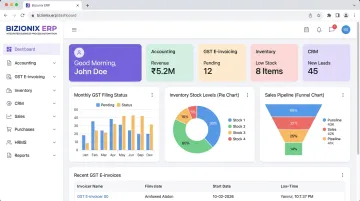
Best for: MSMEs wanting a unified, India-built platform with no per-module pricing and strong GST compliance built in.
TallyPrime
TallyPrime has a 37-year track record among Indian traders and small businesses. It operates on a perpetual licensing model — buy the software once and pay annually for Tally Software Services (TSS) to retain online features.
The accounting and GST compliance capabilities are strong. Where TallyPrime falls short is breadth: it lacks native cloud deployment, and businesses needing CRM, manufacturing, or procurement workflows will find themselves looking for third-party integrations.
| Feature | Detail |
|---|---|
| Starting Price | Silver: ₹22,500 + 18% GST (single user); Gold: ₹67,500 + 18% GST (multi-user); TSS renewal: ₹4,500/year (Silver) |
| Key Modules | Accounting, Inventory, Payroll, GST Filing, Banking |
| India Compliance | GST-compliant, e-invoicing, e-way bill support, statutory reporting |
| Deployment | Desktop/hybrid; limited cloud access via TSS |
| Note | TSS expiry removes e-invoicing, banking, and remote access features |
Best for: Accounting-first businesses and traders who need robust GST compliance and are already familiar with Tally's interface.
ERPNext
ERPNext is an open-source ERP with broad module coverage — accounting, manufacturing, HR, CRM, procurement, and project management — making it one of the most feature-complete options at the entry level. The software itself is free; costs come from hosting and implementation.
In practice, "free" underestimates the actual cost. Meaningful customisation, India compliance configuration (e-invoicing requires IRP/API credential setup), and ongoing support typically require either a technical team or a paid implementation partner.
| Feature | Detail |
|---|---|
| Starting Price | Software free (open source); Frappe Cloud hosting from ₹410/month (shared) or ₹1,800/month (dedicated server) |
| Key Modules | Accounting, Inventory, Manufacturing, Procurement, HR, CRM, Project Management |
| India Compliance | GST support available; e-invoicing and e-way bill via configuration; active Indian community |
| Deployment | Cloud-hosted (Frappe Cloud) or self-hosted |
| Note | Free tier has no official support; e-invoice setup requires configuration with IRP credentials |
Best for: Tech-capable teams or startups comfortable with open-source platforms who have access to implementation support.
Zoho One
Zoho One bundles 40+ applications — CRM, finance, inventory, HR, marketing — under a single subscription. As an Indian company, Zoho's compliance is solid through Zoho Books: GST invoicing, e-invoicing, e-way bills, IRN validation, and TDS management are all covered.
The key limitation for MSMEs is cost at scale — per-employee pricing adds up quickly as headcount grows. Zoho One also has no native manufacturing module, so product-based businesses may find it less suitable than service or D2C brands.
| Feature | Detail |
|---|---|
| Starting Price | Contact Zoho for verified INR pricing (official India pricing page not available at time of writing) |
| Key Modules | CRM, Finance (via Zoho Books), Inventory, HR, Marketing, Project Management |
| India Compliance | GST-ready invoicing, e-invoicing, e-way bills, IRN, TDS management (via Zoho Books) |
| Deployment | Cloud |
| Note | No native manufacturing module; pricing scales per employee/user |
Best for: Service businesses and D2C brands needing strong CRM and marketing alongside core finance and operations.
Odoo
Odoo's modular approach — start with one app free, add more as you grow — makes it a practical entry point for micro-businesses. The module library is extensive: manufacturing, POS, e-commerce, accounting, HR, CRM. An Indian partner ecosystem provides local implementation support.
Costs climb fast at scale. Paid plans are priced per user (Standard at USD 24.90/user/month, Custom at USD 49/user/month billed annually), so a 15-person team pays for 15 licences. The one-free-app tier is genuinely limited to a single application — it's not a multi-module ERP.
| Feature | Detail |
|---|---|
| Starting Price | One app free (single application only); Standard from USD 24.90/user/month; Custom from USD 49/user/month |
| Key Modules | Inventory, Accounting, Manufacturing, CRM, POS, E-Commerce, HR |
| India Compliance | GST module available; e-invoicing and e-way bill via Indian localisation; requires configuration |
| Deployment | Cloud (Odoo Online) or self-hosted |
| Note | Costs scale per user; India compliance features may require implementation partner setup |
Best for: Businesses wanting module flexibility and willing to invest in implementation; less suitable for tight-budget deployments without technical resources.
What to Look for When Choosing a Budget ERP for Your Indian Business
GST Compliance Is the Starting Point, Not a Bonus Feature
For any Indian business crossing ₹5 crore in annual aggregate turnover, e-invoicing with IRN generation via the NIC/IRP portal is a legal requirement under Notification No. 10/2023-Central Tax. An ERP that only formats invoices correctly isn't sufficient — it needs direct IRP integration to generate IRNs and digital signatures in real time.
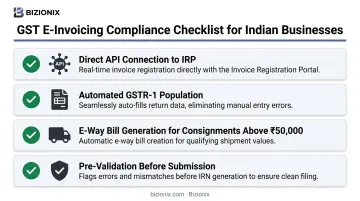
Look specifically for:
- Direct API connection to the Invoice Registration Portal (not just CSV export)
- Automated GSTR-1 population from sales transactions
- E-way bill generation for consignments above ₹50,000
- Pre-validation to catch format or data errors before submission
True Total Cost of Ownership vs. Advertised Price
The subscription price excludes a lot. ERP implementation for small Indian businesses starts around ₹4–8 lakh when factoring in implementation, data migration, training, and customisation — separate from the software licence.
Before signing any contract, calculate:
- Base subscription or licence fee
- Per-user charges as your team grows
- Implementation and data migration costs
- Annual renewal or maintenance (typically 15–20% of licence cost for perpetual software)
- Add-on module fees for features not in the base plan
- Training costs (for on-premise or complex cloud deployments)
Match Module Coverage to Actual Business Needs
A 12-person trading business doesn't need advanced manufacturing planning or complex marketing automation. Over-buying modules inflates cost without delivering value.
Map your core operational pain points first:
- Billing delays → prioritise invoicing and accounts receivable
- Inventory mismatches → prioritise warehouse and stock management
- GST filing errors → prioritise compliance and automated returns
- Scattered data → prioritise unified reporting and dashboards
Choose a platform that covers those gaps — and stops there.
Cloud ERP vs. On-Premise for MSMEs
For small businesses without dedicated IT staff, cloud ERP is the practical choice:
- No hardware investment — no servers, no maintenance contracts
- Automatic updates — compliance changes (like new GST rules) roll out centrally
- Remote access — management and field teams can access the same data in real time
- Predictable costs — subscription pricing versus unpredictable on-premise upgrade cycles
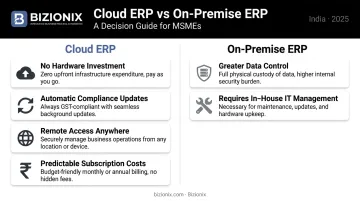
On-premise ERP gives you more control over data location — useful if your business has strict security or data residency requirements. The trade-off is upfront infrastructure investment and ongoing in-house IT management.
How We Selected These Budget ERPs
These tools were assessed on four criteria:
- Pricing transparency — published or verifiable pricing, not demo-only for basic plans
- India compliance depth — GST, e-invoicing with IRN, e-way bill, statutory reporting built in (not via workarounds)
- MSME suitability — appropriate for 5–100 users without enterprise-level implementation requirements
- Module coverage — adequate depth across accounting, inventory, billing, and procurement without requiring expensive add-ons for core functionality
Tools requiring enterprise implementation budgets, lacking verifiable India compliance features, or relying on opaque pricing structures were excluded. Each option below is evaluated on what a typical MSME actually pays and gets — whether you're migrating off TallyPrime, consolidating spreadsheets, or buying your first ERP.
Conclusion
The right budget ERP for an Indian small business isn't the one with the longest feature list or the lowest advertised price. It's the one that handles GST compliance correctly, covers your core operational modules without per-module add-ons, and comes with support that won't disappear after onboarding.
Before committing, request a demo or trial. Real-world usability — how long it takes to generate a GST invoice, run a stock report, or reconcile a bank statement — tells you more than any feature comparison table.
Bizionix is built specifically for Indian MSMEs — with GST-ready accounting, bundled modules, and direct IRP integration for e-invoicing. The NEO plan starts at ₹999/year with a 14-day free trial and a demo environment to evaluate before purchasing. The Enterprise plan covers more complex operations at custom pricing.
To walk through your setup and pricing options, reach the team at info@bizionix.com or +91 91779 99277.
Frequently Asked Questions
How much does ERP software cost in India?
Cloud ERP subscriptions typically run ₹500–₹5,000 per user per month, but total implementation costs for small businesses start around ₹4–8 lakh once setup, data migration, and training are included. Mid-sized and enterprise deployments can run ₹10–30 lakh or more.
Which ERP software is mostly used in India?
TallyPrime dominates among accounting-first SMEs and traders. Zoho's suite is popular with service businesses, while ERPNext and Odoo attract tech-forward MSMEs and startups. The most-used platform varies significantly by industry, business size, and whether compliance or operational management is the primary driver.
Is there any free ERP software?
ERPNext is open source and free to self-host; Odoo offers one free application. Both options require technical setup and come without official support on free tiers. For business-grade use with India compliance features properly configured, paid plans deliver significantly more reliability and less ongoing maintenance burden.
What is the best ERP for a small business that needs GST compliance in India?
Look beyond a generic "GST module" — the ERP should have direct IRP/NIC portal integration for IRN generation, automated GSTR-1 population, e-way bill generation for consignments above ₹50,000, and pre-submission validation. These specifics determine whether compliance actually holds up.
How long does ERP implementation take for a small Indian business?
Cloud ERP for a small business typically takes a few days to 4–6 weeks, depending on data migration complexity and user count. Larger or more complex deployments can extend to several months.
What is the difference between cloud ERP and on-premise ERP for MSMEs?
Cloud ERP requires no hardware, is maintained by the vendor, and is accessible from any device with internet — making it the practical default for MSMEs without dedicated IT staff. On-premise ERP offers greater data control but requires infrastructure investment and ongoing in-house technical management.