Introduction
At some point, every growing business hits a wall. Reports live in three different spreadsheets. The accounts team uses one system, sales uses another, and HR runs on email threads and WhatsApp groups. Harvard Business Review research found that workers toggle between apps roughly 1,200 times per day — burning up to 9% of annual work time, or nearly five working weeks.
Enterprise management software exists to solve this exact problem: replacing disconnected tools with one connected system across finance, operations, CRM, HR, and compliance.
For Indian MSMEs, that shift is already underway. IDC projects India's software market will reach USD 18.4 billion by end-2025, growing at 21.9% year-on-year — yet most MSMEs are still evaluating which platform actually fits their scale, compliance needs, and budget.
This guide covers the top 10 enterprise management software solutions for 2026, evaluated for feature depth, scalability, GST and local compliance support, and practical fit — whether you run a mid-sized Indian enterprise, a manufacturing operation, or a multi-location business group.
Key Takeaways
- Enterprise management software unifies finance, operations, HR, CRM, and more into one platform — replacing fragmented tool stacks
- The best 2026 solutions offer cloud access, workflow automation, real-time reporting, and strong integration capabilities
- Indian MSMEs should prioritise GST compliance, e-invoicing readiness, multi-company support, and low total cost of ownership
- This list spans ERP systems, CRM platforms, work management tools, and ESM solutions
- Bizionix is a cloud ERP built specifically for Indian MSMEs — covering GST compliance, multi-company management, and full operations without SAP-level cost
What is Enterprise Management Software?
Enterprise management software integrates and automates core business functions across departments — replacing disconnected point solutions with a single connected platform.
The category spans five key types:
| Type | Core Function |
|---|---|
| ERP | Finance, inventory, supply chain, production |
| CRM | Customer relationships, sales pipeline |
| HCM | People management, payroll, attendance |
| Work Management | Project and task coordination |
| ESM | Cross-departmental service delivery |
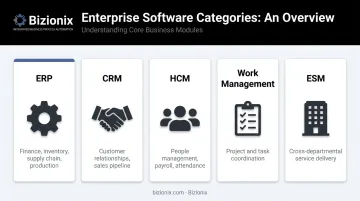
Modern enterprise platforms increasingly combine several of these layers into one system. As organisations scale, that consolidation becomes critical — managing five separate tools means five separate data silos, five integrations to maintain, and compounding inefficiencies as the business grows.
The platforms below represent the leading enterprise management solutions for 2026, evaluated for reliability, feature depth, scalability, and measurable operational impact.
Top 10 Enterprise Management Software Solutions for 2026
These platforms were selected based on market presence, feature breadth, scalability, and user adoption. For Indian businesses, local compliance support and total cost of ownership were weighted heavily. Use this list to shortlist tools that fit your scale, industry, and budget — not every platform suits every buyer.
Note: Pricing for international vendors is shown in their published currency (USD). Bizionix pricing is in INR.
1. Bizionix
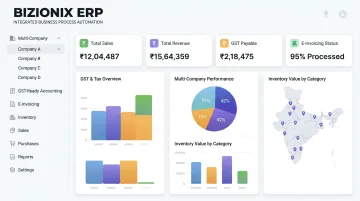
Bizionix, developed by IIS-LLP (a subsidiary of Protocol India Private Limited), is a 100% cloud-based ERP platform built specifically for Indian MSMEs, CA firms, and multi-location enterprises. It covers accounting, GST compliance, e-invoicing, inventory, CRM, HR, and warehouse management under a single login.
Bizionix connects directly to the government's Invoice Registration Portal (IRP) via API for instant IRN generation, automatic QR code creation, and GSTR-1 auto-population — covering the full e-invoicing workflow without manual steps.
The multi-company management system lets CA firms and business groups switch between client entities without logging out, with independent books of accounts per entity and consolidated dashboards for group-level oversight.
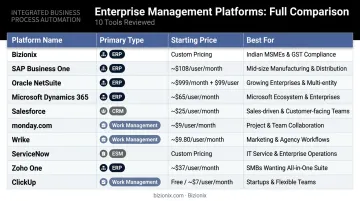
Pricing starts at ₹999/year for the NEO plan (with a 14-day free trial), making it accessible to early-stage MSMEs, while the Enterprise plan provides custom pricing for complex, multi-module deployments.
| Attribute | Details |
|---|---|
| Key Features | GST-ready accounting, e-invoicing with IRN, multi-company management, inventory, CRM, HRMS & payroll, warehouse management |
| Pricing | NEO plan from ₹999/year; Enterprise plan at custom pricing |
| Best For | Indian MSMEs, CA firms, manufacturing companies, franchise networks, multi-location enterprises |
2. SAP Business One
SAP Business One is a globally recognised ERP solution for small to mid-market enterprises, offering modules for finance, inventory, sales, and production planning within a single system.
It earns a 4.3/5 on G2 across 539 reviews. Strengths include all-in-one ERP coverage and structured financial management; users note a dated interface and significant implementation complexity.
| Attribute | Details |
|---|---|
| Key Features | Financial management, inventory, sales, production planning, embedded analytics |
| Pricing | License-based; contact SAP or a certified partner for a quote |
| Best For | Growing mid-market businesses needing structured ERP without transitioning to SAP's full enterprise suite |
3. Oracle NetSuite
Oracle NetSuite is a cloud ERP platform used by more than 43,000 customers globally, offering unified financials, CRM, e-commerce, and inventory management.
True multi-entity and multi-currency support makes it the go-to for businesses managing subsidiaries across geographies. Pricing and implementation complexity can be a barrier for smaller organisations.
| Attribute | Details |
|---|---|
| Key Features | Cloud ERP with CRM, financials, inventory, e-commerce, multi-entity management |
| Pricing | Custom pricing; contact Oracle NetSuite for a quote |
| Best For | Fast-growing companies managing multi-entity operations requiring real-time financial consolidation |
4. Microsoft Dynamics 365
Microsoft Dynamics 365 combines ERP and CRM in one modular platform — finance, supply chain, sales, customer service, and project operations — built for organisations already in the Microsoft ecosystem.
Named a Leader in the 2024 Gartner Magic Quadrant for Sales Force Automation for the 14th consecutive year, it stands out for deep integration with Microsoft 365, Teams, and Power BI, plus AI-powered Copilot features. Setup and licensing costs are significant.
| Attribute | Details |
|---|---|
| Key Features | ERP + CRM integration, AI Copilot, supply chain, finance, multi-billing model support |
| Pricing | Modular pricing; contact Microsoft for enterprise quotes |
| Best For | Organisations embedded in the Microsoft ecosystem needing end-to-end business management |
5. Salesforce
Salesforce is the #1 CRM provider globally, ranked first by IDC for the 12th consecutive year in 2025. It centralises customer data, sales pipelines, and service workflows with an AppExchange marketplace of over 7,000 apps and integrations.
Einstein AI adds predictive lead scoring and revenue forecasting. Native project management capabilities are limited without third-party add-ons — it works best alongside a complementary ERP.
| Attribute | Details |
|---|---|
| Key Features | CRM, sales pipeline, customer service, marketing automation, 7,000+ app marketplace |
| Pricing | Annual contracts; contact Salesforce for module and edition-specific pricing |
| Best For | Enterprises prioritising customer relationship management, sales operations, and revenue growth |
6. monday.com Work Management
monday.com is a visual work management platform recognised as a 2025 Gartner Magic Quadrant Leader for Collaborative Work Management — for the second consecutive year. It serves cross-functional enterprise teams managing projects, workflows, and department-level operations.
It stands out for its no-code automation engine, AI-powered risk identification, customisable dashboards, and 200+ native integrations with tools like Salesforce, Teams, and Slack.
| Attribute | Details |
|---|---|
| Key Features | Portfolio management, workflow automation, AI insights, 200+ integrations, customisable boards |
| Pricing | Starts at $9/seat/month (Basic, billed annually); Enterprise at custom pricing |
| Best For | Enterprises managing cross-departmental workflows, marketing operations, and team coordination at scale |
7. Wrike
Wrike is an enterprise work management platform built for complex, multi-departmental projects, with verified customer deployments at Siemens, Walmart Canada, and Capgemini.
It differentiates through advanced resource bookings, workload views, native time tracking, and enterprise-grade security — GDPR, CCPA, and HIPAA certified. The interface has a steeper learning curve than lighter tools.
| Attribute | Details |
|---|---|
| Key Features | Dynamic Gantt charts, resource planning, workload view, approval workflows, AI-assisted task management |
| Pricing | Team from $10/user/month; Business at $25/user/month; Enterprise at custom pricing |
| Best For | Enterprises needing detailed resource planning, project portfolio visibility, and strong compliance controls |
8. ServiceNow
ServiceNow is an enterprise-grade platform connecting IT service management (ITSM), enterprise service management (ESM), and strategic portfolio management. Named a Leader in the 2024 Gartner Magic Quadrant for AI Applications in IT Service Management.
Its "Now Assist" AI summarises incidents, suggests next steps, and automates resolution workflows. Implementation cost and complexity are high — this is an enterprise-tier platform.
| Attribute | Details |
|---|---|
| Key Features | ITSM, ESM, strategic portfolio management, AI automation, cross-departmental workflow orchestration |
| Pricing | Custom enterprise pricing; contact ServiceNow for scalable package quotes |
| Best For | Large enterprises managing IT operations, shared services, and cross-functional service delivery at scale |
9. Zoho One
Zoho One is an all-in-one business suite offering 50+ integrated applications — CRM, finance, HR, projects, and marketing — under a single subscription. Zoho reported 40% year-on-year small business customer growth as of September 2025, reflecting strong adoption among Indian SMEs.
Individual apps are shallower than specialist tools. For businesses that need breadth over depth — and want to avoid managing a stack of separate subscriptions — Zoho One is a practical choice.
| Attribute | Details |
|---|---|
| Key Features | 50+ apps: CRM, finance, HR, projects, analytics, marketing automation — unified under one login |
| Pricing | All Employees plan at $37/employee/month (billed annually); Flexible User plan also available |
| Best For | SMEs and growing businesses in India seeking a multi-functional suite without managing separate software subscriptions |
10. ClickUp
ClickUp is a highly customisable work management platform combining task management, docs, goals, time tracking, and automation in one workspace.
Its six-level task hierarchy — Workspace, Spaces, Folders, Lists, Tasks, and Subtasks — enables enterprise-scale workflow organisation. It offers 15+ project views and AI-assisted task creation. Note: performance can lag on very large workspaces.
| Attribute | Details |
|---|---|
| Key Features | Hierarchy-based workflows, 15+ views, AI task assistant, time tracking, 100+ automation templates |
| Pricing | Free plan available; Unlimited at $7/user/month; Business at $12/user/month; Enterprise at custom pricing |
| Best For | Teams consolidating task management, documentation, and communication in a single workspace |
How We Chose the Best Enterprise Management Software
These tools were assessed on feature depth, scalability, integration capabilities, ease of adoption, security compliance, and value relative to cost. A common mistake is choosing software based on brand name alone, without testing whether it fits your actual workflow, team structure, or regulatory environment.
Key evaluation criteria:
- Breadth of core modules (finance, CRM, projects, HR)
- Workflow automation and customisation depth
- Real-time reporting and dashboards
- Enterprise-grade security and data compliance
- Quality of customer support and onboarding
- Total cost of ownership including implementation and maintenance
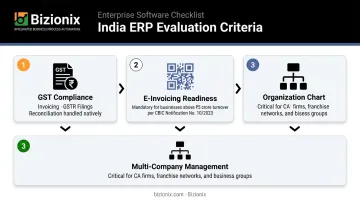
For Indian businesses specifically, three criteria that global platforms often overlook are non-negotiable:
- GST compliance — the platform must handle invoicing, GSTR filings, and reconciliation natively
- E-invoicing readiness — mandatory for businesses with aggregate turnover above ₹5 crore per CBIC Notification No. 10/2023 (effective August 1, 2023)
- Multi-company management — critical for CA firms, franchise networks, and business groups
The broader implementation risk is real: Gartner research indicates that by 2027, more than 70% of recently implemented ERP initiatives will fail to fully meet their original business-case goals. Fit, adoption readiness, and vendor support matter as much as the feature list.
That risk is compounded in India's MSME market, where tool selection itself is a documented barrier. The India SME Forum's 2025 META Report found that 52.6% of surveyed MSMEs found it difficult to identify the right digital tools — which means getting the evaluation framework right is half the battle.
Conclusion
The right enterprise management software is the one that fits how your business actually operates — not the most popular platform, and not the one with the longest feature list. It needs to match your compliance requirements, your team's capacity, and your growth trajectory.
Before finalising any decision, run every shortlisted platform through these filters:
- Scalability: Can it handle your next stage of growth without a re-implementation?
- Total cost of ownership: Factor in setup, training, and ongoing licensing — not just the sticker price
- Vendor support: Is local or regional support available when something breaks?
- Trial access: Free trials and demos reveal real usability gaps that feature lists hide
Switching platforms later is expensive and disruptive. Get this right the first time.
For Indian MSMEs and growing enterprises specifically, the choice narrows considerably when you factor in GST compliance, e-invoicing mandates, multi-entity management, and MSME-appropriate pricing. Most global ERP platforms treat these as afterthoughts.
Bizionix is built around them. It offers direct IRP API integration for instant IRN generation, multi-company management under a single login, and pricing that starts at ₹999/year — structured specifically for this market, not adapted from a global template after the fact. Visit Bizionix.com or reach out via WhatsApp or phone (+91 91779 99277) to see how it fits your business.
Frequently Asked Questions
What are the best enterprise project management software tools?
Top options include monday.com, Wrike, ClickUp, and Microsoft Dynamics 365. Your best pick depends on focus: Wrike for resource planning, monday.com for cross-departmental workflows, and Dynamics 365 for connecting project operations with ERP and CRM.
What is the best enterprise content management (ECM) software?
ECM is distinct from general enterprise management software — it focuses on document storage, version control, and compliance-driven content workflows. Microsoft SharePoint, OpenText, and Laserfiche are the leading ECM platforms in this space.
What is the best enterprise business process management (BPM) software?
ServiceNow, SAP BTP, Appian, and Pega are the leading BPM platforms. BPM software focuses on automating and standardising repeatable workflows across departments — a distinct discipline from general project or task management.
Which enterprise CRM software is best in India?
Salesforce, Zoho CRM, and Microsoft Dynamics 365 are strong contenders. For Indian MSMEs, Zoho CRM and platforms like Bizionix combine built-in CRM with GST-compliant accounting — a more practical fit at a lower cost.
How much does enterprise management software typically cost?
Cloud-based work management tools start around $7–$12/user/month. Full ERP platforms like SAP or Oracle require custom quotes and often significant implementation budgets. India-specific platforms like Bizionix offer more accessible subscription models — starting at ₹999/year — designed for MSME budgets.
What features should I prioritise when choosing enterprise management software?
Focus on workflow automation, real-time reporting and dashboards, integration with existing tools, role-based access controls, and scalability. For Indian businesses, add GST compliance, e-invoicing readiness, and multi-entity management to the top of that list.