Introduction
Running a growing business in India today often means juggling a patchwork of tools — spreadsheets for inventory, WhatsApp for approvals, separate software for GST filing, and manual follow-ups across departments. The result: missed data, delayed decisions, and revenue leakage that compounds as the business scales.
Enterprise software solves this by replacing fragmented systems with a single, connected platform that links finance, operations, sales, and people. The urgency to adopt it is real — India's IT spending is projected to reach US$160 billion in 2025, up 11.2% from 2024, according to Gartner.
Yet despite this growth, only 12% of Indian MSMEs use ERP and 13% use CRM, per the RIS MSME Digitalisation Report — leaving most businesses exposed to the same inefficiencies holding back their revenue and growth.
Closing that gap starts with knowing what's available. This guide covers the top enterprise software solutions across key categories, what each does best, who it's built for, and how to choose the right fit for your operations.
Key Takeaways
- Enterprise software integrates finance, operations, sales, and HR into one platform, replacing scattered tools
- Key categories: ERP, CRM, all-in-one business suites, and cloud productivity platforms
- Global tools like SAP and Salesforce are powerful but costly and complex for most Indian MSMEs
- Indian businesses benefit most from solutions with built-in GST compliance and affordable, scalable pricing
- Evaluate on total cost of ownership, compliance fit, and ease of adoption rather than feature lists alone
Why Indian Businesses Need Enterprise Software Now
Enterprise software refers to integrated digital platforms that replace department-specific tools with a single system connecting finance, operations, sales, and people. For a small business with five staff, a spreadsheet might work. For a growing MSME managing multiple locations, GST filings, and dozens of customer accounts, it quickly becomes a liability.
India has over 8.47 crore formalised MSMEs, contributing roughly 30% of GDP and over 45% of total exports, according to the Ministry of MSME Annual Report 2024-25. But digital adoption remains uneven. A 2025 survey by the India SME Forum and META found that 46.2% of MSMEs are still fully offline.
A separate Zoho survey found 71% of MSMEs use spreadsheets separately or alongside their CRM for customer data — a setup that creates errors, delays, and blind spots.
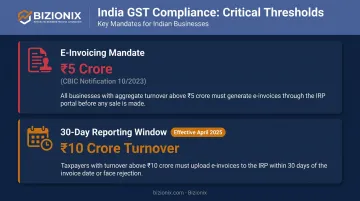
Compliance requirements have tightened considerably. Key thresholds now in effect:
- E-invoicing mandatory for businesses with annual turnover above ₹5 crore (CBIC Notification No. 10/2023-Central Tax, August 2023)
- 30-day reporting window enforced from April 2025 — businesses above ₹10 crore cannot submit e-invoices older than 30 days
- Manual reconciliation across disconnected tools no longer meets these timelines reliably
The sections below cover the leading enterprise software options available to Indian businesses — organised by category, with notes on what each does well and where it fits.
Top Enterprise Software Solutions for Growing Businesses
These solutions are evaluated on functional coverage, GST and compliance relevance, ease of deployment, pricing transparency, and suitability for Indian business environments.
SAP Business One
SAP Business One is a purpose-built ERP from SAP targeting small to mid-sized enterprises across manufacturing, distribution, and services. It covers financials, inventory, procurement, production, and reporting within one integrated system.
Its strength lies in deep process coverage and a large global implementation partner ecosystem. For Indian companies managing multi-location operations or export workflows, SAP Business One offers structured ERP maturity. It does require significant implementation investment and ongoing partner support, though — better suited for businesses with dedicated IT resources and budget.
| Category | Details |
|---|---|
| Best For | Growing mid-market enterprises in manufacturing, distribution, and services needing structured ERP |
| Key Features | Financial management, inventory control, procurement, production planning, multi-currency support, and built-in reporting |
| Pricing Model | Licence-based with per-user pricing; India pricing is not published publicly — contact SAP or an authorised partner for a quote |
Salesforce CRM
Salesforce holds a 21.7% global CRM market share and has been ranked the world's number one CRM provider by IDC for 11 consecutive years. Its platform is used by sales, marketing, and service teams to track leads, manage pipelines, run campaigns, and analyse customer data in real time.
Its AI-powered analytics and 1,000+ integration ecosystem are a strong draw. For Indian SMEs, though, costs can be significant — plans start at $25/user/month (USD) for Starter Suite, rising to $175/user/month (USD) for Enterprise. Add dedicated admin requirements, and it's best suited for organisations with established sales operations and a CRM team.
| Category | Details |
|---|---|
| Best For | B2B and B2C sales-driven organisations needing advanced CRM, pipeline management, and marketing automation |
| Key Features | Lead and opportunity management, AI-powered insights, marketing automation, customer service tools, and 1,000+ integrations |
| Pricing Model | Subscription-based; Starter Suite from $25/user/month (USD), Pro Suite $100, Enterprise $175, Unlimited $350 (billed annually) |
Zoho One
Zoho One is an all-in-one business suite from Zoho Corporation — an Indian-origin global technology company — offering 50+ integrated applications covering CRM, finance, HR, project management, inventory, and collaboration under a single subscription. Over 75,000 businesses worldwide use the platform.
For Indian MSMEs, it offers strong value: it includes GST invoicing capabilities, runs entirely in the cloud, and eliminates the cost of multiple standalone subscriptions. Global pricing sits at $37/employee/month (USD) billed annually. India-specific INR pricing is not published on official Zoho pages at the time of writing — contact Zoho India directly for current rates.
Individual modules may not match the depth of specialist tools, however, and businesses with complex manufacturing or multi-entity structures may find some areas limited.
| Category | Details |
|---|---|
| Best For | Small to mid-sized Indian businesses wanting a cost-effective, multi-functional suite covering CRM, accounting, and HR |
| Key Features | CRM, invoicing, payroll, HR management, project tracking, inventory, and collaboration — all with single sign-on |
| Pricing Model | Per-employee pricing; $37/employee/month (USD) billed annually (India INR pricing: contact Zoho directly) |
Microsoft 365
Microsoft 365 is a cloud-based productivity and collaboration suite widely adopted across Indian enterprises for email, document creation, team communication via Teams, and cloud storage. It serves as the operational backbone for workforce collaboration in most organisations.
It integrates deeply with Microsoft Dynamics 365 (ERP/CRM) and Power BI (analytics), making it a foundational layer for businesses building a broader tech stack. It is not a standalone ERP — but for most organisations, it is an indispensable starting point.
India pricing (paid yearly, GST extra):
| Plan | Price |
|---|---|
| Microsoft 365 Business Basic | ₹145/user/month |
| Microsoft 365 Business Standard | ₹770/user/month |
| Microsoft 365 Apps for Business | ₹685/user/month |
These plans cover the core productivity stack — Outlook, Word, Excel, Teams, SharePoint, and OneDrive — with higher tiers unlocking desktop app installs and advanced security. Dynamics 365 and Power BI compatibility make it a natural foundation for organisations expanding into ERP or analytics.
Bizionix by IIS-LLP
Bizionix is a 100% cloud-based ERP and business management platform built by IIS-LLP — a subsidiary of Protocol India Private Limited, backed by over two decades of industry experience — and designed specifically around Indian business complexity and compliance requirements. Unlike the global platforms above, every module is built with GST compliance, e-invoicing, and Indian regulatory workflows at the core rather than added on as an afterthought.
What sets it apart:
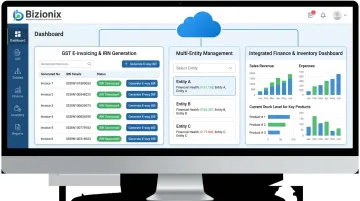
- Invoices are validated and submitted directly to the GST e-Invoice portal via API, returning an IRN and QR code in seconds — no manual upload or third-party tool needed
- Multiple legal entities, GST registrations, and financial books managed under a single login, with entity-level permissions and full audit trails
- Invoice data flows directly into GSTR-1 return preparation, eliminating duplicate entry
- 12+ integrated modules — Finance, Sales, Procurement, Inventory, Warehouse, Production, HRMS & Payroll, and Asset Management — on a single shared database
The NEO plan starts at ₹999 per year (discounted from ₹2,999) with a 14-day free trial, covering core modules including CRM, Sales, Accounts, Finance, HRMS, and Reports. For more complex requirements — multi-entity management, production planning, advanced payroll — the Enterprise plan includes priority support and custom configurations (contact Bizionix for Enterprise pricing).
| Category | Details |
|---|---|
| Best For | Indian MSMEs, multi-location businesses, manufacturers, distributors, CA firms, and service enterprises needing GST-ready ERP without SAP-level complexity or cost |
| Key Features | GST-ready accounting, automated e-invoicing with instant IRN generation, multi-company management, real-time dashboards, inventory, billing, HRMS, and configurable workflows |
| Pricing Model | NEO plan: ₹999/year (14-day free trial included); Enterprise plan: contact Bizionix for pricing |
How We Chose the Best Enterprise Software
Many businesses pick software based on brand recognition or feature checklists — and end up with tools that don't fit how their teams actually work. The criteria below cut through that noise.
Each platform was evaluated on:
- Functional coverage — does the platform cover what the business actually needs at its current stage?
- GST and regulatory compliance — does it handle e-invoicing, IRN generation, and GSTR workflows natively, or require add-ons?
- Ease of adoption — can it be deployed and used without heavy IT support or consultant dependency?
- Integration capability — does it connect with existing systems, banking platforms, or other tools in use?
- Pricing transparency and scalability — are costs clear upfront, and does pricing scale reasonably as the business grows?
- Local support quality — is there meaningful implementation and post-deployment support available in India?
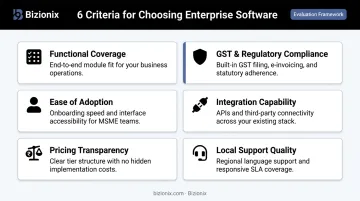
No platform scores perfectly across all six. A distribution company with multi-location inventory has different priorities than a CA firm managing client GST filings — so the recommendations in this guide reflect those distinctions directly.
Conclusion
Enterprise software is no longer reserved for large corporations. Growing businesses and MSMEs that adopt the right platform early gain a structural advantage — better visibility, fewer manual errors, faster billing cycles, and compliance that doesn't require a dedicated team.
That advantage only holds if the platform actually fits your business. Evaluate against real needs: team size, existing processes, India-specific compliance obligations, and where you expect to be in three to five years. A platform that handles ₹2 crore in turnover should scale to ₹20 crore without requiring a rebuild.
If you are an Indian MSME or growing enterprise looking for an ERP built for your reality — GST-ready, cloud-based, affordable, and unified — Bizionix by IIS-LLP is worth a closer look. Request a demo to walk through how it maps to your actual operations.
Frequently Asked Questions
What is enterprise software and why does a growing business need it?
Enterprise software is an integrated digital platform that manages core business functions — finance, operations, sales, and HR — from one connected system. Growing businesses need it to replace fragmented tools, reduce manual work, and make faster decisions based on accurate, real-time data.
What is the difference between ERP software and enterprise management software?
ERP focuses on core operational resources : finance, inventory, and supply chain. Enterprise management software is a broader term covering platforms that coordinate work, people, and data across all business functions. ERP is often a subset of a larger enterprise management platform.
Which enterprise software is best for Indian MSMEs?
Indian MSMEs benefit most from solutions built around GST compliance, affordable pricing, and operational simplicity. Platforms like Zoho One and Bizionix by IIS-LLP are purpose-fit for Indian MSME needs, unlike global tools such as SAP Business One or Salesforce, which are better suited for larger, well-resourced organisations.
How much does enterprise software typically cost for a mid-sized business in India?
Pricing ranges widely depending on platform and scope. Productivity suites like Microsoft 365 start at ₹145 per user per month, while Indian ERP platforms like Bizionix NEO start at ₹999 per year. Full global ERP deployments carry additional licensing, implementation, and training costs. Evaluate total cost of ownership, not just the subscription price.
How long does it take to implement enterprise software in a growing business?
Implementation timelines depend on platform complexity and data readiness. Cloud-based platforms like Bizionix are built for fast deployment: single-entity setups typically go live within days to a few weeks, while multi-entity or multi-location configurations may take 4–8 weeks depending on workflow customisation.
Can enterprise software handle GST compliance and e-invoicing requirements in India?
India-specific platforms treat GST compliance as a core feature, including automated e-invoicing and direct IRN generation via GST portal APIs. Global platforms typically require additional customisation or third-party integrations to match the compliance coverage that Indian-built solutions provide out of the box.