Introduction
GST e-invoicing is no longer a compliance checkbox for large corporations. Since Notification 10/2023-Central Tax brought businesses with annual aggregate turnover above ₹5 crore into the mandate from 1 August 2023, a significant portion of India's MSME sector now has a legal obligation to generate IRN-authenticated invoices. A GST-formatted PDF without IRP connectivity does not meet this requirement.
The operational cost of getting this wrong is real. Invoices issued without a valid IRN by covered taxpayers are not treated as invoices under CBIC Rule 48(5), which means ITC claims fail, GST filings get complicated, and penalties follow under Section 122.
Many businesses are still running on basic billing software or spreadsheets that generate GST-formatted PDFs but have no IRP connectivity whatsoever. This guide reviews five e-invoicing platforms built or configured for India's GST framework, evaluating each on IRP integration depth, ease of setup, pricing, and fit for MSME operations — so you can make an informed choice without wading through sales pages.
Key Takeaways
- E-invoicing in India means IRP registration and IRN generation — a PDF invoice does not qualify
- The ₹5 crore annual aggregate turnover threshold (effective 1 Aug 2023) makes this mandatory for a large slice of MSMEs
- Top platforms reviewed: Bizionix, Zoho Books, TallyPrime, ClearTax e-Invoice, and Vyapar
- Evaluated on IRP connectivity, IRN automation, GST return integration, scalability, and total cost of ownership
- India-native platforms consistently outperform global tools with retrofitted GST plugins — particularly when regulations shift
E-Invoicing in India: What Businesses Need to Know
What GST E-Invoicing Actually Means
GST e-invoicing is not invoice creation on a government portal. Businesses continue generating invoices within their own ERP or accounting systems. They must then report that B2B invoice data to a government-notified Invoice Registration Portal (IRP) in the prescribed schema (Form GST INV-1).
The IRP then returns two things:
- An IRN — a unique 64-character hash generated from the supplier GSTIN, financial year, document type, and document number
- A digitally signed QR code containing key invoice particulars for offline verification
Only after this exchange is the invoice legally valid under GST. Under CBIC Rule 48(5), invoices issued by covered taxpayers outside this process "shall not be treated as an invoice."
Who Must Comply in 2025
The mandate has expanded steadily since its 2020 rollout:
| Effective Date | Turnover Threshold |
|---|---|
| 1 Oct 2020 | Above ₹500 crore |
| 1 Jan 2021 | Above ₹100 crore |
| 1 Apr 2021 | Above ₹50 crore |
| 1 Apr 2022 | Above ₹20 crore |
| 1 Oct 2022 | Above ₹10 crore |
| 1 Aug 2023 | Above ₹5 crore |
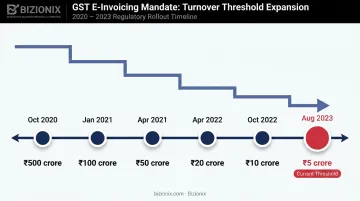
The current threshold is ₹5 crore annual aggregate turnover in any preceding financial year, per Notification 10/2023-Central Tax. Businesses approaching this threshold should adopt compliant software before they cross it, not scramble to comply after the fact.
Best E-Invoicing Software for Indian Businesses in 2025
These five platforms were selected for their genuine IRP connectivity, GST compliance depth, MSME suitability, and overall value — not just brand recognition.
Bizionix (by IIS-LLP)
Bizionix is a 100% cloud-based ERP built specifically for Indian MSMEs by IIS-LLP, a subsidiary of Protocol India Private Limited with over two decades of industry experience. It covers the full business management cycle — billing, inventory, HR, finance, and compliance — within a single unified architecture on one centralized database.
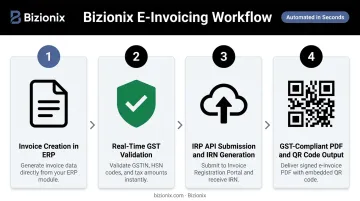
For e-invoicing specifically, the platform connects directly with the GST e-Invoice system via API. When a sales invoice is created, the system validates it against GST rules in real time, generates the IRN and QR code via IRP connection, and produces a GST-compliant PDF and JSON — all within seconds, without manual intervention or third-party tools.
A standout capability is its multi-company management: businesses can manage multiple GST-registered entities under a single secure login, with fully separate books of accounts, ledgers, and compliance records per entity.
This makes Bizionix particularly well-suited for franchise networks, CA firms managing client portfolios, and business groups with multiple subsidiaries.
The Bizionix NEO plan starts at ₹999/year (with a 14-day free trial), and an Enterprise plan with custom pricing is available for larger operations needing the full module suite — including Production Planning, Advanced Warehouse Management, and complete HRMS.
Key Features: Automated IRN generation, GST-ready accounting, multi-company management, real-time visibility, configurable workflows, cloud access
GST Compliance: Direct IRP API integration, pre-invoice validation, QR code embedding, GSTR-1 auto-population
Best Suited For: MSMEs, manufacturing, distribution, multi-location enterprises, CA firms managing client portfolios
Zoho Books
Zoho Books is a cloud-based accounting and finance platform from Zoho Corporation, widely adopted across India's SME segment. It connects to the IRP with Zoho registered as a GSP (GST Suvidha Provider), handling IRN generation, QR code printing on invoice PDFs, and bulk IRN workflows.
The platform integrates e-invoicing with its broader GST suite — e-Way bill creation, GSTR-1 and GSTR-3B workflows, and API access to the GST portal — so businesses get accounting and compliance without switching tools.
India pricing starts at ₹749/month (billed annually) for the Standard plan, with a free tier available for businesses under ₹25 lakh annual revenue.
Key Features: GST invoicing, automated workflows, client portal, multi-currency, inventory tracking, Zoho ecosystem integrations
GST Compliance: IRP integration via GSP, IRN and QR code generation, e-Way bill support, GSTR-1/3B reconciliation
Best Suited For: Small to mid-sized businesses already in the Zoho ecosystem, service-based businesses, startups
TallyPrime
TallyPrime is India's most widely used business accounting software, with 2.7 million+ businesses trusting the platform. Its wide adoption across MSMEs and a large CA community make it a default choice — and for good reason.
The e-invoicing module connects with the IRP for IRN generation, supports bulk sending of invoices, fetches and prints QR codes, and integrates with e-Way bill workflows and GST return filing. TallyPrime is primarily an on-premise solution with cloud access available through TallyPrime on AWS — businesses expecting a fully browser-native experience should factor this in before committing.
Key Features: Accounting, payroll, inventory, banking, MIS reporting, multi-company ledgers
GST Compliance: IRP connectivity, IRN generation, bulk IRP submission, e-Way bill integration, GSTR filing support
Best Suited For: Traditional businesses with existing Tally workflows, CA-managed setups, manufacturing and trading companies
ClearTax e-Invoice
ClearTax is India's leading tax and compliance technology platform. Its e-invoicing product is a specialist compliance layer rather than a full accounting suite — designed for businesses that already have ERP or accounting infrastructure and need reliable IRP connectivity on top.
ClearTax also operates its own IRP (ClearIRP), giving it end-to-end control over the compliance workflow. The platform includes:
- Generate IRN API endpoint compatible with the government schema
- Real-time invoice validation and error resolution dashboards
- Bulk IRN generation with multi-GSTIN support
Key Features: Bulk IRN generation, API-based ERP integration, invoice validation, error resolution dashboard, e-Way bill creation
GST Compliance: Direct IRP API, real-time GSTIN verification, multi-GSTIN support, GSTR reconciliation, HSN code validation
Best Suited For: Businesses with existing ERP systems needing a dedicated compliance layer, high-volume invoice operations, CA firms
Vyapar
Vyapar is a billing and accounting app built for Indian small businesses, with a mobile-first approach that lets owners create GST invoices, track payments, and manage inventory from their smartphone or desktop — including an offline mode that syncs later.
The platform claims IRN-verified e-invoicing support, though the specifics of its direct IRP integration workflow are less thoroughly documented than the other platforms on this list. It works well as an entry-level option for micro-enterprises moving to digital invoicing, but should not be treated as a full IRP-integrated compliance engine.
Key Features: GST billing, payment tracking, inventory management, expense tracking, mobile and desktop access, offline mode
GST Compliance: GST invoice generation, basic e-invoicing support, GSTIN integration, e-Way bill creation for eligible users
Best Suited For: Micro-enterprises, sole proprietors, small retail and service businesses, businesses new to digital invoicing
How We Chose the Best E-Invoicing Software
A common mistake is selecting general-purpose billing tools that produce GST-formatted PDFs but have no genuine IRP connectivity. Under Rule 48(5), those invoices don't count. The businesses that discover this during a GST audit face back-dated penalties and ITC complications — consequences far costlier than switching software before an audit.
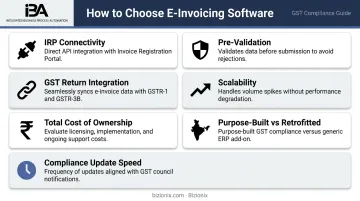
The evaluation criteria for this list:
- IRP connectivity and IRN automation — does the platform actually push invoice data to the IRP and capture the returned IRN and QR code, or is this manual/workaround-based?
- Pre-validation and error handling — does the system catch data errors before submission, preventing IRP rejections?
- GST return integration — is e-invoicing connected to GSTR-1, GSTR-3B, and e-Way bill workflows, or isolated?
- Scalability — can the platform grow with the business as turnover increases and operations expand?
- Total cost of ownership — subscription price matters, but so does implementation effort, training time, and whether the tool replaces other paid systems
- Purpose-built vs. retrofitted — platforms built for India's GST framework from the ground up tend to handle regulatory changes faster than global tools with GST add-on plugins
- Compliance update speed — GST rules and IRP specifications change; a platform that lags during a transition can create gaps even when everything else is working correctly
Conclusion
Choosing e-invoicing software is not really about invoice speed. It is about staying compliant as GST mandates evolve, keeping billing and accounting synchronized, and scaling without disruption as you cross new turnover thresholds or open new locations.
For MSMEs that need one platform to handle it all — without SAP-level complexity or cost — Bizionix is built specifically for India's GST environment. It covers:
- GST e-invoicing with direct IRP integration and pre-invoice validation
- Accounting, inventory, and HRMS in a unified system
- Multi-entity management under a single login
Start a 14-day free trial or email info@bizionix.com to request a demo tailored to your business.
Frequently Asked Questions
What is the best e-invoicing software for Indian businesses?
The best option depends on your business size and setup. Bizionix suits MSMEs needing an all-in-one ERP with built-in IRP connectivity. Zoho Books works well for cloud-first SMEs, and TallyPrime fits businesses already operating in the Tally ecosystem. The non-negotiable requirement across all of them: genuine IRN generation via IRP, not just GST-formatted PDFs.
Is e-invoicing mandatory in India?
Yes. GST-registered businesses with annual aggregate turnover above ₹5 crore in any preceding financial year are required to generate e-invoices through the IRP, per Notification 10/2023-Central Tax effective from 1 August 2023. Businesses above ₹10 crore were already covered under earlier notifications.
What is an IRN in e-invoicing?
IRN (Invoice Reference Number) is a unique 64-character hash generated by the Invoice Registration Portal after a business submits invoice data. It is calculated from the supplier GSTIN, financial year, document type, and document number, and serves as the government's official validation that the invoice is GST-compliant.
What features should I look for in GST e-invoicing software?
Look for these capabilities as a baseline:
- Direct IRP API connectivity with automated IRN and QR code generation
- Pre-submission invoice validation and GSTIN verification
- e-Way bill integration and GSTR reconciliation support
- In-system error resolution (not manual resubmission)
Platforms that handle exceptions within the system save significant time at scale.
Can small businesses use e-invoicing software?
Yes. Platforms like Vyapar and Zoho Books offer accessible, affordable entry points for small businesses. Even micro-enterprises approaching the ₹5 crore threshold should adopt compliant software proactively — switching systems mid-year under compliance pressure is far more disruptive than setting it up in advance.
What is the difference between e-invoicing and a regular digital invoice?
A regular digital invoice — including a PDF — is simply an electronic version of a paper bill. A GST e-invoice is a structured data submission to the IRP that receives a government-issued IRN and digitally signed QR code. Under CBIC Rule 48(5), only the latter is legally valid for covered taxpayers.