Introduction
India has over 5.77 crore registered MSMEs contributing roughly 30% of GDP, yet most still run on disconnected spreadsheets and siloed tools. Growing enterprises are managing GST compliance, multi-location operations, and rapid team scaling simultaneously — often with systems that generate compliance errors, delay reporting, and hide financial leakage.
B2B enterprise software addresses this directly. The right platform unifies finance, HR, operations, and customer management into a single system, reducing financial leakage, improving decision speed, and keeping compliance on track. The Indian SaaS sector is projected to reach US$50 billion by 2030 — a sign of how aggressively businesses are now investing in this infrastructure.
This guide breaks down the leading B2B enterprise software options for 2025, evaluated on what actually matters for Indian businesses:
- GST readiness — native compliance, e-invoicing, and IRN generation
- Implementation complexity — how quickly teams can go live without IT overheads
- Total cost — licensing, onboarding, and hidden integration expenses
- Scalability — whether the platform grows as operations expand across locations and entities
Key Takeaways
- B2B enterprise software unifies core operations (finance, CRM, HR, supply chain) into a single cloud-based platform instead of scattered tools
- Indian MSMEs need platforms with GST compliance, e-invoicing, and multi-company support built in, not bolted on
- SAP, Salesforce, and Microsoft Dynamics 365 suit large enterprises but come with high costs and complex implementations
- Zoho One and Bizionix offer affordable pricing with India-specific compliance features built for growing businesses
- Evaluate on GST-readiness, scalability, total cost of ownership, and implementation support — not brand recognition alone
What Is B2B Enterprise Software?
B2B enterprise software refers to platforms built specifically for business-to-business use — designed to handle core organisational functions like accounting, procurement, HR, customer management, and operations through a single digital system rather than multiple disconnected tools.
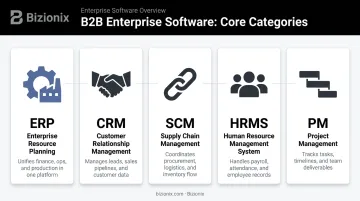
The main categories relevant to growing enterprises include:
- ERP (Enterprise Resource Planning) — manages finance, procurement, manufacturing, and supply chain
- CRM (Customer Relationship Management) — tracks customer interactions, sales pipelines, and marketing
- SCM (Supply Chain Management) — controls inventory flow, supplier relationships, and logistics
- HRMS (Human Resource Management System) — handles payroll, attendance, statutory compliance, and employee data
- Project Management — coordinates tasks, timelines, and cross-team execution
Modern platforms increasingly combine several of these into one system. IDC found that 51% of medium-sized businesses listed moving key data into CRM, ERP, or HCM as a top technology investment priority — confirming that integrated platforms have shifted from a competitive edge to a baseline operational requirement.
For Indian businesses, selecting the right platform involves more than picking a globally popular name. GST compliance, multi-entity structures, e-invoicing requirements, and distributed operations demand platforms that address Indian regulatory realities natively. The solutions evaluated below are assessed through that lens — prioritising tools that work within India's compliance landscape, not around it.
Top B2B Enterprise Software Solutions for 2025
Solutions below were selected based on feature depth, scalability, pricing transparency, and direct relevance to Indian enterprise and MSME use cases — not just global market share.
SAP S/4HANA
SAP S/4HANA is the flagship ERP from SAP SE, built for large-scale organisations managing complex global operations across finance, logistics, procurement, and manufacturing. SAP positions it as suitable for midsize to large enterprises, noting that approximately 80% of SAP customers are SMEs.
In practice, however, the implementation complexity and licensing structure skew toward organisations with dedicated IT teams.
Its in-memory HANA database enables real-time, organisation-wide data processing, and the platform supports multi-currency, multi-language, and multi-country compliance — making it a strong fit for multinationals.
| Category | Details |
|---|---|
| Key Features | Integrated finance, supply chain, manufacturing, HR, and procurement; real-time analytics via SAP Analytics Cloud; AI-driven automation |
| Pricing Model | Custom enterprise licensing (subscription-based for cloud edition); significant implementation investment required beyond licensing |
| Best For | Large enterprises and multinationals with complex, multi-jurisdictional operations and dedicated IT resources |
Salesforce
Founded in 1999, Salesforce holds 20% of the global CRM market and remains the world's leading customer relationship management platform. Its Customer 360 suite covers sales, service, marketing automation, and analytics — all cloud-based and highly customisable via the AppExchange marketplace.
Salesforce excels at sales pipeline visibility and customer lifecycle tracking. For businesses needing ERP capabilities alongside CRM, however, additional integrations or third-party tools are typically required.
| Category | Details |
|---|---|
| Key Features | CRM, sales pipeline management, marketing automation, service cloud, Einstein AI insights, AppExchange integrations |
| Pricing Model | Subscription per user/month: Starter Suite from US$25, Pro Suite US$100, Enterprise US$175, Unlimited US$350 (billed annually) |
| Best For | Businesses prioritising customer acquisition, sales team management, and customer lifecycle tracking |
Microsoft Dynamics 365
Microsoft Dynamics 365 is a suite of cloud-based ERP and CRM applications that integrates tightly with Microsoft 365 — including Teams, Excel, and Power BI. It covers finance, operations, sales, HR, and field service, and was recognised as a Leader in the 2024 Gartner Magic Quadrant for Cloud ERP for both service-centric and product-centric enterprises.
For organisations already invested in the Microsoft ecosystem, the adoption curve is significantly lower. That said, cost and configuration complexity increase noticeably at enterprise scale.
| Category | Details |
|---|---|
| Key Features | Finance and operations, sales, HR, supply chain, project management, Power BI integration, Azure cloud infrastructure |
| Pricing Model | Per-module subscription: Sales Professional from US$65/user/month; Finance at US$210/user/month (effective Oct 2024); Business Central from US$80/user/month |
| Best For | Mid-to-large enterprises already using Microsoft tools, seeking integrated ERP and CRM in one ecosystem |
Zoho One
Zoho One is an all-in-one business operating system from Zoho Corporation — an Indian software company — offering 50+ integrated applications covering CRM, accounting, HR, projects, inventory, and marketing under a single subscription.
It's particularly popular among Indian SMEs for its breadth of features, India-based support, and significantly lower price point compared to global ERP vendors. Zoho Books, included within Zoho One, supports GST compliance and e-invoicing for Indian businesses.
| Category | Details |
|---|---|
| Key Features | CRM, GST-compliant accounting, inventory, HR and payroll, project management, analytics, email and marketing tools |
| Pricing Model | All Employee pricing: US$37/employee/month (annual) or US$45/employee/month (monthly); Flexible User pricing: US$90/user/month (annual) |
| Best For | Indian SMEs and growing businesses seeking a wide feature set at accessible pricing with GST-ready modules |
Bizionix by IIS-LLP
Bizionix is a 100% cloud-based business management platform developed by IIS-LLP (Integrated Information Solutions LLP), a subsidiary of Protocol India Private Limited with over two decades of industry experience. It is purpose-built for Indian MSMEs, manufacturing companies, distribution operations, CA firms, and multi-location enterprises.
Where global platforms require heavy customisation for Indian compliance, Bizionix arrives with it built in. The platform connects directly with the GST e-Invoice system via API — generating IRN and QR codes automatically within seconds, with pre-validation that prevents rejection before submission.
Unlike most platforms, Bizionix handles the entire submission pipeline natively, with no manual uploads or external portals required.
Multi-company management is where Bizionix separates itself from most MSME platforms. Through a single secure login, users can switch between entities — subsidiaries, branches, GST-registered units, franchise locations — without logging out. Each entity maintains independent books, separate compliance records, and isolated ledgers.
Group-level dashboards provide consolidated real-time visibility across all entities — directly relevant for holding companies, CA firms managing client portfolios, and franchise networks currently juggling separate logins or separate files.
The platform covers 12+ integrated modules — Finance & Accounting, Sales & CRM, Inventory Control, Warehouse Management, Purchase Management, Production Planning, HRMS & Payroll, Attendance Tracking, Document Workflows, and Advanced Reporting — all on a single database with real-time cross-department visibility.
| Category | Details |
|---|---|
| Key Features | GST-ready accounting with GSTR-1 auto-population, automated e-invoicing with instant IRN generation, multi-company management under a single login, real-time operational dashboards, inventory and warehouse management, HRMS with statutory compliance, configurable workflows |
| Pricing Model | Bizionix NEO (Basic): ₹999/year; Enterprise plan: custom pricing — contact IIS-LLP for a quote |
| Best For | Indian MSMEs, manufacturing companies, distribution businesses, franchise networks, multi-location enterprises, and CA firms needing an all-in-one, GST-compliant ERP without SAP-level complexity or cost |
How We Chose the Best B2B Enterprise Software
Evaluation Criteria
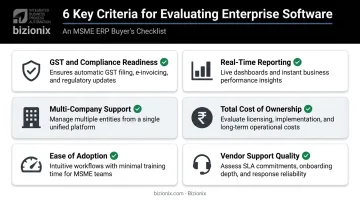
Solutions were assessed on:
- GST and compliance readiness — does it handle GST, e-invoicing, TDS, and GSTR filings natively, or via expensive add-ons?
- Real-time reporting and visibility — can decision-makers see live operational data without waiting for month-end reports?
- Multi-company and multi-location support — critical for Indian business groups managing separate entities or branches
- Total cost of ownership — including implementation, training, and support, not just the subscription fee
- Ease of adoption — how quickly can a growing MSME get operational without a large IT team?
- Vendor support quality — particularly responsiveness for India-based businesses
Why This Matters More Than Brand Rankings
A common mistake: choosing software based on global recognition without checking whether it handles Indian regulatory requirements out of the box. Under CBIC Notification No. 10/2023, businesses with aggregate turnover above ₹5 crore must generate e-invoices with IRN — yet many global platforms require custom integration or third-party tools to meet this requirement.
Implementation risk is real. Gartner reports that by 2027, more than 70% of recently implemented ERP initiatives will fail to fully meet their original business-case goals — and up to 25% will fail outright.
Choosing the wrong platform (or the right platform with the wrong implementation approach) can mean months of disruption, budget overruns, and rollbacks that cost more than the original software investment.
Cloud-native architecture matters more than ever in 2025. On-premise deployments add ongoing infrastructure and maintenance costs that erode any savings from a cheaper licence. Any platform still requiring significant on-site IT overhead should have its total cost of ownership recalculated before shortlisting.
Conclusion
Choosing B2B enterprise software in 2025 is an operational strategy decision, not just a technology purchase. The right platform should align with how your business actually runs — not force your team to adapt to rigid, generic software logic designed for a different market.
Before finalising any decision, assess three things:
- Scalability — can the platform grow as your entity count, headcount, or transaction volume increases?
- Compliance readiness — does it handle GST, e-invoicing, TDS, and Indian regulations natively?
- Total cost of ownership — include implementation, training, support, and customisation in your calculation, not just the licence fee
If those three criteria are guiding your shortlist, a platform built around Indian business requirements will outperform a global ERP adapted for local compliance as an afterthought.
Bizionix by IIS-LLP is a cloud-based ERP designed specifically for Indian MSMEs — covering GST compliance, multi-entity management, and core operations in a single system, without SAP-level cost or complexity.
To see how it fits your operations, contact the Bizionix team at info@bizionix.com or +91 91779 99277 to schedule a demo.
Frequently Asked Questions
What is B2B enterprise software?
B2B enterprise software refers to cloud-based or on-premise platforms that help businesses manage core operations — finance, HR, supply chain, and customer management — through integrated systems rather than siloed tools. By consolidating data into a single source of truth, these platforms enable faster, more accurate decision-making across departments.
What are examples of B2B enterprise software?
Common examples include SAP S/4HANA and Microsoft Dynamics 365 for ERP, Salesforce and Zoho CRM for customer management, and Bizionix for Indian MSME-focused all-in-one ERP. Modern platforms increasingly combine multiple categories — CRM, accounting, HR, and inventory — in a single integrated system.
What is the difference between B2B software and B2C software?
B2B software is built for organisations, prioritising workflow automation, scalability, compliance, and multi-user role management. B2C software targets individual consumers and focuses on personal experience and ease of use. The key difference: B2B platforms handle far higher data volumes, stricter access controls, and regulatory compliance requirements.
How do I choose the right B2B enterprise software for my business?
Start by identifying your core pain points — fragmented data, manual billing, limited visibility — then evaluate platforms against:
- GST compliance readiness and e-invoicing support
- Scalability and total implementation cost
- Ease of adoption and vendor support quality
Always request a demo before committing.
What are the key features to look for in enterprise software for Indian MSMEs?
Prioritise these capabilities:
- GST-compliant accounting with automated e-invoicing and IRN generation
- Multi-company management from a single login
- Real-time dashboards for inventory, billing, and operations
- Configurable modules that adapt to existing workflows without expensive custom development
Is cloud-based B2B enterprise software safe for businesses in India?
Well-built cloud platforms invest in encryption, role-based access controls, and regular security audits. Under CERT-In's 2022 directions, providers must retain logs for 180 days within Indian jurisdiction. Before selecting a vendor, confirm their practices align with India's Digital Personal Data Protection Act, 2023, and that uptime SLAs and disaster recovery procedures are clearly documented.