Introduction
Most Indian manufacturing businesses, particularly MSMEs, run critical operations across spreadsheets, standalone accounting tools, and disconnected systems. Production planners don't know what inventory is available. Finance teams reconcile numbers days after transactions happen. Compliance filings become last-minute scrambles.
The result? Missed orders, inflated costs, and no real-time picture of the business.
The right manufacturing ERP connects production, inventory, procurement, and finance into a single system where data moves without manual intervention.
But choosing the wrong one carries real consequences. According to Gartner, by 2027, more than 70% of recently implemented ERP initiatives will fail to fully meet their original business-case goals. The wrong system wastes implementation budgets, disrupts operations, and often ends up abandoned by the team.
This guide covers what manufacturing ERP is, which five systems lead the market in 2025, how to evaluate them, and what Indian manufacturers specifically need to prioritise.
Key Takeaways
- Manufacturing ERP unifies production, inventory, purchasing, finance, and compliance — replacing fragmented tools and manual workflows
- The best system fits your manufacturing type, business scale, and compliance environment — not just your budget or brand preference
- Key evaluation criteria: deployment model, GST readiness, total cost of ownership, scalability, and local support
- This guide compares SAP Business One, Oracle NetSuite, Microsoft Dynamics 365 Business Central, Odoo, and Bizionix
- Indian MSMEs should prioritise GST-compliant systems with e-invoicing built in — not bolted on as an afterthought
What Is Manufacturing ERP Software?
Manufacturing ERP (Enterprise Resource Planning) is a unified platform that connects every core business function — production planning, bill of materials, inventory management, shop floor control, procurement, and financial accounting — into a single system.
Most mid-sized manufacturers cobble together several disconnected tools to get through the day:
- Tally for accounting
- Excel for production scheduling
- A standalone inventory tool
- WhatsApp to coordinate between departments
Each system holds a fragment of the truth. Nothing talks to anything else.
Manufacturing ERP eliminates this fragmentation. When a production order is created, it draws from live inventory data, triggers purchase requisitions for shortfalls, and feeds into financial accounts — automatically, in real time.
Why This Matters for Indian Manufacturers
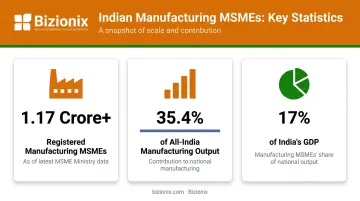
The scale of Indian manufacturing makes systematic operations management non-negotiable. According to the MSME Annual Report 2024-25, there are over 1.17 crore registered manufacturing MSMEs in India, contributing 35.4% of all-India manufacturing output. Manufacturing as a whole accounts for approximately 17% of India's GDP.
Compliance adds another layer of pressure: GST filings, e-invoicing mandates, e-way bills, and TDS obligations. A manufacturer crossing ₹5 crore turnover now faces mandatory e-invoicing requirements. Running that on spreadsheets is not a sustainable strategy.
The comparison below evaluates the five leading manufacturing ERP systems for 2025 — specifically through the lens of what Indian manufacturers actually need.
Best Manufacturing ERP Systems Compared for 2025
These five systems were shortlisted based on manufacturing feature depth, deployment flexibility, compliance capabilities, scalability, and fit for the Indian market — covering the full spectrum from global enterprise platforms to MSME-first solutions.
SAP Business One
Designed for small to mid-sized manufacturers, SAP Business One is one of the most widely adopted SMB ERPs globally — over 83,000 customers rely on the platform. It supports both discrete and process manufacturing and handles multi-warehouse inventory with bin-level precision.
Its standout manufacturing capabilities include an MRP Wizard for automated material requirements planning, detailed BOM management, and production scheduling integrated with financial controls. The deep ecosystem of implementation partners is a practical advantage — but also a cost driver. SAP Business One requires partner-led implementation, and pricing is configuration and partner-based rather than publicly listed.
| Category | Details |
|---|---|
| Key Features | MRP Wizard, BOM management, production scheduling, bin-level inventory tracking, real-time dashboards, financial integration |
| Pricing & Deployment | Cloud (on-demand) and on-premise options available; pricing is quote-based through SAP partners — no standard public per-user price |
| Best Suited For | Mid-sized manufacturers with complex inventory needs, multi-warehouse operations, and an in-house IT team to manage implementation |
Oracle NetSuite
With more than 43,000 customers globally, Oracle NetSuite is a cloud-native ERP built for mid-to-large manufacturers needing end-to-end coverage — production management, supply chain, order management, multi-site warehouse control, and financial planning in one platform.
NetSuite's architecture is entirely cloud-based — there is no on-premise deployment option. This means real-time data across all functions without needing custom integrations, which matters most for manufacturers managing multiple locations or complex sales-to-production workflows. Its licensing structure covers a core platform, optional modules, and per-user fees, but exact base prices are not publicly listed and require a direct quote from Oracle.
| Category | Details |
|---|---|
| Key Features | Production management, supply chain visibility, multi-site inventory, financial planning, real-time analytics, demand forecasting |
| Pricing & Deployment | Cloud-only; three-component licensing (platform + modules + users); pricing is quote-based |
| Best Suited For | Growing manufacturers with multi-location or multi-entity operations; better fit for mid-to-large scale than early-stage MSMEs |
Microsoft Dynamics 365 Business Central
Business Central is Microsoft's cloud ERP for small to mid-sized businesses, with manufacturing capabilities that include production planning, supply chain management, serial and lot number traceability, multi-location inventory, and capacity planning.
Its key advantage is ecosystem fit. If your team already uses Microsoft 365, Power BI, or Teams, Business Central integrates natively — reducing the learning curve and making it easier for teams to get up to speed. It also offers the strongest pricing transparency among the global platforms compared here.
| Category | Details |
|---|---|
| Key Features | Production planning, multi-location inventory, lot traceability, warehouse management, Microsoft 365 and Power BI integration |
| Pricing & Deployment | Essentials: USD 80/user/month; Premium (includes manufacturing): USD 110/user/month; cloud, on-premise, and hybrid deployment |
| Best Suited For | SME manufacturers already operating within the Microsoft ecosystem who want a familiar, integrated platform |
Odoo
Odoo is an open-source, modular ERP used by over 13 million users globally. For manufacturers, it offers BOM management, production orders, real-time shop floor monitoring, and barcode-based inventory tracking at a significantly lower cost than enterprise platforms.
The key differentiator is flexibility. Manufacturers can deploy only the modules they need — manufacturing, inventory, sales, accounting — and add more as operations scale. Odoo has an active India partner network, making local implementation support accessible.
| Category | Details |
|---|---|
| Key Features | Bill of Materials, work orders, real-time production monitoring, barcode scanning, integrated sales and inventory, accounting module |
| Pricing & Deployment | Community (free, open-source); Standard at USD 24.90/user/month; Custom at USD 49/user/month — cloud or self-hosted |
| Best Suited For | Cost-conscious small and mid-sized manufacturers with limited IT budgets who need a flexible, scalable system |
Bizionix
Bizionix, developed by IIS-LLP (a subsidiary of Protocol India Private Limited), is a 100% cloud-based ERP built specifically for Indian MSMEs across manufacturing, distribution, and service sectors. Backed by over two decades of industry experience, it replaces the patchwork of separate Tally instances, manual GST filings, and disconnected inventory sheets with a single, GST-compliant platform.
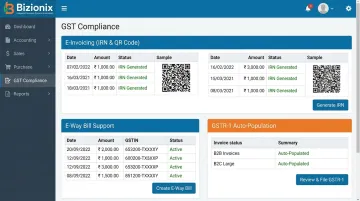
For Indian manufacturers, Bizionix addresses the compliance layer that global ERPs often treat as an afterthought. The platform includes direct API integration with the GST Invoice Registration Portal (IRP) — meaning IRN generation is instant and automatic, e-way bills are supported, TDS is handled within the accounting module, and GSTR-1 auto-populates from invoice data. There is no need for third-party tools or manual JSON uploads.
The multi-company management feature is particularly relevant for manufacturing groups running multiple entities or GST registrations. All companies are accessible under a single login, with independent books of accounts per entity and group-level dashboards for consolidated oversight.
Pricing reflects an MSME-first philosophy. The Bizionix NEO plan starts at ₹999/year (with a 14-day free trial), covering core modules including administration, CRM, sales, warehouse, accounts, finance, HRMS, and reports.
The Enterprise plan — which includes Production Planning, advanced Purchase Management, complete HRMS with payroll, document workflows, and custom configurations — is priced on request based on business size and module requirements.
| Category | Details |
|---|---|
| Key Features | GST-ready accounting, automated e-invoicing with instant IRN generation, e-way bill support, production planning, multi-company management, inventory control, real-time operational visibility |
| Pricing & Deployment | 100% cloud-based; NEO plan from ₹999/year; Enterprise pricing on request |
| Best Suited For | Indian MSMEs in manufacturing who need GST-compliant, affordable, cloud-native ERP without the implementation complexity of global enterprise platforms |
How We Chose the Best Manufacturing ERP Systems
This comparison evaluated real-world fit, not just feature checklists. Manufacturers routinely make the same costly mistakes during ERP selection: choosing based on brand recognition, underestimating implementation costs, ignoring compliance requirements, or picking a system built for the wrong business size.
Evaluation Criteria Used
| Criterion | Why It Matters |
|---|---|
| Manufacturing feature depth | BOM, MRP, production scheduling, shop floor control — not just generic inventory |
| Deployment flexibility | Cloud vs. on-premise vs. hybrid; data residency and IT resource requirements |
| GST and regulatory compliance | E-invoicing, e-way bills, GSTR filings — built in, not bolted on |
| Total cost of ownership | Licensing + implementation + training + ongoing support |
| Scalability | Can the system grow with the business without re-implementation? |
| Local support availability | India-based implementation partners, local support teams, and training |
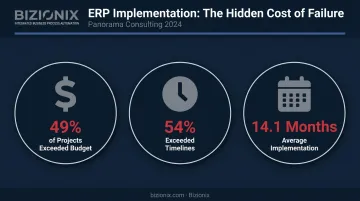
These criteria exist because the stakes are high. Panorama Consulting's 2024 ERP Report found that 49% of ERP projects exceeded budget and 54% exceeded timelines, with an average implementation duration of 14.1 months across industries.
For Indian manufacturers, GST compliance readiness and MSME-appropriate pricing are non-negotiable. A system that takes 14+ months and heavy capital to go live isn't solving an efficiency problem — it's creating a new one.
Conclusion
The right manufacturing ERP aligns with your production model, your business scale, your compliance environment, and your team's realistic ability to adopt it. Features and brand recognition matter far less than fit.
Before committing, shortlist systems based on your production model — discrete, process, or mixed-mode. Run demos with real operational scenarios, not sanitized sample data. Factor in implementation timelines and ongoing support quality alongside upfront pricing.
Once you've narrowed down your shortlist, Indian manufacturing MSMEs need to apply one more filter: compliance-readiness. A system that requires workarounds for GST e-invoicing, e-way bills, or GSTR reconciliation adds friction exactly where you need automation. That's a baseline requirement, not a bonus.
Bizionix is built specifically for Indian manufacturing businesses: GST-compliant by design, fully cloud-based, modular, and priced for MSME scale rather than enterprise budgets. If you are evaluating ERP options, request a Bizionix demo to see how it handles your actual workflows.
Frequently Asked Questions
Frequently Asked Questions
How do you compare two ERP systems?
Start by defining your core business requirements — manufacturing features, compliance needs, team size, and budget. Then evaluate both systems against the same criteria using a structured scorecard. Demos run with your actual operational scenarios are more useful than vendor-led presentations.
What is the difference between cloud-based and on-premise manufacturing ERP?
Cloud ERP is hosted on vendor servers with lower upfront costs, automatic updates, and remote access. On-premise ERP is installed locally, gives you more control over data and customisation, but requires greater IT investment and internal maintenance resources.
What are the must-have features in a manufacturing ERP?
Core requirements include:
- Production planning and scheduling
- Bill of materials (BOM) management
- Inventory control — raw materials, WIP, and finished goods
- Procurement management and shop floor visibility
- Financial management and real-time reporting
How much does manufacturing ERP software cost in India?
Costs vary significantly by vendor and business size. Global enterprise platforms are typically quote-based with significant implementation costs on top. India-specific MSME solutions like Bizionix start from ₹999/year for the base plan — request vendor-specific quotes for accurate comparisons.
How long does it take to implement a manufacturing ERP?
Timelines range from a few months for cloud-first, MSME-focused solutions to 12–24 months for large enterprise implementations with heavy customisation. Panorama Consulting's 2024 data puts the cross-industry average at 14.1 months. Cloud-native systems typically deploy in significantly less time.
Can small manufacturers in India benefit from ERP software?
Yes — particularly with cloud-based solutions built for MSMEs. These systems cover production tracking, GST compliance, inventory management, and financial visibility at a fraction of enterprise costs, and most deploy within weeks rather than months.