Introduction
Running a business across multiple locations — or even across a single factory floor and a remote office — exposes a fundamental problem: your data stays in one place while your people don't. Managers make calls based on yesterday's numbers. Field staff log data on paper and hand it over at day's end. Finance sits in desktop software that nobody can access from a warehouse.
This is the operational gap that mobile ERP closes.
The global cloud ERP market was valued at ₹2.9 lakh crore (USD 34.83 billion) in 2023 and is projected to reach USD 110.26 billion by 2030, growing at an 18% CAGR.
For Indian MSMEs, the shift is being driven not just by market forces but by regulatory ones. Businesses with aggregate turnover exceeding ₹5 crore must now comply with GST e-invoicing mandates — making ERP infrastructure a compliance necessity, not just an efficiency tool.
This guide reviews five mobile ERP systems worth considering in 2025. Each is evaluated for real-world fit for Indian businesses — covering mobile capabilities, GST compliance support, pricing, and which business types each solution suits best.
Key Takeaways
- Mobile ERP gives teams real-time access to financials, inventory, and operations from any smartphone or tablet
- The best systems combine cloud architecture, GST compliance, role-based access, and offline capability
- For Indian MSMEs, native GST support and e-invoicing readiness are non-negotiable selection criteria
- This guide covers five platforms: Bizionix, Oracle NetSuite, Microsoft Dynamics 365, Zoho Finance Plus, and Odoo
- Choose based on compliance exposure, team size, and operational complexity — not just feature count
What Is Mobile ERP and Why Does It Matter in 2025?
Mobile ERP is an enterprise resource planning system accessed through smartphones or tablets, giving users real-time visibility into business data (financials, inventory, sales, procurement) without being tied to a desktop or office terminal.
In 2025, that access is no longer a convenience. It's an operational requirement.
Businesses run across shifts, remote sites, and distributed teams. A purchase manager approving orders from a factory visit, a CA reviewing client P&L from a client's office, a hotel manager checking occupancy from home at 7 AM — these are daily realities now, not exceptions.
Mobile App vs. Mobile-First Architecture
Before shortlisting vendors, understand this distinction:
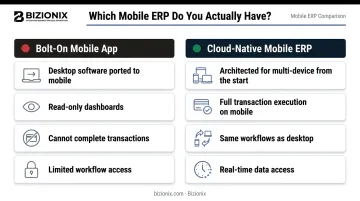
- ERP with a bolt-on mobile app — desktop software ported to mobile, typically limited to read-only dashboards where users can view data but can't complete transactions
- Cloud-native mobile ERP — systems architected for multi-device access from the start, where mobile users can execute the same workflows as desktop users, not just observe them
The second category is what you actually want. A view-only dashboard on your phone doesn't help a warehouse manager receive a shipment or a billing team generate an IRN (Invoice Reference Number) at the point of invoice. If your mobile user can't complete a transaction, it's not mobile ERP — it's mobile reporting.
With those criteria in mind, here are five platforms that deliver genuine mobile ERP capability in 2025.
Best Mobile ERP Systems in 2025
These five platforms were selected based on mobile capability depth, India compliance readiness, total cost of ownership, and practical fit for growing businesses — not feature list length.
Bizionix
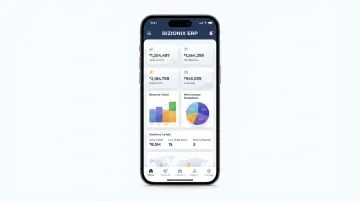
Bizionix, developed by IIS-LLP — a subsidiary of Protocol India Private Limited — is a 100% cloud-based ERP built specifically for Indian MSMEs. It serves manufacturers, distributors, CA firms, hotels, and multi-location enterprises, replacing fragmented tools with a single unified platform accessible from any device.
What separates Bizionix from the other platforms on this list is its ground-up design for Indian business compliance. The system connects directly with the GST e-Invoice portal via API, generating IRNs and QR codes at the point of billing in seconds — with no third-party connector or manual upload required. GSTR-1 auto-population keeps sales, returns, and accounting aligned without separate reconciliation steps.
For business groups and franchise networks, Bizionix's single secure login for multiple entities is a practical differentiator. Each entity maintains independent books of accounts, GST filings, and ledgers, while administrators get group-level dashboards and consolidated financial views — all accessible from mobile.
| Category | Details |
|---|---|
| Best Suited For | Indian MSMEs, manufacturers, distributors, CA firms, multi-location businesses, and business groups managing multiple entities |
| Key Mobile Capabilities | 100% cloud-based access from any device; real-time dashboards; live inventory, billing, and financial visibility; activity tracking across teams |
| India Compliance | GST-ready accounting, direct API integration with GST e-Invoice system, automated IRN generation, GSTR-1 auto-population, e-way bill support |
| Pricing | NEO plan: ₹999/year (14-day free trial included); Enterprise plan: custom pricing on request |
Oracle NetSuite
Over 43,000 businesses worldwide use Oracle NetSuite, a cloud ERP covering finance, supply chain, manufacturing, HR, and e-commerce. Mobile access is available through native iOS and Android apps, supporting dashboards, approval workflows, expense tracking, and real-time KPIs.
NetSuite's strength lies in its multi-subsidiary architecture, deep analytics, and SuiteCloud customisation platform. The platform is built for organisations with dedicated IT and ERP teams. For Indian MSMEs, the quote-only pricing model and implementation complexity make it better suited to mid-to-large enterprises.
| Category | Details |
|---|---|
| Best Suited For | Mid-to-large enterprises with global operations, multiple subsidiaries, or complex supply chains |
| Key Mobile Capabilities | Role-based mobile dashboards, real-time KPIs, approval workflows, mobile access to financials and inventory |
| India Compliance | Supports GST via configuration; not natively optimised for Indian MSME compliance workflows |
| Pricing | Custom pricing only; annual licence based on platform, modules, and users |
Microsoft Dynamics 365
Microsoft Dynamics 365 is a modular cloud ERP and CRM platform with native integration into Microsoft 365 tools — Excel, Outlook, and Teams. Mobile access is available across its application suite, and the Finance module includes India GST localisation through Microsoft's official configurations.
The platform's AI-assisted analytics and Microsoft ecosystem depth make it compelling for enterprises already invested in Microsoft infrastructure. Its licensing complexity is a real constraint, though — the July 2024 licensing guide lists 39 distinct licence types, and most deployments require an ERP implementation partner, which raises the barrier significantly for smaller businesses.
| Category | Details |
|---|---|
| Best Suited For | Medium-to-large enterprises using Microsoft tools, requiring modular ERP with CRM integration |
| Key Mobile Capabilities | Mobile-ready across its application suite; real-time data from Dynamics and Microsoft 365; AI-assisted decision support |
| India Compliance | India GST support via Microsoft Finance localisation and configuration; not built natively for MSME workflows |
| Pricing | Business Central: from USD 80/user/month; broader Dynamics 365 pricing varies by application |
Zoho Finance Plus
Zoho Finance Plus is a unified finance suite integrating invoicing, accounting, order management, inventory, and payments — connected within the broader Zoho ecosystem including CRM and HR tools. Its Zoho Books module is widely used by Indian SMBs for built-in GST compliance.
The platform's primary advantages are affordability and ecosystem breadth. Zoho Books supports GST return filing, e-invoicing with IRN generation, and e-way bill creation directly. The trade-offs: manufacturing depth and multi-entity management are thinner than a dedicated ERP, which matters for businesses with complex operational workflows.
| Category | Details |
|---|---|
| Best Suited For | Small to mid-sized Indian businesses needing integrated accounting, GST compliance, and invoicing on mobile |
| Key Mobile Capabilities | Mobile access via Zoho Books and Zoho Invoice apps; real-time inventory updates; payment tracking and approvals on iOS and Android |
| India Compliance | Built-in GST return filing, e-invoicing (IRN), e-way bill generation through Zoho Books |
| Pricing | USD 199/organisation/month (annual) or USD 249/organisation/month (monthly), including 10 users |
Odoo
Odoo is an open-source ERP suite available in community (free) and enterprise editions, covering accounting, CRM, manufacturing, e-commerce, inventory, HR, and more. Mobile access works through both a browser-based interface and a dedicated app. India localisation documentation covers GST workflows, e-way bills, and e-invoicing via GSP configuration.
Odoo's open-source flexibility makes it highly customisable — the community edition is a zero-cost entry point for cost-conscious businesses. The trade-off: multi-module enterprise deployments typically require third-party consultants, and G2 reviewers flag performance degradation and complexity in larger implementations.
| Category | Details |
|---|---|
| Best Suited For | Tech-comfortable SMBs and growing enterprises seeking a customisable, modular ERP with broad functional coverage |
| Key Mobile Capabilities | Mobile-responsive browser interface; dedicated Odoo mobile app; real-time data across inventory, sales, and finance modules |
| India Compliance | GST support via community and partner modules; requires configuration for full Indian compliance workflows |
| Pricing | Community: free; Enterprise: pricing varies by plan — check the Odoo pricing page for current regional rates |
Key Features to Look for in a Mobile ERP Solution
Not all ERP systems that claim mobile access actually deliver it. Here's what separates a genuinely useful mobile ERP from one that looks good in a demo.
Real-Time Data Access and Offline Functionality
A true mobile ERP pulls live data from a central cloud database — current inventory levels, pending approvals, outstanding invoices — rather than a stale snapshot from the last sync. For Indian businesses with teams in warehouses, factory floors, or remote sites, offline mode is equally important: users should be able to continue working when connectivity drops, with automatic sync when it restores. India's mobile internet penetration gaps make this a practical requirement — not an edge case worth overlooking.
GST and Compliance Readiness
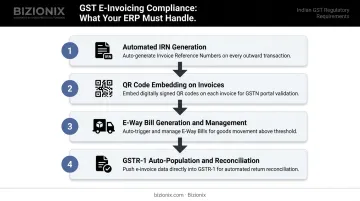
For businesses with aggregate turnover exceeding ₹5 crore, e-invoicing compliance under GST Council Notification 10/2023-Central Tax is mandatory. This means your ERP must handle:
- Automated IRN generation at the point of billing
- QR code embedding on invoices
- E-way bill generation and management
- GSTR-1 auto-population and reconciliation
Systems that rely on third-party plugins or manual portal uploads for these workflows add compliance risk, not just inconvenience.
Role-Based Access Control and Multi-Entity Support
Growing businesses need different people to see different data. The right mobile ERP enforces granular permissions at the module, location, and entity level:
- Salespeople see pipeline and customer data — not P&L statements
- Warehouse staff manage inventory without touching billing records
- Admins control access at view, edit, or full-admin levels per role
For business groups or franchise networks, single-login multi-entity management is a critical capability. Look for systems that maintain independent books per entity while providing group-level consolidated views.
Ease of Deployment and Scalability
Gartner estimates that by 2027, more than 70% of ERP implementations will fail to meet their original business-case goals — largely because of implementation complexity and poor adoption. This makes deployment simplicity a genuine evaluation criterion for Indian MSMEs:
- Cloud-based setup with guided onboarding
- Module-by-module rollout options
- Ability to add users, locations, or entities without re-implementation
- Support that doesn't require an SAP-level consulting engagement
Mobile UX Quality and Dashboard Design
A dashboard that requires 12 taps to find inventory levels — or financial reports that don't render on a 6-inch screen — will see low adoption within weeks of go-live. Look for:
- Clean, intuitive interfaces designed for mobile-first use
- KPIs surfaced on the home screen — sales trends, overdue collections, stock alerts
- Responsive design that works on both Android and iOS without a degraded experience
How to Choose the Right Mobile ERP for Your Business
Evaluate by Workflow, Not Feature List
Most ERP decisions go wrong in the demo room. Teams get impressed by feature breadth and miss the real test: can the mobile interface complete your actual daily workflows end-to-end? Before shortlisting vendors, map your three or four core daily workflows — billing, inventory dispatch, expense approval, or GST filing — and walk through each one on the mobile app.
A platform that handles those workflows smoothly on mobile, even with fewer total features, will outperform a more complex platform your team abandons within three months.
Match Platform to Business Complexity
Different business types have genuinely different requirements:
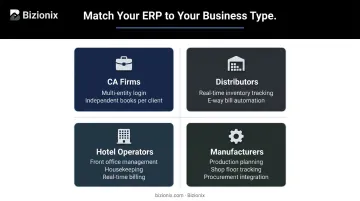
- CA firms managing multiple client portfolios need multi-entity login and independent books per client — not manufacturing modules
- Distributors with multiple warehouses need real-time inventory tracking and e-way bill automation across locations
- Hotel operators need front office, housekeeping, and billing modules that update in real time, not batch reporting
- Manufacturers need production planning and shop floor tracking integrated with procurement and finance
No single platform fits all of these. Once you've identified which category your business falls into, use that as your primary filter — it will eliminate most vendors before you ever schedule a demo.
Validate GST Compliance Before Everything Else
For Indian businesses approaching or above the ₹5 crore threshold, GST compliance is a legal requirement, not an optional module. Confirm whether GST support is native to the platform or depends on third-party configuration. Ask specifically:
- Does IRN generate automatically at the point of invoice creation?
- Is e-way bill management integrated with delivery and dispatch workflows?
- Does the system auto-populate GSTR-1 from sales data?
Conclusion
Mobile ERP has moved from enterprise luxury to operational necessity for Indian MSMEs. The combination of distributed teams, GST compliance mandates, and increasingly affordable cloud platforms means the question is no longer whether to adopt mobile ERP — it's which one fits your business.
Evaluate solutions on native compliance support, mobile UX quality, deployment simplicity, and scalability. Ask whether the platform handles GST natively, whether your non-technical team members will actually use the mobile interface, and whether the pricing makes sense at your current size and your projected size in three years.
If you're an Indian MSME looking for a cloud ERP built around your compliance requirements — direct GST e-invoice API integration, multi-entity management, and real-time mobile access across finance, inventory, and operations — explore Bizionix. Built by IIS-LLP with over two decades of industry experience, it gives growing businesses full operational control without SAP-level complexity or cost.
Start with a 14-day free trial or reach out at info@bizionix.com or connect via WhatsApp to get started.
Frequently Asked Questions
What is a mobile ERP?
Mobile ERP is an enterprise resource planning system that employees can access and operate through smartphones or tablets, giving them real-time visibility into business data — financials, inventory, orders, and more — from any location. Unlike traditional ERP that requires desktop access, mobile ERP keeps teams connected whether they're on the factory floor, at a client site, or working remotely.
Which ERP software is best for accounting?
For Indian MSMEs, systems with native GST support, automated e-invoicing, and integrated accounts payable/receivable such as Bizionix or Zoho Books offer the most practical accounting value. Larger enterprises with complex multi-entity or international requirements may find Oracle NetSuite or Microsoft Dynamics 365 Finance better suited to their needs.
What features should I look for in a mobile ERP system?
Prioritise real-time data access, offline functionality, role-based access controls, and GST/e-invoicing compliance. Beyond that, look for a clean mobile UX that non-technical teams will actually use, plus multi-entity or multi-location support as your business grows.
Can mobile ERP work without an internet connection?
Most modern mobile ERP solutions support offline functionality, letting users continue working without a connection and syncing data automatically once it's restored. This matters most for warehouse staff, factory floors, and field sales teams operating in areas with inconsistent connectivity.
Is mobile ERP suitable for small businesses in India?
Yes. Cloud-based mobile ERP has become more accessible and affordable for Indian small businesses, with options ranging from ₹999/year for basic plans to subscription models that scale with team size. The key advantage for small businesses is eliminating the upfront infrastructure investment that traditional on-premise ERP required.
What is the difference between cloud ERP and mobile ERP?
Cloud ERP describes how the software is hosted: on the vendor's servers, accessed via the internet. Mobile ERP describes how it is accessed: via smartphones or tablets. Most modern cloud ERP systems include mobile access, though the best ones replicate the full desktop experience rather than offering a stripped-down, view-only interface.