Choosing an ERP in 2025 is not just a software decision. It is a choice about which operational reality your business wants to inhabit — one where finance, inventory, sales, and compliance stay permanently out of sync, or one where they all speak the same language in real time.
This list covers 10 ERP providers selected for their reliability, feature depth, India-market relevance, and fit across different business sizes. It includes both global enterprise platforms and India-built solutions designed specifically for how MSMEs here actually operate.
Key Takeaways
- ERP software connects finance, inventory, HR, sales, and operations into one unified platform with shared, real-time data
- Indian MSMEs have GST, e-invoicing, and TDS requirements that most global platforms don't handle natively
- The right ERP depends on company size, industry, deployment preference, and how complex your compliance requirements are
- This list covers 10 providers ranging from enterprise-grade global platforms to India-built MSME solutions
- Bizionix is a purpose-built cloud ERP for Indian MSMEs — GST-ready, e-invoicing integrated, and priced without SAP-level complexity
What Is ERP and Why Do Indian MSMEs Need It?
An ERP (Enterprise Resource Planning) system is a unified software platform that connects finance, inventory, procurement, sales, HR, and operations so every department works from the same data in real time — not from separate spreadsheets that nobody trusts.
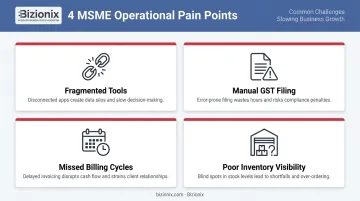
For Indian MSMEs, the pain is specific:
- Fragmented tools — accounting in Tally, inventory in Excel, HR in a separate system, nothing talking to each other
- Manual GST filing — error-prone, time-consuming, and increasingly non-negotiable as thresholds tighten
- Missed billing cycles — no automated follow-up, no consolidated view of receivables
- Poor inventory visibility — stock discrepancies across locations with no single source of truth
GST e-invoicing is now mandatory for businesses with aggregate turnover above ₹5 crore in any preceding financial year. That threshold covers a large share of growing MSMEs — and without integrated software, teams are left managing compliance manually across dozens of filings, with penalty exposure for every error.
The India ERP Software Market was valued at USD 4,500 million in 2024 and is projected to grow at a 9.33% CAGR through 2035 — reflecting how quickly Indian businesses are moving away from patchwork tools toward unified platforms. If you're evaluating that move, here are the 10 providers worth shortlisting.
Top 10 Best ERP Software Solution Providers for 2025
These providers were assessed on industry relevance, India-market readiness, scalability, deployment flexibility, and real-world usability for businesses ranging from growing MSMEs to mid-sized enterprises.
1. Bizionix (by IIS-LLP)
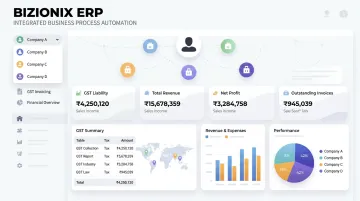
Bizionix is a cloud-based ERP built specifically for Indian MSMEs by IIS-LLP, a subsidiary of Protocol India Private Limited backed by over two decades of industry experience. It covers accounting, GST compliance, inventory, billing, HR, sales, and multi-company management, all accessible from a single secure login.
Its India-first design goes beyond cosmetic localisation. Bizionix connects directly with the GST Invoice Registration Portal (IRP) via API, generating IRNs and QR codes instantly at the point of invoice creation, with no manual JSON uploads or third-party intermediaries. Every invoice is automatically validated against GST rules before submission, eliminating rejection risk.
Multi-company management is built into the core architecture. CA firms, holding companies, and franchise networks can switch between GST-registered entities without logging out. Each entity maintains fully independent books while consolidated group-level dashboards remain accessible from one login.
The pricing reflects its MSME focus: the Bizionix NEO plan starts at ₹999 per year, with an Enterprise plan available for larger operations requiring production planning, advanced warehouse management, and custom configurations.
| Attribute | Details |
|---|---|
| Best For | Indian MSMEs, manufacturing, distribution, hotels, CA firms, multi-location businesses |
| Deployment | 100% Cloud-based |
| Key Differentiator | GST-ready with direct e-invoicing API, multi-company management, India-first design |
2. SAP Business One
SAP Business One is SAP's ERP solution for small to mid-sized businesses, covering finance, inventory, sales, purchasing, and production management. It is one of the most widely deployed SME ERPs globally, available in India through a certified partner network.
SAP's India localisation guide for Business One (updated May 2024) covers electronic billing, IRP communication, IRN generation, and QR code handling, confirming verified compliance support for Indian e-invoicing requirements. Its financial reporting depth and broad industry coverage make it a credible option for businesses that need enterprise-grade capability without moving to SAP S/4HANA.
The tradeoff: licensing and implementation costs are significant, and customisation for specific Indian workflows typically requires partner engagement.
| Attribute | Details |
|---|---|
| Best For | Small to mid-sized businesses, manufacturing, distribution |
| Deployment | Cloud, On-premise, Hybrid |
| Key Differentiator | Enterprise-grade depth with SAP's global credibility and verified India e-invoicing localisation |
3. Oracle NetSuite
Oracle NetSuite is a globally recognised cloud ERP platform serving over 43,000 customers across 200+ countries. It offers ERP, CRM, inventory, e-commerce, and financial management from a single cloud platform.
NetSuite's strength is financial consolidation across multiple entities and currencies, which makes it particularly useful for fast-growing businesses and those with international operations. The platform scales effectively from mid-market businesses into larger enterprise environments.
Pricing is not publicly listed and can be significant for smaller firms. India-specific compliance customisation may require additional configuration.
| Attribute | Details |
|---|---|
| Best For | Mid-market businesses, global operations, high-growth companies |
| Deployment | Cloud only |
| Key Differentiator | Multi-entity, multi-currency financial management with strong real-time analytics |
4. Microsoft Dynamics 365 Business Central
Microsoft Dynamics 365 Business Central is a cloud-based ERP for small to mid-sized businesses with deep integration across the Microsoft 365 ecosystem: Excel, Outlook, Power BI, and Teams. It includes India local functionality pages on Microsoft Learn covering GST, audit trail, TDS, and GST Input Service Distribution.
The 2024 release wave added Copilot-powered features including bank reconciliation assistance, sales line suggestions, and a Sales Order Agent preview. Official pricing starts at USD 80/user/month for the Essentials plan and USD 110/user/month for Premium.
Implementation effort for customisation can be substantial, and total cost of ownership scales with user count and partner fees.
| Attribute | Details |
|---|---|
| Best For | SMBs already using Microsoft tools, finance and operations management |
| Deployment | Cloud, On-premise, Hybrid |
| Key Differentiator | Seamless Microsoft ecosystem integration with AI-assisted workflows |
5. Tally Prime
Tally Prime is India's most widely used business management software, trusted by 2.7 million+ businesses for accounting, GST filing, inventory, and payroll. It supports IRN generation, QR code embedding, and e-way bill workflows natively.
TallyPrime 4.0 introduced cloud access hosted on Oracle Cloud Infrastructure. The platform's familiarity among Indian accountants and CAs, combined with its affordable pricing and offline capability, makes it the default tool for accounting-first operations.
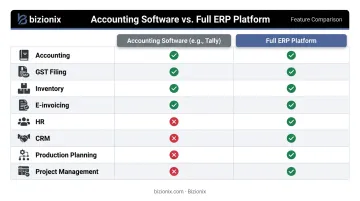
Tally primarily excels at accounting, GST, and inventory. It does not offer the broader operational modules (HR, CRM, production planning, project management) that define a full ERP platform — an important distinction for businesses that need more than compliance and bookkeeping.
| Attribute | Details |
|---|---|
| Best For | Micro and small businesses, Indian accounting-first operations |
| Deployment | On-premise (with cloud access via TallyPrime 4.0) |
| Key Differentiator | Dominant GST compliance tool, widely supported by Indian CAs |
6. Zoho One
Zoho One is an integrated suite of 46 cloud business applications from Chennai-based Zoho Corporation, covering CRM, accounting, inventory, HR, marketing, and project management. With 100M+ users globally, Zoho has strong India roots and offers competitive pricing with India-relevant compliance features.
For service businesses and startups, Zoho One functions effectively as a de facto ERP: affordable, easy to deploy, and well-integrated across its own app ecosystem. Businesses with heavy manufacturing, MRP, or warehouse management needs should validate whether Zoho's depth in those specific areas meets their requirements before committing.
| Attribute | Details |
|---|---|
| Best For | Service businesses, SMBs, startups seeking integrated tools |
| Deployment | Cloud only |
| Key Differentiator | Affordable all-in-one suite with 46 integrated apps and strong India presence |
7. Odoo ERP
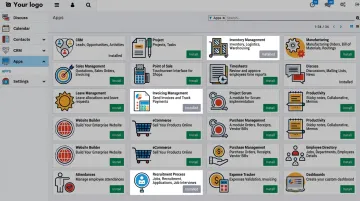
Odoo is an open-source, modular ERP platform with 30+ core business applications covering sales, inventory, manufacturing, accounting, HR, and project management. It is available in two versions: Community (open-source, free) and Enterprise (licensed).
The modular approach lets businesses start with one or two applications and expand as needed, which is a practical path for SMBs that cannot justify a full ERP investment upfront. A large global partner network supports implementation, with India-specific partners available through Odoo's partner directory.
Implementation and customisation require technical resources, and the total cost of the Enterprise version scales with application count and user size.
| Attribute | Details |
|---|---|
| Best For | SMBs with technical resources, e-commerce, service and manufacturing businesses |
| Deployment | Cloud, On-premise |
| Key Differentiator | Highly modular open-source platform with flexible starting costs |
8. ERPNext
ERPNext is a 100% open-source ERP built on the Frappe framework, covering accounting, inventory, manufacturing, HR, CRM, and project management. It has meaningful adoption among Indian MSMEs, NGOs, and educational institutions.
Zero licensing cost makes ERPNext an attractive starting point for technically capable teams. The web-based architecture means no local installation, and the active open-source community supports ongoing development. Businesses without in-house technical resources will typically need an implementation partner for initial setup and customisation.
| Attribute | Details |
|---|---|
| Best For | MSMEs, NGOs, educational institutions, technically capable teams |
| Deployment | Cloud, On-premise |
| Key Differentiator | Free and open-source with built-in Indian GST compliance |
9. Epicor Kinetic
Epicor Kinetic is a global cloud ERP designed specifically for manufacturers, covering production scheduling, supply chain, inventory, and shop-floor management. Its Prism AI module delivers outcomes-based AI capabilities embedded directly into ERP workflows, including RFQ automation.
Epicor's industry-specific depth in manufacturing processes makes it a strong fit for mid-market manufacturers who need more than generic ERP. India localisation and pricing are not publicly verified; businesses considering Epicor should confirm compliance coverage for Indian tax requirements before proceeding.
| Attribute | Details |
|---|---|
| Best For | Mid-market manufacturers, distributors, retail chains |
| Deployment | Cloud, On-premise |
| Key Differentiator | Industry-specific manufacturing modules with AI-powered operational insights |
10. Sage X3
Sage X3 is positioned for mid-sized businesses in manufacturing, distribution, and services. It offers comprehensive financial management, inventory, purchasing, and supply chain capabilities with multi-company and multi-currency support.
Sage has a Bangalore office, though X3 localisation for Indian compliance requirements should be verified before selection. Its balance between capability and implementation complexity suits growing mid-sized businesses with international or multi-country operations.
| Attribute | Details |
|---|---|
| Best For | Mid-sized manufacturers, distributors, businesses with multi-country operations |
| Deployment | Cloud, On-premise |
| Key Differentiator | Mid-market ERP with strong financial management depth and multi-entity support |
How We Chose the Best ERP Software Providers
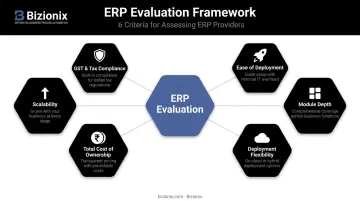
Providers on this list were evaluated across six key criteria:
- GST and tax compliance readiness — native e-invoicing, GSTR filing, TDS/TCS support
- Ease of deployment and adoption — time to go live, technical requirements, onboarding support
- Module depth — coverage across finance, inventory, HR, sales, and production
- Deployment flexibility — cloud, on-premise, or hybrid options
- Total cost of ownership — licensing, implementation, ongoing support, and customisation costs combined
- Scalability — ability to grow with the business without platform migrations
Gartner's ERP research notes that by 2027, more than 70% of recently implemented ERP initiatives will fail to fully meet original business-case goals. The most common reason is not a bad product — it is a poor fit between the platform and the operational reality of the business.
That fit problem is more acute for Indian MSMEs, where local compliance requirements can expose gaps that global platforms weren't built to handle. Three criteria therefore carry extra weight in this evaluation:
- Affordable licensing — pricing that doesn't assume enterprise-scale budgets
- Local implementation support — partners or in-house teams with India-specific deployment experience
- Native GST e-invoicing integration — built-in IRN generation and GSTR filing, not a bolt-on afterthought
Global platforms requiring extensive customisation to meet these requirements add hidden costs and stretch implementation timelines. Platforms purpose-built for the Indian market address them out of the box, which is why compliance readiness is a decisive factor in the rankings below.
Conclusion
The right ERP is not the most recognised brand or the longest feature list. It is the one that aligns with your operational complexity, your compliance environment, your team's technical capacity, and your growth trajectory.
Before finalising any decision, evaluate on:
- Total cost of ownership: factor in implementation, training, ongoing support, and customisation — not just the licensing fee
- India compliance readiness — GST, e-invoicing, TDS, and GSTR filing should be native, not add-ons
- Implementation timeline: assess how quickly your team can go live and operate the system without ongoing vendor dependency
- Vendor understanding of your industry — a manufacturing business has different ERP requirements than a service firm or hotel group
For Indian MSMEs that need a GST-ready cloud ERP without the complexity or cost of enterprise platforms, Bizionix is built specifically for how Indian businesses operate. It covers multi-company management, direct e-invoicing API integration, real-time dashboards, and subscription pricing sized for growing businesses. Explore Bizionix or request a demo to see it in action.
Frequently Asked Questions
Is SAP a CRM or an ERP?
SAP is primarily an ERP platform. SAP Business One and SAP S/4HANA are full ERP systems covering finance, supply chain, manufacturing, and HR. SAP does offer a separate CRM product (SAP Customer Experience / C4HANA), but its core identity and market leadership is rooted in ERP.
What is the best ERP software for small businesses in India?
It depends on your primary need. Tally Prime dominates for accounting-first operations; Zoho One suits service businesses and startups; ERPNext works well for technically capable teams seeking zero licensing costs. Bizionix fits MSMEs that need a full-featured cloud ERP with GST compliance, multi-department management, and multi-company support.
What is the difference between cloud ERP and on-premise ERP?
Cloud ERP is hosted on the vendor's servers and accessed via the internet, with lower upfront costs and faster deployment. On-premise ERP is installed locally, offering more control but requiring higher investment in IT infrastructure and ongoing maintenance. For most Indian MSMEs, cloud ERP is the more practical choice.
How long does ERP implementation typically take?
Timelines vary widely. Simple cloud ERP setups can go live in days or weeks — Bizionix, for instance, lets businesses connect their GSTIN and generate compliant invoices within minutes. Complex enterprise implementations with heavy customisation typically take 6–18 months.
What features should I look for in an ERP for my Indian business?
Prioritise GST and e-invoicing compliance, real-time financial reporting, inventory management, multi-location support, and ease of use for non-technical staff. India-specific features worth checking for include e-way bill integration, TDS/TCS management, and GSTR-1 auto-population.
Is Tally considered an ERP system?
Tally Prime is better categorised as accounting and business management software rather than a full ERP. It excels at accounting, GST compliance, and inventory but lacks the broader operational modules — HR, CRM, production planning, project management — that define a complete ERP platform.