Introduction
Running an eCommerce business today means simultaneously managing inventory across multiple warehouses, processing orders from several marketplaces, reconciling payments from different gateways, and staying GST-compliant — all while trying to grow. Fragmented tools can handle this at small scale, but they crack under pressure as order volumes rise.
The cost of not having a unified system is measurable: missed orders, stock mismatches, delayed book closures, and customer experience failures. According to Blue Yonder and IHL Group, retail inventory distortion alone cost the industry $1.77 trillion USD in 2023 — a direct consequence of disconnected data across sales channels and warehouses.
An ERP solves this by connecting inventory, orders, finance, and customer management into one platform. With worldwide retail eCommerce forecast at $6.419 trillion USD in 2025, the gap between businesses running unified systems and those relying on patchwork tools keeps widening.
This guide covers the top ERP solutions for eCommerce in 2025 — including options built specifically for Indian MSMEs with GST compliance — the features that matter most, and how to evaluate them for your business size and growth stage.
Key Takeaways
- ERP software unifies inventory, orders, accounting, and CRM into a single platform — essential for scaling eCommerce operations
- Choose based on operational complexity, channel count, compliance needs, and budget — not brand recognition
- For Indian businesses, GST e-invoicing compliance and IRN generation are non-negotiable ERP requirements
- Top options in 2025: Bizionix, Oracle NetSuite, Odoo, Microsoft Dynamics 365 Business Central, and Acumatica
- Indian MSMEs should prioritise GST-readiness and local implementation support, where India-built solutions lead
What Is ERP for eCommerce and Why Does It Matter?
An ERP (Enterprise Resource Planning) system is a centralised software platform that connects all core business functions — inventory, order processing, procurement, finance, and customer management — into one shared data environment. For eCommerce businesses, this means every sale, stock movement, payment, and return flows through a single system of record.
Early-stage eCommerce operations typically manage with platform-native tools: Shopify's built-in inventory, spreadsheets for reconciliation, standalone accounting software. These tools hold up under low volume. As SKU counts grow, channels multiply, and order volumes increase, the gaps compound fast.
Common failure points include:
- Overselling on one channel because another channel's stock wasn't updated
- Closing the books days late due to manual marketplace fee reconciliation
- GST filings requiring data pulled from five different sources
- Returns not reflected in inventory until someone manually updates a spreadsheet
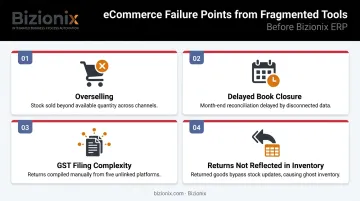
The trigger for ERP adoption isn't a specific order count or SKU threshold. It's process failure — when inventory distortion becomes routine and manual reconciliation starts eating hours that should go toward growth.
The ERP solutions below are evaluated for functionality, integration depth, and fit across business sizes — from Indian MSMEs scaling their first warehouse to mid-market companies managing multi-channel operations.
Best ERP Software for eCommerce in 2025
These solutions were selected based on reliability, eCommerce-specific functionality (inventory sync, multi-channel order management, GST/tax compliance), deployment flexibility, and fit for different business sizes.
Bizionix
Bizionix is a 100% cloud-based ERP developed by IIS-LLP (a subsidiary of Protocol India Private Limited), built specifically for Indian MSMEs. It serves eCommerce businesses, manufacturers, distributors, and multi-location enterprises that need unified business management without SAP-level complexity.
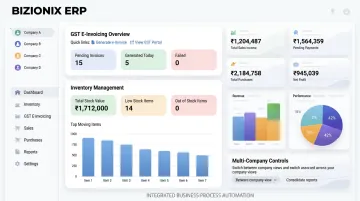
For Indian eCommerce sellers, its most distinctive capability is direct API integration with the GST Invoice Registration Portal (IRP) for instant IRN generation — a four-step process that goes from invoice creation to QR-code-ready PDF in seconds, not hours. Businesses above the ₹5 crore turnover threshold are now required to generate e-invoices, making this built-in compliance a practical necessity rather than a nice-to-have.
The platform also supports multi-company management under a single login, letting operators manage separate legal entities, GST-registered branches, or regional warehouses from one account — with entity-level access controls and independent books of accounts per entity.
| Feature Category | Details |
|---|---|
| Key Features | 100% cloud-based; real-time inventory and stock tracking; GST-ready accounting; automated e-invoicing with direct IRP API; multi-company and multi-location management; Sales & CRM; configurable workflows |
| Pricing | NEO plan at ₹999/year (14-day free trial); Enterprise plan with custom pricing — contact Bizionix directly |
| Best For | Indian MSMEs, eCommerce businesses, distributors, manufacturers, and franchise networks needing GST compliance and unified operations |
Oracle NetSuite
Oracle NetSuite is a cloud ERP used by tens of thousands of organisations across more than 200 countries. Its SuiteCommerce module adds a native eCommerce storefront, while its core handles financial management, inventory, and order processing at scale.
NetSuite's multi-subsidiary financial architecture handles complex corporate structures cleanly. It supports multi-warehouse inventory with lot and serial tracking, and its ecosystem includes mature integrations with Shopify, Amazon, and major 3PLs. The trade-off is cost — mid-market implementations carry significant price tags that make it a poor fit for early-stage businesses.
| Feature Category | Details |
|---|---|
| Key Features | Multi-channel order management; real-time inventory across locations; financial automation; SuiteCommerce native storefront; demand forecasting; advanced reporting |
| Pricing | Quote-based; analyst sources place the base licence around $999/month plus $99–$199/user/month, with implementation costs ranging from $25,000 to $750,000 depending on scope |
| Best For | Mid-to-large eCommerce businesses selling across multiple channels and geographies, with complex financial management needs |
Odoo
Odoo is an open-source, modular ERP that includes a native eCommerce module alongside inventory, accounting, CRM, and marketing — all in one platform. Its open-source Community edition is free, which removes the licensing barrier for cost-conscious businesses. The modular design means companies can start with just inventory and accounting, then add eCommerce or CRM as needed.
Implementation quality varies significantly by partner, so choosing an experienced Odoo implementer matters — the software's flexibility is its strength and its risk.
| Feature Category | Details |
|---|---|
| Key Features | Native eCommerce storefront; inventory and warehouse management; accounting and tax automation; CRM; multi-channel support; drag-and-drop web store configuration |
| Pricing | Community edition: free; Enterprise Standard: $24.90/user/month (billed annually); Enterprise Custom: $37.40/user/month (billed annually); implementation costs vary by partner |
| Best For | Cost-conscious SMBs and mid-market eCommerce businesses wanting flexibility and broad functionality without high licensing fees |
Microsoft Dynamics 365 Business Central
Microsoft Dynamics 365 Business Central is a cloud ERP designed for growing businesses, covering financial management, supply chain, inventory, and eCommerce. Its built-in Shopify connector makes it a strong back-office option for Shopify-based merchants.
Native Shopify integration, Power BI reporting, and Microsoft ecosystem compatibility (Teams, Outlook, Excel) reduce implementation friction for businesses already running on Microsoft tools. Demand forecasting, sales and returns management, and real-time inventory updates are all handled within a scalable cloud environment.
Note: Microsoft updated Business Central pricing effective November 2025.
| Feature Category | Details |
|---|---|
| Key Features | Built-in Shopify connector; financial and cash flow management; inventory tracking; demand forecasting; Power BI reporting; sales, returns, and shipment management |
| Pricing | Essentials: $80/user/month; Premium: $110/user/month; Team Members: $8/user/month (all billed yearly); implementation costs depend on partner scope |
| Best For | Growing eCommerce businesses and mid-market companies already in the Microsoft ecosystem, particularly Shopify merchants needing integrated back-office operations |
Acumatica Commerce Edition
Acumatica offers a purpose-built Commerce Edition with vendor-developed (not third-party) native integrations for Shopify, BigCommerce, and Amazon. Its consumption-based pricing — based on resource usage rather than per-user seats — makes it cost-effective for teams where many staff need system access.
Multi-warehouse inventory management, order routing, and fulfillment automation are strong suits. Its open API supports integration with a wide range of shipping, CRM, and analytics tools. It suits businesses that have outgrown basic platform tools but aren't ready for enterprise-level complexity.
| Feature Category | Details |
|---|---|
| Key Features | Native Shopify, BigCommerce, and Amazon connectors; multi-warehouse inventory; order routing and fulfillment automation; CRM; reporting dashboards; unlimited users |
| Pricing | Quote-based; consumption/resource-based model — not per-user; implementation costs typically fall in the mid-market range |
| Best For | Multi-channel eCommerce businesses scaling across marketplaces that need strong native integrations and unlimited user access without per-seat fees |
Key Features to Look for in an eCommerce ERP
Inventory and Order Management
Real-time inventory sync across all sales channels is essential. Without it, overselling and stockouts become routine — and the industry-wide cost of that failure was $1.77 trillion in 2023.
What to evaluate:
- Multi-channel sync: Does inventory update instantly when a sale happens on any channel?
- Multi-location support: Can the system track stock across multiple warehouses or fulfilment centres?
- Order consolidation: Are orders from all platforms pulled into one queue with automated routing to the right fulfillment location?
Financial Automation and Compliance
eCommerce businesses manage revenue from multiple channels simultaneously — marketplace fees, refunds, payment gateway deposits, and tax obligations all need reconciliation. Manual handling at scale creates errors and delays.
For Indian businesses specifically, GST compliance requirements have expanded. Notification No. 10/2023 brought e-invoicing requirements down to taxpayers with aggregate annual turnover between ₹5 crore and ₹10 crore from August 2023. Any MSME above this threshold needs an ERP with direct IRP integration to handle IRN generation without manual intervention.
Features to confirm:
- Automated IRN generation and QR code creation
- GST return preparation and filing support
- Bank reconciliation and multi-channel revenue matching
Scalability and Integration Capability
The right ERP should accommodate growth without requiring a platform switch. Evaluate:
- API connectivity: Does the ERP integrate with your payment gateways, shipping carriers, and storefronts?
- Native vs. third-party connectors: Native connectors (like Acumatica's Shopify integration or Business Central's built-in connector) are more reliable than third-party middleware
- User and transaction limits: Understand the pricing implications of growth — per-user models become expensive as teams scale
How We Chose the Best ERP for eCommerce
The most common mistake in ERP selection is choosing based on brand recognition rather than operational fit. An ERP built for large manufacturing enterprises may be over-engineered and overpriced for an MSME eCommerce operation — and vice versa.
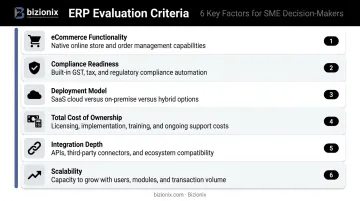
The evaluation criteria used for this list:
- eCommerce functionality: Multi-channel inventory, order management, marketplace integrations
- Compliance readiness: GST/tax automation, e-invoicing, IRN generation
- Deployment model: Cloud-first preferred; SaaS removes infrastructure burden
- Total cost of ownership: Licensing + implementation + ongoing maintenance — not just the per-user sticker price
- Integration depth: Native connectors preferred over middleware-dependent approaches
- Scalability: Fit for expected growth over 12–24 months, not just current state
For Indian MSMEs specifically, GST e-invoicing compliance, rupee-based pricing transparency, and local implementation support should be weighted heavily. Gartner predicts that by 2027, more than 70% of recently implemented ERP initiatives will fail to fully meet original business case goals — which makes phased evaluation and realistic scoping critical before signing any contract.
That failure risk is amplified when an ERP isn't built for the local regulatory environment. India-specific solutions like Bizionix address this directly: direct IRP API integration for GST e-invoicing, local support teams in Hyderabad, and rupee pricing that removes the currency conversion markup common with global ERP vendors.
Conclusion
Choosing the right ERP for eCommerce comes down to fit — operational fit, compliance fit, and growth fit. An overpowered platform bogs teams down; an underpowered one creates workarounds that multiply over time.
Before finalising a decision, assess:
- Scalability: Can the platform handle your projected order volumes and channel growth?
- Total cost of ownership: Include implementation, customisation, and annual maintenance — not just licensing
- Integration fit: Does it connect cleanly with the platforms you already use?
- Compliance readiness: For Indian businesses, GST e-invoicing support is a baseline requirement, not a differentiator
A phased evaluation — pilot one core workflow first, then expand — reduces implementation risk far more than a full organisational rollout at once.
For Indian MSMEs evaluating a cloud ERP with GST compliance, automated e-invoicing, and unified operations management, Bizionix is worth including in that shortlist.
Frequently Asked Questions
What is the best ERP for a small business?
The best ERP for a small business depends on budget, operational complexity, and compliance needs. For Indian MSMEs, Bizionix offers enterprise-grade functionality with built-in GST compliance starting at ₹999/year. Globally, Odoo's free community edition and Acumatica suit small businesses with multi-channel eCommerce needs.
What is the best cloud-based ERP system?
Top cloud-based ERP systems include Oracle NetSuite, Acumatica, Microsoft Dynamics 365 Business Central, and Bizionix. For Indian MSMEs, the best choice combines GST compliance, real-time operational visibility, and local support in a single platform.
What are the top 5 ERPs?
The top 5 ERPs covered in this guide are Bizionix, Oracle NetSuite, Odoo, Microsoft Dynamics 365 Business Central, and Acumatica. The right fit depends on your business size, eCommerce model, and regional compliance requirements — use those three filters to narrow your shortlist.
Which cloud platform is best for small business?
When evaluating cloud platforms, prioritize uptime reliability, data security, and how well the system scales as transaction volumes grow. Indian SMBs should also confirm GST e-invoicing support and local implementation assistance — both of which Bizionix provides natively.
Can an ERP be cloud-based?
Yes — most modern ERP systems are available as cloud-based (SaaS) solutions hosted on remote servers and accessed via the internet. Cloud ERPs offer real-time access from any device, automatic updates, lower upfront costs, and easier scalability, making them the preferred deployment model for most eCommerce businesses today.