Introduction
Running a retail store in India in 2025 means juggling more than just sales. Between managing inventory across locations, staying GST-compliant, and generating e-invoices, most store owners end up patching together four or five disconnected tools. None of them talk to each other properly.
The result? Billing errors, stock mismatches, missed ITC claims, and decisions made on stale data.
India's retail sector is on track to reach between $1.6 trillion and $1.93 trillion by 2030, yet only 12% of Indian MSMEs have adopted ERP software to manage their operations. That gap is a real operational liability — and the right retail software is how growing stores close it.
This guide covers five retail software solutions evaluated specifically for Indian businesses — on GST readiness, core features, pricing, and real-world fit.
Key Takeaways
- Retail software consolidates sales, inventory, billing, and GST compliance into one system
- Indian retailers above ₹5 crore turnover are legally required to use e-invoicing — software must support it natively
- The right solution depends on your store size, number of locations, and whether you need POS, accounting, or full ERP
- Five solutions compared side-by-side: Bizionix, Gofrugal, Zoho Books, Shopify POS, and Oracle NetSuite
- Bizionix is the top all-in-one ERP pick for Indian MSMEs needing GST-ready, cloud-based retail management
What Is Retail Software and Why Does Your Store Need It in 2025?
Retail software covers any digital tool that helps a store manage its operations — from simple billing apps to full ERP platforms handling finance, inventory, compliance, and customer relationships simultaneously.
The Main Categories
| Category | What It Does | Best For |
|---|---|---|
| POS Systems | Processes transactions, tracks basic inventory, generates bills | Single-store retailers needing fast checkout |
| Inventory Management | Tracks stock levels, purchase orders, and reorder points | Retailers with large SKU counts or multiple warehouses |
| Accounting & Billing Software | GST-compliant invoicing, expense tracking, returns | Businesses prioritising financial compliance |
| All-in-One ERP | Combines all of the above plus CRM, multi-entity management, and reporting | Growing or multi-location retailers replacing fragmented tools |
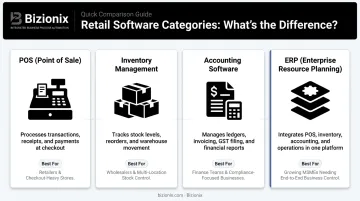
For a single kirana store, a solid POS with GST billing may be enough. For a retail chain, franchise network, or any business crossing the ₹5 crore aggregate turnover threshold where e-invoicing becomes mandatory, an all-in-one ERP delivers far more control and a cleaner path to staying compliant.
Each solution below was evaluated on core functionality, ease of use, GST and e-invoicing compliance, scalability, and overall value — covering Indian retail businesses from single stores to multi-location operations.
Best Retail Software Solutions for Your Store in 2025
Bizionix
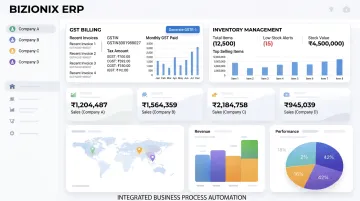
Bizionix is a 100% cloud-based ERP platform built specifically for Indian MSMEs by IIS-LLP, a subsidiary of Protocol India Private Limited. With over two decades of combined industry experience behind it, Bizionix is designed for retail businesses that need unified management across billing, inventory, accounting, and compliance — without SAP-level complexity or cost.
What sets Bizionix apart for Indian retailers is its native GST infrastructure. The platform connects directly with the government's Invoice Registration Portal (IRP) via API, generating IRNs and QR codes instantly at the point of invoice creation. There's no manual JSON upload, no third-party middleware, and no waiting — the invoice is authenticated and ready to share within seconds.
For retailers issuing high volumes of B2B invoices, this alone eliminates hours of weekly admin.
The multi-company management feature is equally relevant for franchise networks and retail chains. A single secure login gives access to all entities — with separate books of accounts, GST compliance, and financials per location — plus consolidated group-level dashboards for owners who need the full picture without switching between systems.
| Feature | Details |
|---|---|
| Key Features | Cloud ERP with modules for inventory, billing, GST accounting, e-invoicing with direct IRP integration, CRM, multi-company management, HRMS, and financial reporting |
| Pricing | NEO plan at ₹999/year (14-day free trial available); Enterprise plan on request — contact info@bizionix.com or +91 91779 99277 |
| Best For | Indian MSMEs, growing retail chains, franchise networks, and businesses replacing scattered tools with a single unified platform |
Gofrugal
Gofrugal is an India-focused retail POS and business management platform with a strong presence across grocery, pharmacy, apparel, and general merchandise retail. It integrates sales, inventory, and accounting in one system — making it a practical choice for store owners who want tight POS-to-accounts connectivity without adopting a full ERP.
Key differentiators include real-time inventory updates, automated purchase orders, built-in GST calculations, and offline transaction support — useful for stores in areas with inconsistent internet connectivity.
| Feature | Details |
|---|---|
| Key Features | POS billing, inventory management, integrated accounting, automated GST calculations, multi-store management, offline/online transactions |
| Pricing | Starter edition at ₹18,000/year (inclusive of GST); higher tiers available; Enterprise requires a custom quote |
| Best For | Small to mid-sized Indian retail stores needing a POS-led solution with built-in accounting and GST support |
Zoho Books
Zoho Books is a cloud-based accounting platform from Zoho Corporation, widely used by Indian MSMEs for GST-compliant invoicing, expense management, and inventory tracking. It's not a POS system — its retail relevance comes through integration with Zoho Inventory and Zoho CRM, making it most powerful for businesses already inside the Zoho ecosystem.
The platform supports direct e-invoicing via the IRP, online GST return filing, e-way bill generation, and smart validation that catches errors before submission. The free plan (for businesses with annual revenue up to ₹25 lakhs) makes it accessible for micro-retailers just starting out.
| Feature | Details |
|---|---|
| Key Features | GST-compliant invoicing with HSN/SAC codes, e-invoicing, e-way bills, bank reconciliation, expense tracking, Zoho Inventory and CRM integration |
| Pricing | Free plan (up to ₹25L revenue); paid plans from ₹749/org/month (billed annually) up to ₹7,999/org/month |
| Best For | Small retailers and growing businesses already using Zoho tools, or those prioritising affordable GST-compliant accounting |
Shopify POS
Shopify POS is the go-to platform for retailers who sell both in-store and online. It unifies physical and digital inventory, customer profiles, and transactions across channels — giving omnichannel retailers a single view of their business regardless of where the sale happens.
One important caveat for Indian retailers: Shopify helps calculate taxes but does not file or remit GST returns. Merchants need a separate GST process or a third-party tax app to handle compliance obligations. This makes Shopify POS most suitable for retailers whose primary challenge is omnichannel operations rather than GST-heavy back-office management.
| Feature | Details |
|---|---|
| Key Features | In-store POS, e-commerce integration, real-time inventory across locations, customer loyalty tools, buy-online-return-in-store workflows |
| Pricing | Basic at ₹1,499/month; Grow at ₹5,599/month; Advanced at ₹22,680/month (billed annually); POS Pro add-on at ₹7,000/month per location |
| Best For | Omnichannel retailers managing both physical stores and online storefronts who need a unified sales platform |
Oracle NetSuite
Oracle NetSuite is a comprehensive cloud ERP for mid-to-large retail businesses, consolidating financial management, inventory, order management, CRM, and e-commerce into one enterprise platform. Its SuiteCommerce module unifies online and in-store operations, while its multi-entity capabilities support complex organizational structures across geographies.
The trade-off is significant: NetSuite pricing is entirely quote-based, implementation typically takes around six months, and the learning curve is steep. For most Indian MSMEs, it's over-engineered and over-budget. For larger chains with complex operations, it's worth evaluating.
| Feature | Details |
|---|---|
| Key Features | ERP, financial management, inventory, CRM, order management, e-commerce fulfillment, multi-currency support |
| Pricing | Quote-based; includes annual licence fee, optional modules, per-user charges, and a one-time implementation fee — contact NetSuite directly |
| Best For | Mid-to-large retail enterprises or growing businesses with complex, multi-location operations requiring enterprise-grade capabilities |
How We Chose the Best Retail Software
The most common mistake retailers make when choosing software is picking a tool that solves one visible problem — like billing — while ignoring inventory accuracy, GST compliance, or the ability to scale across locations. Choosing by name recognition alone can leave critical gaps that surface only after go-live.
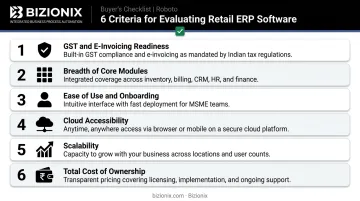
The solutions in this guide were evaluated against the following criteria:
- GST and e-invoicing readiness — does it support Indian compliance requirements natively, including e-invoicing for businesses above the ₹5 crore threshold?
- Breadth of core modules — does it cover billing, inventory, accounting, and CRM, or only one function?
- Ease of use and onboarding — how quickly can a store team get operational?
- Cloud accessibility — is real-time visibility available across locations without local servers?
- Scalability — can it grow from one store to ten without switching platforms?
- Total cost of ownership — includes implementation, training, per-user charges, and whether advanced features require a higher tier
Pricing transparency is worth calling out separately. Gofrugal, Zoho Books, Shopify, and Bizionix all publish usable pricing online. NetSuite does not. For MSMEs working within a defined budget, that gap can determine whether a platform is worth evaluating at all.
Conclusion
The right retail software in 2025 does more than process transactions. It keeps your inventory accurate, your GST returns clean, your multi-location operations visible, and your business decisions grounded in real data rather than end-of-month guesswork.
Before committing to any platform, clarify what you actually need: single store or multiple locations, POS-only or full ERP, and whether GST compliance and e-invoicing are non-negotiable — and for most Indian retailers crossing the ₹5 crore turnover mark, they are.
For Indian MSMEs that need billing, inventory, GST compliance, and multi-company management in one place — without the complexity or cost of enterprise software — Bizionix covers all of it on a single platform.
Start with a 14-day free trial, or reach the team directly at info@bizionix.com or +91 91779 99277 to request a demo.
Frequently Asked Questions
What is the best software for retail business?
The best retail software depends on your size and priorities. For Indian MSMEs, an all-in-one ERP like Bizionix that handles billing, inventory, and GST compliance natively is often the strongest fit. Retailers with a significant online presence may find Shopify POS better suited to their omnichannel needs.
Which ERP is best for the retail industry?
For Indian retail businesses, ERPs with built-in GST compliance and e-invoicing — such as Bizionix or the Zoho ecosystem — offer the most practical day-to-day value. Global enterprises with multi-currency needs may consider Oracle NetSuite, though at significantly higher cost and implementation complexity.
What is a POS monthly fee?
POS costs vary widely. Gofrugal's Starter plan works out to ₹18,000/year; Shopify's Basic plan starts at ₹1,499/month with an additional ₹7,000/month per location for POS Pro. Entry-level POS software in India generally starts well under ₹2,000/month, with feature-rich platforms charging more plus transaction fees.
What is the difference between POS software and ERP software for retail?
POS software handles sales transactions, payments, and basic inventory at the point of purchase. ERP software integrates all business functions — accounting, inventory, billing, CRM, and compliance — into one unified platform. For single-store retailers, POS may suffice. Growing or multi-location businesses typically need the broader operational control that only ERP provides.
What features should retail software have?
Core features to look for include inventory management, billing, GST compliance with e-invoicing, and sales reporting. Multi-location stock tracking and CRM become important as your business scales.
How do I choose the right retail software for my store?
Start by identifying whether you need POS-only, accounting-focused, or full ERP capabilities. Then evaluate options on GST readiness, scalability, total cost of ownership, and vendor support quality — and always request a demo before committing.