Manual registers and spreadsheets work until they don't. The moment your SKU count grows or you open a second location, data mismatches and GST filing errors become daily friction. With over 1.51 crore active GST taxpayers and gross collections of ₹22.08 lakh crore in FY 2024-25, Indian tax authorities have never been more active — and compliance gaps are costly.
The good news: 2025 has brought a wave of affordable, cloud-based inventory tools built specifically for Indian MSMEs. This guide cuts through the noise and compares five of the most relevant options.
Key Takeaways
- Retail inventory software replaces error-prone spreadsheets with real-time tracking, auto-reordering, and GST-compliant billing
- For Indian businesses, GST compliance is non-negotiable: HSN codes, e-invoicing (IRN), and GSTR support must be built in natively
- Top picks covered: Bizionix, Zoho Inventory, Vyapar, Tally Prime, and Marg ERP
- The right tool depends on your business type, location count, and whether you need standalone inventory or full ERP
What Is Retail Inventory Management Software?
Retail inventory management software is a digital system that tracks stock movement — from purchase orders and goods receipt through storage, sales, and returns — in real time. It replaces the manual ledger and the disconnected spreadsheet with one unified view of your stock across every transaction.
For Indian small businesses, this is more complex than it sounds. You need SKU-level stock visibility, GST-compliant invoicing with correct HSN codes, and often multi-location support — needs that generic tools built for Western markets rarely address out of the box.
Why GST Compliance Changes Everything
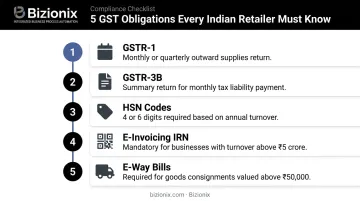
Under current GST rules, businesses must handle several distinct compliance requirements:
- GSTR-1 — monthly or quarterly outward supplies return
- GSTR-3B — summary return to declare and discharge GST liabilities
- HSN codes — required at 4 or 6 digits in GSTR-1 based on annual turnover
- E-invoicing (IRN) — mandatory for businesses with aggregate turnover exceeding ₹5 crore from 1 August 2023
- E-way bills — required when consignment value exceeds ₹50,000
A tool that handles stock but not compliance forces you to maintain parallel systems — doubling your admin workload and leaving you exposed during audits. The tools below were evaluated on exactly this: how well they handle both stock control and GST compliance under one roof.
Best Retail Inventory Management Software for Small Business in 2025
These five tools were shortlisted based on real-world fit for Indian MSMEs: GST compliance, ease of use, cloud accessibility, multi-location support, and value for money.
Bizionix
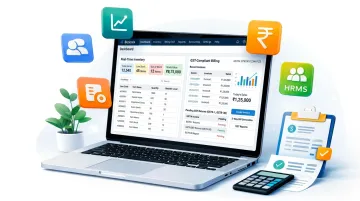
Built by IIS-LLP (a subsidiary of Protocol India Private Limited), Bizionix is a cloud ERP platform designed specifically for Indian MSMEs. It brings inventory management together with GST-compliant billing, purchase orders, multi-company management, and real-time reporting under a single login.
GST compliance is built into the core architecture — not patched on as an afterthought. The system connects directly to the Invoice Registration Portal via API, so when a sales invoice is created, IRN generation and QR code embedding happen automatically without manual JSON uploads or portal workarounds.
Pre-validation catches format errors before submission, which eliminates the back-and-forth that plagues businesses using manual or semi-automated invoicing workflows.
For businesses managing more than one location or entity, Bizionix supports multi-company operations from a single login. Each entity maintains independent books of accounts, separate GST registrations, and its own compliance ledgers — while a group-level dashboard gives owners consolidated visibility without switching between systems.
| Attribute | Details |
|---|---|
| Key Features | Real-time inventory tracking, GST-ready billing with automated e-invoicing, IRN generation via direct IRP API, QR code generation, GSTR-1 auto-population, multi-company and multi-location management, purchase orders, GRN, unified dashboard, role-based access controls, configurable workflows |
| Pricing | NEO plan: ₹999/year (discounted from ₹2,999/year), includes 14-day free trial. Enterprise plan: custom pricing — contact sales for details |
| Best For | Indian MSMEs, retail chains, franchise networks, multi-location stores, and businesses that need GST compliance built into inventory and billing from day one |
One limitation to note: Bizionix is fully cloud-dependent. Businesses operating in areas with unreliable internet connectivity should factor this into their evaluation.
Zoho Inventory
Zoho Inventory is a cloud-based inventory and order management platform from Zoho Corporation, widely adopted by Indian SMEs for its native GST support and integration with the broader Zoho ecosystem (Books, CRM, and others).
Its multi-channel selling support is a genuine strength — the platform connects with Amazon, Shopify, and Zoho Commerce natively, with integrations for additional marketplaces. For businesses that sell both in-store and online, this matters because stock levels update across channels automatically.
| Attribute | Details |
|---|---|
| Key Features | GST-compliant invoicing with GSTIN, HSN/SAC mapping, tax preference settings; multi-warehouse support; barcode and serial number tracking; automated reorder points; batch tracking; e-commerce channel integrations |
| Pricing | Free plan: 50 orders/month, 1 user, 2 locations. International pricing starts at USD 29/month (billed annually) — verify current India pricing at zoho.com/in/inventory/pricing before purchasing |
| Best For | Small to mid-size Indian retailers who sell across multiple online channels and want native Zoho ecosystem integration |
Watch for: Advanced features like deeper analytics and extended multi-warehouse management are gated behind higher-tier paid plans.
Vyapar
Vyapar is an India-built accounting and inventory app designed for small business owners who want simple GST billing and stock tracking without the complexity of a full ERP. With over 1 crore downloads, it has strong adoption among traders and kirana-style retailers.
Its standout feature is offline functionality — billing and invoice generation work without an internet connection, with data syncing once connectivity is restored. For businesses in areas with unreliable internet, this is a practical advantage that cloud-only tools cannot match.
| Attribute | Details |
|---|---|
| Key Features | GST invoicing, stock management, purchase and sales tracking, party-wise balance reports, barcode support, offline-capable mobile and desktop app |
| Pricing | Desktop: approx. ₹2,499/year; mobile: approx. ₹1,499/year; combo: approx. ₹2,999/year. Verify current pricing at vyaparapp.in/pricing — pricing varies by device and plan tier |
| Best For | Solo traders, kirana stores, and micro-businesses needing affordable GST billing and inventory on mobile with offline capability |
Watch for: Vyapar is best suited for single-location operations. Multi-branch businesses will quickly outgrow its capabilities.
Tally Prime
Tally Prime (by Tally Solutions) has been the default choice for Indian MSME accounting for decades. Its inventory module is deeply integrated with its accounting engine, making it the go-to for businesses where a CA or accountant manages the books alongside operations. It serves nearly 2.5 million businesses worldwide.
The depth of Indian compliance support — GST, TDS, e-invoicing, e-way bills — is unmatched. For complex inventory scenarios like batch tracking, expiry management, and manufacturing journals, Tally covers ground that most newer cloud tools simply don't reach.
| Attribute | Details |
|---|---|
| Key Features | GST accounting and filing, GSTR-1 and GSTR-3B support, IRN and QR code generation via IRP, stock group/category management, batch and expiry tracking, manufacturing journal support, multi-location godown management, e-way bill support |
| Pricing | Monthly subscription: ₹750/month + GST. Annual plans also available — verify current India pricing at tallysolutions.com |
| Best For | Businesses with a CA or accounts team, retailers with complex inventory (batches, expiry, manufacturing), and businesses already in the Tally ecosystem |
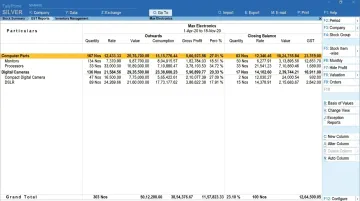
Watch for: Tally Prime is primarily desktop/on-premise. Remote access and browser-based reports are available but require active TSS, internet, and a connected Tally.NET setup — it is not a native SaaS product.
Marg ERP
Marg ERP is widely used in pharmacy, FMCG distribution, and grocery retail, claiming over 10 lakh businesses served through 850+ sales and support centres across India. It combines inventory management with GST billing, purchase management, scheme handling, and distribution workflows in a single platform.
For businesses dealing with trade schemes, rate-based pricing, and batch/expiry tracking — common in pharma and FMCG — Marg offers a level of sector-specific depth that general-purpose tools aren't designed for.
| Attribute | Details |
|---|---|
| Key Features | GST billing, batch and expiry tracking, scheme and discount management, purchase order management, salesperson tracking, multi-location stock visibility |
| Pricing | Nano: ₹5,550 + 18% GST (limited to 450 bills/month); Basic: ₹10,300 + GST; Silver: ₹13,900 + GST; Gold: ₹26,000 + GST. Cloud add-on: ₹7,500–₹10,800/year + GST. Verify at margcompusoft.com |
| Best For | Retailers and distributors in pharmacy, FMCG, grocery, and consumer goods sectors who need scheme management and batch/expiry tracking |
Watch for: The interface is older-style compared to newer cloud tools, and the cloud version is a paid add-on rather than the default deployment model.
How We Chose These Tools
Tool selection was driven by three core questions relevant to Indian small businesses:
- Does it handle GST compliance natively — not as a plugin or workaround?
- Does it provide real-time stock visibility, ideally across multiple locations?
- Is it priced and scoped appropriately for a small business with limited IT resources?
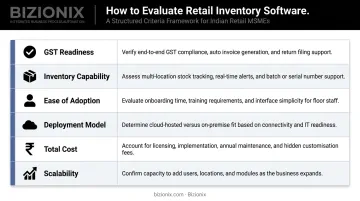
Key Evaluation Criteria
| Criterion | What We Checked |
|---|---|
| GST readiness | HSN/SAC mapping, GSTR-1 and GSTR-3B support, IRN generation, e-way bill capability |
| Inventory capability | Real-time tracking, multi-location support, purchase order management |
| Ease of adoption | Onboarding complexity, training requirements, interface clarity |
| Deployment model | Cloud-native vs. desktop with remote access vs. offline-capable |
| Total cost | License fees, cloud add-ons, setup costs, support fees |
| Scalability | Can the tool grow from one location to five without a forced migration? |
Two selection mistakes consistently cause problems for Indian small businesses:
- Choosing globally popular tools (QuickBooks, inFlow) that lack native GST support and require workarounds for compliance
- Optimizing purely for price without checking whether the tool can handle a second branch or an added e-commerce channel
The tools reviewed below are evaluated against all six criteria above. The right fit depends on your business type, industry, and whether you need inventory as a standalone function or integrated with accounting, CRM, and payroll.
Conclusion
Retail inventory management software is no longer optional for small businesses in India. GST compliance requirements alone — e-invoicing above ₹5 crore turnover, HSN code mapping, GSTR filing — create real liability when managed through manual processes. Add the operational cost of stockouts and overstocking, and the business case is clear.
Choosing the right software matters as much as the decision to adopt one. Evaluate scalability carefully: a tool that fits a single-location store today may create a painful migration when you open a second branch or add an online channel.
For Indian MSMEs looking for a single platform that unifies inventory, GST-compliant billing, purchasing, and real-time reporting, Bizionix is built specifically for that need — without the complexity or cost of larger ERP systems.
The NEO plan starts at ₹999/year with a 14-day free trial. Visit bizionix.com or call +91 91779 99277 to see how it fits your operations.
Frequently Asked Questions
What is the best inventory software for small business?
The right choice depends on your business type, location count, and compliance needs. For Indian small businesses, shortlist tools with native GST support: Vyapar for simple single-location billing, Zoho Inventory for multi-channel retail, Tally Prime if you have an accounts team, or Bizionix if you need a unified ERP that scales across locations.
What is the 80/20 rule in inventory?
The Pareto Principle holds that roughly 80% of a business's revenue typically comes from 20% of its SKUs. In inventory management, this means prioritising stock monitoring and reordering on your top-performing products while actively reducing dead stock on slow-moving items.
What GST features should retail inventory software have?
At minimum: HSN/SAC code mapping on invoices, GSTR-1 outward supplies report generation, GSTR-3B summary return support, e-invoice IRN generation via the GSTN portal, and e-way bill support for consignments above ₹50,000. These are non-negotiable for any Indian retailer using software for billing.
Can small businesses manage inventory without software?
Spreadsheets and manual registers work at very low volumes, but reliability drops as SKU counts grow or operations span more than one location. At that point, stock count errors and GST calculation mistakes tend to cost more than the software subscription itself.
What is the difference between inventory management software and an ERP?
Standalone inventory tools track stock, orders, and basic billing. An ERP integrates inventory with accounting, purchasing, payroll, and reporting in one unified system. Growing businesses often start with standalone tools and migrate to ERP as operations become more complex — so checking whether a tool can scale before you commit saves a costly migration later.
How does cloud-based inventory software benefit small retailers?
Cloud-based tools provide real-time stock visibility from any device, automatic data backups, and access across multiple store locations without investing in local servers. For owners managing operations across more than one branch, the ability to monitor inventory and sales remotely — is a practical advantage that reduces dependence on on-site staff for routine checks.