Introduction
Walk into any growing retail store in India and you'll likely find the same hidden problem: not poor sales, but poor stock visibility. Bestsellers run out on busy weekends, slow-movers pile up in back rooms, and the manual register entries from Tuesday don't match Wednesday's purchase order. The result: markdowns, lost sales, and cash tied up in stock no one ordered.
As Indian retail scales toward a projected market size exceeding USD $1.6 trillion by 2030, the gap between retailers using dedicated inventory software and those still managing stock on spreadsheets is widening fast. The wrong software choice — one that ignores GST compliance or can't handle multiple locations — compounds those losses quietly.
This guide shortlists the best retail inventory management software available in 2026, with a specific lens on what Indian MSMEs actually need: GST e-invoicing, multi-location visibility, and pricing that doesn't require an enterprise budget — so you can find the right fit without sitting through a dozen sales demos.
Key Takeaways
- Retail inventory software tracks real-time stock, automates reordering, and connects purchases, sales, and returns in one system
- Indian retailers must prioritise GST compliance, multi-location visibility, and POS integration
- Bizionix is built exclusively for Indian MSMEs — GST e-invoicing, GSTR-1 auto-population, and multi-company management included
- Other strong options: Zoho Inventory (budget-friendly SMBs), Cin7 (omnichannel retailers), Lightspeed (POS-first stores), Oracle NetSuite (large enterprises)
- Match software complexity to your current operations, not your aspirational scale
What Is Inventory Management Software for Retail Stores?
Retail inventory management software is a system that tracks stock levels across locations, records every sale and return, triggers purchase orders when stock drops below set thresholds, and connects purchasing data to point-of-sale transactions — updating the moment a sale posts.
Unlike generic inventory apps, retail-specific software is built for the complexity of store operations. It handles:
- SKU-level tracking across hundreds or thousands of product lines
- Product variant management — size, colour, style combinations
- POS integration so every sale automatically deducts stock
- Seasonal demand patterns that affect reorder timing
- GST compliance workflows: required for any Indian retailer above the ₹5 crore turnover threshold mandated for e-invoicing
Without a dedicated system, the costs surface in predictable ways: stockouts on high-demand items lose direct revenue, overstocking ties up working capital, and audit gaps create chaos during quarterly reconciliation.
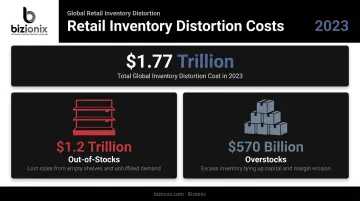
The numbers reflect how far this reaches. Global inventory distortion cost retailers $1.77 trillion in 2023, with out-of-stocks alone accounting for $1.2 trillion — a figure that shows why getting stock visibility right is not optional for any serious retail operation.
Top Inventory Management Software for Retail Stores in 2026
These platforms were selected based on retail-specific features, India-market relevance, integration depth, pricing accessibility, and scalability for growing retail businesses.
Bizionix
Bizionix is a cloud-based ERP platform developed by IIS-LLP (a subsidiary of Protocol India Private Limited), built specifically for Indian MSMEs across retail, distribution, manufacturing, and hospitality — with over two decades of combined industry experience shaping its design.
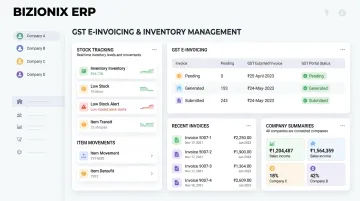
Unlike international platforms on this list, Bizionix is built around India-first architecture. The system connects directly with the GST e-Invoice system via API, generating IRN and QR codes within seconds of invoice creation — no third-party tools, no manual steps. GSTR-1 is auto-populated from sales data, keeping returns aligned with invoices automatically.
For multi-location retailers and business groups, a single secure login provides access to all company entities, with role-based permissions controlling what each user sees across branches.
| Feature Category | Details |
|---|---|
| Key Features | Real-time stock tracking, multi-location inventory, GST e-invoicing (direct IRP API), GSTR-1 auto-population, multi-company management, automated purchase orders, cloud access |
| Pricing | NEO plan at ₹999/year; Enterprise plan at custom pricing — contact sales for tier details |
| Best For | Indian MSMEs, multi-location retailers, distribution businesses, franchise networks requiring GST compliance baked into billing and inventory |
Zoho Inventory
Zoho Inventory is a cloud-based inventory platform from Zoho Corporation, widely adopted by small and mid-sized businesses in India and globally. It earns its place on this list through strong affordability, a usable free tier, and deep integration with the broader Zoho ecosystem — particularly Zoho Books for accounting.
For retailers moving off spreadsheets, it's a practical first system. Native integrations with Shopify and Amazon mean e-commerce stock adjustments happen automatically, and the multi-warehouse features handle basic multi-location needs. Capterra rates it 4.5 stars from 416 reviews.
| Feature Category | Details |
|---|---|
| Key Features | Real-time inventory tracking, multi-warehouse support, automated reordering, e-commerce integrations (Shopify, Amazon), barcode scanning, sales order management |
| Pricing | Free plan available; paid plans from $29/org/month (billed annually) — check Zoho's India pricing page for current INR tiers |
| Best For | Small to mid-sized retailers already using Zoho products; budget-conscious businesses needing solid multi-channel inventory |
Cin7
Founded in 2012, Cin7 has grown into a Connected Inventory Performance platform serving 8,500+ customers across 11 countries — retailers, wholesalers, and manufacturers managing stock across multiple sales channels.
Its strength is omnichannel integration depth — 700+ integrations spanning Shopify, Amazon, Walmart, QuickBooks, and Xero. For retailers selling simultaneously through physical stores, online marketplaces, and wholesale, Cin7 unifies those channels into a single inventory view. G2 rates it 4.1 stars from 450 verified reviews.
| Feature Category | Details |
|---|---|
| Key Features | Real-time multi-channel inventory, automated replenishment, order management, 700+ integrations, multi-currency and multi-warehouse support |
| Pricing | Standard $349/month (5 users); Pro $599/month; Advanced $999/month; Omni — contact sales. USD pricing shown; confirm India/INR pricing directly with Cin7. |
| Best For | Mid-to-large omnichannel retailers selling across physical stores, online marketplaces, and wholesale simultaneously |
Lightspeed Retail
Listed on the NYSE and Toronto Stock Exchange (LSPD), Lightspeed Retail operates in over 100 countries. It's a cloud-based POS and inventory platform purpose-built for retail, most valued for its tight POS-inventory integration.
Every in-store sale deducts inventory automatically. Head office can view, transfer, and compare stock across locations in real time — cutting the reconciliation work that slows growing retail chains. Note: India-specific GST compliance features were not verified from official Lightspeed sources; confirm GST readiness directly with their sales team before purchasing.
| Feature Category | Details |
|---|---|
| Key Features | Integrated POS + inventory, multi-store management, variant tracking, supplier management, sales analytics, automated reorder points |
| Pricing | Basic $89/month; Core $149/month; Plus $289/month (billed annually, per location). USD pricing shown; confirm India/INR pricing directly with Lightspeed. |
| Best For | Growing multi-store retailers needing tightly integrated POS and inventory in a single platform |
Oracle NetSuite
Oracle NetSuite is a comprehensive enterprise ERP with inventory management as one component of a broader suite covering financials, CRM, order management, and supply chain. Consider it when inventory complexity — across warehouses, channels, and entities — demands a single system of record rather than connected point solutions.
NetSuite's retail inventory capabilities include real-time visibility across warehouses, retail stores, pop-up shops, drop shippers, and 3PLs — all in a unified system. Features like lot and serial number tracking, cycle counting, and demand forecasting are built in.
Gartner Peer Insights lists 432 in-depth reviews, and Oracle NetSuite was recognised in the 2025 Gartner Magic Quadrant for cloud ERP categories.
| Feature Category | Details |
|---|---|
| Key Features | Real-time multi-location inventory, demand forecasting, automated replenishment, lot and serial tracking, full ERP integration (finance, CRM, supply chain) |
| Pricing | Annual licence fee based on platform, modules, and users; one-time implementation fee applies — contact Oracle NetSuite sales for a quote |
| Best For | Large retail enterprises and multi-national chains needing a single, fully integrated ERP rather than a standalone inventory tool |
Key Features to Look for in Retail Inventory Management Software
Core Inventory Capabilities
Every retail inventory system should cover these non-negotiables:
- Real-time SKU-level stock tracking — know exactly what's available across every variant and location
- POS integration — sales automatically deduct from inventory without manual entry
- Multi-location visibility — a single view across all stores and warehouses
- Product variant management — handle size, colour, and style combinations cleanly, without creating duplicate SKUs
- Automated reordering when stock dips below set thresholds
- Supplier management — vendor records, lead times, and purchase history in one place
GST Compliance for Indian Retailers
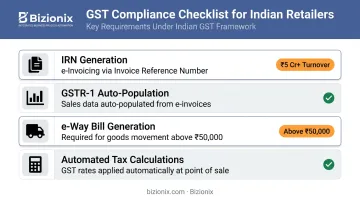
For Indian retailers, GST compliance isn't a nice-to-have — it's a technical requirement. GST Council Notification No. 10/2023-Central Tax mandates e-invoicing for businesses with aggregate turnover exceeding ₹5 crore, effective 1 August 2023. E-way bills are required for goods movements valued above ₹50,000.
Look specifically for:
- GST-ready invoicing with IRN generation
- GSTR-1 auto-population from sales data
- E-way bill generation capability
- Automated tax calculations to prevent manual reconciliation errors
Reporting and Scalability
The right system surfaces key retail KPIs without manual calculations — including:
- Inventory turnover (COGS divided by average inventory value)
- Stockout rate and lost-sales tracking
- Carrying cost and dead stock ratio
It should also scale with the business across more SKUs, locations, and sales channels without needing to switch platforms within 18 months.
How We Chose the Best Inventory Management Software
The most common mistake retailers make when evaluating software is choosing based on brand recognition or feature count rather than operational fit. A platform built for global enterprise workflows may lack India-specific GST compliance. A basic POS tool may collapse under multi-location complexity.
Each platform on this list was evaluated specifically to avoid those traps. The shortlist criteria:
- SKU tracking, variant management, and POS integration — not just generic inventory features
- GST compliance, e-invoicing support, and pricing accessible to Indian retailers
- Integration with accounting tools, e-commerce platforms, and POS hardware
- Total cost of ownership, not just the monthly subscription fee
- Ability to scale across more locations and SKUs as the business grows
- Independent review ratings from Capterra, G2, and Gartner Peer Insights
Platforms were excluded if they lacked retail-specific features, had no verifiable presence in the Indian market, or appeared on review platforms without sufficient verified user feedback.
Conclusion
Inventory management software is what separates retailers who grow from those who spend every month chasing stockouts and fixing reconciliation errors. Get the right platform in place, and cash flow visibility, margin clarity, and stock accuracy follow.
The right choice depends on where the business actually operates today:
- Single-store Indian MSME → Bizionix NEO or Zoho Inventory
- Omnichannel retailer → Cin7
- Multi-store, POS-centric operation → Lightspeed Retail
- Large enterprise → Oracle NetSuite
Before committing to any platform, assess integration depth with existing systems, total cost of ownership beyond the subscription price, and — for Indian retailers, whether GST compliance is built in or added as an afterthought.
For Indian MSMEs that need inventory management, GST e-invoicing, GSTR-1 auto-population, and multi-company management in one place, explore Bizionix. It's built specifically for growing Indian enterprises — without the complexity or cost of enterprise-grade legacy systems.
Frequently Asked Questions
How to manage inventory in a retail store?
Effective retail inventory management means centralising stock records in one system, setting automated reorder points per product, and integrating sales data with purchasing workflows. Regular cycle counts and real-time POS integration ensure your system reflects actual stock — not last week's numbers.
What software is best for inventory management?
The best software depends on business size and geography. Indian MSMEs benefit most from GST-compliant platforms like Bizionix or Zoho Inventory. Omnichannel retailers typically prefer Cin7, and large enterprises often use Oracle NetSuite. Match the tool to actual operations, not just feature lists.
What are the 4 types of inventory management?
The four core types are:
- Just-In-Time (JIT) — minimises holding stock by ordering only when needed
- ABC Analysis — prioritises inventory by value and movement velocity
- FIFO (First In, First Out) — ensures older stock sells before newer arrivals
- Safety Stock Management — maintains buffer inventory against demand spikes
Most retail software supports all four.
Which WMS software is best?
WMS (Warehouse Management System) software focuses on bulk movement, putaway, and outbound shipping — it's distinct from retail inventory software. For warehouse operations, Oracle NetSuite and Fishbowl are strong options. Many growing retailers run both: a WMS for the warehouse and a retail inventory system for the storefront.
What features should I look for in retail inventory management software?
Prioritise real-time SKU tracking, POS integration, multi-location visibility, automated reordering, and variant management. For Indian retailers, built-in GST compliance and e-invoicing are non-negotiable — reconciling GST manually on a non-compliant system adds significant operational burden.
How much does retail inventory management software cost?
Costs vary widely. Entry-level tools like Bizionix NEO start at ₹999/year for Indian MSMEs. Zoho Inventory's paid plans begin around $29/month (international pricing), and Cin7 starts at $349/month for omnichannel operations. Oracle NetSuite follows custom annual enterprise licensing. Factor in implementation and training costs alongside the subscription fee.