The challenge is that inventory management software pricing in India spans a wide range — from under ₹200/month for basic billing tools to custom enterprise quotes running well above ₹10,000/month. That spread reflects real differences in deployment model, business size, feature depth, and vendor type. Misunderstanding where your business fits leads to three common mistakes: underbudgeting for what you actually need, choosing a tool you'll outgrow within a year, or getting blindsided by implementation and support costs not reflected in the headline price.
This article breaks down verified pricing ranges, the factors that drive costs up or down, what you're actually paying for beyond the subscription, and how to build a realistic budget for your business.
Key Takeaways
- Cloud-based inventory and ERP tools for Indian MSMEs range from roughly ₹200 to ₹10,000+/month, depending on tier, features, and users
- The biggest cost drivers are user count, feature tier (especially GST compliance and multi-location support), and transaction volume limits
- Growing MSMEs with GST filing, multi-location operations, or reporting needs should budget for the mid-range — not the entry tier
- Low-cost tools frequently cost more in practice once you add separate GST software, accounting tools, and manual reconciliation time
How Much Does Inventory Management Software Cost in India?
There is no single fixed price. What you pay depends on the deployment model, vendor, the number of users, and which features your operations actually need. The most common budgeting mistake is comparing tools on headline subscription price alone — ignoring implementation, support, transaction limits, and compliance costs that surface later.
When cost is misunderstood at the evaluation stage, businesses either lock themselves into underpowered tools they'll outgrow quickly, or choose configurations that force an expensive mid-growth migration. Getting the range right from the start matters.
Pricing Tiers at a Glance
| Tier | Verified INR Range | Best For |
|---|---|---|
| Entry-level cloud IMS | ₹200–₹1,000/month | Solo operators, micro-businesses |
| Mid-range cloud ERP/IMS | ₹1,000–₹6,000/month | Growing MSMEs, distributors |
| Advanced/enterprise | ₹7,000+/month or custom quote | Large manufacturers, enterprise groups |
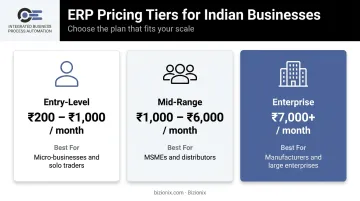
Entry-level (₹200–₹1,000/month): Verified examples include myBillBook Diamond at ₹217/month billed annually, Kladana from ₹742/month, and Zoho Books Standard at ₹749/month annually. These plans typically cover basic stock tracking, GST invoicing, limited users, and capped transaction volumes. Best suited to solo operators, micro-retailers, and early-stage startups.
Mid-range (₹1,000–₹6,000/month): This tier adds multi-location support, GST compliance, deeper reporting, and higher user or SKU limits. Verified prices include Zoho Books Professional at ₹1,499/month (annual), TallyPrime Gold rental at ₹2,250/month, and BUSY Standard at ₹14,999/year per user. Platforms like Bizionix also sit in this range. It is a unified cloud ERP built for Indian MSMEs that combines inventory management, GST-ready accounting, billing, and multi-company management in a single system — reducing the need for multiple standalone subscriptions.
Enterprise (₹7,000+/month or custom quote): Zoho Books Ultimate is ₹7,999/month billed annually. Beyond that, major ERP systems are typically priced on request. This tier covers advanced warehouse management, deep customisation, dedicated support, and complex integrations.
On-Premise vs. Cloud Pricing
The two deployment models differ significantly in how costs are structured upfront versus over time:
| Model | Example Pricing | Hidden Costs |
|---|---|---|
| On-premise (perpetual) | TallyPrime Silver ₹22,500; Gold ₹67,500 | IT maintenance, upgrades, server infrastructure |
| On-premise (annual renewal) | Marg ERP Gold ₹26,000 + 18% GST; renewals ₹2,400–₹19,100/yr | Version upgrades, local IT support |
| Cloud SaaS | ₹200–₹7,999+/month (subscription) | Minimal — updates and hosting included |
For most Indian MSMEs, cloud wins on total cost of ownership. There is no server infrastructure to maintain, no IT overhead, and software updates happen automatically. On-premise may suit large enterprises with strict data control requirements, but the long-term cost runs considerably higher once IT staffing, upgrades, and hardware are factored in.
Key Factors That Affect the Cost of Inventory Management Software
Several variables — user count, feature depth, compliance needs, and implementation complexity — determine what you'll actually pay. Understanding each one prevents both overpaying for unused features and underestimating your real requirements.
Number of Users and Locations
Most vendors price by user count or user-count tier. Zoho Books, for example, includes a set number of users per plan and charges ₹150–₹180 per additional user per month. Marg ERP charges ₹3,000 per extra user on its Basic plan. TallyPrime separates Silver (single-user) and Gold (multi-user) as distinct products.
Multi-location businesses typically need higher-tier plans that unlock warehouse and branch management. A business with three locations and eight staff across them will cost meaningfully more than a single-location operation with two users.
Feature Tier and Transaction Limits
Base plans cover stock tracking and purchase orders. Moving up adds:
- Batch and serial number tracking
- Automated reordering
- Demand forecasting
- Manufacturing bill of materials
- Advanced analytics and reporting
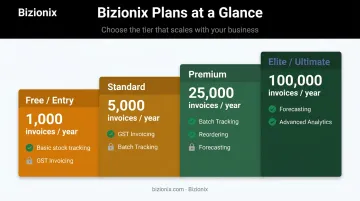
Each of these unlocks at a higher subscription tier. Transaction limits matter too. Zoho Books Free caps at 1,000 invoices annually; Standard allows 5,000; Premium 25,000; Elite/Ultimate 100,000. Marg Nano is capped at 450 bills per month. A business processing 2,000 orders monthly will hit entry-level caps quickly and face a forced upgrade. That makes entry-level pricing a poor benchmark for any mid-scale operation.
GST Compliance and Integrations
India's GST requirements add a compliance layer that directly affects software cost. E-invoicing became mandatory from 1 August 2023 for businesses with aggregate turnover exceeding ₹5 crore, under GST Council Notification No. 10/2023. Software that handles IRN generation, e-invoicing, and GST return filing natively is worth more than basic tools that require a third-party compliance add-on.
Standalone GST and e-invoicing compliance tools like ClearTax start from ₹7,777/month — a cost that disappears when your inventory platform includes GST compliance natively. Bizionix, for instance, connects directly with the GST e-Invoice system via API for instant IRN generation without any third-party middleware.
Customisation and Implementation Complexity
Off-the-shelf cloud solutions are cheaper and faster to deploy. Businesses requiring custom workflows, industry-specific configurations, or migration from legacy systems will incur one-time implementation fees. Common cost components include:
- Vendor-led implementation and training (Marg charges ₹5,400 + GST)
- Third-party partner rollouts for complex configurations
- Data migration from legacy systems
Some vendors include basic onboarding at no extra cost on higher-tier plans. Kladana, for example, offers free support and one to three onboarding sessions depending on the plan selected.
Full Cost Breakdown: What You're Actually Paying For
The subscription fee is only part of what you'll spend. Total cost of ownership includes several components that buyers routinely overlook.
| Cost Component | Type | What to Expect |
|---|---|---|
| Software subscription | Recurring | Core monthly/annual fee; annual plans save 10–17% vs monthly |
| Implementation & onboarding | One-time | Varies by vendor; more for complex rollouts |
| Training | One-time / periodic | Varies; some vendors include sessions, others charge separately |
| Premium support | Recurring | Zoho charges 20% of subscription fee for Premium support |
| Integrations | One-time or recurring | API costs for e-commerce, logistics, or third-party tools |
A few cost factors are worth understanding before you commit:
- Annual billing saves 10–17% over monthly plans. TallyPrime's annual rental saves 10%; Zoho Books annual rates run roughly 16.7% lower than month-to-month.
- Support tiers matter. Basic email support is typically included, but priority access, dedicated account managers, or extended hours cost extra. Bizionix includes priority support and custom configurations in its Enterprise plan, with phone, email, and ticket support across all plans.
- Cloud SaaS updates are handled automatically by the vendor — eliminating a real hidden cost of on-premise systems, where version upgrades often require paid IT support or vendor engagement.
Budget vs. Premium Inventory Software — What's the Real Difference?
Choosing a budget tool over a more capable platform is not purely a price decision. It's a question of fit, reliability, and what it costs you when the tool can't keep up.
Performance and Reliability
Budget tools often lack real-time sync and carry slower support response times. Downtime during peak sales periods has a direct, measurable cost. Premium solutions typically offer uptime SLAs — Zoho, for instance, guarantees 99.9% monthly uptime — along with faster resolution times.
Feature Depth and Scalability
Budget tools work until you outgrow them. Hitting SKU caps, user limits, or discovering that multi-warehouse support and GST automation are missing forces a mid-growth migration. That means data transfer, staff retraining, and weeks of operational disruption. Premium platforms are built to scale alongside the business — those costs don't appear.
The Real Total Cost Comparison
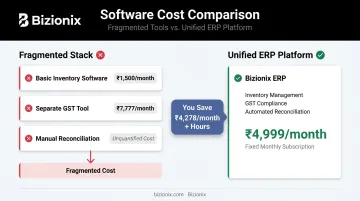
Consider a growing MSME running three separate tools:
- Basic inventory software: ₹1,500/month
- Separate GST/e-invoicing tool: ₹7,777/month (ClearTax verified pricing)
- Manual reconciliation time: real but unquantified
A unified ERP platform covering inventory, GST-ready accounting, billing, and multi-company management in one subscription routinely comes in below that combined figure. Once you add up what the fragmented stack actually costs, the "premium" label often doesn't hold up.
How to Estimate the Right Budget for Your Business
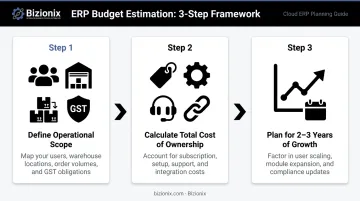
The right budget covers your actual operational needs — nothing more. Before comparing tools, get clear on what your business actually requires. These three steps help you do that:
1. Define your operational scope:
- How many users need system access?
- How many locations or warehouses?
- Approximate monthly order volume and SKU count
- Whether you need GST e-invoicing, batch tracking, or manufacturing integration
These parameters alone will narrow you to one or two appropriate tiers.
2. Calculate total cost of ownership — not just the subscription:
Factor in implementation, training, support, and integrations. If you're evaluating a unified ERP like Bizionix — which combines inventory, GST accounting, billing, and multi-company management — compare the consolidated cost against the sum of separate tools. That's the real number that matters, not just the subscription line.
3. Plan for 2–3 years of growth, not just today:
Upgrading or migrating mid-growth is expensive and disruptive. A platform that handles 500 SKUs and 3 users today — but caps out at 1,200 SKUs — means a forced migration precisely when your operations can least afford the disruption. Build scalability into your evaluation criteria from the start, not as an afterthought.
What Most Buyers Miss When Evaluating Inventory Software Costs
The subscription price is rarely the full story — implementation, onboarding, integrations, and support add significantly to year-one spend. Comparing platforms on headline fees alone produces poor decisions.
A cheaper tool missing GST automation, multi-location support, or real-time tracking creates workarounds: spreadsheets, manual reconciliation, and additional software purchases that carry their own cost.
Switching platforms mid-operations means data migration, staff retraining, downtime, and data integrity risk. Evaluating thoroughly upfront almost always costs less than correcting a bad choice later.
Conclusion
Inventory management software costs in India range from roughly ₹200/month for basic cloud tools to custom enterprise pricing for advanced warehouse and ERP solutions — with most growing MSMEs landing somewhere in the ₹1,000–₹6,000/month range depending on users, features, and vendor.
Before committing, evaluate the total cost of ownership — not just the subscription fee. Factor in implementation, training, support charges, and integration costs. A few practical guidelines:
- Match features to actual business needs, not the longest feature list
- Avoid optimising for the lowest upfront price; missing features and eventual migrations cost more in the long run
- Choose a platform that can support your business 2–3 years from now, not just current operations
The right software pays for itself in reduced errors, faster stock visibility, and fewer manual workarounds.
Frequently Asked Questions
What is the average cost of inventory management software in India?
Basic cloud tools start from around ₹200–₹1,000/month, with mid-range plans running ₹1,000–₹6,000/month. Most Indian MSMEs land in the mid-range depending on user count, features, and vendor. These figures cover licence costs only — implementation and support are billed separately.
How much does a Warehouse Management System (WMS) cost?
Standalone WMS platforms typically start at ₹5,000–₹15,000/month and scale higher for operations involving RFID, bin locations, or pick-pack-ship workflows. Most Indian MSMEs find better value starting with inventory management embedded in a cloud ERP — lower cost, less implementation overhead, and sufficient for MSME-scale complexity.
What is the 80/20 rule for inventory?
The 80/20 rule (Pareto Principle) holds that roughly 80% of revenue comes from 20% of SKUs. For software budgeting, this means prioritising features that manage your high-value stock — and not paying for capabilities that only serve low-priority items.
Is cloud-based inventory software cheaper than on-premise?
Yes, for most Indian MSMEs. Cloud has lower upfront costs, no hardware requirement, and includes automatic updates. On-premise options like TallyPrime Silver start at ₹22,500 as a lifetime licence but carry ongoing IT, maintenance, and upgrade costs that increase total cost of ownership significantly over time.
Does inventory management software in India need to support GST compliance?
For businesses with aggregate turnover above ₹5 crore, e-invoicing and IRN generation are legally mandated under CBIC Notification No. 10/2023. Verify whether your chosen software includes GST compliance natively or requires a separate tool — the latter adds both monthly cost and integration complexity.