But WMS costs vary enormously. Two businesses in the same industry can face pricing that differs by 10x — depending on deployment model, user count, integration complexity, and whether implementation is bundled. This guide breaks down pricing tiers, real cost components, key cost drivers, and how to build a WMS budget that holds up.
Key Takeaways
- Entry-level cloud WMS for Indian MSMEs: approximately ₹3,000–15,000/month for basic operations
- Mid-range WMS: ₹15,000–60,000/month, covering multi-location support and integrations
- Enterprise or on-premise: ₹60,000+/month plus substantial one-time implementation costs
- Key cost drivers: deployment model, user count, integration complexity, and customisation depth
- Plan for 3-year total cost of ownership (TCO); the monthly licence fee is rarely the full picture
- Most Indian MSMEs get better value from an integrated cloud ERP with built-in WMS than a standalone tool
How Much Does Warehouse Management Software Cost?
WMS pricing varies far more than most buyers expect. Two businesses in the same sector — say, FMCG distribution — can face costs that differ tenfold based solely on deployment choice and integration requirements. Businesses that don't account for this early tend to underbudget implementation or lock into the wrong model before they realize it.
Here's how the three main tiers stack up for Indian MSMEs.
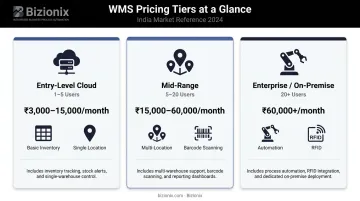
Entry-Level Cloud WMS — Small Operations
Cloud-hosted SaaS solutions for businesses with 1–5 warehouse users focused on basic inventory tracking, receiving, and order fulfilment.
Approximate pricing: ₹3,000–15,000/month
Typically included:
- Core receiving and dispatch workflows
- Basic inventory tracking (single location)
- Standard reports
- Limited SKU volumes
Typically excluded: Multi-warehouse support, advanced reporting, barcode scanning integrations, automation interfaces, GST/ERP sync
Best for: Small trading companies, single-location manufacturers, and distributors moving off spreadsheets without heavy IT investment.
Mid-Range WMS — Growing Operations
Solutions built for 5–20 users managing multiple storage locations, moderate SKU counts, and some integration requirements.
Approximate pricing: ₹15,000–60,000/month
Publicly available Indian WMS pricing gives a useful reference point here. WMS Engine's pricing page lists packages starting from ₹1,20,000 as a one-time investment (minimum 10 users), with cloud access at ₹300–500 per user per month depending on the module tier. This reflects the mid-market reality: per-user cloud fees plus an initial setup commitment.
Typically included: Multi-location support, barcode scanning, integration connectors, reporting dashboards
Typically excluded: Full automation, RFID, unlimited customisation, dedicated account support
Best for: Growing MSMEs with expanding warehouse footprints, distribution centres, or e-commerce fulfilment needs.
When operations scale beyond 20 users or span multiple facilities, costs shift significantly — both in licence fees and implementation scope.
Enterprise / On-Premise WMS — Large Operations
Comprehensive solutions for 20+ users, multi-facility operations, high transaction volumes, and advanced automation or RFID requirements.
Approximate pricing: ₹60,000+/month (cloud) or substantial one-time perpetual licence fees for on-premise, plus annual maintenance
Implementation costs at this tier are significant — often equalling or exceeding the first year's licence cost. For reference, international benchmarks from Descartes cite on-premise perpetual licence ranges of USD 2,500 to USD 200,000 per facility, with implementation at USD 3,500 to USD 40,000 — numbers that show what large deployments actually cost before a single item ships.
Best for: Large manufacturers, 3PL providers, and multi-city distribution businesses with complex, high-volume operations.
Quick Comparison: WMS Cost by Tier
| Tier | Users | Approx. Monthly Cost | Key Inclusion |
|---|---|---|---|
| Entry-Level Cloud | 1–5 | ₹3,000–15,000 | Basic inventory, single location |
| Mid-Range | 5–20 | ₹15,000–60,000 | Multi-location, barcode, integrations |
| Enterprise / On-Premise | 20+ | ₹60,000+ (or perpetual licence) | Automation, RFID, multi-facility |
Key Factors That Affect WMS Cost
WMS pricing is shaped by a combination of technical requirements, operational scale, and business-specific decisions. Knowing which factors drive cost — and which don't — makes it easier to build a realistic budget before you start talking to vendors.
Deployment Model: Cloud vs. On-Premise
| Factor | Cloud/SaaS | On-Premise |
|---|---|---|
| Upfront cost | Low | High (licence + hardware) |
| Recurring cost | Monthly/annual subscription | Annual maintenance (10–25% of licence) |
| Updates | Automatic | Manual / vendor-dependent |
| Scalability | Built-in | Requires infrastructure investment |
Annual maintenance on perpetual licences typically runs 10–25% of the initial licence cost annually, based on multiple industry sources. Cloud removes this variable but introduces ongoing subscription dependency.
For Indian MSMEs, cloud is increasingly the practical choice — lower capital expenditure, no server management, and built-in scalability as operations grow.
Number of Users and Locations
Most vendors price per user, per device, or per facility. Key points to factor in:
- Adding users increases licence costs proportionally
- Multi-warehouse setups add complexity and often trigger a tier upgrade
- Indian businesses with multi-branch or multi-city operations should get multi-location pricing upfront — not as an afterthought
Feature Set and Customisation
Core features (receiving, putaway, picking, packing) are usually base-priced. Add-ons that push costs higher:
- Lot tracking and expiry management
- Wave picking and zone management
- RFID integration
- Custom reporting and dashboards
- Automation interfaces
Heavy customisation for specific workflows adds development costs that sit entirely outside the standard licence fee — a line item many buyers miss in early budget estimates.
Integration Complexity
Connecting WMS to existing systems is where businesses most often exceed their initial budget estimates. Variables that drive integration cost:
- Number of systems to connect (ERP, accounting, e-commerce, logistics)
- Whether pre-built connectors exist or custom API work is needed
- GST e-invoicing integration requirements
For Indian businesses, GST compliance integration is non-negotiable. Businesses with turnover above ₹5 crore are required to generate e-invoices, so IRP API integration needs to be scoped and costed from day one — not discovered mid-implementation.
Full Cost Breakdown: What You're Actually Paying For
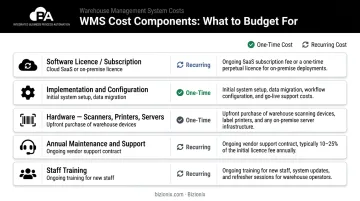
The subscription price is just one line item. Implementation, hardware, training, and ongoing support often add 40–80% on top of the base licence cost — and most businesses don't account for these until the invoice arrives.
| Cost Component | One-Time or Recurring | What to Expect |
|---|---|---|
| Software licence / subscription | Recurring (cloud) or one-time (on-premise) | Core access fee; scales with users and features |
| Implementation & configuration | One-time | Setup, workflow config, data migration, go-live testing |
| Hardware | One-time + periodic replacement | Scanners, printers, mobile devices, servers (on-premise) |
| Annual maintenance & support | Recurring | 10–25% of licence (on-premise); included or tiered for cloud |
| Staff training | Recurring | Initial + ongoing as system evolves |
Implementation and Data Migration
Implementation is the most commonly underestimated cost. For a mid-sized Indian MSME, this covers system configuration, integration with existing tools, historical data migration, and go-live support.
Businesses migrating from spreadsheets typically need data cleaning before migration — which extends the timeline and adds cost. In practice, Indian mid-market deployments range from ₹3 lakh to ₹15 lakh depending on scope and vendor.
Hardware Costs (Where Applicable)
Cloud-based WMS removes most server costs, but you'll still need devices at the warehouse floor level. Here's what to budget for common hardware in the Indian market:
- Barcode scanners: ₹1,000–6,000 (basic wired); ₹33,000–90,000 (handheld mobile terminals)
- Label/barcode printers: ₹4,500–11,000 (entry-level thermal)
- On-premise servers: ₹45,000–5,15,000+ depending on capacity and brand
For most cloud WMS deployments, a basic scanner per warehouse user and a label printer per packing station is the realistic hardware requirement.
Budget vs. Premium WMS: What Actually Changes?
The practical differences between a ₹5,000/month solution and a ₹50,000/month solution go beyond feature lists.
| Dimension | Budget WMS | Premium WMS |
|---|---|---|
| Operational capability | Basic inventory tracking, single location | Advanced multi-location management, automation |
| Scalability | Works well for current size; may hit limits quickly | Built for multi-facility growth |
| Integration breadth | Limited connectors, manual workarounds | Deep ERP, GST, e-commerce integration |
| Support quality | Community forums, email only | Dedicated account support, defined SLAs |
Budget solutions can be the right call for current needs. The real risk is premature replacement — paying implementation costs twice because the first system couldn't scale.
For most Indian MSMEs, avoiding that replacement cost means choosing a platform where warehouse management is one module in a broader system — not a standalone tool that needs separate licensing and integration.
Bizionix, built for Indian MSMEs by IIS-LLP, follows this model. Warehouse operations — ground stock management, material issue, multi-location tracking — sit alongside GST-compliant accounting, inventory, HRMS, and CRM in one unified system. The NEO plan starts at ₹999/year with a 14-day free trial. The Enterprise plan covers full warehouse management with all 12+ core modules for operations that need more depth.
How to Estimate the Right WMS Budget
Budget planning should start with operational requirements, not price. Anchor the number to what the business actually needs over the next 2–3 years — not the lowest figure on a vendor comparison sheet.
Questions to Answer Before Budgeting
- How many users will access the system daily?
- How many locations or warehouses need to be managed?
- What is the average daily order or shipment volume?
- Which existing systems (ERP, accounting, GST tools) need to integrate?
- Is barcode scanning, RFID, or automation on the 12-month roadmap?
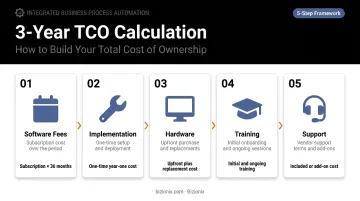
The 3-Year TCO Approach
Add up all cost components across 36 months:
- Software fees — monthly subscription × 36 months (or perpetual license + maintenance)
- Implementation — one-time cost paid in year one
- Hardware — upfront plus replacement cycle
- Training — initial plus ongoing as staff turns over
- Support — included or add-on
Compare this total against estimated savings: reduced manual labour, fewer picking errors, faster order processing, lower inventory discrepancies. Nucleus Research documented 204% ROI with a 6-month payback at an international industrial parts distributor post-WMS implementation. For Indian MSMEs, factor in GST compliance module costs as part of TCO — these are often overlooked but directly affect year-one spend.
What Most Businesses Get Wrong
- Focusing only on the monthly subscription price
- Ignoring implementation and integration costs (often 50–100% of year-one license)
- Over-specifying features not needed for the next 2 years
- Choosing the cheapest option without checking vendor support quality or upgrade roadmap
- For Indian businesses specifically: failing to verify GST compliance readiness before signing
Conclusion
WMS costs range from affordable cloud subscriptions for small operations to significant enterprise investments. The right budget comes from matching the solution to your actual operational scale and growth plans — not from chasing the lowest monthly price.
The total cost of ownership across three years — license, implementation, hardware, integration, and ongoing support — is the only number worth planning around. Businesses that evaluate on this basis make sharper decisions, avoid mid-project budget shocks, and end up with a WMS that scales with them rather than one they'll need to replace in 18 months.
Frequently Asked Questions
How much does WMS software cost?
WMS software costs vary widely by deployment model, user count, and features. For Indian MSMEs, cloud-based options start from approximately ₹3,000–15,000/month for basic setups, while enterprise or heavily customised solutions can run several lakhs annually when implementation costs are included.
What is the difference between cloud-based and on-premise WMS pricing?
Cloud WMS uses a recurring subscription with lower upfront cost and automatic updates. On-premise requires a large one-time licence fee plus annual maintenance of 10–25% of that licence. Cloud suits growing Indian MSMEs best; on-premise is better for larger operations requiring full infrastructure control.
What hidden costs should I budget for when implementing a WMS?
The most commonly overlooked expenses are implementation and configuration fees, data migration from spreadsheets or legacy systems, staff training, hardware (scanners, printers), ERP and GST integration costs, and ongoing support tiers not included in the base subscription.
Is a standalone WMS better than an integrated ERP with warehouse management for Indian MSMEs?
A standalone WMS offers deep functionality but requires separate integration with accounting and ERP systems, adding cost and complexity. For most Indian MSMEs, an integrated platform like Bizionix delivers better value — built-in warehouse management, GST compliance, and unified operations without duplicate tools.
How long does it typically take to recover the cost of a WMS investment?
Most small to mid-sized businesses achieve measurable ROI within 12–24 months through reduced picking errors, lower labour costs, improved inventory accuracy, and faster order processing. The payback period shortens when implementation is clean and the system integrates well with existing workflows.
Can a small or growing business in India afford warehouse management software?
Yes. Cloud-based WMS and integrated ERP platforms are within reach for Indian MSMEs at modest monthly pricing. Bizionix offers modular entry-level plans from ₹999/year with a 14-day free trial, so businesses can start with core warehouse features and expand as they grow.