Introduction
Indian warehouses are under pressure. Order volumes are climbing, multi-location operations are becoming the norm, and the margin for manual error is shrinking fast. For distribution businesses and 3PLs, the wrong WMS decision doesn't just slow operations — it creates bottlenecks that compound daily.
The timing matters. India's warehousing market generated USD 58.1 billion in 2024 and is projected to reach USD 104.7 billion by 2030, growing at a 10.3% CAGR. Grade A facilities now account for 66% of transacted warehouse area, and 3PL providers alone represent 31% of warehouse demand. MSMEs are no longer asking whether to adopt a WMS — they're asking which one fits their stage of growth.
That question shapes this guide. Each platform below is assessed on scalability, automation depth, pricing transparency, deployment model, and fit for Indian business sizes and industries — so you can match a system to where your operation actually stands today.
Key Takeaways
- A WMS centralises inventory movement, order fulfilment, labour, and space management in one system
- Top platforms covered span global enterprise suites (SAP, Oracle, Manhattan), mid-market tools (NetSuite, Zoho), and India-built options like Bizionix
- Key selection criteria include cloud vs. on-premise fit, ERP integration depth, multi-location support, and total cost of ownership
- Enterprises with complex workflows should prioritise AI-driven automation; Indian MSMEs should focus on GST compliance, affordability, and ease of deployment
- No single WMS fits every business; match the platform to your operational stage, not brand recognition
What Is a Warehouse Management System and Why Does It Matter in 2026?
A Warehouse Management System (WMS) is software that manages and optimizes warehouse operations — covering inventory tracking, order picking, putaway, packing, and shipping. Modern platforms extend further, integrating with ERP systems, supporting automation equipment, and delivering real-time analytics.
The relevance is growing because warehouse complexity is outpacing what manual or disconnected systems can handle. Businesses running on spreadsheets or legacy tools face compounding errors, invisible stock, and fulfilment delays that erode customer trust and hurt repeat business.
Common WMS Deployment Models
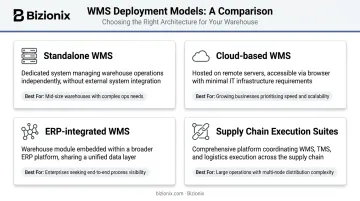
Understanding deployment types helps narrow the shortlist:
- Standalone WMS — purpose-built warehouse software with no native ERP connection; works best when the business already has a separate ERP
- Cloud-based WMS — SaaS delivery with lower upfront cost, faster deployment, and automatic updates; preferred by MSMEs and growing businesses
- ERP-integrated WMS — warehouse management built into a broader ERP platform (SAP, Oracle, NetSuite, Bizionix); eliminates data silos between inventory, finance, and procurement
- Supply chain execution suites — extended platforms covering WMS, transportation, yard management, and demand planning in one environment; suited to large, multi-node supply chains
Top 10 Warehouse Management Software Systems for 2026
These 10 platforms were shortlisted based on feature depth, scalability, deployment flexibility, pricing transparency, and fit across industries and business sizes.
1. Blue Yonder Warehouse Management
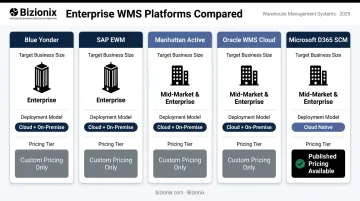
Blue Yonder (founded 1985, now a Panasonic company) is a supply chain execution platform used by large retailers, 3PLs, and global distribution networks. Its WMS is built around AI-driven demand forecasting and end-to-end warehouse orchestration across inbound, inventory, outbound, and micro-fulfilment operations.
The platform's system-directed cycle counting is published to achieve more than 99% inventory accuracy, virtually eliminating traditional cycle counting burdens. Blue Yonder was named a Leader in the 2025 Gartner Magic Quadrant for WMS for the 14th consecutive time.
| Category | Details |
|---|---|
| Key Features | AI-driven task optimisation, labour management, real-time replenishment, multi-site inventory visibility, yard and dock management |
| Best For | Global enterprises, large retailers, and high-volume 3PLs needing predictive supply chain intelligence |
| Pricing | Enterprise custom pricing; positioned at the higher end of the market |
2. SAP Extended Warehouse Management (EWM)
SAP EWM is one of the most widely deployed enterprise WMS solutions globally, built for high-volume complex logistics. Its primary advantage is deep integration with SAP S/4HANA — making it the natural choice for large supply chains already operating within the SAP ecosystem.
Key capabilities include wave and slotting management, automated inbound/outbound processes, resource optimisation, and compliance-grade auditability. SAP was named a Gartner WMS Leader for the 12th consecutive year in 2025.
| Category | Details |
|---|---|
| Key Features | Wave/slotting management, automated inbound/outbound processes, space utilisation tools, resource optimisation, SAP S/4HANA integration |
| Best For | Large enterprises and manufacturers operating within or migrating to the SAP ecosystem |
| Pricing | Enterprise licensing; implementation costs are substantial and typically require SAP-certified partners |
3. Manhattan Active Warehouse Management
Manhattan Associates (founded 1990) holds a notable distinction: named a Gartner Magic Quadrant WMS Leader for the 18th time in 2026. Its cloud-native, microservices-based architecture delivers new functionality every 90 days with zero downtime — eliminating version upgrades and costly migrations entirely.
The platform unifies labour management and warehouse management into a single application, with robotic automation orchestration and AI-driven task interleaving built in. For enterprises managing complex, high-velocity distribution, this continuous-update model is a measurable operational advantage.
| Category | Details |
|---|---|
| Key Features | AI task interleaving, robotic automation orchestration, labour and workforce optimisation, yard and dock management, unified cloud architecture |
| Best For | Global distribution centres, large retailers, and enterprises with high automation maturity |
| Pricing | Enterprise custom pricing; higher-end investment with structured implementation requirements |
4. Oracle Warehouse Management Cloud
Oracle WMS Cloud sits inside Oracle Fusion Cloud Logistics and SCM, giving large global enterprises total inventory visibility from distribution centres to store shelves. The platform supports retail, e-commerce, and manufacturing operations — with AI agents, autonomous mobile robot integration, and digital twin warehouse modelling in one environment.
Oracle's scale and cloud infrastructure make it a credible choice for multi-country supply networks, though product-specific pricing is not publicly listed.
| Category | Details |
|---|---|
| Key Features | Digital twin modelling, dock/yard/labour management, global inventory visibility, AI agents, end-to-end supply chain optimisation |
| Best For | Large-scale global enterprises and multi-country supply networks across retail and manufacturing |
| Pricing | Enterprise custom pricing; contact Oracle for product-specific quotes |
5. Infor CloudSuite WMS
Infor WMS is a tier-1 cloud-based system built for large distribution centres in retail, food & beverage, and 3PL environments. It combines advanced workflow automation with 3D warehouse visualisation for smarter space planning — and Infor officially claims over 99% order accuracy at bin level.
Available in both cloud and on-premise deployment, it suits operations that need flexibility in how the system is hosted. Voice-enabled picking, slotting optimisation, and embedded analytics make it a capable choice for high-volume facilities with complex picking requirements.
| Category | Details |
|---|---|
| Key Features | 3D warehouse visualisation, voice-enabled picking, multi-site inventory visibility, labour and yard management, workflow automation |
| Best For | Large warehouses and distribution centres handling heavy inventory volumes requiring advanced automation |
| Pricing | Custom subscription pricing; six-figure implementation costs for large facilities |
6. Microsoft Dynamics 365 Supply Chain Management
Microsoft D365 SCM integrates warehouse management with procurement, manufacturing, and distribution workflows — designed for large organisations already invested in the Microsoft ecosystem. The WMS module includes wave/zone picking, inbound/outbound operations, and work pool management. IoT device connectivity is available via Sensor Data Intelligence using Azure IoT capabilities.
Pricing is publicly listed at USD 210/user/month (standard) and USD 300/user/month for the Premium tier, making it one of the few enterprise platforms with transparent published rates.
| Category | Details |
|---|---|
| Key Features | Wave/zone picking, IoT connectivity via Azure, integrated procurement and manufacturing workflows, advanced inventory operations |
| Best For | Large enterprises and global manufacturers already using the Microsoft technology ecosystem |
| Pricing | USD 210/user/month (standard); USD 300/user/month (Premium) — both billed annually |
7. NetSuite Warehouse Management System
NetSuite WMS (by Oracle NetSuite) combines warehouse execution with ERP in a single cloud platform — making it well-suited to mid-sized businesses that want unified finance and inventory management. RF barcode scanning, lot/serial/expiration tracking, and multi-location inventory are all native to the platform.
The trade-off: implementation timelines tend to be longer, and the system works best for businesses with dedicated IT resources. Quote-based pricing means costs vary by configuration and user count.
| Category | Details |
|---|---|
| Key Features | RF barcode scanning, real-time picking and putaway, lot/serial/expiry tracking, multi-location inventory, native NetSuite ERP integration |
| Best For | Mid-sized businesses seeking a unified cloud ERP and WMS without managing separate systems |
| Pricing | Quote-based NetSuite module pricing; contact Oracle NetSuite for details |
8. Zoho Inventory
Zoho Inventory is a cloud-based warehouse and inventory management platform for growing businesses and e-commerce teams. Its strength is accessibility — an intuitive interface, a broad integration ecosystem (Shopify, Amazon, eBay, major shipping carriers), and a free plan for businesses just starting out.
It lacks the deep automation features of enterprise-grade WMS platforms, but for small to mid-sized operations moving away from spreadsheets, it's one of the most practical entry points available.
| Category | Details |
|---|---|
| Key Features | Multi-warehouse tracking, serial and batch tracking, composite item management, shipment tracking, reorder point alerts |
| Best For | Small to mid-sized retail and e-commerce businesses needing affordable, non-technical warehouse management |
| Pricing | Free plan available (limited); paid plans from USD 29/organisation/month, billed annually |
9. Fishbowl Inventory
Fishbowl Inventory is built for small to mid-sized manufacturers, distributors, and wholesalers — particularly those using QuickBooks who need stronger inventory control without jumping to a full enterprise ERP. It adds barcode scanning, Bill of Materials support, order management, and real-time multi-location tracking on top of what basic accounting tools can handle.
The interface is less modern than cloud-native platforms, and advanced automation is limited — but for QuickBooks users who have outgrown manual stock management, it addresses that need directly.
| Category | Details |
|---|---|
| Key Features | Real-time multi-location inventory tracking, barcode scanning, Bill of Materials support, QuickBooks integration, basic warehouse workflow automation |
| Best For | Small to mid-sized manufacturers and distributors using QuickBooks who need tighter inventory control |
| Pricing | Essentials from USD 229/month billed annually; Growth at USD 429/month; Scale at USD 729/month |
10. Bizionix
Bizionix is a 100% cloud-based ERP developed by IIS-LLP specifically for Indian MSMEs. Rather than a standalone WMS, it delivers warehouse and inventory management as part of a unified platform covering accounting, GST compliance, procurement, sales, HRMS, and production planning — all under a single login. The platform connects directly with the GST e-Invoice system via API for instant IRN generation, with GSTR-1 auto-population and built-in audit trails. For distribution or manufacturing MSMEs managing multiple locations and GST entities, this removes significant compliance overhead.
The NEO plan starts at ₹999/year with a 14-day free trial, covering core modules including warehouse management, accounts, sales, CRM, and HRMS. The Enterprise plan adds production planning, advanced purchase management, full HRMS with payroll, and custom configurations — with pricing available on request.
| Category | Details |
|---|---|
| Key Features | Real-time inventory and warehouse visibility, GST-compliant accounting, automated e-invoicing with direct IRP API, multi-location and multi-company management, 100% cloud-based with single login |
| Best For | Indian MSMEs in manufacturing, distribution, and warehousing needing an affordable, GST-ready ERP with integrated warehouse management |
| Pricing | NEO plan from ₹999/year; Enterprise plan — contact Bizionix for pricing |
How to Choose the Right Warehouse Management Software
The most common mistake buyers make is evaluating WMS platforms on features alone — without accounting for total cost of ownership, implementation complexity, or whether the team can realistically adopt it.
These platforms were assessed across core functionality, scalability, automation depth, integration capability, ease of deployment, and pricing transparency.
Key Selection Factors
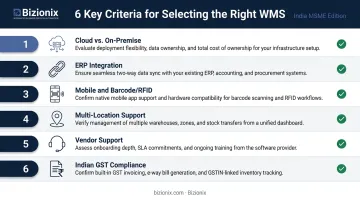
Before shortlisting any platform, work through these questions:
- Cloud vs. on-premise — Does your infrastructure and IT capability support a cloud-first deployment, or do you need on-premise hosting for compliance or connectivity reasons?
- ERP integration — Will the WMS need to connect with an existing ERP, or should it include ERP functionality natively?
- Mobile and barcode/RFID capability — Do your warehouse staff need mobile-based picking, scanning, or real-time floor updates?
- Multi-location support — Can the platform manage stock transfers, consolidated reporting, and location-specific rules across sites?
- Vendor support — What does post-deployment support look like, and is there a local Indian support team available when issues arise?
- For Indian businesses specifically — Does the platform handle GST compliance, e-invoicing, e-way bills, and GSTR filings natively, or will you need additional tools?
A Practical Note on ROI
Once you've worked through the selection criteria above, the ROI question becomes straightforward: brand recognition is not a proxy for fit.
A purpose-built system that integrates well with existing workflows and grows with the business often delivers better returns than an over-engineered enterprise platform. Consider the difference:
- Over-engineered platforms can take 12–18 months to implement and require specialist consultants to maintain
- Purpose-built systems aligned to your current operations go live faster and see higher team adoption
- Total cost of ownership — not license price alone — determines real value
Match the platform to where your operations are — not where you hope to be in five years.
Conclusion
No single WMS is right for every business. The right fit depends on scale, complexity, and existing infrastructure:
- SAP EWM and Manhattan Active suit enterprises managing complex, high-velocity distribution
- Oracle WMS Cloud and Infor CloudSuite serve large global supply chains with demanding automation requirements
- Microsoft D365 SCM makes sense for organisations already deep in the Microsoft stack
- NetSuite and Fishbowl sit in the middle ground for growing mid-market businesses
- Zoho Inventory is a practical, affordable starting point for small e-commerce and retail operations
For Indian MSMEs specifically, the priorities shift. GST compliance, affordable total cost of ownership, cloud deployment, and local support matter more than enterprise feature lists. Before signing, evaluate whether the vendor offers long-term commitment and scalability that matches how your business actually operates — not just the longest feature list.
If you're an Indian MSME looking for a platform that brings warehouse management, inventory, accounting, and GST compliance into one place without SAP-level complexity or cost, explore Bizionix, a platform built specifically for growing Indian businesses.
Frequently Asked Questions
Which software is best for warehouse management?
There is no single best WMS — the right choice depends on business size, industry, and operational complexity. Large enterprises typically favour SAP EWM, Manhattan Active, or Blue Yonder, while growing MSMEs and mid-market businesses often find more practical value in platforms like Zoho Inventory, Fishbowl, or Bizionix.
What is a Warehouse Management System (WMS)?
A WMS is software designed to manage and optimise warehouse operations — covering inventory tracking, order picking, putaway, packing, and shipping. Most modern platforms also integrate with ERP systems and deliver real-time reporting across multiple locations.
What are the types of Warehouse Management Systems?
The four main deployment models are: standalone WMS, cloud-based WMS, ERP-integrated WMS, and supply chain execution suites. The best fit depends on your operational scale, existing software stack, and whether you need warehouse-only functionality or a broader platform.
What is the difference between a WMS and an ERP system?
A WMS focuses specifically on warehouse operations — inventory movement, order fulfilment, picking, and packing. An ERP is a broader platform covering finance, procurement, HR, and more. Many modern ERPs include a built-in WMS module, as seen with SAP, Oracle, and Bizionix.
Which industries commonly use Warehouse Management Systems?
The most common industries include retail and e-commerce, manufacturing, distribution and wholesale, third-party logistics (3PL), pharmaceutical, and food & beverage. Any business managing physical inventory at scale benefits from a WMS.
What should Indian MSMEs look for in a WMS?
Key criteria to evaluate:
- GST compliance and e-invoicing integration (GSTR filings, IRN generation, e-way bills)
- Cloud-based deployment with multi-location support
- ERP integration capability and affordable total cost of ownership
Platforms that handle these natively are better fits than most global enterprise options for Indian MSMEs.