Introduction
Running a local business in India often means juggling accounts in Tally, customers in a spreadsheet, inventory in a separate app, and HR in yet another system. Each tool works in isolation. Data doesn't sync. Month-end becomes a scramble to reconcile numbers that should have aligned automatically.
This fragmentation carries a real cost: missed invoices, compliance errors, and decisions made on outdated information. And it's a widespread problem. According to the Ministry of MSME Annual Report 2024-25, 5.77 crore MSMEs are registered as of December 2024, contributing 30.1% of GDP — yet many still manage operations through disconnected tools that compound these exact problems.
The right local business software unifies operations, automates GST compliance, and gives owners real-time visibility to make faster, better decisions.
This guide covers the best local business software tools for Indian MSMEs, along with a practical framework for choosing the right one at your stage of growth.
Key Takeaways
- Indian MSMEs need software built for GST compliance, e-invoicing, and multi-department operations, not generic global tools built for other markets
- Key categories: GST-ready accounting, CRM, inventory, ERP, and HR
- Top tools include Bizionix, Zoho One, Tally Prime, Vyapar, and HubSpot, each suited to different business sizes and needs
- Choose based on compliance readiness, integration depth, and total cost of ownership rather than brand recognition alone
- Start small with Vyapar or Tally Prime; scale to a unified ERP like Bizionix or Zoho One as operations grow
Why Local Businesses in India Need Purpose-Built Software
For Indian MSMEs, "local business software" covers far more than billing or basic bookkeeping. These are operational platforms handling accounting, GST compliance, inventory, CRM, sales, and HR — ideally within a single integrated system.
The compliance burden alone justifies purpose-built tools. GST-registered taxpayers must file GSTR-1 and GSTR-3B monthly or quarterly, plus GSTR-9 annually.
Businesses with aggregate turnover above ₹5 crore must also generate e-invoices with an IRN (Invoice Reference Number) for every B2B transaction — mandated under GST Council Notification 10/2023-Central Tax effective August 2023.
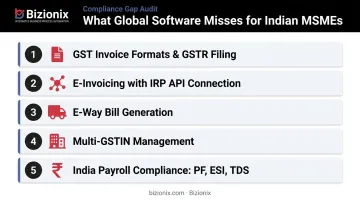
Software built for US or European markets rarely covers these requirements. Common gaps include:
- GST invoice formats and GSTR return filing integration
- E-invoicing with direct IRP (Invoice Registration Portal) API connection
- E-way bill generation
- Multi-GSTIN management for businesses operating across states
- India-specific payroll compliance (PF, ESI, TDS on salary)
These gaps are pushing MSMEs toward India-specific platforms across every function. A FICCI survey on SME digital adoption found that 60% of SMEs used digital tools for HR, 51% for sales and marketing, and 48% for finance — demand is no longer limited to accounting alone.
The tools listed below prioritize GST compliance depth, module coverage, and practical usability for teams without dedicated IT support.
Best Local Business Software Tools for Indian MSMEs
Here's a closer look at the tools worth considering, covering pricing, compliance features, and who each one suits best.
Bizionix by IIS-LLP
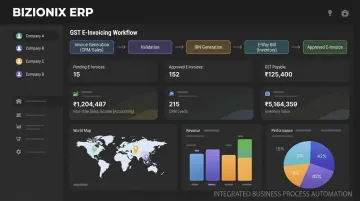
Bizionix is a 100% cloud-based, all-in-one ERP platform built specifically for Indian MSMEs by IIS-LLP, a subsidiary of Protocol India Private Limited with over two decades of industry experience. The platform replaces fragmented tools with a single unified system running on one database — meaning CRM, accounting, inventory, HRMS, and operations all work from the same real-time data.
What makes it particularly relevant for Indian local businesses is its direct API integration with the GST e-Invoice system. When a sales invoice is created in Bizionix, the system automatically validates the data, connects to the IRP, and generates the IRN and QR code instantly — the entire process takes seconds, not hours. There's no manual upload or third-party tool required.
The multi-company management feature is another standout for business groups, CA firms, and franchise networks: a single secure login manages multiple GST-registered entities, each with independent books of accounts, separate compliance, and entity-level role permissions.
| Details | |
|---|---|
| Key Features | GST-ready accounting, automated e-invoicing with IRN generation, multi-company management, inventory control, CRM, HRMS with statutory compliance, real-time dashboards, activity tracking, cloud access from any device |
| Best Suited For | Indian MSMEs, CA firms managing client portfolios, manufacturing companies, distribution and warehouse operations, franchise networks, multi-location enterprises |
| Pricing | Bizionix NEO starts at ₹999/year (14-day free trial included); Enterprise plan with custom pricing for advanced requirements. Visit bizionix.com for current details |
Zoho One
Zoho One is an Indian-origin business suite bundling 50+ integrated applications — covering CRM, accounting, HR, marketing, project management, and helpdesk. For Indian SMBs looking to consolidate tools under one vendor, it's one of the broadest options available.
Its accounting arm, Zoho Books, handles GST-compliant invoicing, online GST return filing, multi-GSTIN management, e-way bill generation, and electronic invoicing for B2B transactions authenticated by GSTN. Zoho Books also has a free plan for businesses with annual revenue below ₹25 lakhs — a practical entry point for very early-stage businesses.
The ecosystem depth is genuinely useful: Zoho CRM, Zoho Books, Zoho Payroll, and Zoho Projects all share data natively, so a sale in CRM flows through to accounting without manual re-entry.
| Details | |
|---|---|
| Key Features | CRM (Zoho CRM), GST accounting (Zoho Books), email marketing, HR management, project tracking, inventory management, 50+ interconnected apps |
| Best Suited For | SMBs wanting a modular suite with tight CRM and accounting integration |
| Pricing | Zoho Books Standard from ₹749/month (billed annually). Zoho One per-employee pricing: check Zoho's India pricing page for current rates |
Tally Prime
Tally Prime is India's most widely adopted business management software, trusted by traditional businesses and chartered accountants across the country. It handles accounting, GST filing, payroll, inventory management, and financial reporting — and is available both as an on-premise installation and in connected (cloud-enabled) mode.
Its compliance depth is the main advantage. TallyPrime supports GSTR-1 filing directly from within the software using EVC or DSC (no separate portal login needed), GSTR-3B reporting, e-invoicing with IRN generation and QR code printing, and e-way bill generation. The large ecosystem of Tally-certified partners across India makes implementation support widely accessible.
| Details | |
|---|---|
| Key Features | GST return filing (GSTR-1, GSTR-3B), e-invoicing with IRN, e-way bill generation, inventory management, payroll, multi-currency support, offline-capable operation |
| Best Suited For | Traditional Indian businesses and CAs prioritising accounting depth and GST compliance; businesses with existing Tally workflows |
| Pricing | Silver (single PC) from ₹750/month + 18% GST; Gold (multi-user) from ₹2,250/month + 18% GST. Lifetime licences available. Verify at Tally Solutions India |
Vyapar
Vyapar is a mobile-first billing and inventory app built for small Indian businesses and retailers. It lets users create GST invoices, track inventory, manage payments, and generate basic financial reports — directly from a smartphone, even without an internet connection.
Its appeal for very small or early-stage businesses is straightforward: the interface is simple enough that someone with no accounting background can issue a GST-compliant invoice in under a minute. Invoices can be shared instantly via WhatsApp or SMS, which matters for retailers and sole proprietors whose customers communicate primarily through WhatsApp.
| Details | |
|---|---|
| Key Features | GST invoicing, inventory tracking, payment reminders, expense management, business reports, barcode scanning via mobile, offline functionality |
| Best Suited For | Very small businesses, retailers, and sole proprietors taking their first steps toward digital business management |
| Pricing | Check current plan pricing at vyaparapp.in/pricing |
HubSpot
HubSpot is a globally recognised CRM and marketing platform covering sales pipeline management, email marketing, customer service, and content management. Its free tier makes it accessible for local businesses focused primarily on customer growth rather than back-office compliance.
One important clarification: the free CRM supports up to 2 users and 1,000 contacts with 1 deal pipeline — functional for a small team, but growing businesses will likely need the Starter plan fairly quickly. HubSpot doesn't handle GST compliance or inventory; it's purpose-built for the customer-facing side of the business.
| Details | |
|---|---|
| Key Features | Free CRM (up to 1,000 contacts, 2 users), sales pipeline management, email marketing, lead capture, customer service ticketing, marketing analytics, 500+ integrations |
| Best Suited For | Service-based businesses, growing SMBs, and local businesses prioritising CRM and marketing over back-office operations |
| Pricing | Free tier available; Starter from ₹3,300/month (billed annually, 2 paid users); Professional from ₹33,000/month (billed annually, 5 paid users). Verify at HubSpot India pricing |
How to Choose the Right Local Business Software
The Four Criteria That Matter
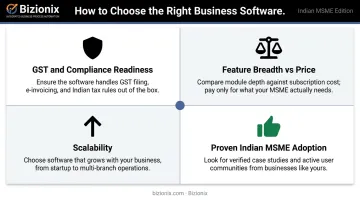
Most businesses choose software based on what they've heard of — not what fits their operational reality. These four criteria cut through the noise:
- GST and India-specific compliance readiness — Does the software support e-invoicing with IRN, e-way bills, and GSTR return filing natively? International tools often treat India as an afterthought.
- Feature breadth relative to price — A ₹999/month tool that replaces four separate subscriptions beats a cheaper app that still requires three paid add-ons.
- Scalability — The cost of migrating to a new platform mid-growth — in time, data risk, and retraining — is almost always underestimated.
- Proven adoption among Indian MSMEs — Community support, certified implementation partners, and India-specific documentation matter when things go wrong.
Once you've filtered by these criteria, the shortlist narrows quickly based on your current stage.
Matching the Tool to Your Stage
- Very small businesses and retailers — Start with Vyapar. It's affordable, offline-capable, and gets GST invoicing right without a learning curve.
- Accounting-first businesses and CA clients — Tally Prime's depth of GST compliance and its partner ecosystem make it the default for many traditional businesses.
- Growing businesses needing CRM + accounting — Zoho One's interconnected suite handles both without forcing two separate systems.
- Multi-department MSMEs and business groups — A unified ERP like Bizionix connects accounting, operations, CRM, and HR under one system — the point where running separate tools stops being inconvenient and starts costing measurable money.
A US-market CRM with strong reviews may have zero GST integration. Always verify India-specific compliance features before shortlisting any tool.
Conclusion
The best local business software is the one that fits your compliance requirements, team size, and growth trajectory — not necessarily the one with the most features. A small retailer and a manufacturing business with 50 employees have very different needs, and no single tool is right for everyone.
That context should drive your evaluation. Beyond sticker price, consider:
- How many separate tools the platform replaces
- How much time compliance will consume each month
- Whether the system can scale without forcing a migration within 12 months
For Indian MSMEs needing a unified, GST-ready platform covering accounting, CRM, inventory, HR, and operations in one system — without SAP-level complexity or cost — Bizionix is worth a close look.
The platform offers a 14-day free trial on the NEO plan, and the team provides demos and walkthroughs for businesses evaluating an ERP move. Visit bizionix.com or contact the team at info@bizionix.com to explore whether it fits your operational reality.
Frequently Asked Questions
What local business software is best for a small business?
Vyapar or Tally Prime suit small businesses focused on GST invoicing and basic accounting. Businesses needing unified operations across sales, finance, inventory, and HR from one platform are better served by Bizionix or Zoho One.
Is there a 100% free CRM for local businesses?
HubSpot offers a free CRM supporting up to 2 users and 1,000 contacts. Zoho CRM and EngageBay also have free tiers. Paid plans become necessary once you exceed those contact limits or need workflow automation.
What is the difference between accounting software and an ERP for a small business?
Accounting software handles financial records, GST invoicing, and compliance. An ERP integrates those functions with inventory, HR, CRM, and operations in one system. Businesses with multiple departments benefit from ERP; those needing financial management alone can start with accounting software.
How important is GST compliance when choosing business software in India?
Non-negotiable. The software must support GST invoice generation, e-way bills, e-invoicing with IRN generation, and GSTR return filing. Missing any of these creates compliance gaps that lead to penalties, audit issues, and manual workarounds.
Can one software handle all my local business needs?
For most MSMEs, yes. All-in-one platforms like Bizionix and Zoho One consolidate accounting, sales, operations, HR, and compliance in a single system, eliminating errors from disconnected tools. Businesses with highly specialized workflows may still need one or two add-ons.
How much should a small Indian business budget for business management software?
Entry-level tools like Vyapar and Tally Prime Silver start under ₹1,000/month. Cloud ERP options like Bizionix NEO start at ₹999/year. Factor in the cost of tools being replaced, implementation time, and training — cloud-based options now bring enterprise-level capabilities within MSME budgets.