This is the daily reality for thousands of Indian distribution businesses. And it compounds quickly as you grow.
This guide explains what distribution ERP software is, how it differs from generic tools, which features matter most for Indian distributors, and how to evaluate solutions that fit your business—without paying enterprise-level prices.
Key Takeaways
- Distribution ERP unifies inventory, orders, purchasing, warehouse, and finance into one platform built for buy-store-resell businesses
- Generic accounting tools fail distributors at scale: siloed data, manual GST filing, and no multi-location visibility create serious operational risk
- GST e-invoicing is mandatory for businesses with aggregate turnover above ₹5 crore. Your ERP must handle IRN generation natively to stay compliant.
- Cloud ERP is the practical choice for most Indian MSMEs: lower upfront cost, remote access, no IT infrastructure needed
- Only 12% of Indian MSMEs currently use ERP, meaning early adopters gain a real competitive edge
What Is Distribution ERP Software and Why Do Indian Distributors Need It Now?
Distribution ERP is a unified software platform built specifically for businesses that buy, store, and resell products. Unlike generic business software, it covers the entire operational cycle—inventory management, purchasing, order processing, warehouse operations, accounts payable/receivable, and GST compliance—through a single system with shared data.
The Problem with Disconnected Tools
Most growing distributors start with a combination of Tally for accounts, spreadsheets for inventory, and WhatsApp for orders. This works at small scale. It breaks down quickly once you have multiple branches, hundreds of SKUs, and daily GST obligations.
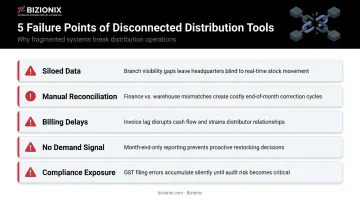
The specific failure points:
- Siloed data: Stock levels in one branch are invisible to another
- Manual reconciliation: Finance reconciles what sales promised against what warehouse shipped—manually
- Billing delays: Invoices wait for someone to manually pull order data into accounting
- No demand signal: Nobody knows what's actually selling until the month-end report is assembled
- Compliance exposure: Manual GST filing is slow and error-prone at volume
Why Now, Specifically
The Indian context makes this urgent. According to the RIS MSME Digitalisation Report 2026, only **12% of Indian MSMEs use ERP software**, and 46.2% remain fully offline. Businesses adopting integrated systems now are pulling ahead operationally as that gap closes.
GST compliance adds more pressure. E-invoicing is now mandatory for businesses with aggregate annual turnover of ₹5 crore and above (effective 1 August 2023). That means generating invoices in your own system, reporting them to the Invoice Registration Portal (IRP), and receiving a signed invoice with an IRN and QR code—a workflow that demands ERP-level automation at any real volume.
How Distribution ERP Differs from General Business or Manufacturing ERP
The distinction matters when you're evaluating software options.
| ERP Type | Designed Around | Core Strengths |
|---|---|---|
| Manufacturing ERP | Production workflows | Bills of materials, shop floor control, production planning |
| General Business ERP | Finance and HR | Ledgers, payroll, basic reporting |
| Distribution ERP | Purchase-to-sale workflow | Multi-location inventory, order fulfillment, supplier management |
Distribution ERP is built around the movement of goods—from supplier purchase order through receiving, storage, picking, invoicing, and payment collection. Each stage introduces its own tracking, pricing, and compliance requirements that generic systems aren't designed to handle.
Distribution-Specific Capabilities Generic Systems Lack
When a wholesale distributor tries to use a general ERP or accounting tool, they typically run into these gaps:
- Tracks stock by branch or warehouse in real time — not at month-end reconciliation
- Handles customer-specific pricing: separate price lists, volume discounts, and contract rates per account
- Manages batch and lot numbers for food, pharma, or any regulated product category
- Triggers automatic replenishment when stock falls below defined thresholds — no manual monitoring needed
- Matches purchase orders, goods receipt notes, and supplier invoices in a single automated step before payment releases
Closing these gaps in a generic ERP requires customisation—which adds cost, time, and long-term maintenance burden. Distribution-specific ERP includes them by design.
Core Features to Look for in Distribution ERP Software
Inventory and Warehouse Management
Real-time, multi-location inventory visibility is the foundation of any functional distribution ERP. Every downstream process—ordering, fulfillment, finance—depends on knowing exactly what stock exists, where, and when.
What this looks like in practice:
- Stock levels visible by branch, warehouse, or storage location at any moment
- Inter-location transfer tracking—when goods move between sites, both sides update instantly
- Automated reorder alerts when stock falls below defined minimums
- Goods Receipt Note (GRN) management to confirm what actually arrived versus what was ordered
- Consumption analytics to identify which SKUs move fast and which sit idle
Bizionix includes a Warehouse Management module with multi-location stock tracking as standard, giving distribution groups centralized inventory visibility across all branches from a single login.
Order and Purchase Management
End-to-end order processing covers both sides of the distribution business:
On the sales side: customer-specific pricing, sales orders linked to delivery challans, and invoices generated directly from fulfilled orders—no manual re-entry.
On the purchase side: purchase orders linked to GRNs, which link to supplier invoices. This three-way matching process is what separates disciplined AP operations from error-prone ones. According to Ardent Partners' State of ePayables 2024, best-in-class AP teams have 70% adoption of two- or three-way matching—versus 53% for others—and an invoice exception rate of 9% versus 22% for others. That gap translates directly into fewer payment disputes, faster close cycles, and lower AP overhead.
GST Compliance and Financial Management
For Indian distributors, GST compliance is non-negotiable infrastructure, not a nice-to-have feature.
Your ERP must handle:
- Automated GST calculation at invoice level across applicable tax rates
- E-invoice generation with INV-01 JSON reporting to the IRP and instant IRN return
- QR code embedding on every invoice
- GSTR-1 auto-population from confirmed sales invoices
- TDS management integrated into the accounts payable workflow
- Audit-ready financial records with full transaction traceability
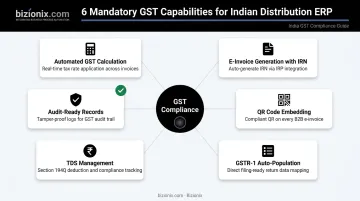
Bizionix handles this through direct API integration with the GST e-Invoice system. The workflow is straightforward: create an invoice in the ERP, and the system validates it against GST rules automatically, then generates the IRN and QR code via direct IRP connection within seconds.
The invoice is ready to share as a compliant PDF immediately. No manual steps, no third-party tools required.
Analytics and Reporting Dashboards
Distribution businesses run on fill rates, turnover, and receivables. These metrics determine whether working capital is being deployed well or quietly eroding through slow-moving stock and late collections.
Role-based dashboards give each function what they need:
- Management: Branch-wise sales performance, overall inventory turnover, aging receivables
- Sales teams: Customer order history, outstanding payments, top-performing products
- Warehouse staff: Pending dispatch, stock movement, GRN status
- Finance: AP aging, GST liability position, cash flow view
Real-time dashboards replace the end-of-month scramble to assemble reports from multiple spreadsheets.
Key Benefits Distribution ERP Delivers for Growing Businesses
Operational Efficiency
Automation of repetitive tasks—invoice generation, replenishment alerts, GRN matching—directly reduces manual labour hours. The AP benchmark data shows just how wide the gap can be:
| Best-in-Class | Average | |
|---|---|---|
| Invoice processing time | 3.1 days | 17.4 days |
| Cost per invoice | ₹231 | ₹1,071 |
Even partial improvement in the invoice processing cycle has real cash flow consequences for a mid-sized distributor handling hundreds of vendor invoices monthly.
Better Inventory and Working Capital
Real-time stock visibility means you stop over-ordering to compensate for uncertainty—and stop discovering stockouts only when customers call. Heidelberg Distributing, a US-based distributor, reduced average inventory from $120M to $90M (a 25% reduction) after implementing supply chain planning software, according to a Nucleus Research case study. The mechanism—better demand data, automated replenishment signals—applies equally to Indian wholesale distributors.
Faster Billing and Improved Cash Flow
Better inventory control directly feeds into faster cash cycles. The path from fulfilled order to collected payment has several friction points: manual invoice preparation, GST calculation errors, disputed amounts, and delayed follow-ups. Integrated order-to-invoice workflows eliminate most of these. Bizionix's pre-validation step checks invoice data against GST rules before submission—so fewer invoices get rejected and fewer disputes stall your collections.
Multi-Branch Visibility and Centralized Control
For distribution groups with multiple branches, a unified ERP eliminates the information gap between locations. Bizionix's multi-company management allows branch managers to operate independently within their entity while senior management gets consolidated dashboards across the entire group—without logging into separate systems or waiting for manual reports.
Scalability Without Proportional Cost
Adding a new branch or product line to a spreadsheet-based system means rebuilding processes from scratch—new files, new formats, new reconciliation headaches. In a well-implemented ERP, it means adding a new entity to an existing structure: same workflows, same reporting, same controls. For MSMEs in active growth phases, that distinction determines whether your systems support expansion or slow it down.
Cloud-Based vs. On-Premise Distribution ERP: What's Right for Indian MSMEs?
Cloud ERP is the practical default for most Indian MSMEs. Here's why:
Cloud advantages:
- Lower upfront cost—subscription model versus large capital expenditure on servers and licences
- Faster deployment—no infrastructure setup required
- Automatic updates—compliance changes (GST rule updates, e-invoicing thresholds) are reflected without manual patches
- Remote access for field sales teams and branch managers from any location
- No dedicated IT staff needed to maintain servers
RIS reports cloud adoption among Indian MSMEs sits at just 14% overall, but rises to 28.43% for firms with more than 50 workers. Businesses that have crossed this threshold recognize the operational advantage—and the pattern will continue as connectivity improves.
When on-premise still applies:
- Specific data residency or regulatory requirements (rare in distribution)
- Poor internet connectivity at primary operating locations
- Heavily customized legacy processes that would require extensive rework
These exceptions are narrow. For most Indian distributors operating across multiple cities with a growing team, cloud ERP wins on both cost and operational flexibility.
How to Choose the Right Distribution ERP for Your Business
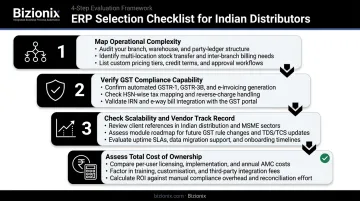
Step 1: Map Your Operational Complexity
Before evaluating vendors, document:
- Number of warehouses or branches
- SKU count and whether you handle batch/lot products
- Monthly transaction volume (orders, invoices, purchase orders)
- Whether you operate multiple legal entities or GST registrations
- Integration requirements with logistics, e-commerce, or payment tools
These factors determine whether you need a basic cloud ERP or a more configurable, multi-entity platform.
Step 2: Verify GST Compliance Capability
Ask vendors specific questions:
- Does the system generate IRN through direct IRP API or through a GSP intermediary?
- How does GSTR-1 auto-population work?
- Is TDS management integrated into accounts payable?
- What happens when the GST portal has downtime—does the system queue submissions?
An ERP that handles GST through manual export-import workflows is not a compliance solution—it's just a different kind of manual process.
Step 3: Check Scalability, Integration, and Vendor Track Record
- Can the platform add new entities or users without a system overhaul?
- Does it connect with your logistics partners, marketplace channels, or payment gateways?
- Does the vendor have verifiable deployments with Indian MSMEs in distribution or wholesale?
On the last point, look for vendors who can name specific MSME clients in distribution or wholesale — not just showcase enterprise logos. Bizionix by IIS-LLP, for instance, targets this segment directly: it offers multi-company management, real-time inventory visibility, and direct API e-invoicing under a single login, at a price point sized for growing Indian businesses rather than large enterprises.
Step 4: Assess Total Cost of Ownership
The subscription fee is just one component. Factor in:
- Implementation and data migration effort
- Training time for staff across functions
- Ongoing support quality and responsiveness
- Cost of any customisation required
Gartner notes that ERP initiatives frequently fail due to weak executive commitment, poor change management, and low end-user adoption—with a prediction that more than 70% of recently implemented ERP initiatives will fail to meet original business-case goals by 2027. Choosing the right software is step one. Budgeting time and resources for proper rollout is what actually determines whether it sticks.
Frequently Asked Questions
What is distribution ERP software?
Distribution ERP is a purpose-built software platform that unifies inventory, order management, purchasing, warehouse operations, and financials for businesses that buy, store, and resell products. Unlike generic accounting tools, it's architected around the complete purchase-to-sale workflow with real-time data across all functions.
How is distribution ERP different from regular or manufacturing ERP?
Distribution ERP prioritizes multi-location inventory tracking, order fulfillment, customer pricing management, and procurement workflows. Manufacturing ERP centers on production planning and bills of materials. General ERP focuses on financials and HR—neither handles the distribution workflow without significant customization.
What are the must-have features in a distribution ERP for Indian businesses?
Real-time multi-location inventory management, automated purchase and order processing, GST compliance with native IRN generation, multi-branch visibility from a single dashboard, and integrated financial reporting covering receivables, payables, and audit-ready statements.
Is cloud-based distribution ERP better than on-premise for MSMEs?
For most Indian MSMEs, yes. Cloud ERP requires lower upfront investment, deploys faster, updates automatically with GST rule changes, and provides remote access without dedicated IT infrastructure—all of which matter for growing multi-location operations.
How long does it take to implement a distribution ERP system?
Timelines vary based on data migration complexity, number of locations, and customization required. A straightforward deployment with limited legacy data can be operational within weeks; multi-branch implementations with significant historical data typically take longer.
How does distribution ERP help with GST compliance in India?
Distribution ERP automates tax calculation at the invoice level, submits invoice data to the IRP via API to generate IRN and QR codes instantly, and auto-populates GSTR-1 from confirmed sales—eliminating manual filing steps and reducing the risk of mismatches and late filings.