This fragmented reality isn't just frustrating. It creates financial leakage through untracked expenses, billing delays from manual data transfers, and decisions made on reports that contradict each other. As your business grows — more SKUs, more staff, more locations — each disconnected tool compounds the problem.
This guide explains what a genuine all-in-one business management platform is, what it must include, how to tell real unified platforms from loosely stitched-together apps, and how to choose one that fits the operational reality of a growing Indian business.
TLDR
- An all-in-one business management platform runs all departments — sales, finance, inventory, HR — on a single shared database with no manual data transfers between tools
- Fragmented tools create three compounding costs: financial leakage, time lost to re-entry, and decisions made on conflicting data
- A genuine platform must natively cover accounting (with GST/IRN), inventory, CRM, HR/payroll, and real-time reporting
- Evaluate vendors on native data flow, single-source-of-truth architecture, and whether they pass the "Zapier test"
- Indian MSMEs specifically need built-in GST compliance, e-invoicing, PF/ESI/TDS handling, and multi-entity management — not expensive customisations
What Is an All-in-One Business Management Platform?
One Database, Every Department
An all-in-one business management platform is a unified software system where every core business function — sales, finance, inventory, HR, procurement, and reporting — shares a single database and communicates in real time. That means no separate tools, no manual transfers between departments, and no version conflicts.
According to IDC's 2024 MarketScape, ERP is defined as a packaged integrated suite of business applications using common data and process models to support administrative, financial, and operational processes. That "common data model" requirement is what separates a true all-in-one from a bundle of loosely connected apps.
How It Actually Works
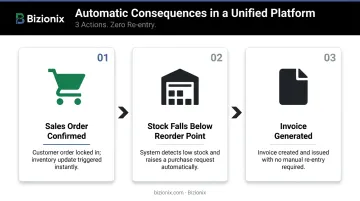
In a genuine all-in-one platform, actions have automatic consequences:
- A confirmed sales order instantly reduces inventory levels
- If stock falls below the reorder point, a purchase request triggers automatically
- The invoice is generated from the same transaction record — no re-entry required
Every department works from the same live data — no switching screens, no chasing updates across teams.
The Relationship With ERP
That real-time coordination you just saw described is exactly what ERP (Enterprise Resource Planning) systems are built around. Most all-in-one platforms fall under this category, though the terminology confuses many buyers — ERP historically implied expensive, months-long implementations designed for large enterprises. That's changed. Modern cloud-based platforms have brought ERP-grade capabilities to mid-sized and growing businesses at a fraction of the traditional cost and complexity.
The IDC research reflects this shift: about 50% of small businesses now identify ERP and financial management tools as a top technology priority, and nearly 40% are specifically focused on moving data out of spreadsheets into unified systems to reduce manual errors.
Who Benefits Most
This type of platform is most valuable for:
- Growing businesses in the 20–500 employee range managing multiple departments
- Multi-location enterprises with branches, warehouses, or regional offices
- Manufacturing and distribution companies managing inventory across the supply chain
- Any organization where syncing data between departments currently requires human effort
The Hidden Cost of Running on Disconnected Tools
Fragmented tools don't just create inconvenience — they create measurable financial risk.
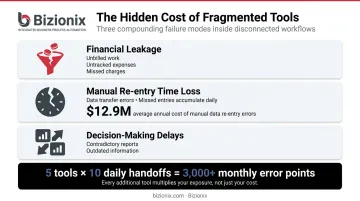
Three Operational Losses
1. Financial leakage Unbilled work, untracked expenses, and missed charges accumulate when sales, operations, and finance don't share the same data. A job completed but not invoiced because it never made it from the ops team's sheet to the billing team's system is money that simply disappears.
2. Time lost to manual re-entry Every time data moves between tools by human hand, someone is spending time they could spend on something productive — and introducing an opportunity for error. Gartner reports that poor data quality costs organisations at least $12.9 million per year on average (roughly ₹100 crore) globally. For MSMEs operating on tighter margins, even a fraction of that exposure adds up fast.
3. Decision-making delays When finance runs one report from their accounting tool and operations pulls a different number from their inventory sheet, management gets conflicting data. Decisions slow down or get made on outdated information.
The Compounding Effect
Fragmentation compounds fast. A business running five tools with just ten data handoffs per day produces 3,000+ potential error points every month. Add SKUs, staff, or locations, and that number multiplies — not linearly, but exponentially.
This is the operational ceiling Bizionix was built to address. Excel works fine at 50 transactions per month. At 500 transactions with five departments sharing that same data, it fails silently — wrong stock counts, missed invoices, and no one notices until month-end reconciliation.
The Subscription Cost Reality
Most mid-sized businesses accumulate separate subscriptions for accounting software, an inventory tool, a CRM, an HR platform, and assorted communication or approval tools. Each carries its own subscription fee, maintenance overhead, and the hidden cost of someone manually bridging the gaps between them. A single unified platform removes most of that stack — and closes the data gaps that come with it.
Core Modules Every All-in-One Platform Should Cover in 2025
Not all "all-in-one" claims hold up under scrutiny. A platform genuinely earns that label only when it covers the full operational cycle of a business without requiring third-party connectors for core functions.
Accounting and Finance
This module must include: GST-compliant invoicing, accounts receivable and payable, bank reconciliation, journal entries, and financial statements (Balance Sheet, P&L, Trial Balance). These must be native to the platform — not an integration with an external accounting tool.
For Indian businesses, e-invoicing with IRN generation is non-negotiable. Per CBIC Notification No. 10/2023, e-invoicing is mandatory for businesses with aggregate turnover exceeding ₹5 crore from August 1, 2023. From April 1, 2025, businesses with AATO of ₹10 crore and above cannot report e-invoices older than 30 days on the IRP — making timely, automated IRN workflows a compliance requirement, not a nice-to-have.
Bizionix handles this natively: the platform connects directly to the IRP via API, generates IRN and QR codes in seconds, auto-populates GSTR-1, and validates invoices before submission to prevent rejection.
Inventory and Warehouse Management
Core requirements:
- Multi-warehouse stock tracking across locations
- Real-time stock movement logs
- Reorder point alerts connected to purchase management
- Integration with sales orders so inventory updates the moment a sale is confirmed
Inventory that isn't connected to sales and purchasing creates the classic twin problem: stockouts that lose orders, and overstock that ties up cash.
Sales, CRM, and Customer Management
A sales module should operate within the same environment as invoicing — not as a separate tool that syncs data overnight. Core requirements:
- Lead tracking and follow-up management
- Quotation generation with pricing rules
- Sales order management linked directly to inventory
- Customer history and communication logs accessible without switching systems
When CRM and billing data share a single platform, billing cycles shorten and customer service teams can resolve queries without chasing other departments. Bizionix's CRM module connects lead management, quotations, and sales orders directly to the accounting module — a confirmed sales order flows into invoicing without re-entry.
HR, Payroll, and Attendance
HR module requirements for Indian businesses:
- Employee records and attendance tracking
- Leave management with approval workflows
- Payroll processing with salary calculations
- Statutory compliance: PF (12% of wages, employer + employee), ESI (3.25% employer / 0.75% employee for eligible employees up to ₹21,000/month), and TDS under Section 192
When HR data connects to operations, management can track headcount costs against project activity and catch payroll anomalies before they become compliance issues — neither of which is possible when HR runs in isolation.
Reporting and Dashboards
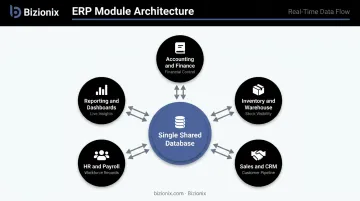
Reporting is the proof of integration. A truly unified platform should deliver a single live dashboard covering:
- Sales pipeline status and conversion rates
- Current stock value and low-inventory alerts
- Outstanding receivables and overdue accounts
- Payroll status and statutory dues
- Operational flags requiring immediate attention
If pulling any of these figures requires exporting data from separate modules and combining them manually, the platform is integrated in name only.
What Separates a True All-in-One from a "Stitched-Together" Suite
The Zapier Test
Many platforms market themselves as all-in-one but quietly rely on third-party automation tools like Zapier or Make to pass data between modules. This matters because middleware introduces sync delays, creates additional failure points, and adds subscription costs that compound over time.
In a genuine unified platform, data flows natively — no middleware required. Bizionix is built on this architecture: all modules share a single database, so a sales transaction updates inventory, accounting, and GST records in real time — no external connectors needed.
The Single Source of Truth Test
When a customer record is updated in CRM, a real all-in-one system reflects that change instantly across invoicing, purchase history, and sales reporting. Stitched systems break this consistency — the same customer can appear with different contact details, different balances, or conflicting transaction histories depending on which module you're looking at.
The IDC's definition explicitly requires "common data and process models" across the full ERP suite. When evaluating vendors, ask them to demonstrate live data sync between CRM, invoicing, and inventory — that test alone will separate genuine unified platforms from stitched ones.
Role-Based Access and Audit Trails
A genuinely integrated platform manages permissions across all modules from a centralised settings panel and maintains a unified audit log of every action.
You should be able to trace the full activity trail from one place — who created an invoice, who approved a purchase order, who modified a customer record — not chase down separate logs in separate modules.
Bizionix enforces role-based controls (view/edit/admin) at the entity level with full activity logs per company — including for multi-entity environments where different users have access to different subsidiaries or branches.
Scalability as the Final Test
A genuine all-in-one platform should handle multi-company management, multiple branch locations, and growing transaction volumes without additional tools or migrations. If adding a second branch means buying another licence or building a new integration, the platform isn't truly unified.
How to Evaluate and Choose the Right Platform
Identify Your Core Workflows First
Before looking at any software, map the three or four workflows that actually run your business daily:
- Order-to-cash: lead → quotation → sales order → delivery → invoice → payment
- Purchase-to-pay: reorder trigger → purchase order → GRN → vendor invoice → payment
- Hire-to-retire: recruitment → onboarding → payroll → statutory compliance
The platform you choose must natively support these workflows — not require workarounds or manual steps to bridge gaps between modules.
Questions to ask any vendor during a demo:
- Can you show my purchase approval workflow end to end, within the platform?
- How does a confirmed sales order update inventory in real time?
- What happens to my consolidated reporting when I add a second branch?
- Which local compliance features (GST, e-invoicing, PF, ESI, TDS) are native versus add-ons?
- What does onboarding look like — timeline, data migration, training support?
Calculate Total Cost of Ownership
The subscription fee is the smallest part of the actual cost. Panorama Consulting's 2024 ERP Report found the median global ERP project cost at USD $450,000 with a 15.5-month timeline — figures that reflect large enterprises, not MSMEs, but the underlying lesson is the same: unexpected technology needs are the most common reason projects go over budget.
For Indian MSMEs, the numbers are smaller but the risk is real. When comparing platforms, look beyond the monthly subscription and factor in:
- Implementation time — weeks of staff attention, even for cloud deployments
- Data migration effort — cleaning and moving years of records from legacy systems
- User training — the hidden cost most vendors underquote
- Ongoing support quality — what happens after go-live when something breaks
The cheapest subscription often becomes the most expensive choice when adoption fails or hidden costs surface later.
Cloud-based platforms designed for smaller businesses can deploy significantly faster. IDC notes that implementations can be as short as 1–4 weeks for smaller organisations — but only when the platform is purpose-built for that scale, not a trimmed-down version of an enterprise system.
Why Indian MSMEs Need a Platform Built for Their Business Reality
The Compliance Layer Is Not Optional
Indian businesses operate in a compliance environment that most global platforms treat as an afterthought. GST filing, e-invoicing with IRN generation, TDS deduction and reporting, multi-state operations across different GST registrations, and multi-entity management under a holding structure — these must be native features, not bolt-on add-ons requiring expensive customisation.
The numbers make this concrete:
- E-invoicing is mandatory for businesses above ₹5 crore turnover
- From April 2025, businesses above ₹10 crore AATO have a 30-day window to report invoices on IRP
- PF applies from 20 employees, ESI from 10 employees in most establishments
- Managing multiple GST-registered entities requires entity-level books of accounts, not just sub-folders in a spreadsheet
The MSME Digital Gap
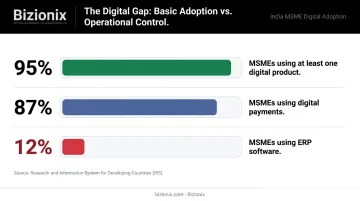
According to RIS research covering 2,882 enterprises, 95% of Indian MSMEs use at least one digital product and 87% have adopted digital payments. But only 12% use ERP software. The gap isn't basic digitisation — it's the deeper operational system adoption that creates genuine process control.
That gap is what Bizionix is built to close. The platform delivers enterprise-grade capabilities — multi-company management, native GST/e-invoicing/PF/ESI compliance, real-time dashboards, role-based access — without the cost or complexity of legacy ERP systems.
A single secure login manages multiple entities, branches, or franchise networks, with independent books of accounts per entity and consolidated group-level visibility.
The Right Time to Implement
Most MSMEs delay adopting a unified platform until they're already in operational chaos — when fixing the problem means unravelling months of manual processes and reconciling conflicting data across multiple systems. The right time is during growth, typically in the 50–200 employee range, when the cost of implementing a system is far lower than the cost of the disorder it prevents.
PIB data from 2025 puts India's registered MSME base at over 5.70 crore businesses, contributing 30% of GDP and over 45% of exports. The operational systems this sector uses directly affect India's economic productivity — and the gap between 95% digital adoption and 12% ERP adoption represents an enormous, addressable problem.
Frequently Asked Questions
What is the all-in-one business model?
The all-in-one business model is an operational approach where a company runs all departments — sales, finance, HR, inventory, and operations — through a single connected software platform. Data flows automatically across functions, eliminating manual transfers between separate tools and creating a single source of truth for the entire organisation.
What is the best platform for business management?
The right platform depends on your business size, industry, compliance requirements, and existing workflows. Start there, not with brand recognition. For Indian businesses specifically, native GST compliance and e-invoicing support should be non-negotiable criteria.
How is an all-in-one platform different from ERP software?
ERP is the broader category that most all-in-one business platforms fall under. Modern cloud-based all-in-one platforms are essentially practical, mid-market ERP systems — they deliver the same integrated data model as traditional ERP without the implementation complexity, lengthy timelines, or enterprise-level costs.
What are the signs my business needs an all-in-one management platform?
Clear signals include: data living in different places with reports that contradict each other, approvals happening over WhatsApp or email threads, slow billing cycles because data has to be manually pulled from multiple sources, or adding a new branch dramatically increasing your operational overhead.
Do all-in-one platforms work for small and mid-sized businesses in India?
Yes — modern cloud-based platforms are built specifically for growing and mid-sized businesses, not scaled-down enterprise tools. For Indian MSMEs, look for direct IRP integration for e-invoicing and multi-entity management as built-in features, not expensive add-ons.