The Indian MSME sector has specific demands. GST e-invoicing is now mandatory for businesses with annual turnover of ₹5 crore or more, active GST taxpayers have crossed 1.51 crore as of April 2025, and over 5.77 crore MSMEs are registered across India. These businesses need tools that are cloud-ready, GST-compliant, and deployable without a six-month onboarding cycle.
This article evaluates the top ERP alternatives for small businesses in 2025 — assessed on cloud readiness, GST compliance, ease of adoption, and total cost of ownership for Indian MSMEs.
Key Takeaways
- SAP and Oracle are built for enterprises — the cost and complexity make them a poor fit for small businesses
- ERP alternatives include cloud unified platforms, standalone accounting tools, modular app suites, and open-source ERP
- For Indian MSMEs, non-negotiable criteria are GST compliance, cloud access, multi-company support, and affordable TCO
- Top alternatives reviewed: Bizionix, Zoho One, TallyPrime, and Odoo Community
- Your best fit depends on operational complexity, compliance needs, and whether one unified platform beats a stack of point tools
Why Small Businesses Are Looking Beyond Traditional ERP
Traditional ERP systems — platforms like SAP S/4HANA or Oracle Fusion — were engineered to integrate finance, HR, supply chain, and operations for organisations with hundreds of millions in revenue and dedicated IT departments. Vendors have since marketed these systems downmarket, but the fit for smaller businesses has not meaningfully improved.
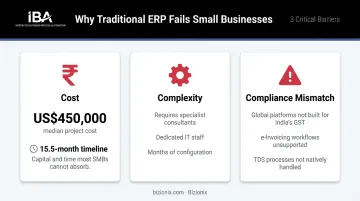
Three problems drive Indian SMBs toward modular cloud platforms and India-specific tools:
- Cost: Panorama Consulting's 2024 ERP Report found a median ERP project cost of US$450,000 and a median timeline of 15.5 months — figures derived from organisations with median revenue of US$200M and 750 employees. For a business with ₹8 crore in turnover, this is simply not viable.
- Complexity: Enterprise ERP systems require consultants, IT staff, and months of configuration. A 30-person manufacturing unit cannot absorb that overhead.
- Compliance mismatch: Global platforms are not built around India's GST structure, e-invoicing mandates, TDS workflows, or GSTR filing cycles. Localisation is often an afterthought.
Gartner projects that by 2027, more than 70% of recently implemented ERP initiatives will fail to fully meet their original business-case goals. That figure covers large enterprises with dedicated project teams and implementation budgets. For businesses without that infrastructure, the failure rate is likely higher.
Purpose-built cloud platforms, modular suites, and open-source tools address specific business functions with faster deployment, lower total cost, and compliance features built for Indian operations — not retrofitted after the fact.
Top ERP Alternatives for Small Businesses in 2025
These tools were selected based on GST compliance depth, cloud accessibility, total cost of ownership, and practical fit for Indian MSMEs.
Bizionix
Bizionix is a 100% cloud-based, all-in-one ERP platform developed by IIS-LLP specifically for Indian MSMEs. It covers accounting, inventory, procurement, HR, CRM, and GST-ready invoicing under a single unified system — with one secure login for managing multiple companies or entities.
Its direct API integration with the GST e-Invoice system enables automatic IRN generation, real-time invoice validation, and QR code creation — no manual steps or third-party middleware required. GSTR-1 auto-population keeps sales and tax returns aligned.
For businesses managing multiple GST-registered entities — holding companies, franchise networks, CA firms handling client portfolios — the multi-company management feature provides entity-level data isolation with centralized dashboards and role-based access controls.
| Detail | Bizionix |
|---|---|
| Key Features | GST e-invoicing with IRN generation, multi-company management, CRM, inventory, procurement, HRMS & payroll, statutory compliance, real-time dashboards, activity logs |
| Pricing | NEO plan: ₹999/year (14-day free trial); Enterprise: contact for quote |
| Best For | Indian MSMEs, manufacturing and distribution businesses, CA firms, franchise and multi-location networks |
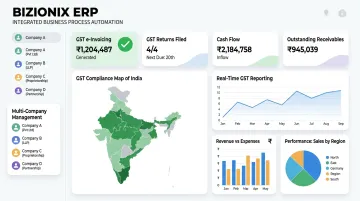
The NEO plan at ₹999/year includes core modules — administration, CRM, sales, warehouse, accounts, finance, HRMS, and reports. The Enterprise tier adds production planning, advanced purchase management, complete payroll with attendance tracking, and document workflows with digital approval chains.
Zoho One
Zoho One bundles 45+ integrated business applications — covering CRM, accounting (Zoho Books), HR, marketing, project management, and more — under a single per-employee subscription. For Indian SMBs already using Zoho CRM or Zoho Books, it is a natural extension.
Zoho Books covers GST returns, B2B e-invoicing authenticated by GSTN, e-way bills, HSN/SAC codes, and multi-GSTIN support. Zoho is also a registered GST Suvidha Provider.
The trade-off is coordination overhead — 45 apps require deliberate configuration to function as a coherent system rather than a collection of tools.
| Detail | Zoho One |
|---|---|
| Key Features | CRM, GST-compliant accounting, inventory, HR, email marketing, project management, analytics |
| Pricing | Approx. US$37–45/employee/month (official INR pricing: verify directly on Zoho India pricing page) |
| Best For | SMBs wanting a flexible app suite; businesses already on Zoho CRM or Zoho Books |
TallyPrime
TallyPrime is India's most widely deployed accounting software, serving over 2 million businesses and 7 million users across India and 100+ countries. Its GST compliance is deep and well-documented: IRN generation, QR code printing, e-way bills, GSTR-1 upload, and TDS/TCS handling are all built in.
For businesses running CA-driven workflows, TallyPrime is familiar and trusted. It is not, however, a full business management platform — there is no CRM or project management. Real-time multi-location collaboration also requires a separate cloud access subscription on top of the base licence.
| Detail | TallyPrime |
|---|---|
| Key Features | GST filing, e-invoicing, TDS/TCS, inventory, payroll, bank reconciliation |
| Pricing | Silver: ₹750/month or ₹22,500 lifetime; Gold: ₹2,250/month or ₹67,500 lifetime (all + 18% GST) |
| Best For | Small businesses and traders focused on accounting, GST compliance, and CA-driven workflows |
Odoo Community
Odoo Community is a free, open-source ERP with modular apps covering accounting, inventory, manufacturing, CRM, HR, and project management. The licence (LGPLv3) is genuinely free — but a compliant Indian deployment is not plug-and-play.
GST compliance requires installing Indian localization modules — Indian Accounting, Indian E-invoicing, Indian E-way Bill, and GST return modules — plus separate API credential configuration. One Indian SMB implementation guide from Tatvamasi Labs estimates first-year costs at ₹3–8 lakh for implementation, plus ₹60K–1.2 lakh for hosting and ₹60K–1.5 lakh for AMC.
Without in-house or contracted IT support, the "free" licence quickly becomes the smallest cost line — implementation and ongoing maintenance typically dwarf it.
| Detail | Odoo Community |
|---|---|
| Key Features | 40+ modular apps: accounting, inventory, manufacturing, CRM, HR, project management |
| Pricing | Community edition: free (open-source); Enterprise: US$24.90–49/user/month; implementation costs extra |
| Best For | Tech-forward businesses with internal or contracted IT resources seeking maximum customisation |
How to Choose the Right ERP Alternative
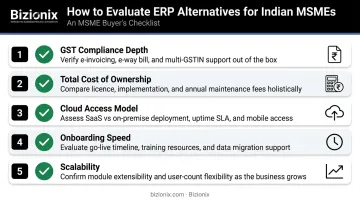
Generic software comparison sites rarely account for what Indian small businesses actually need. Evaluate on these factors:
- GST compliance depth — Does the platform support IRN generation, GSTR-1 auto-population, e-way bills, and TDS? Or is GST an afterthought bolted on via a third-party integration?
- Total cost of ownership — Licensing is only part of the number. Factor in implementation, training, hosting (for on-premise tools), and the ongoing cost of missing modules
- Cloud access model — TallyPrime's base license is desktop-first; cloud access requires a separate subscription. For multi-location businesses, this distinction matters operationally
- Onboarding speed — A tool that takes six months to configure defeats the point of moving away from enterprise ERP
- Scalability — Will the platform handle two additional branches and 30 more employees without requiring a full system switch in 18 months?
Getting the evaluation criteria right is only half the challenge. These are the mistakes that trip up most buyers at the decision stage:
Common selection mistakes to avoid:
- Choosing based on brand recognition rather than operational fit
- Selecting the cheapest option without accounting for missing modules
- Picking a global platform without verifying India-specific compliance features
- Underestimating training time for non-accountant users
Capterra's 2024 Tech Trends report found 58% of buyers regretted at least one software purchase in the prior 12–18 months — most often because they evaluated on price or brand rather than actual workflow fit. Mapping a tool to your specific operations before purchase is the single step most buyers skip.
Conclusion
The right ERP alternative fits where your business actually operates today, not an idealized version of it five years from now. For a 25-person distribution company managing GST compliance across three locations, the needs are fundamentally different from a freelancer tracking invoices or a CA firm managing 40 client books.
For Indian MSMEs specifically, the decision should weigh GST compliance depth, multi-company support, and whether the vendor understands the realities of running a business in India — regulatory requirements, cash flow cycles, and the likelihood that your team may not include a dedicated IT person.
If your business is ready to move beyond disconnected spreadsheets and fragmented tools, Bizionix is a GST-compliant cloud ERP built for growing Indian businesses, starting at ₹999/year with a 14-day free trial. Reach out to the Bizionix team to see how the platform maps to your operations.
Frequently Asked Questions
What are the alternatives to ERP?
The most common ERP alternatives include cloud-based unified platforms (like Bizionix), standalone accounting software (Tally, QuickBooks), modular app suites (Zoho One), and open-source ERP (Odoo). Each covers specific business functions without requiring a full enterprise deployment or its associated infrastructure costs.
Is ERP necessary for a small business?
Full-scale ERP is not necessary for most small businesses. What matters is a unified system covering core operations: billing, inventory, compliance, and reporting. A well-chosen alternative delivers the same visibility at significantly lower cost.
How do I choose the right ERP alternative for my small business?
Start by identifying your biggest pain points — billing delays, inventory errors, GST compliance gaps, or data silos — then evaluate tools based on how well they resolve those specific problems. Always verify India-specific compliance readiness and calculate total cost including implementation and training, not just the license fee.
What is the most affordable ERP alternative for Indian MSMEs?
Affordability is best measured as total cost of ownership. TallyPrime has low licensing costs but limited operational scope; Odoo Community is free but demands significant technical investment for a compliant Indian setup. Purpose-built cloud platforms like Bizionix deliver integrated billing, inventory, and GST compliance at MSME-friendly pricing with no infrastructure overhead.
What is the difference between ERP and ERP alternatives?
Traditional ERP systems are monolithic, enterprise-grade platforms requiring large upfront investment and long implementation cycles. ERP alternatives are more focused, flexible, and affordable — often cloud-based — covering specific or unified business functions without the overhead of a full ERP deployment.
How long does it take to implement an ERP alternative?
Timelines vary by tool and scope. Simple accounting platforms can be operational within days. A full-featured cloud platform like Bizionix or Zoho One typically takes 2–8 weeks, depending on module count and data migration needs.