Introduction
Apparel manufacturing is operationally demanding in ways that most industries simply aren't. A single product line can generate hundreds of SKUs across size, colour, and style combinations. Seasonal demand cycles compress production windows. Fabric procurement spans dozens of vendors. And GST compliance doesn't pause for any of it.
Generic accounting software and disconnected spreadsheets can't keep up. The result is production delays, inventory mismatches, and tax filing errors that quietly erode margins.
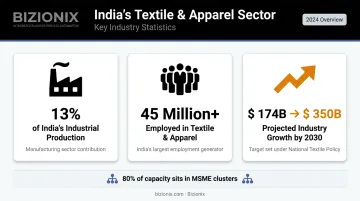
According to India's Press Information Bureau, the textile and apparel sector contributes 13% of India's industrial production and employs over 45 million people. The industry is projected to grow from $174 billion to $350 billion (USD) by 2030. About 80% of that capacity sits in MSME clusters — businesses that need efficient, affordable systems to scale.
Yet RIS data shows only 11% of Indian MSMEs in the wearing-apparel segment actually use ERP software. This guide breaks down what the right ERP system looks like for apparel manufacturers — and how to choose one that fits your operations.
Key Takeaways
- ERP for apparel manufacturing connects production, inventory, procurement, and finance into one system
- Must-have features: multi-SKU tracking, production scheduling, vendor management, and GST-compliant accounting with e-invoicing
- Top options range from Bizionix (built for Indian MSMEs) to SAP S/4HANA (enterprise-grade, global scale)
- Cloud-based ERP wins for most apparel businesses — lower upfront cost, real-time access, automatic compliance updates
- Workflow fit matters more than feature counts — pick what matches how your business actually runs
What Is ERP for Apparel Manufacturing?
An ERP for apparel manufacturing is a centralised software platform that brings production planning, inventory control, procurement, order management, and financial reporting into one system. Instead of a patchwork of tools (separate accounting software, a spreadsheet for inventory, WhatsApp for vendor coordination), everything runs through a single source of truth.
Generic ERP or accounting software falls short for garment businesses for one fundamental reason: it wasn't designed for apparel complexity. Standard tools can't handle:
- Size/colour/style variant matrices across thousands of SKUs
- Seasonal production cycles with hard delivery windows
- Fabric and trim tracking tied to Bills of Materials
- Multi-vendor coordination with lead time visibility
- GST-compliant invoicing with automated IRN generation
An apparel-specific ERP handles all of this natively, without stitching together workarounds.
What This Means for Indian MSMEs
For Indian apparel manufacturers, the baseline requirements extend beyond production management. GST compliance is non-negotiable: e-invoicing is now mandatory for businesses with aggregate turnover above ₹5 crore (effective 1 August 2023 per GST Council Notification No. 10/2023-Central Tax). Any ERP that can't handle automated IRN generation, GSTR-1 auto-population, and e-way bills creates a compliance liability.
For businesses running more than one production unit or warehouse, operational needs add up quickly:
- Multi-location inventory visibility across all sites
- Real-time production tracking against open orders
- Procurement linked directly to BOM requirements
Best ERP Software for Apparel Manufacturing
The options below cover the range from purpose-built Indian MSME solutions to global enterprise platforms. Each was evaluated on production management depth, apparel-specific inventory capabilities, GST compliance readiness, deployment model, and scalability for growing businesses.
Bizionix
Bizionix, developed by IIS-LLP (a subsidiary of Protocol India Private Limited), is a 100% cloud-based ERP built specifically for Indian MSMEs, including manufacturing businesses. The platform unifies inventory control, production planning, procurement, GST-compliant accounting, and multi-company management under one login.
For Indian apparel manufacturers, its standout capabilities include:
- Automated e-invoicing with direct API connection to the IRP — IRN and QR codes generated instantly, with GSTR-1 auto-population
- Real-time inventory tracking across multiple warehouse locations and production units
- Multi-company management — manage multiple manufacturing entities, GST registrations, and branches from a single login with both consolidated and entity-level views
- Purchase management with vendor tracking, purchase orders, and GRN processing
- Production planning module for scheduling and tracking manufacturing processes
- Cloud access 24/7 with role-based access controls and activity logs
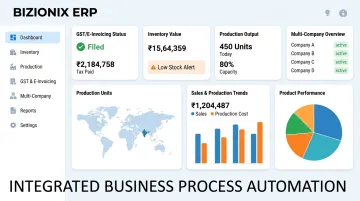
Pricing is structured as a flat annual subscription: the NEO tier starts at ₹999/year for core modules, while the Enterprise plan (which includes production planning, advanced procurement, and full HRMS) is available on custom pricing — designed to stay accessible for growing businesses rather than requiring SAP-level budgets.
| Bizionix | |
|---|---|
| Key Features | GST-compliant accounting, automated e-invoicing, IRN generation, real-time multi-location inventory, production planning, multi-company management, cloud-based |
| Best For | Indian MSME apparel manufacturers needing an affordable, GST-ready, all-in-one cloud ERP |
| Pricing | NEO: ₹999/year; Enterprise: custom pricing |
SAP S/4HANA
SAP S/4HANA for fashion and vertical business is an enterprise-grade platform designed for large-scale global manufacturers. It covers advanced production planning, multi-currency finance, demand forecasting, and design-to-distribution workflows across international operations.
Its analytics depth and supply chain management capabilities are built for complex, multi-country organisations running high-volume seasonal cycles. However, implementation timelines, resource requirements, and enterprise pricing make it impractical for most Indian MSMEs.
| SAP S/4HANA | |
|---|---|
| Key Features | Production planning, advanced analytics, global supply chain management, multi-currency support, demand forecasting |
| Best For | Large-scale apparel enterprises with global supply chains and high-volume seasonal production |
| Pricing | Enterprise pricing; custom quotes based on deployment scale |
Microsoft Dynamics 365 Business Central
Microsoft Dynamics 365 Business Central is a modular, cloud-based ERP suited for mid-to-large apparel businesses. It supports inventory management, production workflows, and financial reporting, with strong integration across Shopify, Power BI, and Salesforce.
An Apparel Accelerator for Dynamics 365 Business Central is available on Microsoft's AppSource marketplace, adding apparel-specific capabilities including matrix item creation, size-run templates, and automated allocation. Its modular structure lets businesses activate only what they need.
| Microsoft Dynamics 365 | |
|---|---|
| Key Features | Inventory and order management, production workflows, financial reporting, Shopify/Power BI/Salesforce integrations, apparel accelerator add-on |
| Best For | Mid-to-large apparel brands with regional operations and omnichannel sales |
| Pricing | Subscription-based (USD); Business Central plans from $8/user/month (Team Members); Essentials and Premium tiers priced separately |
ApparelMagic
ApparelMagic is a cloud-based ERP built exclusively for the fashion and apparel industry. Managing SKUs by size, colour, and style is built into its core — not added on. It covers inventory management, production tracking, PLM support, and B2B e-commerce from a single platform.
Its apparel-native design makes onboarding faster for fashion SMBs. The Professional plan starts at $255/month annually (3 users, 3 integrations, 3 warehouses), making it accessible for smaller brands.
| ApparelMagic | |
|---|---|
| Key Features | Multi-SKU inventory (size/colour/style matrix), order management, production tracking, PLM, B2B e-commerce, reporting |
| Best For | Small to mid-sized fashion and apparel businesses seeking a purpose-built cloud ERP |
| Pricing | Professional: $255/month annually — USD (3 users); Enterprise: $495/month annually — USD (5 users) |
Odoo
Odoo is an open-source, modular ERP that can be deployed on cloud or on-premise. Its modules cover inventory, manufacturing, purchasing, accounting, and production order management. Product variants for size, style, and colour are supported natively, with each variant maintaining its own SKU and inventory count.
The primary advantage is cost — the community edition is free, and cloud plans are among the most affordable available. Apparel-specific features like size/style matrices may require third-party modules or configuration, which adds implementation effort.
| Odoo | |
|---|---|
| Key Features | Modular ERP (inventory, manufacturing, accounting, purchasing), product variant tracking, open-source flexibility, cloud or on-premise |
| Best For | Small apparel businesses or startups seeking a low-cost, scalable ERP starting point |
| Pricing | Free (community edition); Standard and Custom cloud plans available; pricing varies by modules |
Key Features to Look for in an Apparel Manufacturing ERP
Multi-SKU Inventory Management
A single garment can generate 30–50 SKUs when size and colour combinations are factored in. Multiply that across a seasonal collection and you're managing thousands of variant-level inventory records. The ERP must track each variant independently — its own barcode, stock count, and reorder point — across every warehouse location.
Without this, teams lose visibility into exactly which sizes are running low, which colours are overstocked, and where inventory is sitting idle.
Production Planning and Scheduling
Apparel operates on seasonal cycles. A delay at the cutting stage cascades into missed dispatch dates. The ERP should support batch production orders, capacity allocation across units, and production stage tracking so managers can identify bottlenecks before they become delivery failures.
Vendor and Procurement Management
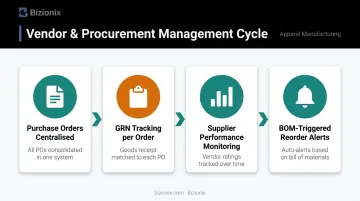
Fabric, trims, linings, threads, and accessories come from multiple vendors with varying lead times. A capable ERP centralises this complexity so procurement is driven by actual production needs rather than memory. Key capabilities to look for:
- Centralises purchase orders across all vendors
- Tracks GRNs (Goods Receipt Notes) against each order
- Monitors supplier performance over time
- Triggers reorder alerts based on BOM requirements
GST-Compliant Accounting and E-Invoicing
For any Indian apparel manufacturer with aggregate turnover above ₹5 crore, e-invoicing is a legal requirement. Non-compliance can attract penalties of ₹10,000 or the tax amount evaded, whichever is higher, under CGST Act Section 122.
The ERP must handle automated IRN generation, QR code creation, GSTR-1 auto-population, and e-way bill support — without manual reconciliation. A GST-ready ERP eliminates this compliance risk by integrating directly with the IRP.
Demand Forecasting and Reporting
Fashion excess stock was estimated at $70–140 billion globally in 2023, driven largely by poor demand planning. The ERP should generate production and procurement forecasts from historical sales data, seasonal patterns, and open order volumes. Configurable dashboards give management the visibility to act before overstock or stockouts occur.
How We Chose the Best Apparel ERP Software
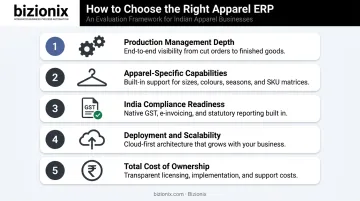
Options were assessed on five criteria:
- Production management depth — does it actually track manufacturing stages, not just inventory?
- Apparel-specific capabilities — native multi-SKU support, seasonal planning, BOM-linked procurement
- India compliance readiness — GST, e-invoicing, IRN generation, QRMP support
- Deployment and scalability — cloud-preferred, able to grow with order volumes and entity count
- Total cost of ownership — licensing, implementation, support, and upgrade costs combined
Gartner reports that more than 70% of recently implemented ERP initiatives are predicted to fail to fully meet their original business goals by 2027, with 75% of ERP strategies misaligned with overall business strategy.
The leading cause is poor fit, not poor technology. An ERP that covers 100 features but doesn't map to your cut-to-pack workflow, GST filing cycle, or multi-warehouse setup won't deliver ROI regardless of its brand recognition.
For this reason, workflow fit, implementation support quality, and compliance depth were weighted more heavily than feature counts or vendor name recognition — criteria that matter more to an apparel manufacturer than any sales brochure will tell you.
Conclusion
Apparel manufacturing demands a system that can hold the whole operation together: raw material procurement, production tracking, multi-SKU inventory, vendor coordination, and GST compliance — all running in parallel, every day. A patchwork of disconnected tools creates the gaps that cost manufacturers time and margin.
When evaluating your options, focus on three questions:
- Does it handle your actual production workflows, not just generic manufacturing?
- Can it scale as your order volumes, SKU range, and entity count grow?
- Is it built for India's GST and e-invoicing requirements out of the box?
For Indian MSME apparel manufacturers, Bizionix is a practical option — affordable, GST-ready, and cloud-based, with real-time visibility across production and finance without enterprise-level complexity or cost.
A 14-day free trial is available on the NEO plan, and the team offers demos for businesses that want a walkthrough of how the platform fits manufacturing workflows. Reach out at info@bizionix.com or call +91 91779 99277.
Frequently Asked Questions
What is ERP software for apparel manufacturing?
Apparel manufacturing ERP is a business management platform that connects production planning, inventory, procurement, vendor management, and finance into one system. It handles garment-specific complexity — multi-SKU tracking across size, colour, and style variants, seasonal production cycles, and GST compliance.
Which ERP is best for small and medium apparel manufacturers in India?
Indian MSME apparel manufacturers should prioritise cloud-based options with GST-compliant accounting, real-time inventory tracking, and production management. Bizionix is built specifically for Indian MSMEs with automated e-invoicing and multi-location inventory. ApparelMagic and Odoo are strong global SMB alternatives.
What are the must-have features in an apparel manufacturing ERP?
Six features are non-negotiable for apparel manufacturing:
- Multi-SKU inventory management (size, colour, and style variants)
- Production scheduling tied to order timelines
- BOM-linked procurement to align material purchases with actual needs
- Vendor management for supplier tracking and lead times
- GST-ready accounting with automated IRN generation
- Configurable reporting dashboards for demand and production visibility
How much does ERP software for apparel manufacturing cost?
Pricing varies widely. Odoo's community edition is free; Bizionix NEO starts at ₹999/year; ApparelMagic's Professional plan starts at $255/month (3 users annually); SAP S/4HANA requires custom enterprise quotes. Indian MSME-focused solutions like Bizionix are priced to be accessible without upfront infrastructure investment.
Is cloud-based ERP better than on-premise for apparel businesses?
For most apparel manufacturers, yes. Cloud ERP provides real-time access across production units and warehouses, eliminates upfront server costs, delivers automatic compliance updates (critical for GST changes), and scales more easily as SKU complexity and order volumes grow.
How does ERP help reduce costs in garment manufacturing?
ERP targets cost leakage at several points in garment operations:
- Eliminates manual data entry errors that cause rework and reconciliation delays
- Aligns fabric and trim procurement directly with BOM requirements
- Prevents overstock and stockouts through demand-linked inventory planning
- Accelerates billing cycles with automated invoicing and pre-validated GST data