Introduction
Picture this: an MSME business owner in Hyderabad running a mid-sized distribution company. Inventory is tracked in Excel. Customer follow-ups happen over WhatsApp. Accounts are managed in one tool, payroll in another, and GST filings involve a third. By month-end, the team spends three days chasing data across five different sources — and still finds mismatches.
This isn't an unusual situation. The India SME Forum's 2025 survey of 7,835 MSMEs found that 52.6% of businesses struggle to find the right digital tools, and 36.8% face difficulty navigating and setting up the ones they do adopt. The root problem isn't a lack of software — it's fragmentation across too many disconnected tools.
Solving that requires more than just adding another app. This guide walks through what growing Indian businesses need to make a confident decision:
- What corporate software solutions actually are and why they matter in 2025
- Which features are non-negotiable for Indian MSMEs
- How to evaluate and choose the right platform
- How to implement it without the disruption most businesses experience
Key Takeaways
- Corporate software consolidates finance, inventory, sales, and HR into one platform — replacing fragmented tools and manual processes
- Indian MSMEs with turnover above ₹5 crore must comply with GST e-invoicing; non-compliant invoices are void under CGST Rule 48(5)
- The right ERP delivers enterprise-grade functionality at MSME-appropriate pricing — without SAP-level complexity
- Poor change management and inadequate training kill more implementations than bad software ever does
- Start with a process audit, not a feature checklist
What Is Corporate Software? Key Types and Categories
Corporate software refers to integrated digital platforms that help organisations manage, automate, and unify operations across departments. The goal is a single source of truth — replacing the patchwork of Excel files, standalone tools, and WhatsApp approvals that slow down most growing businesses.
"Corporate software" is an umbrella term. It covers everything from a standalone accounting tool to a full-suite ERP. The right solution depends on the business's size, complexity, and stage of growth.
Core Types of Corporate Software Solutions
Enterprise Resource Planning (ERP)
ERP is the most comprehensive category, integrating finance, inventory, procurement, HR, and operations into one platform. It's built for businesses that need cross-departmental coordination.
Traditional ERP systems like SAP and Oracle were designed for large enterprises and carry significant cost and complexity. Modern cloud-based alternatives, such as Bizionix by IIS-LLP, are purpose-built for MSMEs, offering the same depth of integration without the implementation burden or enterprise price tag.
Customer Relationship Management (CRM)
CRM manages customer interactions, sales pipelines, and marketing campaigns. Most relevant for businesses where customer retention and conversion tracking are critical. Many modern ERP platforms include CRM as a native module rather than a separate tool.
Business Intelligence (BI) and Analytics
BI tools transform raw data into dashboards and reports to support decision-making. Increasingly, this functionality is bundled within ERP platforms , giving giving business owners real-time visibility without purchasing a separate analytics tool.
Other Categories
- HR and payroll management (HCM) for attendance, compliance, and workforce tracking
- Supply chain and procurement (SCM) for distribution, logistics, and vendor coordination
- Internal communication and collaboration tools for cross-team coordination
Modern platforms like Bizionix integrate several of these categories natively, so businesses get ERP, CRM, HRMS, and inventory management under one login rather than subscribing to five different products.
Why Corporate Software Matters for MSMEs in 2025
Eliminating Manual Work and Financial Leakage
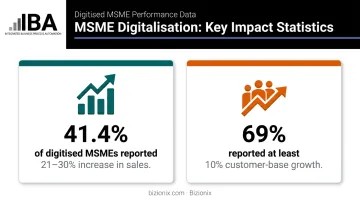
The most immediate impact of corporate software is time recovery. Automating invoice generation, stock reconciliation, and payroll processing frees teams from tasks that currently consume hours per week. Among digitised MSMEs, 41.4% reported a 21–30% increase in sales attributable to digital tools — and 69% reported at least 10% customer-base growth after adoption.
Fragmented systems create predictable financial blind spots. Operating across disconnected tools leads to:
- Untracked expenses that never surface until audit time
- Missed billings from orders that fall between systems
- Duplicate data entry that inflates error rates and reconciliation time
Bizionix addresses this directly — tracking every transaction, flagging unmatched entries, and giving finance teams a complete picture of cash flow in real time rather than at month-end.
Real-Time Visibility Across the Business
A unified platform gives owners and managers a live view of performance across finance, sales, and inventory simultaneously. With Bizionix, sales, finance, and operations teams work from the same real-time numbers — no delayed reports, no conflicting versions. When a sales order is confirmed, inventory updates instantly. When an invoice is raised, it posts to accounts automatically.
GST Compliance Is No Longer Optional
For Indian MSMEs, regulatory compliance is one of the strongest arguments for structured software. Businesses face over 500 micro-regulations annually, and GST e-invoicing adds a non-negotiable layer on top.
Under CGST Rule 48(5), businesses notified under the e-invoicing mandate must generate an IRN (Invoice Reference Number) via the Invoice Registration Portal. Any invoice issued without this process is not legally treated as an invoice — creating real compliance and penalty risk.
The current mandate applies to taxpayers with aggregate annual turnover above ₹5 crore, effective from 1 August 2023 (Notification No. 10/2023 – Central Tax). Bizionix connects directly to the GSTN e-invoice system via API, generating IRNs and QR codes instantly within the same workflow used to raise invoices — no separate portal, no manual upload.
Scalability Without Structural Pain
When a business adds a new location, product line, or entity, spreadsheet-based operations hit a wall fast — more files, more manual reconciliation, more risk. A platform designed for multi-company and multi-location operations from day one absorbs that growth without rework.
Bizionix supports multi-entity management under a single secure login — giving business groups, franchise networks, and CA firms managing client portfolios consolidated visibility while keeping each entity's books independent.
Must-Have Features to Look For in 2025
Not all ERP platforms are equal. For Indian MSMEs evaluating options in 2025, these are the capabilities that actually matter:
| Feature | What to Look For |
|---|---|
| Unified architecture | Single shared database across all modules — not loosely connected tools |
| Cloud-based access | 100% cloud with role-based access controls; no costly on-premise hardware |
| GST and e-invoicing | Direct API integration with GSTN IRP for automatic IRN generation |
| Configurable workflows | Adaptable to your processes without requiring custom development |
| Multi-company support | Manage multiple entities from one login without data fragmentation |
| Real-time reporting | Live dashboards, not end-of-month reports |
On unified architecture specifically: Bizionix operates on a single shared database. When one department enters data, every other department sees it immediately. There's no synchronisation lag, no reconciliation required between modules. Sales, inventory, finance, and HR all work from the same record.
GST compliance is a hard requirement for any MSME near or above ₹5 crore turnover. The platform should handle GSTR-1 auto-population, e-way bills, and IRN generation natively — not as an add-on that requires a third-party tool.
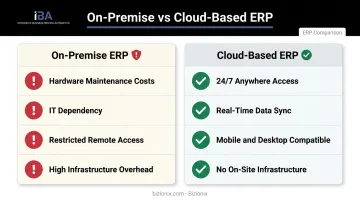
Cloud vs. on-premise is no longer a close call. In 2025, on-premise systems carry avoidable overhead — hardware maintenance, IT dependence, and restricted remote access. Bizionix is 100% cloud-based with 24/7 access, mobile and desktop compatibility, and real-time data sync across locations. If a platform still requires on-site infrastructure, it's adding cost and complexity you don't need.
How to Choose the Right Corporate Software for Your Business
Start With a Process Audit
The first step is not selecting a product — it's documenting what's broken. Map current workflows, identify where time is lost, and pinpoint which processes generate the most errors or financial leakage. This audit defines real requirements and prevents businesses from purchasing based on a feature list they'll never fully use.
Common pain points that surface in this audit:
- Month-end close taking multiple days due to manual reconciliation
- Invoice errors causing customer disputes or GST return mismatches
- Inventory discrepancies between physical stock and system records
- No visibility into outstanding receivables without manual follow-up
Match the Solution to Your Growth Stage
Two mistakes are equally costly: buying software that's too basic (and needs replacing in 18 months) or buying enterprise complexity that a 50-person team can't operate. For Indian MSMEs, the right solution balances enterprise-grade capability with practical usability.
Gartner estimates that by 2027, more than 70% of recently implemented ERP initiatives will fail to fully meet original business-case goals — and up to 25% will fail outright. Choosing a system calibrated to your actual operational complexity dramatically reduces this risk.
Bizionix occupies this middle ground: practical enough for a 20-person team, capable enough for multi-entity operations. The NEO plan starts at ₹999/year and covers core finance, CRM, inventory, and HRMS. The Enterprise plan extends to multi-module, multi-entity operations with custom configuration and priority support.
Evaluate Total Cost of Ownership
The subscription fee is rarely the largest cost. Account for:
- Implementation time to configure and go live — often underestimated
- Data migration from spreadsheets or legacy systems into the new platform
- Team training until adoption is consistent, not just initial onboarding
- Support access when processes change or something breaks post-launch
- Integration work if third-party tools need to connect
A platform that looks affordable upfront but requires constant vendor involvement for changes becomes expensive quickly. Bizionix is built to reduce that dependency: workflows are configurable to match business processes without requiring custom development for every operational change.
Assess Vendor Credibility and Domain Fit
Total cost of ownership also depends on who's behind the software. Look for providers with proven experience in your industry, reachable support, and a track record with businesses at your scale — not just enterprise logos on a case study page.
IIS-LLP, the company behind Bizionix, was established as a subsidiary of Protocol India Private Limited with a specific focus on Indian MSMEs, drawing on over two decades of industry experience. The platform covers manufacturing, distribution, hospitality (via HotelEase), and multi-entity business groups, with India-specific compliance embedded throughout — not added as an afterthought.
Corporate Software Implementation: Best Practices
Phase the Rollout — Don't Go Live All at Once
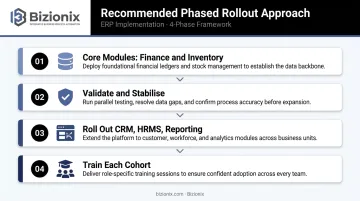
A "big bang" go-live (where all modules activate simultaneously across the organisation) is one of the most common causes of implementation failure. The better approach:
- Start with core modules — Finance and Inventory are usually the highest priority
- Validate and stabilise before adding the next phase
- Roll out CRM, HRMS, and reporting in subsequent stages
- Train each cohort before moving to the next module
This reduces disruption and gives the business time to catch configuration issues before they compound across every department.
Invest in Training and Change Management
Technology is rarely why implementations fail. Adoption is. Teams revert to familiar tools — Excel, WhatsApp — when the new system feels unfamiliar or when the value isn't clear.
Effective change management includes:
- Identifying internal champions in each department who are trained first and can support their colleagues
- Communicating the "why": not just what's changing, but what each team gains
- Structured training before go-live, not after problems emerge
- Clear escalation paths for issues during the first 60–90 days
When evaluating vendors, prioritise those who offer structured onboarding and accessible post-go-live support — these factors often determine whether adoption succeeds or stalls.
Define Success Metrics Before Go-Live
If you don't establish a baseline, you can't measure ROI. Before implementation begins, document:
- Current time to close monthly books
- Current invoice error rate
- Current inventory variance percentage
- Time spent on GST return preparation
Track the same metrics post-go-live. This data serves two purposes: it demonstrates return on investment to leadership, and it identifies where the system is underperforming and needs adjustment.
Frequently Asked Questions
What is a software solutions company?
A software solutions company creates, distributes, and maintains software products that help businesses automate operations, manage data, and improve efficiency. They range from niche point tools to comprehensive ERP platforms, and provide implementation support and ongoing maintenance alongside the product.
What are the main types of corporate software solutions?
The primary categories are ERP (enterprise resource planning), CRM (customer relationship management), BI/analytics, HCM (human capital management), and SCM (supply chain management). Modern platforms like Bizionix integrate several of these under one architecture rather than requiring separate products.
What is the difference between ERP and CRM software?
ERP manages internal operations — finance, inventory, production, HR — across the whole organisation. CRM focuses specifically on managing customer interactions, sales pipelines, and marketing activities. Bizionix, for instance, includes CRM as a native module within its ERP platform.
How long does it take to implement corporate software?
Timelines vary based on scope and complexity. For cloud-based MSME platforms, smaller deployments can be operational in weeks; broader multi-module rollouts typically take several months. A phased approach — starting with core modules — reduces disruption and shortens the time to initial value.
What should Indian MSMEs look for in business management software?
Key criteria to evaluate:
- Built-in GST compliance with direct IRP integration for IRN generation
- 100% cloud-based access with real-time visibility
- Pricing that fits MSME budgets — not enterprise-scale costs
- Scalability for multi-entity or multi-location growth
- A vendor with proven experience serving Indian businesses at your scale