This guide covers what vendor relationship management (VRM) software actually does, which features matter most, how a structured VRM framework works in practice, and how Indian MSMEs can choose the right solution without overspending.
TLDR
- VRM software centralises supplier data and automates vendor lifecycle tasks across onboarding, performance, and contracts
- Key features: centralized vendor database, performance scorecards, risk monitoring, contract management, and ERP integration
- A six-step VRM framework gives businesses a structured approach from segmentation through vendor review
- Indian MSMEs should prioritise GST compliance, integration readiness, and ease of use over feature overload
- All-in-one ERP platforms like Bizionix eliminate integration complexity by bundling vendor management with finance, procurement, and GST workflows
What is Vendor Relationship Management?
Vendor relationship management is the structured process of identifying, onboarding, evaluating, and developing suppliers to reduce costs, prevent disruptions, and build supply chains that hold up under pressure. It goes well beyond transactional purchasing — the focus is on the relationship itself, not just the order.
VRM software (also called SRM software) digitises this process. Instead of scattered spreadsheets, disconnected email threads, and manually maintained files, you get a centralised system for supplier data, contracts, communication history, and performance metrics — accessible to every stakeholder who needs them.
How VRM Differs from Procurement Software
The distinction matters when choosing tools:
- Procurement software answers: What are we buying, from whom, and at what price?
- VRM software answers: How well is this supplier performing, how strategically important are they, and how do we develop the relationship?
The purchase order is where procurement ends. VRM takes over from there — tracking delivery reliability, flagging performance dips, and building the supplier intelligence that protects your operations over time.
Why VRM Software Matters for MSMEs in 2025
As supplier counts grow, manual tracking creates compounding blind spots — contracts expire unnoticed, compliance documents go stale, delivery performance drifts. Each gap looks manageable in isolation.
Stack them together, and you have real operational and financial exposure that most MSMEs don't catch until the damage is done.
The Cost of Weak Contract Management
WorldCC's 2025 contract management research puts average contract value erosion at 8.6% — with the worst performers losing more than 15% of contract value annually. For an MSME managing ₹2 crore in annual supplier spend, that's a significant and entirely avoidable leakage.
The Indian MSME Context
India's MSME sector spans 7.34 crore establishments and contributes roughly 30% of GDP and over 45% of exports (Ministry of MSME Annual Report 2024-25). At this scale, supplier management quality directly affects national economic performance — not just individual business outcomes.
MSMEs face specific vulnerabilities that make structured VRM more urgent:
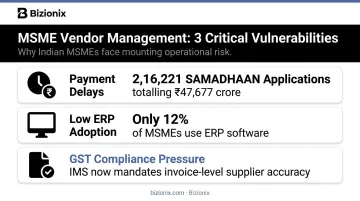
- Payment delays: MSME SAMADHAAN had received 2,16,221 applications involving ₹47,677.28 crore in delayed payment claims cumulatively to December 2024
- Low ERP adoption: RIS surveys show only 12% of Indian MSMEs use ERP and 11% use SCM software — meaning most are managing vendor relationships manually
- GST documentation requirements: India's Invoice Management System (IMS) now allows taxpayers to accept, reject, or pend invoices to reduce input tax credit errors, making supplier documentation accuracy a compliance requirement, not just an operational preference
VRM software addresses each of these pressure points directly — giving MSMEs the structured oversight that manual tracking simply cannot provide at scale.
Must-Have Features in Vendor Relationship Management Software
Not all VRM tools are built the same. These are the features that separate a genuinely useful platform from one that just looks good in a demo.
Centralized Vendor Database and Onboarding Workflows
A good VRM system maintains a single supplier record covering contact details, certifications, payment terms, bank information, and compliance documents. Onboarding should be structured — collecting and validating supplier information systematically, not through ad hoc email requests.
The goal: new suppliers activated in days, not weeks, with complete records from day one.
Performance Tracking and Scorecards
Gartner research shows 62% of SRM-practicing companies use supplier scorecards, but only 22% track both operational and non-operational metrics. The gap matters — delivery rates alone don't tell you about supplier financial stability, sustainability compliance, or innovation capacity.
Effective scorecards should track:
- On-time delivery rate
- Quality defect or return rate
- Invoice accuracy
- Responsiveness to issues
- Compliance document status
Risk and Compliance Monitoring
Deloitte's 2025 TPRM survey found nearly half of respondents believe a major third-party incident could exceed ₹415 crore (USD 50 million) in damages globally — yet many organisations still rely on manual processes for risk assessment. Automated alerts for expiring certifications, deteriorating performance trends, or GST documentation gaps let procurement teams intervene before disruptions occur.
Contract Lifecycle Management
Contract management is one of the most common sources of value leakage in supplier operations. Automated renewal alerts, centralised document storage, and approval workflow routing reduce the risk of accidental lapses or unauthorized vendor engagements — critical when managing multiple supplier agreements simultaneously.
Integration with ERP and Finance Systems
VRM software that cannot sync with your existing systems creates a new silo instead of eliminating old ones. For Indian MSMEs, the integration checklist should include:
- Accounting and accounts payable modules
- Purchase order management
- GST compliance and e-invoicing workflows
- Inventory tracking
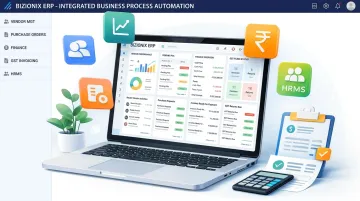
That's where a unified platform has a clear advantage over point solutions. Bizionix addresses this directly — vendor management is built into its ERP platform alongside Purchase Management, Finance & Accounting, and GST-ready invoicing. When vendor data, purchase orders, and payments all live in the same system, the integration overhead drops significantly.
The Six-Step VRM Framework Every Business Should Follow
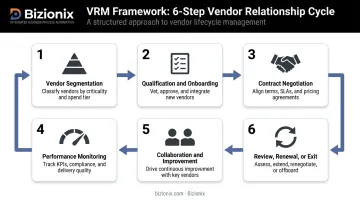
A framework gives structure to what can otherwise become an ad hoc set of vendor interactions. This six-step model draws on practices from Gartner, CIPS, and McKinsey's supplier collaboration research — adapted into a practical sequence for growing businesses.
Step 1 — Vendor Segmentation
Not all suppliers deserve equal attention. Classify your vendor base into three tiers:
| Tier | Characteristics | Management Approach |
|---|---|---|
| Strategic | High-value, high-risk, hard to replace | Active relationship management, regular joint reviews |
| Operational | Regular, moderate risk | Structured monitoring, periodic check-ins |
| Transactional | Low-value, easily replaceable | Automated tracking, minimal touch |
Gartner notes that only 35% of CPOs have a working model to differentiate critical suppliers by value — meaning most businesses are treating all vendors the same and wasting effort on low-priority relationships.
Step 2 — Vendor Qualification and Onboarding
Structured onboarding collects and validates supplier information before any commercial engagement begins:
- Business registration and legal documents
- GST registration and tax compliance records
- Certifications relevant to the category
- Bank details and payment terms
- Contact hierarchy and escalation paths
Step 3 — Contract Negotiation and Documentation
This step formalises the relationship — establishing SLAs, pricing terms, payment schedules, compliance obligations, and renewal conditions. Store all documents centrally and set automatic renewal date alerts. Manual contract tracking is where most cost leakage begins.
Step 4 — Performance Monitoring
After onboarding, the vendor relationship must be tracked continuously against defined KPIs. Scorecards should be reviewed monthly or quarterly, with automated alerts when performance trends downward. Catching a delivery issue in month two is manageable. Discovering it existed for six months is a different problem entirely.
Step 5 — Collaboration and Continuous Improvement
The best vendor relationships move beyond compliance monitoring into active partnership. This includes:
- Sharing demand forecasts so suppliers can plan capacity
- Soliciting vendor feedback on process friction
- Joint problem-solving when issues arise
- Co-developing process improvements that benefit both parties
McKinsey's supplier collaboration research found that companies engaging suppliers as strategic partners consistently outperform peers on revenue growth and operating cost efficiency — not just in good market conditions, but through disruptions too.
Step 6 — Vendor Review, Renewal, or Exit
Each contract cycle should end with a formal review:
- High performers: Renew, potentially with enhanced terms or preferred status
- Underperformers: Structured development plans or planned phase-out
- Redundant suppliers: Rationalise the base based on updated business needs
The review feeds directly back into Step 1, updating segmentation based on what the cycle revealed.
How to Choose the Right VRM Software for Your Business
Assess Pain Points First
Map your actual bottlenecks before comparing tools. Common problem areas:
- Onboarding delays because document collection is manual
- Contract renewals missed because tracking is in a spreadsheet
- No visibility into supplier performance until a customer complaint arrives
- Compliance gaps discovered during audits rather than proactively
The right software solves your actual problem — start there, not with the longest feature list.
Match Software Type to Business Size
| Business Type | Best Fit |
|---|---|
| Large enterprise, global supply chain | Dedicated SRM suite (SAP Ariba, Coupa) |
| Mid-market with complex procurement | Integrated procurement + vendor management platform |
| Indian MSME, growing supplier base | Unified ERP with built-in vendor management, GST compliance, and finance integration |
For Indian MSMEs, stitching together a standalone VRM tool, separate accounting software, and a GST compliance tool creates constant re-entry of data and ongoing sync issues. Bizionix addresses this by bundling vendor management within a cloud ERP that already handles purchase orders, accounts payable, GST e-invoicing, and inventory tracking.
The ₹999/year entry point and flat subscription model keep costs predictable regardless of how many vendors you add.
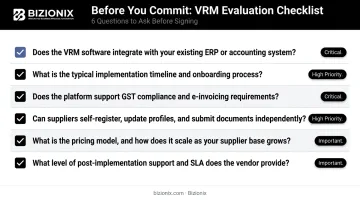
Evaluation Checklist
Before committing to any platform, get clear answers on these:
- Does it integrate with our current accounting or ERP system?
- How long does a typical implementation take for a business our size?
- Does it support GST-compliant vendor documentation and e-invoicing?
- Can suppliers self-update their profiles and compliance documents?
- Is pricing per-user, per-supplier, or flat — and how does it scale?
- What support is available post-implementation?
Ease of use matters as much as feature depth. For most Indian MSMEs, a platform that needs a 12-month rollout or a dedicated IT team isn't a solution — it's a new operational burden.
Frequently Asked Questions
What is vendor relationship management?
Vendor relationship management (VRM) is the structured process businesses use to identify, onboard, evaluate, and develop supplier relationships across the full lifecycle — from qualification through performance monitoring and contract renewal. The goal is to maximise supplier value while minimising operational risk and compliance exposure.
What are the main six steps of VRM?
The six steps are: vendor segmentation, qualification and onboarding, contract negotiation and documentation, performance monitoring, collaboration and continuous improvement, and vendor review or exit. Each step builds on the previous one, creating a proactive and structured approach rather than reactive problem-solving.
What is the difference between vendor management and procurement software?
Procurement software handles the transactional side: sourcing, purchase orders, and invoices. Vendor management software focuses on the relational side — supplier performance, risk, compliance, and long-term partnership development. Modern ERP platforms increasingly combine both functions in a single system.
Can small businesses and MSMEs use vendor relationship management software?
MSMEs benefit from VRM software just as much as large enterprises do. Even basic capabilities — centralised supplier records, contract tracking, and performance alerts — deliver measurable value. The priority for MSMEs should be solutions that are cloud-based, affordable, and deployable without dedicated IT resources.
How does VRM software integrate with ERP systems?
Most modern VRM tools offer API-based or native integration with ERP and accounting systems to sync vendor data, purchase orders, invoices, and payment history. Businesses using an all-in-one ERP platform with built-in vendor management — like Bizionix — avoid integration complexity entirely, since all data already lives in the same system.