Introduction: What Is Vendor Performance Management?
Most growing businesses manage vendor relationships reactively — chasing late deliveries, disputing invoices, or discovering quality problems only after they've disrupted operations. By then, the damage is done.
Vendor performance management (VPM) is the structured process of measuring, tracking, and improving how third-party vendors deliver on their commitments. Done well, it shifts procurement teams from firefighting mode to proactive control — catching declining performance before it becomes a crisis.
This guide covers everything procurement teams and business owners at growing and mid-sized enterprises need to know: the core VPM framework, which KPIs actually matter, what software features to prioritise, and best practices grounded in how procurement actually operates.
Key Takeaways
- Unmanaged vendor performance compounds operational and financial risk; VPM gives you early warning before disruption hits
- Track KPIs across five categories: quality, delivery, cost, service, and compliance
- APQC benchmarks set the median supplier on-time delivery at 90% and first-time error-free invoice processing at 92%
- Essential software features: centralised vendor records, automated alerts, ERP integration, and audit trails
- Indian MSMEs managing 20+ vendors need a unified system to avoid financial leakage and GST compliance gaps
Why Vendor Performance Management Matters for Growing Businesses
Unmanaged vendor performance doesn't create one problem — it creates a chain of them. A delayed shipment stalls production. A quality failure triggers customer complaints. A non-compliant vendor creates regulatory exposure. Each issue compounds the next.
The operational stakes are real. According to the Deloitte 2025 Global CPO Survey, 84% of digital procurement leaders met or exceeded their supplier performance plans, compared to just 59% of followers. The gap comes down to structured tracking and early intervention, not luck.
From Reactive to Proactive
That data advantage translates into something practical: early warning signals. Structured VPM surfaces a vendor's declining quality scores, delivery rates creeping upward, or compliance documents approaching expiry — giving teams room to intervene before disruption, not after.
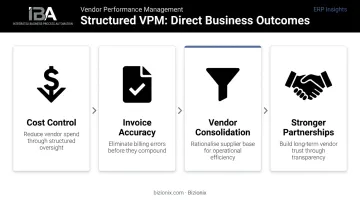
The direct business outcomes are concrete:
- Cost control — catching price variance and billing errors before they accumulate
- Invoice accuracy — reducing the rework and dispute cycles that drain AP teams
- Vendor consolidation — identifying underperformers early enough to renegotiate or replace with leverage intact
- Stronger partnerships — giving high-performing vendors recognition and deeper engagement
The Indian MSME Reality
For Indian MSMEs specifically, the stakes extend further. The Ministry of MSME Annual Report 2024-25 recorded 2,16,221 delayed-payment applications involving ₹47,677.28 crore filed on MSME SAMADHAAN by December 2024 — a figure that reflects how deeply payment performance issues run through vendor relationships.
Managing 20–30 active vendors across categories without a unified system leads to financial leakage, missed GST compliance timelines, and manual follow-up overhead that steadily erodes margins. Structured VPM replaces that fragmentation with a single, consistent process — so when vendor count doubles, the workload doesn't.
Key Components of a Vendor Performance Management Framework
Setting Expectations Upfront
VPM only works when both parties agree on measurable standards before the relationship begins. Service level agreements (SLAs) and contractual performance clauses should cover:
- Delivery timelines and lead time commitments
- Quality thresholds and acceptable defect parameters
- Payment terms and invoice submission requirements
- Compliance obligations — licences, GST registration, certifications, and documentation
Without this foundation, performance conversations devolve into disagreements rather than structured, data-backed reviews.
Aligning KPIs to Vendor Type
Not every vendor should be measured on the same metrics. KPIs should reflect what actually matters for each vendor's role:
- Raw material suppliers — delivery reliability, quality consistency, lead time variance
- IT service vendors — uptime, resolution time, escalation responsiveness
- Logistics providers — on-time delivery, order accuracy, damage rates
Weighted scoring is essential here. Not all metrics carry equal importance, and a scoring model that treats invoice accuracy the same as product defect rate will produce misleading results.
Continuous Monitoring vs. Periodic Reviews
Point-in-time reviews (quarterly assessments, annual scorecards) catch problems after they've already accumulated. Continuous monitoring — automated alerts triggered by performance thresholds — surfaces issues earlier and reduces the manual data collection burden on procurement teams.
With continuous monitoring in place, periodic reviews shift from firefighting sessions into strategic conversations about vendor development.
Vendor Tiering and Review Cadences
Review frequency should match vendor criticality:
| Vendor Tier | Criteria | Review Frequency |
|---|---|---|
| Strategic / Critical | High spend, production dependency, low substitutability | Monthly or quarterly |
| Preferred | Regular use, moderate impact | Quarterly or semi-annual |
| Tactical / Transactional | Low spend, easily substitutable | Semi-annual or annual |
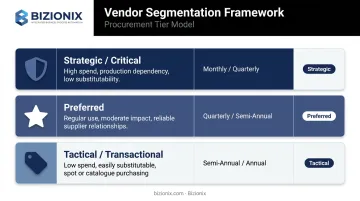
Building review schedules into vendor contracts matters. If performance conversations only happen at renewal time, procurement leverage is already lost.
Corrective Action and Improvement Planning
When performance falls below threshold, a structured escalation process keeps accountability intact:
- Document the specific gap against agreed KPIs with timestamps and supporting data
- Engage the vendor to identify underlying causes, not just symptoms
- Set a written improvement plan with targets, deadlines, and named owners
- Verify resolution formally before closing — these records form your audit trail for renewals and dispute resolution
KPIs and Metrics to Track Vendor Performance
Quality KPIs
Quality metrics measure how reliably vendors deliver goods or services that meet your specifications — and for manufacturing, distribution, and service businesses, incoming defects translate directly into rework costs and production delays.
Key metrics to track:
- Defect rate — percentage of delivered goods or services failing specifications
- SLA resolution rate — percentage of issues resolved within agreed timeframes
- Return and rejection rate — volume of goods returned or rejected at receipt
APQC's defect rate data (median 4,500 per million) reflects internal manufacturing output, not supplier incoming quality. Set your targets based on your industry and product category — there's no single benchmark that applies universally.
Delivery KPIs
Delivery performance directly affects production schedules, customer commitments, and working capital. APQC benchmarks the median supplier on-time delivery rate at 90% across 4,648 companies — a useful baseline for setting targets.
Track:
- On-time delivery rate — percentage of orders delivered by the agreed date
- Lead time consistency — variance between promised and actual lead times
- Order accuracy rate — percentage of orders delivered complete and without errors
Cost and Financial KPIs
Cost KPIs reveal whether vendors are honouring financial commitments or creating hidden expense through billing errors and gradual price creep.
- Price variance — actual cost vs. contracted price
- Invoice accuracy rate — APQC benchmarks 92% of invoices processed error-free first time across 2,342 companies; anything below this warrants attention
- Contracted savings delivered — whether negotiated discounts or terms are actually being honoured
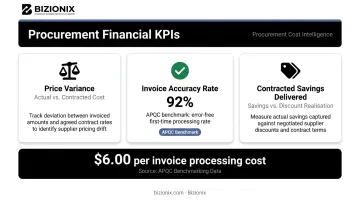
The cost of invoice exceptions is real: APQC puts the median total AP processing cost at $6.00 per invoice (a global benchmark in USD) — every disputed invoice adds to that figure.
Service KPIs
Service metrics are among the most underused indicators of long-term vendor reliability. They capture how vendors behave when things go wrong — not just whether deliveries arrive on time.
Track:
- Responsiveness — time to acknowledge and act on escalations
- Communication quality during incidents or scope changes
- Internal stakeholder satisfaction scores from teams working directly with the vendor
Compliance KPIs
For Indian businesses, compliance KPIs carry direct financial consequences — not just audit risk:
- GST registration validity and documentation currency
- Certification and licence renewal status
- Audit finding resolution time
- Regulatory adherence rate across applicable requirements
Gaps in vendor compliance documents can affect input tax credit (ITC) eligibility, creating financial exposure that shows up well after the transaction closes.
Must-Have Features in Vendor Performance Management Software
Centralised Vendor Records and Scorecards
An effective VPM tool maintains a single record for each vendor that combines performance scores, contract terms, compliance documents, and review history. Without this, teams work across email chains, spreadsheets, and disconnected systems: the full picture is rarely available when a contract renewal or escalation demands it.
Look for:
- Vendor master with transaction history
- Scorecard views with weighted KPI scoring
- Document storage for certificates, contracts, and compliance records
- Review history and corrective action logs
Automation, Alerts, and Dashboards
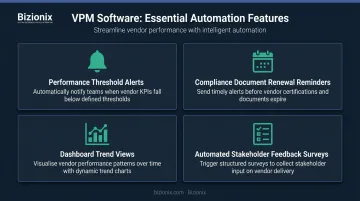
Manual data assembly creates lag. By the time a trend surfaces in a spreadsheet, it's typically already a problem worth escalating. Automated capabilities to prioritise:
- Performance threshold alerts (vendor score drops below defined level)
- Compliance document renewal reminders
- Dashboard views showing performance trends across the full vendor base
- Automated surveys for collecting internal stakeholder feedback on service quality
ERP and System Integration
VPM software that connects with your accounting or ERP platform pulls in operational data automatically, keeping performance and financial records in one place. Look for integration support covering:
- Delivery records and purchase order history
- Invoice data and payment status
- Spend analytics linked to vendor scorecards
- Two-way sync to avoid duplicate data entry
Top Vendor Performance Management Tools to Consider
VPM tools fall into three broad categories: dedicated supplier performance platforms, full SRM or procurement suites with VPM modules, and integrated ERP systems with vendor management capabilities. The right choice depends on team size, vendor count, budget, and whether you need a standalone tool or a unified business management platform.
SAP Ariba
An enterprise SRM suite with structured supplier performance management (SPM) projects, scorecard creation, KPI libraries, and stakeholder surveys. SAP Ariba supports typical criteria including account management, quality, on-time delivery, price/total cost, and contract compliance. Best suited for large enterprises with existing SAP infrastructure — the implementation complexity and cost is disproportionate for most mid-market teams.
JAGGAER
A full source-to-pay procurement platform with configurable performance dashboards, near-real-time supplier intelligence, and automated development plan triggers when vendor performance drops. Strong on analytics and predictive insights, and well-suited for organisations needing a comprehensive SRM layer alongside VPM capabilities.
Gatekeeper
A vendor and contract lifecycle management tool that links SLA tracking directly to contract records — practical when performance accountability and contract compliance need to be managed together. Features include balanced scorecards, automated surveys, a vendor portal, risk register, and spend module. Gatekeeper publishes transparent, plan-based pricing (PRO, ENTERPRISE, ENTERPRISE PLUS tiers) with third-party quotas, which makes budget planning more predictable for mid-market buyers.
Kodiak Hub
An AI-powered supplier intelligence platform with multi-dimensional scorecard capabilities across quality, delivery, commercial, collaboration, and sustainability dimensions. Scorecards can automatically update with latest performance data. Well-suited for procurement-first teams wanting structured supplier development workflows.
Bizionix
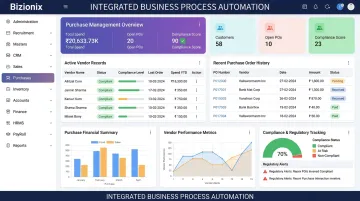
Bizionix is a cloud ERP built for Indian MSMEs, with a Purchase Management module that brings vendor management, purchase orders, GRN processing, and consumption analytics into one platform. No separate procurement tools, no manual reconciliation between accounting and purchasing.
Unlike SAP Ariba, which requires significant IT infrastructure and implementation investment, Bizionix is built for teams that want process discipline without that complexity. Purchase data, vendor records, and financial transactions all live in one system, giving procurement and finance teams a connected view without manual data stitching.
Key capabilities relevant to vendor performance:
- GST-ready workflows with full compliance built in
- Activity tracking showing who did what, when, and why
- Invoice history and spend data accessible without separate reporting tools
- Scales cleanly from 20 to 100+ active vendor relationships
The NEO package starts at ₹999/year with a 14-day free trial, making it an accessible entry point for businesses moving off spreadsheets. The Enterprise plan covers more complex procurement requirements with custom configurations.
Best Practices for Effective Vendor Performance Management
Three practices separate organisations that manage vendor performance well from those that manage it in name only.
Segment Vendors by Business Impact
Strategic vendors affecting production continuity or revenue warrant intensive oversight — frequent reviews, dedicated relationship owners, and escalation protocols. Tactical or low-spend vendors can be managed through lighter periodic check-ins.
Applying the same review intensity across all vendors wastes resources and often means the wrong vendors receive the most attention.
Build Performance Terms Into the Contract Upfront
Performance expectations, KPI definitions, review cadences, and corrective action processes should be agreed upon and written into vendor contracts before the relationship begins. This removes ambiguity and creates accountability from the start.
Renewal conversations then become straightforward — grounded in documented evidence rather than recent impressions or memory.
Use VPM Data to Develop Vendors, Not Just Audit Them
The most productive use of VPM data is identifying where underperforming vendors need support, process alignment, or capability development — and tracking improvement over time.
Businesses that use performance reviews to build collaborative improvement plans get more lasting results than those that treat VPM purely as a compliance or penalty mechanism.
Frequently Asked Questions
Frequently Asked Questions
What is vendor performance management and why does it matter?
VPM is the structured process of measuring and improving how vendors deliver on agreed commitments. It matters because unmanaged vendor performance leads to cost leakage, service disruptions, and compliance gaps that compound as a business grows and its vendor base expands.
What KPIs should businesses track for vendor performance?
Track KPIs across five categories: quality, delivery, cost, service, and compliance — covering metrics like defect rates, on-time delivery, price variance, and audit readiness. APQC benchmarks a 90% median on-time delivery rate and 92% first-time invoice accuracy as cross-industry baselines.
How is vendor performance management different from vendor risk management?
Vendor risk management assesses whether a vendor poses acceptable risk before and during a relationship — covering financial stability, security posture, and compliance standing. VPM tracks whether the vendor is actually delivering on their commitments after contract execution. Both are necessary; they address different points in the vendor lifecycle.
How often should vendor performance reviews be conducted?
Review frequency should match vendor criticality. Strategic vendors warrant monthly or quarterly reviews; lower-risk vendors may only need semi-annual check-ins. Building these cadences into contracts ensures performance conversations happen before something goes wrong.
Can small and mid-sized businesses benefit from VPM tools?
Yes. MSMEs with 30+ active vendors quickly outgrow spreadsheet-based tracking. Integrated ERP platforms like Bizionix offer an affordable entry point — with GST-ready workflows and centralised vendor records — without the cost or complexity of dedicated enterprise procurement software.
What features should I look for in vendor performance management software?
Prioritise these three capabilities:
- Centralised vendor records with scorecards and document storage
- Automated alerts and dashboards for real-time performance visibility
- ERP or accounting integration to eliminate manual data duplication