The good news: a well-chosen ERP system can bring all of this under one roof — purchase orders, inventory, vendor tracking, warehouse operations, and financial reporting — giving your team real-time control instead of reactive firefighting. With over 5.77 crore registered MSMEs contributing roughly 30% of India's GDP and 45% of exports, getting supply chain operations right isn't just an efficiency play — it's a competitive necessity.
This guide covers what ERP actually does for supply chains, the top platforms suited to Indian businesses, and what to look for before you sign a contract.
Key Takeaways
- ERP integrates procurement, inventory, warehousing, and financials into one system — eliminating data silos and manual reconciliation
- Indian MSMEs need GST e-invoicing (mandatory above ₹5 crore turnover), e-way bill support, and multi-location inventory tracking
- Top picks: Bizionix, SAP Business One, Oracle NetSuite, Microsoft Dynamics 365 Business Central, and Odoo
- Shortlist based on operational complexity and compliance requirements, not name recognition alone
- Always validate real-world usability with a demo before committing
What Is ERP in Supply Chain Management?
ERP (Enterprise Resource Planning) in supply chain management refers to an integrated software platform that connects procurement, inventory, warehousing, order fulfilment, and financials into a single system. According to Gartner's definition, ERP tools share common process and data models — meaning every department works from the same live data, not separate spreadsheets.
How ERP Differs from Standalone SCM Software
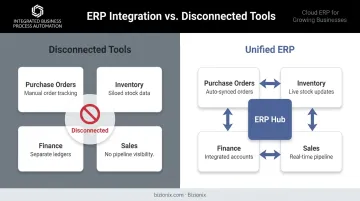
Standalone supply chain tools handle logistics and planning well. What they don't do is connect that data to your finance, HR, and sales functions. An ERP bridges that connection directly:
- Purchase orders flow into accounts payable automatically
- Inventory movements update financial reports in real time
- Vendor payments reconcile without manual intervention
- Sales data reflects stock levels across all locations instantly
This means your finance team, warehouse staff, and procurement managers all work from the same live data — no month-end reconciliation across four disconnected systems.
Why Indian MSMEs Are Adopting ERP Now
Two compliance triggers have accelerated ERP adoption among Indian businesses significantly:
- GST e-invoicing: Mandatory for businesses with aggregate turnover above ₹5 crore (effective 1 August 2023, per CBIC Notification No. 10/2023-Central Tax)
- E-way bills: Required under CBIC Rule 138 for any goods movement above ₹50,000 in consignment value
Managing both requirements manually — or through disconnected tools — creates errors, delays, and audit risk. An ERP with built-in GST integration handles both automatically.
Best ERP Software for Supply Chain Management
These platforms were evaluated for supply chain module depth, GST compliance readiness, India-market fit, scalability, and suitability for MSMEs and growing enterprises.
Bizionix (by IIS-LLP)
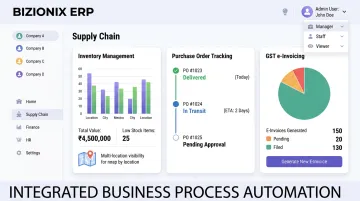
Bizionix is a 100% cloud-based ERP developed by IIS-LLP (Integrated Information Solutions LLP), a subsidiary of Protocol India Private Limited backed by over two decades of industry experience. It's purpose-built for Indian MSMEs and mid-sized enterprises, covering inventory, procurement, warehouse operations, multi-company management, and GST-ready accounting within a unified platform.
The standout feature for supply chain management is direct API integration with the GST e-Invoice system — instant IRN generation at the point of invoice creation, with no third-party tools or manual uploads required.
Beyond compliance, the platform provides real-time visibility across multiple business locations through a single login, role-based access controls per entity, and configurable workflows that adapt to existing processes rather than forcing changes.
Pricing starts at ₹999/year for the NEO plan (which includes basic warehouse and sales functionality with a 14-day free trial), with Enterprise tier pricing available for businesses needing full Purchase Management, Production Planning, and advanced Warehouse Management.
| Feature | Detail |
|---|---|
| Key Supply Chain Features | Inventory management, purchase order tracking, GRN, warehouse operations, multi-location stock visibility, vendor management, GST e-invoicing with IRN generation, automated billing, multi-company support |
| Best Suited For | Indian MSMEs, manufacturing companies, distribution businesses, multi-location enterprises, franchise networks |
| India Fit | Built-in GST compliance, direct IRP API integration, e-way bill support, designed specifically for Indian business workflows |
SAP Business One
SAP Business One is SAP's dedicated ERP for small and mid-sized enterprises, with strong adoption across Indian manufacturing and distribution sectors. It covers procurement, production planning, inventory, and financial management through a modular design.
Deep supply chain planning capabilities, multilevel Bill of Materials (BOM) support, and a broad network of SAP-certified implementation partners across India set it apart. The India localization guide (FP 2405, document version 16.0) covers CGST, SGST, IGST, HSN/SAC codes, and e-way bill JSON export, with IRP authentication supported via ClearTax. SAP reports over 83,000 global Business One customers.
Implementation and licensing costs run higher than India-native solutions, and GST/compliance customisation typically requires help from an SAP implementation partner.
| Feature | Detail |
|---|---|
| Key Supply Chain Features | Procurement management, inventory control, MRP, production planning, warehouse management, analytics dashboards |
| Best Suited For | Mid-sized manufacturers and distributors seeking an established global ERP with local partner support |
| India Fit | India GST localization with ClearTax-supported IRP authentication; higher total cost of ownership |
Oracle NetSuite ERP
NetSuite is a leading cloud-first ERP used by fast-growing businesses and mid-market companies globally, with over 43,000 customers worldwide. Its India Localization SuiteTax Engine supports GST calculation on purchase and sales transactions, and the SuiteTax Reports SuiteApp generates GSTR-compatible reports — though it requires a standard fiscal calendar.
Core supply chain strengths include:
- Real-time inventory visibility across locations
- Demand planning and automated procurement workflows
- Strong reporting through customisable dashboards
NetSuite scales well for businesses expanding internationally.
Pricing follows an annual licence model covering the core platform, optional modules, and user count — plus a one-time implementation fee. Specific INR pricing isn't publicly listed; expect it to be on the steeper side for early-stage MSMEs.
| Feature | Detail |
|---|---|
| Key Supply Chain Features | Demand planning, inventory management, warehouse management, order management, procurement, supply chain analytics |
| Best Suited For | Fast-growing mid-market businesses with multi-location or international supply chains |
| India Fit | India GST localization available; pricing may be steep for smaller MSMEs |
Microsoft Dynamics 365 Business Central
Business Central is Microsoft's cloud ERP for small and mid-sized businesses, trusted by 50,000 companies globally. It integrates natively with Teams, Excel, and Power BI — a real advantage for businesses already running on Microsoft tools.
Microsoft's India local functionality includes built-in GST, GST e-way bill, GST e-invoice, TDS, TCS, and gate entry support — documented directly in Microsoft Learn, not just through third-party add-ons. India pricing is publicly listed:
- Essentials: ₹6,655/user/month
- Premium: ₹9,150/user/month
- Team Members: ₹665/user/month
| Feature | Detail |
|---|---|
| Key Supply Chain Features | Inventory management, purchase orders, warehouse management, demand forecasting, vendor performance tracking, Power BI integration |
| Best Suited For | SMBs and mid-sized businesses already using Microsoft tools, looking for a scalable supply chain ERP |
| India Fit | Built-in GST e-invoice and e-way bill in Microsoft Learn India local functionality; subscription-based pricing |
Odoo ERP
Odoo is a popular open-source ERP with modular architecture, used by more than 13 million users worldwide. Its official India localization (documented in Odoo 19.0) includes modules for Indian Accounting, Indian E-invoicing, Indian E-waybill, and GST E-Filing supporting GSTR-1, GSTR-2B, and GSTR-3B.
The entry cost is low, the customisation potential is high, and it can be deployed on-cloud or on-premise. One important caveat: Odoo has Community and Enterprise editions, and the official India localization documentation doesn't explicitly confirm whether full GST e-invoice and e-way bill modules are available in the Community edition — businesses should verify this before assuming parity.
| Feature | Detail |
|---|---|
| Key Supply Chain Features | Inventory management, purchase management, manufacturing (MRP), warehouse management, delivery tracking, sales integration |
| Best Suited For | Small and growing businesses seeking a flexible, cost-effective ERP customisable to specific supply chain workflows |
| India Fit | Official India GST localization in Enterprise edition; Community edition GST e-invoice parity should be independently verified |
Key Features to Look For in a Supply Chain ERP
Choosing an ERP for supply chain management means looking past the feature checklist. These are the capabilities that actually move the needle for Indian MSMEs:
Core Supply Chain Functionality
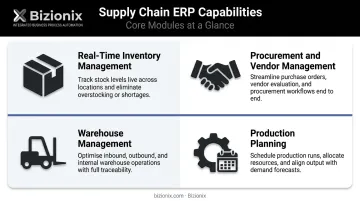
- Real-time inventory management: Multi-location stock tracking, live dashboards, and movement history — not batch updates
- Procurement and vendor management: Purchase orders, GRN workflows, vendor performance tracking, and payables integration
- Warehouse management: Storage optimization, picking and dispatch workflows, and inward/outward documentation
- Production planning: Scheduling, MRP, and integration with sales and purchase data where relevant
India-Specific Compliance (Non-Negotiable)
If you're an MSME above ₹5 crore turnover, GST e-invoicing is mandatory. Selecting an ERP without built-in compliance means paying for third-party tools or managing manual uploads — both of which create reconciliation headaches and error risk.
Look for:
- Direct IRP/GSTN API integration for instant IRN generation
- E-way bill generation for goods movement above ₹50,000
- GSTR-1, GSTR-3B, and GSTR-2B reporting
- GST-ready accounts payable and receivable
Cloud Architecture and Scalability
A cloud-based ERP gives warehouse managers, branch staff, and head office access to the same live data — simultaneously, with no syncing delays or version conflicts.
For growing MSMEs, this matters beyond day-to-day operations. When you add a new warehouse, open a branch in another state, or register a second GSTIN entity, a cloud system absorbs that growth without new server purchases or IT setup. Key advantages include:
- Simultaneous multi-location access with no data lag
- New entities or branches onboarded without infrastructure investment
- Centralized admin controls with location-level visibility
How We Chose These ERPs
Every ERP on this list was evaluated against the same set of criteria, with Indian MSMEs specifically in mind:
Evaluation criteria:
- Supply chain module depth — inventory, procurement, warehouse, production planning
- Ease of use for non-technical users
- India-specific compliance features (GST e-invoicing, e-way bills, GSTR reporting)
- Scalability for growing MSMEs
- Total cost of ownership including implementation
- Market reputation among Indian businesses
The selection process also surfaced patterns in how businesses get ERP decisions wrong. Watch out for these:
- Choosing enterprise SAP when a purpose-built MSME solution offers lower complexity and comparable results at a fraction of the cost
- Picking an ERP without built-in GST integration — missing this forces costly workarounds after go-live
- Underestimating implementation risk: Gartner reports that by 2027, more than 70% of recently implemented ERP initiatives will fail to meet original business-case goals — governance and planning are non-negotiable
- Skipping a real-world demo — request walkthroughs of your actual workflows, not a curated product showcase
Conclusion
The right ERP for supply chain management isn't the biggest or most globally recognised — it's the one that matches your operational complexity, meets Indian compliance requirements, and doesn't need a team of consultants to keep running.
Before finalising any decision, evaluate scalability, built-in GST readiness, and whether the vendor understands Indian business workflows. Request a hands-on demo using your own data scenarios, not a scripted walkthrough.
Bizionix by IIS-LLP is built specifically for Indian MSMEs and growing enterprises — a cloud-based, GST-compliant ERP that unifies procurement, inventory, warehousing, and financials at a cost and complexity level that actually makes sense for your business. Contact the team for a demo or start a 14-day free trial at x.bizionix.com/auth/register.
Frequently Asked Questions
What is ERP in supply chain management?
ERP in supply chain management is an integrated software platform that connects demand planning, procurement, inventory, warehousing, and order fulfilment within a single system. Unlike standalone tools, it links supply chain data with finance, sales, and HR — giving businesses unified visibility and eliminating manual reconciliation between departments.
What are the key features to look for in supply chain ERP software?
Must-have features include real-time multi-location inventory tracking, procurement and vendor management, warehouse operations, and order management. For Indian businesses, built-in GST e-invoicing with IRN generation, e-way bill support, and GSTR reporting are non-negotiable — without them, you'll need expensive workarounds.
Which ERP software is best for small and medium businesses in India?
India-specific platforms like Bizionix are purpose-built for MSMEs with GST compliance and affordability built in. Odoo and Microsoft Dynamics 365 Business Central also serve the SMB segment effectively. Start by mapping your supply chain complexity and compliance requirements — then shortlist platforms that fit your budget and can scale with you.
What is the difference between ERP and SCM software?
SCM software focuses narrowly on supply chain planning and execution — logistics, procurement, and inventory. ERP takes a broader scope, integrating those functions with financials, HR, and sales into one platform. The practical difference: SCM tools optimise the supply chain; ERP manages the entire business around it.
How long does ERP implementation take for supply chain management?
Cloud-based ERPs for MSMEs typically go live in a few weeks to three months. Enterprise deployments with heavy customisation can stretch to six to twelve months or longer — data migration readiness and process complexity are usually the biggest factors, not the software itself.
Is cloud ERP better than on-premise ERP for supply chain management?
For most MSMEs, yes. Cloud ERP eliminates upfront hardware costs, enables real-time access across locations, and scales as the business grows — without dedicated IT infrastructure. On-premise still makes sense for businesses with strict data residency requirements or limited internet connectivity.