The harder problem isn't finding enterprise software — it's finding the right one. Hundreds of platforms claim to be "enterprise-grade." Most decision-makers end up evaluating by brand recognition rather than operational fit, which is how businesses end up with over-engineered implementations that cost more to run than they save.
This guide covers the top 10 enterprise software companies in 2026, how they were selected, and how to identify which one actually matches your business size, industry, and region — including options built specifically for Indian MSMEs navigating GST compliance.
Key Takeaways
- Enterprise software manages core business functions — ERP, CRM, HR, finance, supply chain — at scale, replacing fragmented tools with a unified system.
- Global software spending is growing at 14.2% annually, driven by AI adoption, cloud migration, and digital transformation across industries.
- Rankings weigh product depth, innovation track record, customer trust, market presence, and regional relevance.
- Global giants like Microsoft, SAP, Oracle, and Salesforce lead at the enterprise tier, while India-native platforms like Zoho and Bizionix are better suited for MSMEs.
- Choosing the right platform means matching it to your scale, compliance needs, budget, and implementation capacity — not defaulting to the most recognised name.
What Is Enterprise Software and Why Does It Matter in 2026?
Enterprise software refers to platforms that manage complex, large-scale business operations across departments in a single unified system — rather than a fragmented collection of tools. This includes ERP (finance, inventory, supply chain), CRM (customer management), HRM (HR and payroll), and workflow automation.
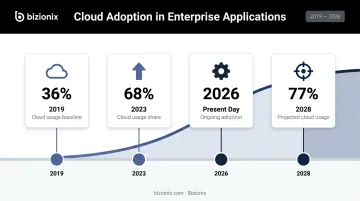
What's changed in 2026 is the baseline expectation. AI-powered automation, cloud-native architecture, and real-time analytics are now minimum requirements — not differentiators. IDC found that public cloud usage in enterprise applications rose from 36% in 2019 to 68% in 2023, with projections reaching 77% by 2028. Businesses delaying modernisation face rising operational costs, compliance gaps, and competitive disadvantage.
The 10 companies below were evaluated against these evolving expectations.
Top 10 Enterprise Software Companies in 2026
Selection criteria: product capability, market footprint, customer trust, innovation track record, and relevance across business segments and geographies — including the Indian MSME market.
1. Microsoft (Dynamics 365 + Azure)
Microsoft is the world's largest software company by revenue, posting $281.7B in FY2025 — up 15%. Its enterprise offering centres on Dynamics 365 (ERP and CRM) and Azure cloud, with Dynamics 365 growing 23% in FY25 Q4 alone. Azure surpassed $75B in annual revenue, making it one of the world's dominant cloud infrastructure providers.
The key differentiator is ecosystem depth — deep integration with Office 365, Teams, and Power BI, plus AI-powered Copilot features embedded across the entire suite.
| Category | Details |
|---|---|
| Best For | Large enterprises with existing Microsoft infrastructure |
| Key Features | Dynamics 365 ERP + CRM, Azure AI, Power BI, Teams collaboration, Copilot Studio |
| Pricing | Module-based subscription; enterprise licensing tends to be high-cost |
2. SAP SE
SAP has held the top position in enterprise resource planning for decades, serving more multinationals than any other ERP vendor. Its cloud backlog reached EUR 21.9B (up 20%), with cloud revenue growing 19% — and SAP Cloud ERP was recognised as a Leader in the 2025 Gartner Magic Quadrant for Cloud ERP for Product-Centric Enterprises.
SAP S/4HANA's in-memory computing and industry-specific cloud modules make it well-suited for manufacturing, logistics, and public sector. Implementation complexity and cost, however, position it firmly in the large-enterprise segment.
| Category | Details |
|---|---|
| Best For | Large enterprises and multinationals needing complex ERP customisation |
| Key Features | SAP S/4HANA, real-time analytics, supply chain management, industry cloud modules |
| Pricing | High implementation and licensing costs; typically requires certified SAP partners |
3. Oracle
Oracle's enterprise portfolio spans Oracle Cloud ERP and NetSuite, covering finance, HR, supply chain, sales, and manufacturing. Oracle was named a Leader in the 2025 Gartner Magic Quadrant for Cloud ERP for Service-Centric Enterprises — placing highest in Ability to Execute.
NetSuite specifically serves 43,000+ customers across 200+ countries, making it the dominant mid-market cloud ERP. Oracle's own infrastructure layer (OCI) gives it a data security and disaster recovery edge that few vendors can match.
| Category | Details |
|---|---|
| Best For | Mid to large enterprises needing robust database-backed ERP and cloud infrastructure |
| Key Features | Oracle Cloud ERP, NetSuite for mid-market, OCI infrastructure, advanced analytics |
| Pricing | Subscription-based for cloud; pricing varies by module and deployment model |
4. Salesforce
Salesforce has held the #1 CRM position for 12 consecutive years, with 20.7% CRM market share in 2024 according to IDC. Its SaaS platform serves healthcare, finance, retail, manufacturing, and media — and it owns Slack for team collaboration.
The AppExchange (now AgentExchange) marketplace contains 7,000+ prebuilt apps and integrations. Salesforce Einstein AI adds predictive intelligence across sales, service, and marketing workflows. It's a front-office powerhouse — though not a full ERP replacement.
| Category | Details |
|---|---|
| Best For | Enterprises prioritising sales, marketing, and customer service operations |
| Key Features | CRM, marketing automation, Einstein AI, Slack integration, AgentExchange |
| Pricing | Tiered subscription; enterprise plans are premium-priced; India offices in Hyderabad, Bengaluru, and Mumbai |
5. ServiceNow
ServiceNow is purpose-built for digital workflow automation — particularly IT operations management (ITSM), HR service delivery, and enterprise-wide process automation. It reported nearly $11B in 2024 revenue with approximately 8,400 customers, and 1,930 customers with more than $1M in annual contract value as of Q3 2025.
It was the only vendor named a Leader in Gartner's 2025 Magic Quadrant for AI Applications in IT Service Management — a distinction that reflects its depth in AI-assisted incident resolution and workflow intelligence.
| Category | Details |
|---|---|
| Best For | Large enterprises automating internal workflows and IT operations |
| Key Features | ITSM, AI-powered workflow automation, HRSD, low-code app development |
| Pricing | Enterprise licensing model; pricing requires a direct quote |
6. Workday
Workday is the benchmark for cloud-native Human Capital Management and financial planning. It serves more than 11,000 organisations globally — including approximately 30% of the Forbes Global 2000 — and counts 65M+ users across its platform.
Its FY2025 revenue reached $8.446B, with subscription revenue of $7.718B. Workday was named a Leader in the 2025 Gartner Magic Quadrant for Cloud HCM Suites and delivers two major product releases annually — meaning customers always run the latest version without costly upgrade projects.
| Category | Details |
|---|---|
| Best For | Enterprises needing unified HR management and financial planning |
| Key Features | HCM, financial management, workforce planning, payroll, analytics |
| Pricing | Subscription-based; scales by employee count and module selection |
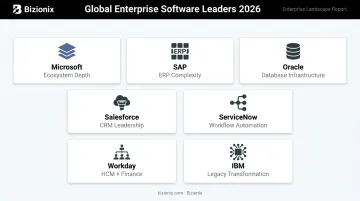
7. IBM
IBM's enterprise software portfolio centres on watsonx (its AI and data platform), hybrid cloud solutions, and business process automation. Software revenue reached approximately $26.2–26.3B in 2025. IBM's combination of consulting depth, AI research, and partnerships with AWS, Oracle, Salesforce, and Adobe gives it a unique ability to modernise legacy environments at scale.
For large enterprises undergoing transformation, IBM is best understood as an integrated, consultant-led partner — not a plug-and-play SaaS vendor.
| Category | Details |
|---|---|
| Best For | Large enterprises modernising legacy systems or undergoing digital transformation |
| Key Features | watsonx AI, hybrid cloud, business automation, IT infrastructure management |
| Pricing | Varies significantly; consulting and implementation costs add substantially to total investment |
8. Zoho
Zoho is a Chennai-born global SaaS company with 100M+ users across 55+ business applications — used in more than 150 countries. It offers one of the broadest product suites available at competitive price points, covering CRM, ERP, HR, accounting, project management, and more.
Zoho Books includes GST invoices, GST returns, e-way bills, and e-invoices — making it directly useful for Indian businesses navigating compliance. Local workflow logic, GST-ready modules, and pricing calibrated for SMBs reflect its India-first design philosophy.
| Category | Details |
|---|---|
| Best For | SMBs and growing businesses seeking an affordable, all-in-one business management suite |
| Key Features | Zoho CRM, Zoho Books, ERP, HR, inventory, project management, GST compliance |
| Pricing | Competitive subscription pricing with free tiers; India-specific GST-ready modules |
9. Tata Consultancy Services (TCS)
TCS is India's largest IT services company, crossing the $30B revenue milestone in FY2025 with 603,305 employees across 55 countries. By revenue, it ranks among the world's top five IT services firms.
TCS operates as an end-to-end transformation partner — building, implementing, and managing enterprise platforms for BFSI, manufacturing, retail, and government sectors — rather than a packaged software vendor.
Its Location Independent Agile™ model enables large-scale distributed delivery, and its domain depth across industries makes it a strong choice for large Indian enterprises and global corporations needing transformation partnerships rather than off-the-shelf software.
| Category | Details |
|---|---|
| Best For | Large Indian enterprises and global corporations needing end-to-end IT transformation |
| Key Features | Cloud solutions, AI & analytics, cognitive business operations, managed security |
| Pricing | Project-based and retainer engagements; pricing varies by scope and contract size |
10. Bizionix
Bizionix (by IIS-LLP, a subsidiary of Protocol India Private Limited) is a purpose-built cloud ERP designed specifically for Indian MSMEs. India has over 5.77 crore registered MSMEs contributing approximately 30% of GDP and more than 45% of exports.
Most global ERP platforms were never built for this segment's operational reality — and Bizionix addresses that gap directly.
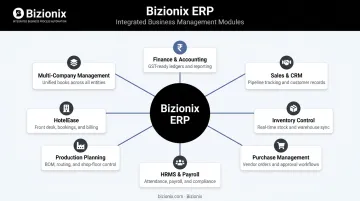
It replaces scattered Excel files, WhatsApp-based approvals, and manual follow-ups with a unified, GST-compliant, 100% cloud-based system covering:
- Finance & Accounting with automated GST invoicing and GSTR-1 auto-population
- Sales & CRM with lead-to-invoice workflows
- Inventory Control with multi-location stock tracking
- Purchase Management with vendor and procurement workflows
- HRMS & Payroll with attendance tracking and statutory compliance
- Production Planning for manufacturers
- HotelEase — a specialised Hotel Management System for hospitality businesses
- Multi-company management under a single secure login
Its direct API integration with the GST e-Invoice system generates IRNs instantly — no third-party tools, no manual submission steps. The entire e-invoicing process completes in seconds, with invoice data validated against GST rules before submission to prevent rejections.
Pricing starts at ₹999 per year for the NEO plan — a fraction of what global ERP licensing costs — with a 14-day free trial included.
| Category | Details |
|---|---|
| Best For | Indian MSMEs, CA firms, manufacturers, distributors, hotels, and multi-location businesses |
| Key Features | GST-compliant accounting, e-invoicing with instant IRN generation, multi-company management, configurable workflows, real-time dashboards |
| Pricing | NEO plan from ₹999/year; Enterprise plan on request — no SAP-level cost or complexity |
How We Chose the Best Enterprise Software Companies in 2026
Ranking purely by market capitalisation or revenue would produce a list useful only to Fortune 500 procurement teams. That's not how most businesses — especially Indian MSMEs — make software decisions.
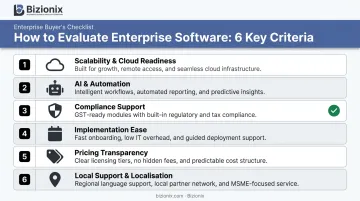
The evaluation framework considered:
- Scalability and cloud readiness: built for growth without requiring expensive infrastructure upgrades
- AI and automation capabilities: measurable reduction in manual work, not just feature-list promises
- Compliance support: GST, e-invoicing, and Indian regulatory requirements out of the box
- Implementation ease: deployable without months of consulting engagement
- Pricing transparency: total cost of ownership that's clear and proportionate to business scale
- Local support and localisation: India-specific features and local language support where needed
Businesses frequently choose vendors based on brand prestige and end up with platforms that are technically powerful but operationally irrelevant. A manufacturer with 50 employees doesn't need SAP's supply chain complexity. They need a system that's running by month two, not still being configured.
That bias toward prestige is why this ranking weights fit and deployability as heavily as features. The right enterprise software for 2026 is the one that matches your actual operations, not the one with the most impressive product roadmap.
Conclusion
The enterprise software market in 2026 covers significant ground. Global players like Microsoft, SAP, and Oracle serve multinationals with deep, complex stacks. At the other end, platforms like Zoho and Bizionix serve Indian businesses with context-aware, affordable solutions built for regional compliance and scale.
Choosing the right platform means evaluating total cost of ownership, implementation timeline, compliance readiness, and long-term scalability alongside features.
For Indian MSMEs and growing businesses that need enterprise-grade ERP without global-scale complexity or cost, Bizionix offers a unified, GST-ready, cloud-based platform built for the way Indian businesses operate day-to-day. Request a demo to see how it fits your business.
Frequently Asked Questions
Frequently Asked Questions
What are the top 10 enterprise software companies?
The leading enterprise software companies in 2026 are Microsoft, SAP, Oracle, Salesforce, ServiceNow, Workday, IBM, Zoho, TCS, and Bizionix. The right choice depends on your business size, industry, and regional compliance requirements — large global platforms don't always suit Indian MSMEs.
Who are the big 5 software companies?
Microsoft, Oracle, SAP, Salesforce, and IBM are the five most dominant enterprise software companies globally based on revenue, market capitalisation, and product breadth. Revenue and market share don't determine which platform fits your business — fit depends on your operational context and compliance needs.
What is enterprise software used for?
Enterprise software manages large-scale business operations — including ERP (finance, inventory, supply chain), CRM (customer management), HRM (HR and payroll), and workflow automation. It replaces manual processes and fragmented tools with a unified digital system accessible across departments.
Which enterprise software is best for Indian MSMEs?
For Indian MSMEs, the priority is GST compliance, local workflow support, and pricing that doesn't assume an enterprise IT budget. Zoho and Bizionix are built specifically for this segment; global platforms like SAP or Oracle carry complexity and cost that most smaller Indian businesses don't need.
What is the difference between ERP and enterprise software?
ERP (Enterprise Resource Planning) is a category within enterprise software focused on integrating core business functions — finance, inventory, HR — into one system. Enterprise software is the broader term that also includes CRM, HRM, workflow automation, and other large-scale business platforms.
How do I choose the right enterprise software for my business?
Start with five criteria before committing to any platform:
- Business size and operational complexity
- Regulatory requirements (GST compliance for Indian businesses)
- Total cost of ownership, including implementation
- Scalability for future growth
- Availability of local vendor support