
Introduction
Hotel managers coordinate reservations, housekeeping, front desk, F&B billing, and GST compliance—simultaneously, every day. When those operations run on disconnected tools, the gaps show fast:
- Excel sheets for occupancy that are always one update behind
- WhatsApp threads for housekeeping with no audit trail
- Manual guest registers prone to entry errors
- Billing done separately from room charges, causing folio disputes
Errors multiply. Service slows. Revenue slips through the cracks.
A Property Management System (PMS) consolidates these operations into one platform—and its value shows up in concrete outcomes: fewer billing disputes, faster room turnarounds, smarter pricing decisions, and accurate GST compliance. For Indian hotel MSMEs, where nearly half lack the infrastructure to support advanced software, the real question isn't whether a PMS helps. It's whether the investment delivers measurable improvements in operations, revenue, and control.
This guide walks through what a hotel PMS actually improves, which properties benefit most, and what it costs to operate without one.
Key Takeaways
- A hotel PMS centralizes reservations, front desk, housekeeping, billing, and reporting into one system
- Key benefits: streamlined operations, improved guest experiences, smarter revenue management, accurate GST-compliant billing
- Hotels without a PMS face rising errors, slower service, and revenue leakage
- Indian hotels gain the most when PMS integrates GST billing, ERP, and operations — replacing several disconnected tools at once
- The right PMS pays for itself through fewer errors, faster check-ins, and tighter revenue control
What Is a Hotel Property Management System?
A hotel PMS is software that acts as the central command for managing hotel operations—from reservations and check-ins to room assignments, housekeeping schedules, billing, and performance reporting. Rather than functioning as a standalone booking tool, it connects front desk, back office, and guest-facing functions into one platform—replacing spreadsheets, manual registers, and siloed department tools.
The purpose of a PMS is to give hotel operators control, visibility, and speed across every part of the guest lifecycle. A few practical examples show how this plays out daily:
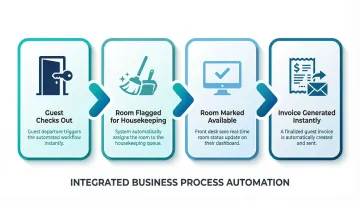
- When a room is checked out, the system instantly flags it for housekeeping
- Once cleaned and inspected, the front desk sees it as available with no manual update needed
- Every charge during the stay is logged to the guest's account in real time
- At checkout, the invoice generates instantly with zero manual entry
According to Oracle Hospitality, a modern PMS has evolved from traditional front-office capabilities into a "critical business operations system" that integrates with onsite services to deliver seamless guest experiences. For hotel operators tracking performance, the PMS is the primary source of data that feeds metrics like RevPAR (Revenue Per Available Room) and ADR (Average Daily Rate)—making it as much a business intelligence tool as an operational one.
Key Benefits of a Property Management System in Hotels
The benefits below are grounded in operational outcomes—each one maps to something a hotel can measure: time saved, errors reduced, revenue captured, or compliance maintained.
Benefit 1: Streamlined Front Desk and Daily Operations
A PMS automates the most time-consuming manual tasks at the front desk: check-in and check-out processing, room assignment, housekeeping status updates, and inter-department communication.
When a room is checked out, the system instantly flags it for housekeeping. When cleaned and inspected, the front desk sees it as ready. This eliminates walkie-talkies, manual logs, and miscommunication across shifts. Housekeepers can update room status in real time using mobile devices, with modern maintenance platforms allowing status updates in just 3 seconds.
Key metrics this affects: average check-in/check-out time, front desk error rate, housekeeping turnaround time, and staff hours on administrative tasks. This benefit is most pronounced during high-occupancy periods and at properties where shift handovers are prone to communication gaps.
Benefit 2: Smarter Revenue Management and Occupancy Optimization
Operational efficiency at the front desk is only part of the picture. On the revenue side, a PMS gives managers real-time visibility into room availability, booking patterns, and performance — enabling data-driven decisions on pricing, promotions, and channel distribution.
The system consolidates booking data across OTAs (like Booking.com, MakeMyTrip) and direct channels, surfaces occupancy trends, and allows rate adjustments from a single interface rather than logging into each platform separately.
Inconsistent pricing across booking channels leads to rate parity issues and overbookings. Hoteliers estimate that an average of 6% of revenue is lost annually to "rate leakage" — pricing and distribution misalignments. An integrated PMS auto-syncs availability across all connected OTAs in real time, preventing double bookings and protecting online reputation.
Real-time data on booking pace and demand helps managers raise rates during peak periods and offer targeted promotions during slow windows. Research from Cornell University shows that effective rate optimization can increase revenue by up to 11%. Separately, 91% of respondents in the 2026 PMS Impact Study said their PMS directly drives revenue growth through automated upsells, direct bookings, and rate optimization.
Key metrics this affects: RevPAR, Average Daily Rate (ADR), occupancy rate, overbooking incidents, and channel booking mix. The impact is sharpest for seasonal properties, hotels listed on multiple OTAs, and those working to reduce dependence on third-party commissions.
Benefit 3: Accurate Billing, Faster Invoicing, and GST Compliance
A PMS with integrated billing automates the generation of guest folios, consolidating room charges, F&B, laundry, and ancillary services into a single itemized invoice that's ready at checkout without manual calculation.
Every service consumed during the stay is logged against the guest's account in real time. At checkout, the invoice generates instantly with zero manual entry, reducing disputes, correction delays, and billing errors.
Manual billing is a major source of revenue leakage — charges get missed, discounts applied incorrectly, or invoices disputed. A Cornell Hospitality Hackathon analysis found that 41% of negative hotel reviews dealt with billing issues, most occurring at departure.
For Indian hotel operators, GST compliance adds another layer. Room tariffs, F&B, and services attract different slabs:
- Room Tariffs ≤ ₹7,500/day: 5% GST, no Input Tax Credit (ITC)
- Room Tariffs > ₹7,500/day: 18% GST with full ITC
- Restaurant & F&B (Specified Premises): 18% GST where at least one room exceeded ₹7,500 in the previous financial year
- Restaurant & F&B (Non-Specified Premises): 5% GST without ITC
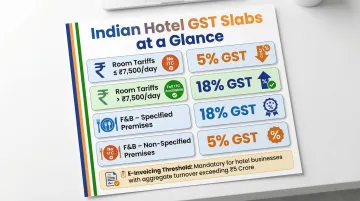
Managing this manually is error-prone and audit-risky. A PMS with built-in GST logic ensures every invoice is tax-compliant. E-invoicing is also mandatory for taxpayers with an Annual Aggregate Turnover exceeding ₹5 crores, and a compliant PMS automatically generates Invoice Reference Numbers (IRNs) and QR codes for B2B corporate clients.
For Indian hotel MSMEs navigating these requirements, Bizionix's hotel management module handles integrated billing with GST-ready invoicing, consolidating all charges in one place without a separate accounting tool.
Key metrics this affects: billing error rate, checkout time, missed-charge leakage, GST filing accuracy, and accounts receivable turnaround. This benefit is most critical for budget and mid-scale hotels with high daily transaction volumes and any Indian MSME hotel subject to GST audits.
What Happens When Hotels Operate Without a PMS
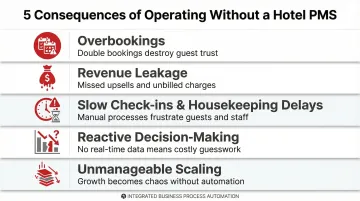
Hotels relying on manual systems, spreadsheets, or disconnected tools face predictable consequences:
- Overbookings and double-bookings: Without automated sync, front desk staff update each OTA manually — creating gaps where the same room gets booked twice.
- Revenue leakage from missed charges: F&B items, minibar consumption, and laundry services logged late (or not at all) frequently disappear by checkout. Finance teams in manual environments spend roughly 30% of their time collecting and reconciling data across disconnected systems.
- Slow check-ins and housekeeping delays: When housekeeping has no way to instantly notify the front desk, cleaned rooms sit empty while guests wait in the lobby.
- Reactive decision-making: Without consolidated data on booking pace, occupancy patterns, and rate performance, managers rely on instinct rather than evidence.
- Scaling becomes unmanageable: Each new property or distribution channel adds another layer of manual coordination, compounding errors across the operation.
How to Get the Most Out of Your Hotel PMS
A PMS delivers its full value only when adopted consistently across all departments—front desk, housekeeping, F&B, and accounts must all work within the same system rather than keeping their own manual records.
Enforce Consistent Adoption Across Departments
If the front desk uses the PMS but housekeeping still relies on WhatsApp and paper logs, the system's real-time visibility advantage disappears. Every department must commit to the digital workflow — no exceptions and no parallel records running alongside it.
Review Outcomes Regularly, Not Just During Crises
Occupancy reports, billing summaries, and channel performance data should inform decisions weekly or monthly. Track metrics like average check-in time, billing error rate, and RevPAR trends to catch problems early and confirm what's working.
Consider Unified ERP If You Outgrow a Standalone PMS
Hotels managing inventory, payroll, and GST compliance alongside reservations often find that a standalone PMS creates data silos. A unified ERP connects hotel management with finance, HR, and inventory in one platform — reducing the cost and friction of running multiple tools. For Indian hotel MSMEs specifically, a solution with built-in GST compliance and e-invoicing integration removes one more layer of manual reconciliation.
Conclusion
The value of a hotel PMS lies in three things: operational control (fewer errors, faster service), financial clarity (accurate billing, revenue visibility), and the ability to make better decisions with real data.
These benefits compound over time. A hotel that runs its PMS consistently for six months will have richer data, fewer recurring errors, and a more efficient team than one that uses it sporadically. Industry data suggests a significant majority of hoteliers report measurable cost savings after PMS modernization, and automated housekeeping coordination can reduce turnaround times by 40–50%.
A PMS is not a one-time software purchase. It is an ongoing operational practice. Hotels that adopt it fully, review outcomes regularly, and let data guide decisions build the kind of operational foundation that supports growth without compounding inefficiencies.
Frequently Asked Questions
What are the benefits of PMS in hotels?
A hotel PMS streamlines front desk operations, automates billing to prevent revenue leakage, and enables smarter revenue management through real-time data. It also ensures GST compliance and improves guest service by eliminating manual errors and communication gaps between departments.
What is a hotel property management system?
A hotel PMS is software that centralizes reservations, check-in/check-out, room assignments, housekeeping coordination, billing, and reporting into a single platform. It replaces manual registers, spreadsheets, and disconnected department tools with unified, real-time operational control.
What is the difference between a POS and PMS system?
A PMS manages the full guest lifecycle: reservations, rooms, billing, and reporting. A POS handles point-of-sale transactions at specific outlets like the restaurant or bar. The two systems are complementary and often integrated so that F&B charges automatically post to guest folios.
What is the best hotel property management system?
The best PMS depends on property size, operational complexity, and compliance needs. For Indian hotel MSMEs, a PMS with integrated GST billing and ERP capabilitieslike Bizionix offers the most complete value, consolidating hotel management, accounting, and compliance into one platform.
Can a small or mid-sized hotel benefit from a property management system?
Yes. Small and mid-sized hotels often gain the most from a PMS because it compensates for lean staffing by automating tasks that would otherwise require multiple employees and reducing costly manual errors that disproportionately impact smaller operations.
How does a PMS help with GST compliance for Indian hotels?
A PMS with built-in GST logic automatically applies the correct tax slab to each service: 5% for rooms under ₹7,500, 18% for rooms above that threshold, and appropriate rates for F&B based on property classification. It generates compliant invoices and reduces the risk of errors during GST filing or audits.