Introduction
Most growing businesses reach a point where spreadsheets break down, departments stop talking to each other, and decisions get made on stale data. ERP systems exist to solve exactly that — and adoption has accelerated fast.
The global cloud ERP market is projected to grow from USD $87.73 billion in 2024 to USD $172.74 billion by 2029, a 14.5% compound annual growth rate, whether you're managing a 50-person factory or a multi-location trading firm.
That growth hasn't translated into understanding. Most business owners and decision-makers can't explain what actually sits at the core of an ERP system — and that gap is expensive. Gartner predicts that by 2027, more than 70% of recently implemented ERP initiatives will fail to fully meet their original business case goals, with up to 25% failing catastrophically. Poor vendor selection, underutilized systems, and misaligned expectations are the usual culprits.
This article breaks down what is genuinely at the heart of any ERP system—not the marketing language, but the structural logic that makes ERP work. For Indian MSMEs specifically, understanding this core is critical as e-invoicing mandates now apply to businesses with Annual Aggregate Turnover over ₹5 crore, making real-time, centralized data management a compliance necessity.
Key Takeaways
- At the heart of any ERP system is a centralized database—one shared data layer that every department reads from and writes to
- Built on this core are three functional layers: data management, process automation, and real-time intelligence
- Finance, inventory, HR, and sales modules only work well when a strong core connects them
- A weak core turns ERP modules into silos—recreating the exact inefficiencies ERP was meant to fix
- For Indian MSMEs, the core must include GST integration and e-invoicing as native capabilities, not add-ons
What Is at the Heart of Any ERP System?
The heart of any ERP system is its centralized data repository—a unified database through which every module, department, and transaction is connected and visible. TechTarget defines this as the "central database that records information from business transactions," which distinguishes ERP from standalone applications by creating a "single source of truth" ensuring every module has up-to-date information.
This core exists to solve a fundamental operational gap: fragmented systems, duplicate data entry, and the inability to get a single, accurate view of the business in real time. Before ERP, departments maintained separate records:
- Sales tracked in one system, inventory managed in spreadsheets, accounting in yet another tool
- Manual reconciliation consumed hours across teams
- Version conflicts meant no one could trust which number was correct
The centralized core is not any individual module — not accounting, not inventory, not HR. Those are extensions built on top of the architecture. The core is the database and integration layer underneath all of them, the connective tissue that makes every module communicate instantly.
This centralized architecture continues to define ERP despite newer SaaS point solutions because it provides integration that standalone apps cannot deliver. When inventory, sales, finance, and HR all draw from the same database, the business operates as one organism, not a collection of disconnected organs. That shared data layer is what turns separate functions into a coordinated operation.
For Indian MSMEs, the core must natively handle GST compliance, e-invoicing, and multi-entity operations. These are operational requirements, not add-ons. Bizionix is built around this premise — GST validation, IRN generation, and multi-company management operate within the same centralized database that powers sales, inventory, and finance, so compliance runs automatically rather than as a separate workflow.
How the Core of an ERP System Works
The ERP core does not work as a single function—it operates through three interconnected layers, each dependent on the one beneath it.
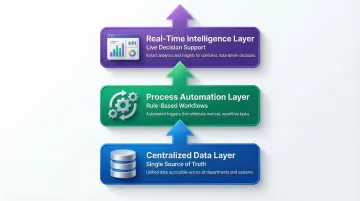
Centralized Data Layer
Data enters the ERP system from every business transaction: sales orders, purchase receipts, inventory movements, payroll entries, and financial postings all feed into a single database. This eliminates parallel record-keeping across departments.
Data accuracy is enforced through:
- Validation rules that prevent incorrect entries at the source
- Role-based data entry permissions ensuring only authorized users can modify specific records
- Audit trails tracking who changed what, when, and why
This layer is what makes downstream reports and decisions trustworthy. When a sales order is created, inventory levels update automatically — without a manual email or a separate spreadsheet to maintain.
Bizionix implements this through unified data architecture where CRM, accounting, inventory, and HRMS share the same real-time database. The platform tracks all modifications with user identification and timestamps, creating audit-ready records that meet both operational and compliance requirements.
Process Automation Layer
ERP's core automation translates repetitive, rule-based tasks into system-triggered workflows. Order approvals, invoice generation, stock replenishment alerts, and payroll processing run on defined logic rather than manual effort.
Automation directly addresses MSME pain points:
- Manual follow-ups replaced by automated alerts and notifications
- Delayed billing cycles eliminated through real-time invoice generation
- Approval bottlenecks resolved with digital workflow chains
For Indian MSMEs, this is where compliance overhead shrinks. Bizionix generates GST-compliant invoices with instant IRN creation in seconds, not hours.
The system validates data against GST rules, generates QR codes, and populates GSTR-1 returns automatically — replacing the manual JSON uploads and portal management that drag out billing cycles.
Real-Time Intelligence Layer
This layer produces dashboards, reports, and alerts that give business owners an accurate, current view of operations without waiting for month-end summaries. Its accuracy depends entirely on the quality of data flowing from the layers below.
Real-time intelligence enables:
- Spotting inventory shortfalls before stockouts occur
- Identifying cash flow gaps before they become crises
- Tracking demand shifts as they happen, not weeks later
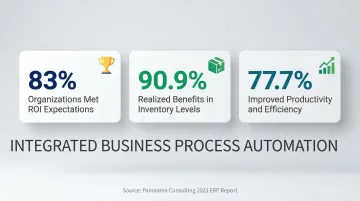
When inventory data, sales data, and financial data exist in one place, leaders make decisions based on facts, not guesses. According to Panorama Consulting's 2023 ERP Report, 83% of organizations met their ROI expectations, with 90.9% realizing expected benefits in inventory levels and 77.7% in productivity and efficiency.
Bizionix surfaces this through group-level dashboards covering consolidated revenue, branch performance, and cash flow — updated in real time across mobile and desktop. Live visibility into occupancy rates, receivables, and sales performance means the numbers business owners need are always current, not assembled after the fact.
Key Modules That Are Powered by the Core
Modules are the functional layer of ERP. Each one draws from and writes back to the centralized database, which is what makes them useful individually and powerful together.
Essential modules most businesses need:
| Module | Core Functions | Integration Points |
|---|---|---|
| Finance & Accounting | Transactions, reconciliation, GST returns, TDS | Settlement destination for all P2P and O2C transactions |
| Inventory & Procurement | Stock visibility, purchase orders, vendor management | Impacts COGS in finance and availability in sales |
| Sales & CRM | Order tracking, customer records, quotations | Triggers inventory allocation and financial invoicing |
| HR & Payroll | Attendance, compliance, salary processing | Updates financial accounts and maintains employee records |
What makes these modules valuable is the live connection between them. When a purchase order is received in procurement, inventory levels update, accounts payable records the liability, and the finance team sees the cash flow impact — all without manual intervention.
The right module combination depends on business type:
- Manufacturers need production planning and bill of materials
- Distributors need warehouse and logistics tracking
- Service businesses need project and timesheet management
The underlying core stays consistent across all these scenarios — the modules are what change. IDC's 2024 MarketScape for SaaS and Cloud-Enabled Small Business ERP notes that ERP suites for smaller businesses "typically start with finance and include procurement and inventory/asset management," with modules like HCM, order management, and manufacturing added as businesses grow — a pattern that holds true for Indian MSMEs as well.
What Happens When the Core Is Weak or Missing
A weak core manifests in fragmented operations: data stored in multiple disconnected systems—Tally for accounts, Excel for inventory, WhatsApp for approvals. Each team has its own version of the truth, and reconciliation happens manually and late.
The downstream consequences pile up fast:
- Delayed invoicing and increased Days Sales Outstanding
- Inaccurate stock counts leading to stockouts or overstock
- Missed compliance deadlines and penalty exposure
- Inability to produce accurate P&L or cash flow reports on demand
The financial impact is substantial. Gartner estimates that poor data quality costs the average enterprise between $12.9 million and $15 million annually. For MSMEs, data silos cost approximately $7.8 million annually in lost productivity, with employees wasting 12 hours per week searching for information across disconnected systems.
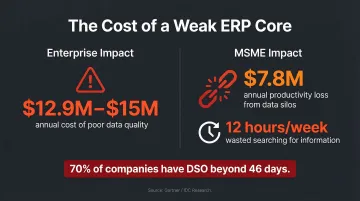
Approximately 70% of companies have Days Sales Outstanding extending beyond 46 days, severely disrupting cash flow. Delays or errors in manual invoices directly increase DSO as customers withhold payment.
For Indian MSMEs, weak cores create specific compliance risks. Effective April 1, 2025, taxpayers with AATO of ₹10 crore and above cannot report e-invoices older than 30 days. Manual processes cannot reliably meet this deadline, exposing businesses to penalties of ₹10,000 or 100% of tax due, whichever is higher.
A properly implemented ERP core resolves these problems structurally. The system design removes the root cause rather than adding pressure on employees.
Bizionix addresses this by replacing scattered Excel files, WhatsApp approvals, and manual processes with a unified platform where all departments work from the same real-time data, with approval workflows enforced automatically and every transaction traceable.
Conclusion
ERP is not a collection of software tools—it is a unified operating system for a business. Its power comes from a single, trusted data core that connects every function.
Businesses that evaluate ERP by module lists alone often select the wrong solution. The better question is whether the system's core is built for how your business actually operates: how data flows between departments, how automation handles repetitive work, and whether visibility is truly real-time or just faster reporting.
For Indian MSMEs, this means the core must natively support GST compliance, e-invoicing, and multi-entity management out of the box. The architecture must enforce operational discipline while providing the flexibility to adapt to diverse industry workflows.
Understanding the core helps you ask the right questions during vendor evaluation:
- Does this system truly centralize data, or just connect separate modules?
- Will automation reduce manual work, or introduce new complexity?
- Is visibility genuinely real-time, or just faster month-end reporting?
Bizionix is built around this architecture: a single centralized database connecting every module, GST compliance embedded at the core rather than bolted on, and real-time dashboards that replace end-of-month guesswork with daily clarity. For Indian MSMEs managing growth across entities, locations, or business lines, that combination means running with the discipline of a large enterprise without its overhead.
Frequently Asked Questions
What is at the heart of any ERP system?
A centralized database—a unified data repository shared across all departments—is the foundational core of any ERP system. This single source of truth enables real-time integration and ensures consistent information flows across sales, finance, inventory, and HR functions.
What is the difference between ERP core and ERP modules?
The ERP core is the shared database and architecture that holds everything together, while modules are the functional applications (finance, HR, inventory, CRM) that run on top of it. The core is what enables modules to share data automatically instead of operating as separate tools.
Why is a centralized database so important in an ERP system?
A centralized database eliminates duplicate records, ensures every department works from the same data, and makes real-time reporting possible. Without it, ERP modules function like disconnected software tools, recreating the silos they were meant to eliminate.
Can small or mid-sized businesses benefit from ERP core features without enterprise-level complexity?
Yes. Modern cloud ERP platforms give MSMEs access to the same core capabilities—centralized data, automation, real-time dashboards—without the cost or complexity of enterprise systems like SAP. Bizionix, for instance, includes GST compliance and automated e-invoicing as standard features rather than add-ons.
How does real-time data in an ERP system improve decision-making?
When financial, inventory, and operational data flow into a single system in real time, decision-makers can identify gaps, track performance, and respond to issues without waiting for manual reports or end-of-period summaries.
What role does process automation play in an ERP system's core?
Process automation converts repetitive, manual tasks—invoice generation, stock alerts, approval routing—into system-triggered actions. This reduces errors, saves time, and keeps operations consistent across departments.