Introduction
Hotel check-in has historically been the first physical touchpoint guests experience, and for decades it has meant queues, paperwork, and front desk delays. Across India's rapidly growing hospitality sector — from independent boutique properties to mid-scale urban hotels — automated check-in is now reshaping that moment entirely.
The operational challenge is real. Mid-sized and independent hotels struggle with front-desk bottlenecks during peak hours, rising labor costs, and guests who increasingly expect frictionless digital experiences.
Yet while the term "automated check-in" is widely used, most hotel operators don't understand how the process works end-to-end — which leads to poor technology choices and missed operational gains.
This guide breaks down exactly what automated hotel check-in is, how it works in practice across its key stages, and what it actually delivers for both guests and hotel operations.
Key Takeaways
- Automated hotel check-in uses digital technology to allow guests to complete registration, ID verification, and room access without waiting at the front desk
- The process runs in a defined sequence — pre-arrival data capture, identity verification, room assignment, digital key issuance, and PMS sync
- The three main formats are mobile check-in, self-service kiosks, and tablet-assisted registration
- Core benefits include reduced front-desk congestion, freed-up staff time, stronger personalization, and incremental upsell revenue
- Automation redirects staff from routine tasks to meaningful guest interactions — it doesn't eliminate the human element
What Is Automated Hotel Check-In?
Automated hotel check-in is a technology-enabled process that allows guests to complete standard arrival procedures — confirming their booking, verifying identity, selecting room preferences, and receiving room access — without requiring manual processing by front desk staff.
The Problem It Solves
Traditional check-in concentrates all arrival tasks into a narrow time window (typically 2–4 PM), creating predictable bottlenecks that frustrate guests and overload staff. One-third of travelers cite long check-in lines as a top service complaint, and guest satisfaction drops by 47–50% after just a 5-minute wait. Automated check-in distributes this process across a wider time window, often starting before the guest even arrives.
What It Is — and Isn't
It's worth being precise here. Automated check-in is not:
- A fully unstaffed hotel model
- A replacement for front desk personnel
- The same as offering an online reservation
The automation applies specifically to arrival registration, identity verification, and room access issuance. Staff remain available — they're just freed from routine processing.
Why Adoption Is Accelerating
Globally, 70% of travelers prefer to check in via app or self-service kiosk over a traditional front desk — a figure that climbs to 82% among Gen Z guests. The supply side is catching up: 60% of hospitality executives worldwide expect fully contactless experiences to become the most widely adopted technology in the industry.
Automated check-in exists in multiple formats — mobile-based, kiosk-based, and tablet-assisted — and the specific process and integration requirements vary slightly across these formats.
How Does Automated Hotel Check-In Work?
Automated hotel check-in does not function as a single step but as a structured sequence of stages, each dependent on data flowing between guest-facing interfaces and the hotel's backend systems.
Initiation: Pre-Arrival Trigger
The process begins when the hotel's Property Management System (PMS) or check-in software sends a digital invitation to the guest — via SMS, email, or app notification. This typically happens 24–72 hours before arrival.
Guests are prompted to:
- Confirm booking details
- Upload ID documents
- Declare arrival time
- Set room preferences
Key dependency: The automated system must be integrated with the booking source (OTA, direct reservation, or corporate portal) to pull accurate guest and reservation data. Gaps in this integration are a common point of failure for hotels adopting check-in automation.
WhatsApp achieves a 99% message delivery rate and an 84% open rate, far above the 20–25% average for travel industry emails. Hotels using WhatsApp or SMS with direct check-in links have seen completion rates as high as 24%.
Core Operation: Verification, Room Assignment, and Access Issuance
During the core execution phase, the system:
- Validates the guest's identity against uploaded documents or via kiosk scanning
- Cross-checks the booking against availability
- Assigns a room based on pre-set logic or guest preference
These three steps replace most of the traditional front-desk workload with automated decision-making.
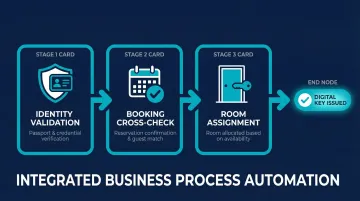
Digital access issuance: Once verified, the guest receives a mobile key (via app or NFC-enabled phone), a QR code, or a PIN — eliminating the physical key card handoff. This stage requires integration between the check-in platform and the property's door-lock or access control system.
Output: Guest Access, Billing Sync, and Data Capture
The process ultimately produces:
- Immediate room access on arrival
- Automatic backend system updates (room occupancy status, billing initiation, guest profile data)
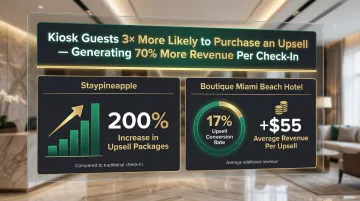
Upsell prompts — room upgrades, early check-in fees, meal packages — are also most effective at this stage. Guests using kiosks are three times more likely to purchase an upsell, generating nearly 70% more upsell revenue per check-in compared to front-desk transactions.
Downstream integration: Check-in data feeds into housekeeping scheduling, front-desk dashboards, and billing. For Indian hotels managing GST-compliant invoicing and folio generation, integration with a unified hotel management or ERP system (such as Bizionix) handles this automatically — syncing guest billing, tax calculation, and financial records without any manual re-entry.
Types of Automated Hotel Check-In Systems
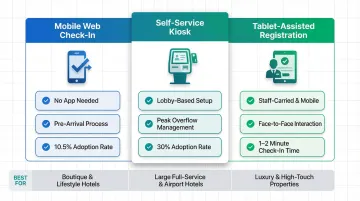
Hotels today deploy check-in automation in three main formats, each suited to different property types and guest profiles:
1. Mobile Web Check-In
- Guests receive a link via SMS or email and complete the process on their own device without downloading an app
- Best suited for Gen Z, frequent business travelers, and pre-arrival scenarios
- 10.5% adoption rate globally, per Mews research
- Bypasses the lobby entirely
2. Self-Service Kiosks
- Lobby-based terminals where guests scan IDs, confirm bookings, and collect key cards
- Ideal for leisure travelers, peak arrival surges, and late-night check-ins
- 30% adoption rate among kiosk-enabled hotels globally, per Mews research
- Serves as a critical overflow counter during peak arrival windows
3. Tablet-Assisted Registration
- Staff-carried tablets that enable mobile, face-to-face check-in outside the confines of a fixed front desk
- Preferred by luxury properties and for service recovery
- Reduces check-in time to 1-2 minutes
- Frees staff to move through the lobby, greet guests personally, and resolve issues on the spot
Property type considerations: A boutique hotel may favor tablet-assisted check-in to preserve a personal touch, while a high-volume resort may deploy kiosks alongside mobile check-in to manage large simultaneous arrivals.
Key insight: These formats work well together. The most effective implementations offer mobile check-in as the primary option, kiosks as a lobby fallback, and tablet registration as a staff-assisted hybrid — giving every guest a path that fits their preference.
Key Benefits of Automated Hotel Check-In for Hotels and Guests
Seamless Arrival: Eliminating Queue Time
The most immediate guest-facing benefit is eliminating queue time — guests arrive and go directly to their room. Guest satisfaction drops by 47–50% after just a 5-minute wait — meaning the check-in line alone can define how guests feel about the entire stay. Removing that friction sets a stronger first impression before guests even reach their room.
Staff Reallocation from Routine to Relational Tasks
When automated systems handle registration, identity checks, and key issuance, front desk staff are freed to focus on meaningful guest interactions. That shift in focus — toward personalized welcomes, problem resolution, and local recommendations — directly improves service quality. A 2025 Hotel Labor Productivity Report found a 13.5% reduction in Hours Per Occupied Room (HOPR) for guest services due to automation.
Staff time freed from routine processing typically goes toward:
- Personalized arrival greetings and room orientation
- Proactive problem resolution before guests escalate
- Upsell conversations that feel helpful rather than transactional
- Local recommendations that build loyalty
Real-world example: ARIA Resort & Casino reduced check-in times from 4–5 minutes down to 1–2 minutes using tablet and mobile solutions.
Personalization and Upsell Revenue
The digital check-in interface is a structured opportunity to present guests with data-driven upgrade offers, meal package add-ons, or early check-in fees. Because the system knows the guest's booking history and preferences, offers can be targeted.
Revenue impact:
- Staypineapple properties saw a 200% increase in upsell packages after implementing automated upsell tools
- A boutique hotel in Miami Beach achieved a 17% upsell conversion rate through online check-in, adding an average of $55 per upsell
Security and Fraud Reduction
Digital ID verification at check-in — especially on systems with document-scanning and fraud detection — reduces the risk of identity fraud compared to paper-based registration processes. Digital systems use Advanced OCR scanning and biometric liveness detection (ISO 30107 standards) to verify government-issued documents in real-time, preventing identity spoofing.
Encrypted digital guest records are more secure than physical registration cards — which are not PCI compliant and remain accessible to unauthorized staff or visitors.
Leaner Staffing Costs and Scheduling Efficiency
By reducing the peak-hour front-desk burden, hotels can optimize shift scheduling, reduce overtime, and — for smaller properties — manage check-in even during off-hours without additional staffing.
Cost savings examples:
- A mid-sized upscale hotel in the Netherlands saved €81,000 in staffing costs within its first year, achieving ROI in under 11 months
- A 42-room boutique hotel in the US saved $28,000 annually on plastic keys and front desk labor by adopting keyless digital locks and contactless check-in
What Hotels Need to Make Automated Check-In Work
Automated check-in only works when the right infrastructure is in place. Three technical integrations form the non-negotiable foundation.
Three essential integrations:
| Core Requirement | Technical Necessity | Risk of Failure |
|---|---|---|
| PMS Integration | Real-time sync of reservations, room status, and guest profiles | Guests assigned to dirty rooms; check-ins fail to register in the backend |
| Door-Lock / Access Control | API connection between the check-in platform and the lock vendor's key server (e.g., ASSA ABLOY, Salto) | Guests complete check-in but cannot access their rooms, forcing them to the front desk |
| Billing / Payment Gateway | Secure tokenization for pre-authorization holds and final folio settlement | Inability to collect incidentals; increased chargebacks and fraud |
Without these integrations, the automation breaks down mid-process and creates worse guest experiences than the manual system it was meant to replace.
Technology alone isn't enough — staff readiness determines whether the rollout holds together. Teams need to understand that automation handles routine tasks so they can focus on higher-value guest interactions, not that their roles are disappearing. Brief training on exception handling — guests who struggle with mobile check-in, ID mismatches, system errors — ensures service continuity when the system hits an edge case.
For Indian hotels using Bizionix, the integrated HMS and ERP architecture ensures that automated check-in data flows seamlessly into GST-compliant invoicing, financial reporting, and housekeeping workflows — eliminating manual re-entry and maintaining complete audit trails.
Frequently Asked Questions
Can I check into a hotel remotely?
Yes, many hotels now offer mobile or web-based check-in that guests can complete from home, in transit, or anywhere before arrival — typically through a link sent by the hotel via SMS or email, eliminating the need to interact with the front desk on arrival.
What is automated hotel check-in?
Automated hotel check-in is a digital process that allows guests to complete arrival registration, identity verification, and room access without front desk intervention, using mobile platforms, kiosks, or tablet systems integrated with the hotel's property management and access control systems.
How does mobile hotel check-in work?
The hotel sends a secure web link to the guest before arrival, the guest confirms booking details and uploads ID if required, and upon arrival receives a digital key or room PIN — without stopping at the front desk. The entire process typically takes under 5 minutes.
Does automated check-in replace front desk staff?
No. Automated check-in does not eliminate front desk staff but reallocates their time — freeing them from repetitive administrative tasks so they can focus on personalized guest service, upselling, and handling complex or exception situations.
Is automated hotel check-in secure?
Yes. Reputable systems use encrypted data transmission and identity verification protocols — generally more secure than paper registration cards. Hotels should confirm their platform complies with India's Digital Personal Data Protection Act (DPDPA) 2023 or applicable data protection standards.
Can small and mid-sized hotels implement automated check-in?
Yes. Many platforms scale for independent and mid-sized properties — the core requirement is integration with the hotel's PMS and access control system, not a minimum property size. Cloud-based options make implementation accessible without large upfront investment.
Ready to transform your hotel check-in experience? Bizionix HMS offers a self check-in system with KYC-compliant identity verification, instant room assignment, and digital key distribution — all connected directly to your property management, housekeeping, and billing operations. Contact us at +91 91779 99277 or info@bizionix.com to schedule a demo.