Introduction
A guest's first impression forms at the front desk, and their last impression forms there too. How a property handles check-in and check-out shapes everything in between — the review they leave, whether they return, and whether they recommend the property to others. These two processes carry more weight than most operators give them credit for.
For hotel operators and front desk managers, the operational stakes are concrete. A poorly structured check-in creates billing disputes that surface at check-out. A delayed departure throws off housekeeping, which delays room availability, which frustrates the next guest before they even arrive.
Every gap has a downstream cost.
This guide is written for hospitality teams who want to go beyond the basics: covering the step-by-step procedures, the compliance obligations specific to Indian hotels, the common failure points, and the operational factors that separate properties that run smoothly from those that spend their day resolving cascading delays in housekeeping, billing, and guest satisfaction.
Key Takeaways
- Check-in confirms the reservation, verifies identity, assigns a room, and issues access — typically from 2:00 PM onward.
- Check-out settles the final bill, returns room access, and triggers housekeeping — typically by 11:00 AM to 12:00 PM.
- Both processes require tight coordination between front desk, housekeeping, and billing — errors in any one area affect the rest.
- Cornell research found that 41% of negative hotel reviews dealt with billing issues, concentrated at departure — making bill accuracy a top operational priority.
- Technology — from property management systems to self check-in — reduces wait times and manual errors when properly implemented.
What Are Hotel Check-In and Check-Out?
Hotel check-in is the formal arrival process: the guest's reservation is confirmed, identity is verified, a room is assigned, and access is granted. It marks the official start of the stay.
Hotel check-out is the formal departure process: the final bill is settled, room access is returned, and the room status is updated for housekeeping. It marks the official end of the stay and returns the room to inventory.
These two processes are distinct from the activities that surround them:
- Pre-arrival: online booking, pre-registration, and pre-stay communication
- Post-departure: feedback collection and loyalty point crediting
- Check-in and check-out: the in-property execution layer where policies, documentation, and payments are actually completed
Hotels often confuse pre-arrival automation with check-in readiness. A guest who completes online pre-registration still needs to be physically processed at arrival — room assigned, access issued, and all documentation collected — before check-in is complete.
Why These Processes Are Critical to Hotel Operations
The Check-In Moment Carries Multiple Simultaneous Obligations
When a guest arrives at the front desk, the team is handling several things at once: confirming reservation details, verifying identity, processing payment authorisation, assigning a room, and meeting compliance requirements. Each of these has consequences if skipped or rushed.
Skip any one step and the fallout is immediate:
- A room assigned before housekeeping clears it creates a direct conflict at the door
- A missed payment authorisation leaves the hotel with no recourse on disputed incidental charges
- An uncollected ID creates a compliance gap that no apology can fix retroactively
Check-Out Speed Directly Controls Revenue
The faster a room is cleared and its status updated, the sooner housekeeping can clean it — and the sooner it can be sold again. Room turnover speed is a direct revenue variable, not a background operational concern.
Cornell's housekeeping research found that at one upper-scale airport hotel, roughly 40% of guests checked out after 12:00 PM. When that many guests depart late, housekeeping cannot begin cleaning on schedule, which delays room availability and compresses the window for re-selling those rooms. The same research notes that when a room is unavailable after stated check-in time, compensation exposure can reach half of that day's room rate per affected guest.
What Happens Without Clear SOPs
Hotels that run check-in and check-out on informal processes — where staff improvise steps based on how busy the desk is — consistently experience:
- Front desk bottlenecks during peak 2:00–4:00 PM arrival windows
- Housekeeping schedule disruption from untracked late departures
- Billing disputes from charges that were never posted or incorrectly reconciled
- Compliance gaps when ID collection is skipped for familiar-looking guests
These failures compound each other. A late departure delays housekeeping, which delays check-in, which triggers compensation — all traced back to a process that was never written down.
How Hotel Check-In and Check-Out Work: A Step-by-Step Breakdown
While the exact flow varies by property type — budget, mid-scale, luxury, chain, or independent — the core sequence follows consistent logic built around verification, coordination, and documentation.
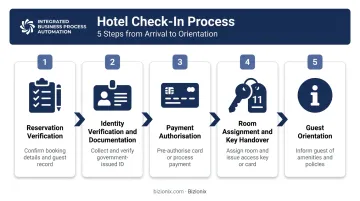
Hotel Check-In Process
Step 1 — Reservation Verification
Greet the guest and confirm the booking using the reservation reference or guest name. Verify room type, rate, meal plan, and length of stay before proceeding. Never assume the booking details match what's in the system — discrepancies are far easier to resolve now than mid-stay.
Step 2 — Identity Verification and Documentation
All guests must present a valid government-issued photo ID. In India, this is a legal obligation, not a courtesy — and it applies regardless of queue length or time pressure.
Foreign nationals must be registered with local authorities via Form C under the Registration of Foreigners Rules, 1992, with filing required within 24 hours of arrival. The Immigration and Foreigners Act, 2025 also imposes accommodation-provider reporting duties; non-compliance carries penalties up to ₹3,00,000 or imprisonment.
Step 3 — Payment Authorisation and Advance Collection
Before room keys are issued, collect any due advance payment and place a security deposit or card authorisation to cover incidentals. This protects the hotel if room damage occurs or if the guest disputes charges at check-out with no pre-authorisation on file.
Step 4 — Room Assignment and Key Handover
Room assignment should factor in guest preferences (floor, view, accessibility), current housekeeping status, and any pre-requested upgrades. Issue access — physical key or digital — only after confirming the room is clean and ready. Handing over a key to an unready room is one of the most avoidable causes of guest complaints.
Step 5 — Guest Orientation
Before the guest leaves the desk, communicate the essentials:
- Wi-Fi credentials
- Breakfast timing and location
- Parking details
- Housekeeping schedule
- Check-out time
This takes under two minutes and cuts inbound front desk calls during the stay.
Hotel Check-Out Process
Step 1 — Pre-Departure Reminder
Remind guests of the check-out time the evening before or morning of departure — via a call, in-room notice, or message. Proactive reminders reduce late check-outs that disrupt housekeeping schedules without the hotel needing to chase guests at the desk.
Step 2 — Bill Preparation and Review
Prepare a consolidated folio capturing all charges: room rate, F&B, room service, laundry, and incidentals. Make it available for guest review before they arrive at the desk. Errors caught before payment take minutes to resolve; the same dispute raised after departure can cost hours of staff time and, often, guest loyalty.
Step 3 — Bill Settlement
Offer multiple payment options. Any adjustments — complimentary items, disputed charges — should be resolved and approved before processing final payment. Rushed settlements under queue pressure are the primary cause of billing discrepancies.
Step 4 — Key Return and Room Status Update
Once settlement is complete, the guest returns the key and the room status must be updated in the hotel system immediately. This handoff is time-critical — housekeeping cannot begin cleaning a room that is still showing as occupied in the system.
Step 5 — Feedback and Farewell
Check-out is the most underused feedback opportunity in hospitality. A brief, genuine inquiry about the stay — not a scripted upsell attempt — leaves a positive final impression and increases the likelihood of a public review or return booking.
Key Factors That Affect Check-In and Check-Out Efficiency
Occupancy Levels and Arrival Patterns
High-occupancy hotels operate within a compressed window: most guests check out at 11:00 AM, new guests arrive from 2:00 PM, and housekeeping has roughly three hours to turn every room. Any delay in departure or late key return shrinks that window and creates a chain reaction that runs through the rest of the day.
Housekeeping Coordination and Real-Time Room Status
The single biggest cause of check-in delays is rooms not being ready. Efficient check-in depends on housekeeping receiving immediate departure notifications and updating room status in real time.
Cornell's housekeeping research defines four room states: occupied, vacant dirty, cleaning in progress, and vacant clean. Front desk teams need to know exactly where each room sits in that sequence — and phone calls or paper lists introduce lag that compounds fast during peak hours.
A 2021 time study of a 4-star hotel found average room-cleaning time of approximately 18 minutes — with checkout suites averaging 27 minutes. That figure underscores why real-time status updates matter: a housekeeping team working efficiently still cannot compensate for a front desk that doesn't know which rooms are available.
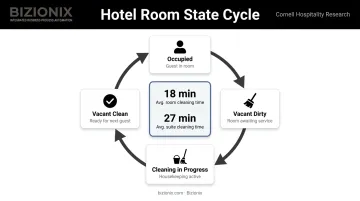
Hotels using integrated systems — where housekeeping updates flow instantly to the front desk without manual relay — consistently achieve faster turnarounds. Bizionix's HotelEase HMS, for example, is built on a no-silos principle: front desk, housekeeping, F&B, and accounts all see the same live data. When a room is marked clean, the front desk sees it immediately, without a phone call.
Documentation and Compliance Requirements
In Indian hotels, ID collection and guest register maintenance are legal obligations. Hotels that rush through documentation for returning guests, or skip it entirely during busy periods, expose themselves to compliance risk. Key requirements include:
- Registration of Foreigners Rules, 1992 — mandatory guest register entries for all foreign nationals
- Immigration and Foreigners Act, 2025 — updated compliance framework for ID verification and record-keeping
- Form C filing — 24-hour deadline for foreign nationals; front desk staff must be trained on this, not just briefed once
Staff Training and SOP Consistency
Inconsistency across shifts is a silent efficiency killer. When the morning team follows a different check-in sequence than the evening team, or individual staff members improvise steps under pressure, errors accumulate. A documented SOP with regular refresher training is what makes the guest experience repeatable and measurable — and keeps service quality consistent regardless of who is at the desk.
Hotel Management Systems and Process Automation
Hotels still managing reservations, billing, and room status through spreadsheets or disconnected tools carry structural inefficiencies that training and effort alone cannot fix. A unified system connects the front desk, housekeeping, and billing on a single real-time platform — eliminating the delays that fragmented tools create. The 2024 Lodging Technology Study by Hospitality Technology found that 70% of hoteliers planned PMS upgrades or supplier changes, a clear signal that the industry has moved past treating fragmented systems as an acceptable trade-off.
Common Issues and Misconceptions in Hotel Check-In and Check-Out
Standard Times Are Suggestions
Many small and mid-sized hotels treat check-in and check-out times as approximate, accommodating every guest request informally. This erodes housekeeping schedules, increases staff overtime, and results in rooms being allocated before they are properly cleaned. Flexibility is appropriate, but it must be policy-governed, not improvised by whoever is at the desk.
Billing Errors from Manual Processes
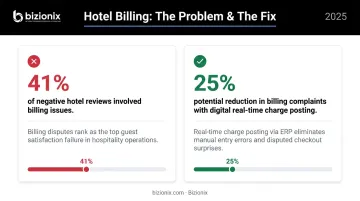
Cornell SC Johnson's analysis of hotel reviews found that 41% of negative comments dealt with billing issues, with problems concentrated at departure — when most guests first see their full charges. In hotels where F&B, room service, and incidentals are logged manually and reconciled at check-out, discrepancies are common and time-consuming to resolve under queue pressure.
The same analysis projected that a digital billing dashboard could reduce billing complaints by 25%. Real-time charge posting, where every transaction is captured the moment it occurs, eliminates the gap between what was consumed and what appears on the folio.
Incomplete Documentation During Check-In
Under time pressure, front desk staff often skip or abbreviate ID verification for guests who appear familiar or are return visitors. This is both a compliance gap and a security risk. The legal requirement applies to every stay, not every new guest.
Check-Out Is Just Key Return
Hotels that treat check-out as a transactional key drop miss genuine revenue and relationship opportunities. Late check-out upsells, loyalty programme enrolment, personalised farewells, and review requests all happen at this moment. Training staff to engage briefly at departure — even 60 seconds — can meaningfully improve both review scores and repeat bookings.
Group Check-In Handled Like Individual Arrivals
Group bookings require a separate pre-arrival coordination workflow — pre-assigned rooms, pre-checked documentation, designated group leader billing. Hotels that route group arrivals through the standard individual check-in queue create bottlenecks that frustrate both the group and other waiting guests. Hotels need a system that manages group reservations separately from individual bookings to handle this cleanly.
Frequently Asked Questions
How does hotel check-in and check-out work?
Check-in covers confirming the reservation, verifying identity, assigning a room, and issuing access — typically from 2:00 PM. Check-out involves settling the final bill and formally vacating, typically by 11:00 AM to 12:00 PM. Both require coordination between front desk, housekeeping, and billing.
What is the standard hotel check-in and check-out time in India?
There is no centrally mandated time under Indian regulation — times are set by individual properties. Common industry norms are check-in from 2:00–3:00 PM and check-out by 11:00 AM to 12:00 noon, giving housekeeping adequate time to turn rooms between departures and new arrivals.
Can guests request early check-in or late check-out?
Both are possible subject to availability, though most hotels charge 30–50% of the room rate for a few hours or the full rate for extended stays. Requesting in advance — not on arrival — significantly improves the chances of approval.
What documents are required for hotel check-in in India?
Indian nationals must present a valid government-issued photo ID such as Aadhaar, passport, or driving licence. Foreign nationals are additionally required to complete Form C registration with local authorities within 24 hours of arrival — non-compliance is a legal risk for the hotel, not just the guest.
What happens if a guest does not check out on time?
Late check-out typically incurs an additional charge — from a partial room rate to the full day's rate depending on how late the departure is. It also delays room cleaning for the next guest. Automated reminders sent the evening before help reduce the frequency of late departures.
How can hotels reduce billing errors during check-out?
The most effective approach is adopting a hotel management system that posts all guest charges in real time across departments — so the check-out folio is accurate before the guest reaches the desk. Bizionix HMS, for instance, auto-posts F&B, room service, and incidentals to the guest folio as they occur, eliminating the rushed end-of-stay reconciliation that causes most disputes.