The good news is that automation's real value isn't in futuristic technology — it shows up in daily operations. Fewer front desk errors. Faster billing cycles. Housekeeping that runs on real-time data instead of WhatsApp messages. This article focuses on those practical, measurable advantages so hoteliers can make an informed decision about where to start — and what to prioritise.
Key Takeaways
- Hotel automation uses software to handle routine tasks — reservations, check-in, housekeeping, billing — with minimal manual effort
- The three highest-impact advantages are operational efficiency, guest experience and revenue growth, and data-driven decision-making
- According to HotelTechReport's 2026 PMS Impact Study, 89% of hoteliers globally save 2–10+ hours per week with a modern property management system
- Automation works best when it connects front-desk, back-office, and guest communications in one unified system rather than a patchwork of disconnected tools
- Properties that automate early gain a measurable edge — lower labour costs, fewer errors, and consistently faster service that guests notice
What Is Hotel Automation?
Hotel automation is the use of technology and software to carry out routine, time-consuming tasks — managing reservations, updating room availability, scheduling housekeeping, sending guest communications, and processing invoices — with little to no manual involvement.
It applies across every department, not just the front desk:
- Guest-facing processes: check-in, check-out, messaging, room access, payment
- Internal operations: billing, inventory, housekeeping coordination, financial reporting
The purpose is to free staff for high-value guest interactions, reduce friction in daily operations, and ensure the property runs predictably — whether the manager is on-site or not. A well-automated hotel doesn't rely on any single person knowing where everything is. That knowledge lives in the system, accessible to whoever needs it.
Key Advantages of Hotel Automation
The advantages below are framed around measurable, operational impact: cost, efficiency, guest satisfaction, revenue, and business risk. They apply across hotel sizes, from mid-sized independent properties to multi-location groups. The gains are also cumulative — properties that automate across departments consistently outperform those that apply it in isolated pockets.
Advantage 1: Operational Efficiency and Cost Reduction
Manual, repetitive processes consume staff hours that could be better spent elsewhere. Room status updates, housekeeping assignments, check-in paperwork, and invoice generation — when done manually — create opportunities for error, miscommunication, and rework.
Automated workflows handle these processes faster and without human error. A property management system (PMS) updates room availability across all booking channels the moment a reservation is made or cancelled — eliminating manual cross-checking and the risk of overbooking.
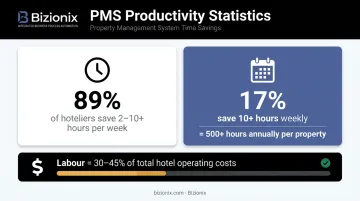
The productivity numbers are significant. HotelTechReport's 2026 PMS Impact Study found 89% of hoteliers save 2 to 10+ hours per week using a modern PMS, with 17% saving more than 10 hours weekly — equivalent to over 500 hours annually per property. That's not trivial when labour typically accounts for 30–45% of total hotel operating costs, according to HVS's 2025 industry report.
The cost connection is direct: fewer manual steps mean fewer errors, less rework, and less pressure to overstaff for administrative load.
KPIs impacted:
- Staff hours per reservation
- Labour cost as a percentage of revenue
- Room turnaround time
- Overbooking rate
- Operational error rate
When this matters most: Peak occupancy periods, properties managing multiple room types, and lean teams that can't afford redundant manual work across shifts.
Bizionix's HotelEase HMS addresses this directly by eliminating the "registers, WhatsApp messages, Excel sheets, and endless phone calls" that mid-sized hotels typically rely on. The platform's live hotel pulse updates occupancy, arrivals, departures, and dues every second — giving managers current data without chasing it across departments.
Advantage 2: Improved Guest Experience and Revenue Growth
This advantage covers two connected outcomes: smoother guest interactions that drive higher satisfaction, and automated revenue tools that increase income per booking without adding sales headcount.
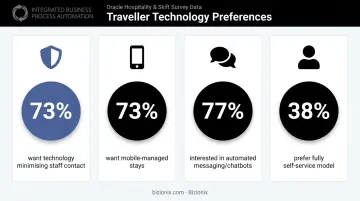
On the guest experience side, the data is clear. An Oracle Hospitality and Skift study of over 5,000 travellers found:
- 73% wanted hotels to offer technology that minimises contact with staff
- 73% wanted to manage their stay via mobile device — check-in, check-out, payments, food ordering
- 77% were interested in automated messaging or chatbots for service requests
- 38% preferred a fully self-service model with staff available on request only
Long check-in queues, delayed responses, and inconsistent communication are the friction points guests notice most. Self-check-in options (mobile or kiosk) eliminate queues, automated messaging handles routine requests at scale, and standardised workflows remove the variation that comes from relying on individual staff.
On the revenue side, automated upselling and dynamic pricing tools work continuously without adding headcount. Triggered upgrade offers — sent at check-in or via pre-arrival message — convert at higher rates than ad-hoc suggestions because the timing is right and the offer is specific. The same Oracle research found 74% of travellers were interested in hotels using AI to deliver more relevant offers, and 37% were willing to pay more for early check-in or late checkout.
HotelEase's self-check-in system completes the entire check-in process in under 5 minutes with KYC-compliant digital ID verification, instant room assignment, and digital key delivery — cutting what was previously a 15–20 minute front desk interaction down to a fast, straightforward arrival.
KPIs impacted:
- Guest satisfaction score (NPS/CSAT)
- RevPAR (Revenue Per Available Room)
- Upsell conversion rate
- Check-in wait time
- Direct booking share
When this matters most: High-demand periods when front desk staff are stretched, properties competing in OTA-heavy markets where reviews drive bookings, and hotels with ancillary services that benefit from cross-selling.
Advantage 3: Data-Driven Decision-Making and Operational Visibility
When occupancy shifts unexpectedly, billing errors accumulate, or a staffing problem surfaces only after guests notice it, the root cause is almost always fragmented information. Decisions made without reliable, current data tend to lag the problem by days — sometimes weeks.
Automation addresses this by consolidating operational and financial data into a single dashboard that managers can act on in real time rather than reconstructing at month-end.
Fragmented systems remain widespread. Hospitality Technology's 2024 Lodging Technology Study found 69% of respondents cited integrating new technology with legacy systems as their top challenge, and 72% prioritised improving analytics for better insights into guest preferences and revenue optimisation.
Disconnected PMS and POS systems, as Hospitality Net documented, create billing delays, manual reconciliation work, transaction posting errors, and guest identity mismatches — each one a signal that data isn't flowing where it needs to.
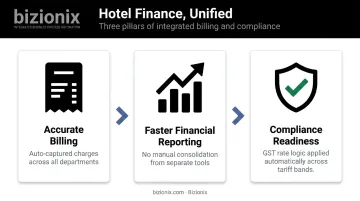
A unified platform closes these gaps. When reservations, housekeeping status, billing records, and financial reports share the same data source, managers get:
- Accurate billing — charges are captured automatically across front office, restaurant, and housekeeping, so nothing falls through between departments
- Faster financial reporting — no manual consolidation from separate tools
- Compliance readiness — critical for Indian hotels managing GST obligations across multiple tariff bands and the e-invoicing threshold above ₹5 Crore aggregate turnover
For Indian hotels specifically, billing automation has a compliance rationale that goes beyond efficiency. The GST Council's 56th meeting implemented a rate change effective 22 September 2025, moving hotel accommodation under ₹7,500 per unit per day from 12% with ITC to 5% without ITC — a change that requires billing systems to apply correct rate logic automatically, not through manual adjustment. FHRAI has noted that tariff-linked GST rate treatment creates genuine billing and compliance complexity for properties managing multiple room categories.
HotelEase's analytics and reports module delivers daily flash reports, occupancy tracking, revenue analysis, ADR, RevPAR, and leakage alerts — all from a single dashboard accessible on mobile and desktop, updated every second.
KPIs impacted:
- Billing accuracy rate
- Financial reporting turnaround time
- Revenue leakage (unbilled services)
- Compliance error rate
- Management decision response time
When this matters most: Multi-location hotel groups, properties with high transaction volumes, hotels managing group or corporate accounts, and any property operating under GST compliance obligations.
What Happens When Hotel Automation Is Missing
Picture a front desk team handling simultaneous check-ins, phone calls, and booking updates across spreadsheets at 3pm on a Saturday. This isn't an unusual scenario — it's the operational baseline for many hotels without automation, and the consequences compound over time.
The typical results:
- Billing errors and revenue leakage: Room charges, F&B billing, and add-on services go unrecorded, sending out wrong invoices and creating costly recovery cycles
- Reactive operations: Staff spend shifts fixing manual coordination failures rather than improving the guest experience
- Headcount-driven scaling: More occupancy means hiring more people for the same admin work — cost per room rises instead of falling
- Knowledge trapped in individuals: Without structured workflows, critical know-how lives with specific staff, making expansion or ownership transitions slow and risky
The Hospitality Technology study found 76% of lodging respondents rated increasing employee productivity as a top priority — a finding that reflects how widely the manual management problem is felt, even if not every property has acted on it yet.
How to Get the Most Value from Hotel Automation
Hotel automation works best when it's treated as a process improvement initiative, not a technology installation. Bolting automation onto broken manual processes just automates the chaos — it doesn't fix it.
Three conditions determine whether automation delivers real return:
1. Cover both guest-facing and back-office functions Automation in check-in but not billing, or in housekeeping but not reservations, creates new gaps instead of closing existing ones. A unified platform — where front desk, housekeeping, billing, and reporting all draw from the same data — eliminates the fragmentation that leads to financial leakage and delayed reporting.
2. Define KPIs before go-live, then review monthly Decide what success looks like before implementation — check-in processing time, billing cycle length, overbooking rate, error rate. If manual steps have crept back in, or a workflow isn't performing, monthly reviews catch it before it becomes a structural problem.
3. Use the data the system generates Occupancy trends, billing patterns, revenue per room, leakage alerts — this data only creates value when management acts on it: adjusting pricing, staffing, and service decisions on a regular cycle. Automation that generates reports nobody reads delivers no advantage over manual processes.
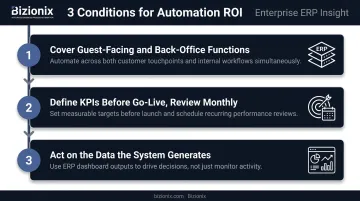
These three conditions apply across single properties and large groups alike. For hotel groups managing multiple properties, a unified platform with multi-company management adds one more advantage: centrally overseen operations with independent financial records per property, all accessible from a single secure login.
Conclusion
What hotel automation actually delivers is measurable control over every touchpoint — from the moment a guest books to the final invoice. Applied consistently across departments, it improves operational efficiency, guest experience, and decision-making in ways that compound over time.
That compounding effect is what separates hotels that get lasting results from those that don't. Automation reviewed and refined monthly consistently outperforms automation implemented once and left untouched. For hotels managing GST compliance, multi-location operations, or high seasonal volumes, the practical next step is treating automation as a recurring operational discipline — one with monthly checkpoints, not a one-time rollout.
Key areas where that discipline pays off most:
- Billing and GST compliance: Fewer errors, faster invoice cycles, audit-ready records
- Front desk and housekeeping coordination: Reduced manual follow-ups, real-time room status
- Reporting and revenue tracking: Clean data for occupancy, ARR, and departmental costs
Frequently Asked Questions
What tasks can be automated in a hotel?
Reservations and booking management, check-in and check-out, housekeeping scheduling and room status updates, guest communications, billing and invoicing, dynamic pricing, and financial reporting. A unified hotel management system handles all of these from a single platform.
How does hotel automation improve the guest experience?
Automation reduces wait times through self-check-in options, enables consistent pre-arrival and in-stay messaging, and frees front desk staff from administrative tasks so they can focus on actual guest interactions.
Is hotel automation affordable for small and mid-sized hotels?
Yes. Cloud-based hotel management platforms use subscription pricing that replaces multiple separate tools, removing the need for a large upfront investment. Bizionix's HotelEase, for example, is specifically designed for mid-sized and smaller properties with a free-to-try model and no complicated setup.
What is the ROI of investing in hotel automation?
ROI comes from reduced labour hours, fewer overbooking incidents, faster billing cycles, and revenue that would otherwise slip through manual processes. Properties that modernise their PMS typically see measurable cost savings within the first year, with the clearest gains in billing accuracy and front desk efficiency.
How long does it take to implement hotel automation?
Core features like booking management and automated communications can be operational within days on cloud platforms. Full integration across PMS, billing, and operations typically takes a few weeks, depending on property size and the complexity of existing systems.
Can hotel automation support GST and billing compliance in India?
Yes. Modern hotel management platforms built for the Indian market handle GST rate logic across tariff categories, automated billing workflows, and e-invoicing requirements for properties above the ₹5 Crore aggregate turnover threshold — reducing compliance errors and keeping financial records audit-ready.