Most hotel operators haven't ignored technology. The problem is the opposite: they've accumulated tools over the years — a PMS here, a billing system there, a WhatsApp group for housekeeping coordination — and ended up with a fragmented stack that creates as much work as it eliminates.
This article covers the essential hotel technology categories every property needs, why fragmented point solutions underperform, and how to build a unified tech strategy that actually scales — with specific context for Indian hotel operators navigating GST compliance requirements.
Key Takeaways
- A cloud-based PMS is only as strong as its integrations with the systems around it
- Channel management, guest communication, and financial tools are all non-negotiable
- Disconnected systems quietly drain revenue through errors, reconciliation delays, and slow decisions
- Indian properties need GST-ready billing with IRN generation — generic tools fall short
- Unified platforms reduce total cost of ownership compared to maintaining multiple subscriptions
Why Hotel Technology Has Become Non-Negotiable
The numbers make the case plainly. According to Hospitality Upgrade's 2024 spend survey, 100% of respondents said digital transformation was very or somewhat important, with PMS replacement ranking as the top hotel-level investment priority.
The pressure driving that urgency comes from two directions at once:
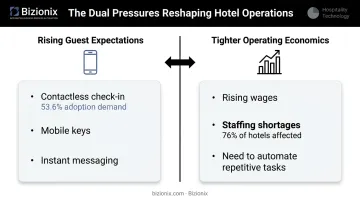
- Guest expectations have reset. Over half of travellers — 53.6% in Oracle and Skift's survey — want contactless check-in and check-out permanently adopted. Mobile check-in, digital keys, and instant messaging are no longer differentiators; they're the baseline for a positive review.
- Operating economics are tighter. With wages rising and staffing difficult, the only way to maintain service standards with leaner teams is to automate repetitive work — folios, billing reconciliation, housekeeping coordination, rate updates — so staff can focus on actual guest interaction.
For Indian hotel operators, there's a third pressure layer: regulatory compliance. GST applies at 12% for rooms priced at or below ₹7,500 per day and 18% above that threshold — meaning billing software must calculate rates dynamically per transaction, not from a flat hotel-wide setting.
Get it wrong, and invoices become non-compliant under CBIC rules. That's a real financial and audit risk that manual or generic systems routinely miss.
The Essential Hotel Technology Solutions Every Property Needs
Each technology category below maps to a specific operational problem — what it does, why it matters, and where gaps typically appear.
Property Management System (PMS)
The PMS is the operational nerve centre, managing reservations, room inventory, check-in/check-out, housekeeping status, and folio creation from a single interface. HotelTechReport's 2026 PMS study of 450 experienced hotel operators found 89% save 2 to 10+ hours per week using a PMS, and 91% report direct revenue growth from PMS tools.
Cloud vs. on-premise matters here. Cloud-based PMS systems offer remote access, automatic updates, and no server maintenance overhead — 44% of operators now prioritise cloud access and remote management as a core selection criterion.
The integration question is equally important. A PMS that cannot connect with your channel manager, accounting system, and POS becomes a data silo. Staff end up re-entering information across platforms — the exact inefficiency a PMS is supposed to eliminate. Look for native integrations or open API connectivity before evaluating features.
Channel Management and Revenue Optimisation Tools
OTA dependency remains a real financial pressure. Independent hotels' OTA share reached 63.4% in 2025, up from 61.3% the prior year. A channel manager synchronises room availability and rates across OTAs, your direct booking engine, and GDS in real time, preventing overbooking and rate parity violations that damage guest trust and trigger direct complaints.
Revenue management systems (RMS) go further, using historical data and demand signals to adjust pricing dynamically. The goal isn't just occupancy — it's net revenue after acquisition costs. A direct booking at 90% occupancy outperforms an OTA booking at 95% once commission is factored in.
Key outcomes a channel manager + RMS combination delivers:
- Prevents overbooking through real-time inventory sync across all channels
- Eliminates manual rate updates across OTA extranets
- Shifts booking mix toward lower-cost direct channels over time
Guest Experience and Communication Technology
Guest-facing technology covers several connected layers:
- Self-service check-in — kiosks or mobile apps that reduce front desk queues and speed up arrivals
- Digital concierge tools — in-app service requests, QR-based menus, and messaging platforms
- Automated guest messaging — pre-arrival confirmations, mid-stay check-ins, and post-departure reviews
- CRM systems — maintaining guest profiles, stay history, preferences, and loyalty data
The CRM layer is what makes personalisation possible. Without stored guest data, every stay starts from zero — no recognition, no tailored offers, no reason for a guest to book direct instead of through an OTA. With it, marketing teams can segment and target repeat guests with precision, building a pipeline of direct bookings over time.
Bizionix's HotelEase includes a Guest CRM module that stores profiles, preferences, history, and loyalty data in a centralised system accessible to front desk, housekeeping, F&B, and accounts simultaneously. That means a returning guest's dietary preferences reach F&B before check-in, not after a complaint at the restaurant.
Back-Office and Financial Management Software
Back-office technology rarely gets the attention it deserves in hotel tech discussions, but it's where profitability lives or leaks.
For Indian properties, the compliance requirements are specific:
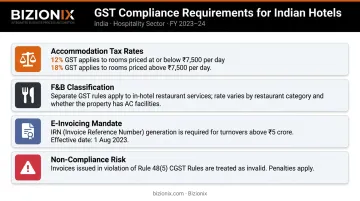
- GST applies at 12% for accommodation valued at ₹7,500 or below per unit per day, and 18% above that threshold
- Restaurant and F&B services within hotel premises are classified differently from standalone restaurant services under GST rules
- E-invoicing with IRN generation is mandatory for hotels with aggregate turnover exceeding ₹5 crore in any preceding financial year from 2017–18 onward (effective 1 August 2023)
- Under Rule 48(5) of CGST Rules, an invoice issued outside prescribed e-invoicing requirements is not treated as a valid invoice — meaning non-compliant billing carries direct audit and penalty exposure
Generic billing software cannot handle these requirements. Hotels need systems that apply GST rates dynamically per transaction type, generate IRN automatically via direct IRP API connection, and maintain audit-ready records.
Bizionix's platform includes GST-ready accounting with automated e-invoicing, direct IRP integration for instant IRN generation, and real-time invoice validation. For hotels crossing the ₹5 crore turnover threshold, this isn't optional — a non-compliant invoice has no legal standing under CGST rules.
The Fragmentation Problem: Why More Systems Don't Mean Better Operations
Skift Research puts the scale of the problem plainly: many hotels operate with 10 to 50 technology vendors and systems. Each one holds a slice of operational data — reservations in the PMS, guest history in the CRM, financials in a separate accounting tool, housekeeping on WhatsApp.
The result is what some operators call a "Frankenstein stack" — tools that individually seem functional but collectively create more work than they eliminate.
The Real Cost of Disconnected Systems
The obvious cost is multiple subscription fees. The hidden costs run deeper:
Building a Unified Hotel Technology Strategy
Buying tools reactively — a new system every time a problem surfaces — is how hotels end up with 20 disconnected subscriptions and a staff that spends half their time moving data between platforms.
A unified strategy works differently: define operational outcomes first, then select technology that serves those outcomes through shared data rather than isolated workflows.
The Three Core Benefits of Data Unification
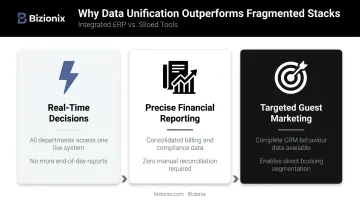
- Real-time operational decisions — when all departments access the same live system, managers can act on accurate data immediately rather than waiting for end-of-day reports
- Precise financial reporting: consolidated billing, receivables, and compliance data without manual reconciliation
- Targeted guest marketing — CRM data that reflects complete guest behaviour, enabling segmentation that generates direct bookings rather than generic email blasts
Evaluating Total Cost of Ownership
Individual tool pricing is a misleading metric. The real comparison is total cost of ownership across the stack:
| Cost Factor | Multiple Point Solutions | Unified Platform |
|---|---|---|
| Monthly subscriptions | 10–20 separate fees | Single platform fee |
| Integration maintenance | Ongoing (per connector) | Native or minimal |
| Staff training | Multiple interfaces | Single interface |
| Reconciliation time | Daily/weekly manual effort | Automated |
| Error correction | Frequent, labour-intensive | Reduced significantly |
The table above makes the case clearly: fragmented stacks cost more in time and errors than they save in licensing fees. For Indian hotel properties managing seasonal demand, multi-department operations, and GST compliance across F&B and accommodation categories, an ERP-style platform that covers guest operations and back-office financials together builds a more reliable operational base than patching together cheaper tools that were never designed to share data.
How to Choose the Right Hotel Technology for Your Property
Start with Outcomes, Not Features
Before evaluating any vendor, define specific operational targets:
- Reduce check-in time from X minutes to Y minutes
- Eliminate end-of-day billing discrepancies
- Achieve full GST compliance with automated IRN generation
- Increase direct booking percentage by reducing OTA dependency
Filter every solution through those outcomes. Impressive features mean little if they don't address your actual bottlenecks — they add complexity without progress.
The Integration and Scalability Test
Ask every vendor these questions before committing:
- Does the system offer open APIs or pre-built connectors to your existing tools?
- Does integration require dedicated IT resources, or is it managed by the vendor?
- Can the platform support multiple properties under a single login if you expand?
- What does the SLA commitment look like during peak season — and what happens when there's downtime?
For multi-property hotel groups, Bizionix's multi-company management module maintains independent books of accounts per property with consolidated group-level dashboards and role-based access controls. Each property operates with full data independence while management retains group-wide visibility.
The Evaluation Process
- Request demos built around your actual workflows, not vendor-guided product walkthroughs
- Check reviews from similarly-sized properties — a system built for large chains rarely fits a 60-room business hotel
- Clarify the pricing model upfront — SaaS subscriptions, one-time licensing, and commission-based structures carry very different long-term costs
- Confirm training and support terms, particularly local support availability — for Indian hospitality businesses, response time and regional language support make a real operational difference
Emerging Trends in Hotel Technology to Watch
AI Moving from Pilot to Production
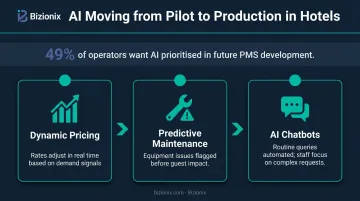
AI is no longer a future consideration. Nearly half of hotel operators (49%) want AI-powered automation and personalisation prioritised in future PMS development, and 51.5% of hotel executives have already planned AI and analytics deployments for personalised marketing. Practically, this means:
- Dynamic pricing tools that adjust rates based on real-time demand signals
- Predictive maintenance alerts before equipment failures affect guest experience
- AI-powered chatbots handling routine queries so staff handle complex requests
Before committing to any AI feature, verify it maps to a specific operational workflow — not just a vendor's product brochure.
The Mobile-First Baseline
Mobile check-in, digital room keys, QR-based service requests — these have shifted from differentiators to expectations. Nearly half of hotel executives (47.7%) were already replacing physical key cards with mobile access in 2022. That adoption has only accelerated since. Hotels that haven't moved on this face negative reviews from guests who expect the experience they get at any modern urban property.
Cybersecurity as a Selection Criterion
The Verizon 2024 Data Breach Investigations Report recorded 1,780 incidents and 1,537 confirmed data breaches in the Accommodation and Food Services sector, with compromised credentials, personal data, and payment data among the most common targets.
Hotels handle sensitive guest payment and identity data across multiple systems — PMS, payments, Wi-Fi, guest messaging — each a potential attack surface. For properties in India, this also intersects with obligations under the Digital Personal Data Protection Act (DPDP) 2023 and RBI payment guidelines.
When evaluating any cloud-based solution, require documentation on:
- MFA enforcement and role-based access controls
- Audit logs and real-time access monitoring
- PCI compliance posture
- Vendor's incident response and breach notification process
Frequently Asked Questions
What is the most important technology system for a hotel?
The PMS is the operational foundation — managing reservations, rooms, check-in/out, and billing from a central point. But its value depends entirely on how well it integrates with channel management, CRM, and back-office tools. Integration capability matters as much as the PMS features themselves.
How do I know if my hotel needs to upgrade its technology?
The clearest warning signs: staff manually re-entering data, frequent billing discrepancies at checkout, no real-time visibility into occupancy, and guest complaints about slow check-in. If any of these occur regularly, the current stack isn't working.
What are the risks of using too many disconnected hotel systems?
Data silos, manual reconciliation errors, high aggregate vendor costs, delayed management decisions, and staff frustration — all of which compound as the property grows. The more systems, the more entry points for errors and the more time spent on coordination rather than service.
Can small or mid-sized hotels afford enterprise-grade technology?
Cloud-based SaaS platforms have made enterprise-grade capabilities accessible without large upfront costs or dedicated IT teams. A unified platform for 50–150 rooms typically costs less than maintaining separate, non-integrated subscriptions for PMS, CRM, billing, and accounting.
How does hotel technology improve the guest experience?
Guest-facing tools — mobile check-in, personalised offers, faster service resolution — are only as effective as the data behind them. Technology improves guest experience when systems share complete guest data, so every interaction is informed by stay history and preferences, not just the current booking.
What should Indian hotels look for specifically in technology solutions?
GST compliance is the baseline requirement — multi-rate tax handling (12% and 18% accommodation tiers, plus F&B classification), automated IRN generation via IRP API, and e-invoice support for properties above ₹5 crore turnover. Beyond compliance, cloud-based access and audit-ready reporting matter most for properties managing seasonal demand across multiple departments.