The result? Data silos, billing delays, manual reconciliation, and GST compliance gaps that quietly drain time and revenue. For growing businesses, this fragmentation becomes the ceiling that stops them from scaling.
This article covers the top 10 business software solutions that address real operational challenges — with a focus on what Indian MSMEs actually need: GST readiness, ease of adoption, and the ability to grow with your business.
Key Takeaways
- Business software helps MSMEs replace fragmented manual systems with unified, automated processes
- The right stack spans ERP, accounting, CRM, project management, communication, and customer support
- For Indian businesses, GST compliance and e-invoicing readiness are must-have selection criteria
- Cloud-based platforms offer real-time visibility and lower infrastructure costs vs. legacy desktop tools
- Consolidating to an all-in-one ERP can eliminate 5–6 separate subscriptions — reducing costs and integration headaches at once
Why Growing Businesses Need the Right Business Software
"Business software" used to mean a billing tool or a basic spreadsheet. Today, the term describes integrated platforms that connect departments, automate workflows, and give leadership real-time data to make faster decisions.
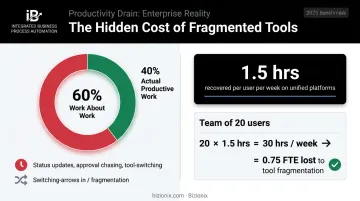
Asana's research shows that knowledge workers spend 60% of their time on "work about work" — status updates, chasing approvals, switching between tools — rather than the work that actually moves a business forward. A Forrester TEI study reinforces the cost: unified productivity platforms recover 1.5 hours of collaboration time per user, per week. For a team of 20, that's the equivalent of a full-time employee lost to coordination overhead.
The Fragmentation Trap
Most small businesses follow a predictable pattern: they start with spreadsheets, add a billing tool, then a separate accounting package, then a CRM, and eventually an HR tool. Each addition solves one problem — but the combined stack becomes harder to manage than the original challenge.
By the time a business hits 20–50 employees, this stack typically creates:
- Manual data re-entry across tools (with errors each time)
- No single view of cash flow, receivables, and inventory together
- GST reconciliation gaps because financial and operational data live separately
- Delayed decisions because leadership has to pull reports from multiple systems
For Indian MSMEs especially, where GST compliance, multi-location operations, and tight cash cycles intersect, fragmented tools don't just slow teams down — they create compliance risk. Replacing the patchwork with a unified platform is what separates businesses that scale from those that stall.
Top 10 Business Software for Growth and Efficiency
These tools were selected based on their ability to solve real operational problems, support growth, integrate with other systems, and suit Indian business requirements where applicable. The list spans key functional categories — not just one area.
1. Bizionix
Bizionix, developed by IIS-LLP (Hyderabad), is a 100% cloud-based, all-in-one ERP built specifically for Indian MSMEs. It covers Finance & Accounting, GST compliance, Inventory Control, Warehouse Management, Sales & CRM, Purchase Management, Production Planning, and HRMS & Payroll.
Unlike standalone tools, every module shares the same database — so sales, finance, and operations always work from the same real-time numbers.
| Attribute | Details |
|---|---|
| Key Features | GST-ready accounting, automated e-invoicing with instant IRN generation via direct IRP API, multi-location inventory, CRM, payroll, multi-company management, real-time dashboards |
| Ideal For | Indian MSMEs, manufacturing companies, distribution operations, franchise networks, CA firms managing client portfolios |
| Deployment | 100% cloud-based; configurable to adapt to existing business processes |
| Pricing | Bizionix NEO from ₹999/year; Enterprise plan with custom pricing |
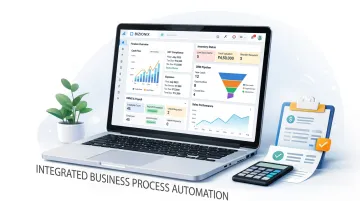
Multi-company management is worth calling out: businesses can manage multiple GST-registered entities, branches, or franchises from a single secure login, with role-based access control per entity and seamless switching without logging out.
2. Tally Prime
Tally Prime is India's most widely adopted accounting and business management software, trusted by 2.7 million+ businesses globally. For most Indian SMBs, formal accounting starts here.
| Attribute | Details |
|---|---|
| Key Features | GST returns, e-invoicing, e-way bill generation, voucher management, inventory tracking, bank reconciliation, payroll |
| Ideal For | Small businesses, traders, CA firms, businesses with limited IT infrastructure |
| Deployment | Desktop-first with optional remote access; works offline (internet required once every 30 days) |
Its offline-first architecture is a practical advantage for businesses in areas with unreliable connectivity. The trade-off: Tally handles accounting and compliance well, but growing businesses often outgrow it when they need integrated CRM, procurement, or multi-department operations.
3. Zoho One
Zoho One is an Indian-origin business suite offering 50+ integrated applications under a single subscription — covering CRM, accounting (Zoho Books), HR, marketing automation, project management, and business intelligence.
| Attribute | Details |
|---|---|
| Key Features | Zoho Books (GST-ready), Zoho CRM, Zoho Projects, Zoho People (HR), Zoho Analytics, 50+ integrated apps |
| Ideal For | Growing SMBs, service-based businesses, businesses scaling across multiple departments |
| Deployment | Cloud-based; accessible via web and mobile |
Zoho Books includes full GST compliance — GSTIN management, HSN/SAC codes, e-way bill generation, and GSTN-authenticated B2B e-invoicing. For businesses that want to avoid vendor-switching as they scale, Zoho One's breadth is its clearest advantage.
4. Microsoft 365
Microsoft 365 is the productivity backbone for businesses of every size, with over 400 million paid commercial seats globally. It provides cloud-hosted versions of Word, Excel, PowerPoint, Outlook, and Teams — plus 1TB OneDrive storage per user.
| Attribute | Details |
|---|---|
| Key Features | Word, Excel, PowerPoint, Outlook, Teams, OneDrive, SharePoint, Copilot AI tools |
| Ideal For | Businesses of all sizes needing a productivity and communication foundation |
| Deployment | Cloud-based subscription; available across desktop, mobile, and web |
Its key differentiator is universal familiarity — almost every employee already knows how to use it. Teams has become the default collaboration hub for hybrid and remote workforces, and its deep integration with Dynamics 365 and third-party business software makes it a near-universal foundation layer.
5. HubSpot CRM
HubSpot is a leading CRM and inbound marketing platform with 288,706 customers as of December 2025 — and one of the few tools in this category with a genuinely useful free tier.
| Attribute | Details |
|---|---|
| Key Features | Contact management, deal pipeline tracking, email automation, marketing campaigns, reporting dashboards |
| Ideal For | Sales-driven businesses, service companies, businesses scaling customer acquisition |
| Deployment | Cloud-based SaaS; free tier available (up to 2 users) with paid upgrades |
The free CRM includes contact management, a deal pipeline, and basic email marketing (2,000 sends/month). Paid tiers remove HubSpot branding and unlock automation depth. Its unified approach — sales, marketing, and service on one platform — is where it outperforms point-solution CRMs.
6. QuickBooks Online
QuickBooks Online is used by 7 million businesses worldwide and is one of the most widely recognised cloud accounting platforms for SMBs.
| Attribute | Details |
|---|---|
| Key Features | Invoicing, expense tracking, bank sync, payroll, inventory, tax tools, 800+ integrations |
| Ideal For | Businesses outside India needing standalone cloud accounting without full ERP investment |
| Deployment | Cloud-based; accessible via web and mobile; multiple pricing tiers |
Important note for Indian readers: QuickBooks is no longer available in India — new sign-ups ended in July 2022, and access was discontinued as of 1 July 2023. Indian businesses should consider Zoho Books, Tally Prime, or Bizionix as alternatives for GST-compliant accounting.
7. Asana
Asana is a leading project management platform that helps teams organise work, assign tasks, set deadlines, and track progress via Kanban boards or Gantt timelines.
| Attribute | Details |
|---|---|
| Key Features | Task management, Gantt charts, workload management, team collaboration, 200+ integrations, automation rules |
| Ideal For | Project-heavy businesses, service teams, multi-department operations |
| Deployment | Cloud-based SaaS; free plan for up to 2 users; paid plans for advanced features |
The free Personal plan includes unlimited tasks and projects, making it accessible for small teams. Its integration ecosystem — connecting with Slack, Microsoft 365, Zoom, Salesforce, and 200+ others — means it fits into most existing software stacks without friction.
8. Slack
Slack is the leading team communication platform used by 200,000+ paid customers across 150+ countries, including 77 of the Fortune 100.
| Attribute | Details |
|---|---|
| Key Features | Channels, direct messaging, file sharing, workflow automation, 2,600+ app integrations, video and voice calls |
| Ideal For | Teams needing centralised, real-time communication and cross-tool workflow coordination |
| Deployment | Cloud-based; available via web, desktop, and mobile; free and paid plans |
What distinguishes Slack from basic messaging tools is its integration depth — over 2,600 apps connect directly into Slack channels, turning it into an operational hub rather than just a chat tool. Teams using Asana, HubSpot, and Google Workspace can surface alerts and updates without switching tabs.
9. Freshdesk
Freshdesk, built by Freshworks (founded in Chennai, India), is a cloud-based customer support platform that manages queries across email, phone, chat, and social media from a unified helpdesk.
| Attribute | Details |
|---|---|
| Key Features | Multi-channel ticketing, AI ticket routing, SLA management, self-service portals, CSAT tracking |
| Ideal For | Service-based businesses, e-commerce companies, businesses scaling customer support operations |
| Deployment | Cloud-based SaaS; free plan for up to 2 agents; paid plans for advanced features |
Its AI-powered ticket routing and SLA management features mean growing businesses can handle higher support volumes without proportionally growing their team. Freshworks reported 23,975 customers contributing more than ₹4.1 lakh+ in ARR as of Q2 2025 — a strong indicator of adoption among mid-market businesses.
10. Vyapar
Vyapar is an Indian-built billing, invoicing, and inventory management app used by 1.5 crore+ businesses across India — specifically designed for small business owners and traders going digital for the first time.
| Attribute | Details |
|---|---|
| Key Features | GST billing, inventory management, payment reminders, profit and loss reports, e-way bill generation |
| Ideal For | Micro and small businesses, retailers, traders, first-time digital adopters in India |
| Deployment | Mobile-first (Android/Windows); free plan available; offline functionality supported |
Its offline-first mobile accessibility and India-specific design — supporting multiple GST types and e-way bill generation — make it the logical starting point for India's smallest enterprises. Businesses that outgrow its billing scope typically step up to Tally Prime, Zoho Books, or Bizionix for fuller operational coverage.
How We Chose the Best Business Software
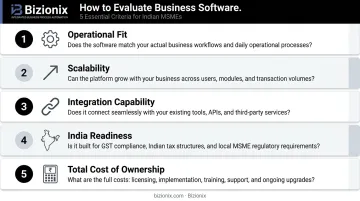
Software was evaluated on its ability to solve real operational problems, not just feature count. The primary criteria:
- Operational fit: Does it address a genuine business bottleneck?
- Scalability: Can it grow with the business, or will it need replacing?
- Integration capability: Does it work with other tools in the stack?
- India readiness: Does it handle GST, e-invoicing, and e-way bills where applicable?
- Total cost of ownership: Subscription cost plus implementation, training, and switching risk
Common Selection Mistakes to Avoid
Businesses consistently make the same errors when choosing software:
- Choosing on brand familiarity alone — a well-known brand doesn't mean it fits your workflows
- Ignoring hidden costs — implementation, data migration, training, and support can dwarf the subscription fee
- Selecting tools that don't integrate — adding a tool that creates a new silo defeats the purpose
- Underestimating the learning curve — a powerful tool that no one uses delivers zero value
Capterra's 2025 Tech Trends report found that 44% of small enterprises report regretful software purchases that caused a security vulnerability — a reminder that poor selection has consequences beyond wasted spend. That regret almost always traces back to the same root cause: choosing a tool for today's needs without asking whether it can handle tomorrow's scale. Configurable platforms that adapt to your processes will consistently outperform rigid, purpose-built tools — especially as your team, transaction volume, and compliance requirements grow.
Conclusion
Choosing the right business software shapes how well your organisation can scale, maintain compliance, and compete. Businesses that get this right early avoid the costly and disruptive process of re-implementation later.
Before committing to any platform, assess it against your actual workflows, current team size, integration requirements, and three-year growth plans. Prioritise vendors who offer platforms that adapt to your processes — not the other way around.
If that evaluation points toward a single integrated platform, Bizionix is built for exactly that. Designed for Indian MSMEs, it covers GST accounting, e-invoicing, inventory, CRM, and payroll in one cloud system — starting at ₹999/year. Get in touch with the Bizionix team to arrange a demonstration.
Frequently Asked Questions
What are the top business software options available?
The strongest options span several categories: ERP platforms (Bizionix, SAP), accounting tools (Tally Prime, Zoho Books), CRM (HubSpot, Zoho CRM), project management (Asana), and communication (Slack, Microsoft 365). The best choice depends on your business size, industry, and operational priorities — there's no universal answer.
What is the difference between ERP software and regular business software?
Regular business software handles a single function — invoicing, task tracking, or communication. ERP integrates multiple functions — finance, inventory, HR, CRM, and operations — into one connected system, eliminating data silos and manual reconciliation across departments.
Which business software is best for Indian MSMEs?
GST compliance, affordability, and ease of use are the key criteria. India-built or India-optimised platforms — Bizionix, Tally Prime, Zoho Books, and Vyapar — are particularly well-suited due to their built-in GST and e-invoicing features aligned with CBIC requirements.
How do I choose the right business software for my growing business?
Start by identifying your biggest operational bottlenecks — billing delays, inventory gaps, or communication breakdowns. Then evaluate tools on scalability, integration with existing systems, total cost including implementation and training, and whether the platform adapts to your workflows.
Is cloud-based business software safe for managing financial data?
Reputable cloud platforms use encryption, role-based access controls, and regular backups to protect data. For most MSMEs, cloud software offers stronger security than local systems — local machines are more vulnerable to hardware failure and physical theft. Verify vendor compliance practices before onboarding.
Can a single software platform replace multiple business tools?
Yes. All-in-one ERP platforms can replace 5–6 separate tools — accounting, CRM, HR, inventory, and project management — with one unified system. This cuts subscription costs, eliminates data duplication, and gives leadership a single source of truth.