Introduction
Walk into almost any growing MSME in India and you'll find the same setup: Tally for accounts, Excel for inventory, WhatsApp for team coordination, and a separate tool for everything else. It works — until it doesn't.
As transaction volumes climb and teams expand across locations, the cracks appear fast:
- Duplicate data entries across systems
- Missed GST deadlines from disconnected workflows
- Inventory mismatches that only surface at month-end
- Financial surprises that better visibility would have caught
The fix isn't working harder across more spreadsheets. It's consolidating these functions into a single platform where finance, operations, HR, and sales work from the same real-time data.
The urgency is real. According to IDC, India's public cloud services market is expected to reach US$30.4 billion by 2029, growing at a 22.6% CAGR from 2024 to 2029 — making cloud-based business software a mainstream investment decision, not an experimental one. This guide breaks down the top business management software options for 2026 — what each does well, where each falls short, and which categories matter most for Indian businesses navigating GST compliance and multi-location growth.
Key Takeaways
- Business management software unifies accounting, CRM, inventory, HR, and project management into one system, replacing fragmented point solutions
- Indian MSMEs need platforms with GST compliance, e-invoicing, and GSTR filing built in as core features
- Top 2026 options include Bizionix (India-built ERP), Zoho One, NetSuite, Odoo, and Monday.com, each suited to a different business size and complexity
- Evaluate on integration flexibility, scalability, compliance readiness, ease of adoption, and total cost of ownership
- Match the platform to your operational complexity and growth stage — not the other way around
What Is Business Management Software?
Business management software is a platform that centralises and automates core business functions — finance, HR, sales, inventory, and operations — into one integrated system. Instead of pulling numbers from three different tools to answer one question, everything lives in one place, updated in real time.
The Indian MSME context makes this especially relevant. India has over 8.47 crore formalised MSMEs registered on the Ministry of MSME dashboard, yet a 2025 survey by India SME Forum covering 7,835 businesses found that 46.2% still operated fully offline. Among those who did adopt digital tools, 69% reported at least 10% customer-base growth — a direct link between digitalisation and business outcomes.
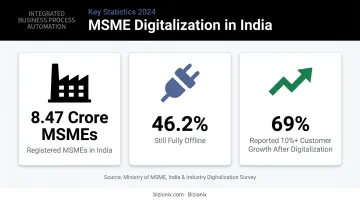
Those numbers point to a specific gap: fragmentation. A business running Tally for accounts, Excel for stock, and WhatsApp for approvals is essentially managing three separate realities. That setup breaks down the moment:
- Transactions increase 5x–10x
- Multiple users need simultaneous access
- Cross-department data reconciliation becomes weekly instead of monthly
- GST deadlines require pulling figures from multiple sources
The tools below were selected based on how well they address these real operational gaps — across manufacturing, distribution, services, and multi-location businesses.
Top Business Management Software Tools for 2026
These platforms were shortlisted based on feature depth, scalability, integration capability, compliance readiness (especially for Indian businesses), and value for money across different business sizes.
Bizionix
Bizionix is an India-built, cloud-based ERP platform developed by IIS-LLP, a subsidiary of Protocol India Private Limited, with over two decades of industry backing. It's designed for growing MSMEs, CA firms, hotels, manufacturing units, and multi-location businesses that need to replace fragmented tools with one unified system, without the complexity or cost of enterprise-grade alternatives like SAP.
What makes it stand out for Indian businesses is the depth of compliance built directly into the platform. GST-ready accounting, automated e-invoicing with direct API integration to the GST Invoice Registration Portal (IRP), and GSTR-1 auto-population are core functions, not add-ons.
The IRN generation workflow takes seconds: create a sales invoice, the system validates against GST rules automatically, connects to the IRP, and delivers the IRN and QR code instantly. No manual uploads, no third-party tools.
The multi-company management feature is particularly strong for CA firms and business groups. Multiple entities (subsidiaries, branches, GST-registered companies) can be managed from a single secure login, with both separate books and group-level consolidated dashboards.
| Feature Area | Details |
|---|---|
| Key Features | GST-compliant accounting, automated e-invoicing (IRN generation), GSTR-1 auto-population, TDS, multi-company management, inventory and warehouse management, payroll, CRM, production planning, project tracking, document workflows, 100% cloud-based |
| Best For | Indian MSMEs, manufacturing companies, distribution businesses, CA firms, hotel groups, franchise networks, and multi-location enterprises needing affordable, compliance-ready ERP |
| Pricing | NEO plan at ₹999/year (with 14-day free trial); Enterprise plan with custom pricing — contact info@bizionix.com or +91 91779 99277 |
Zoho One
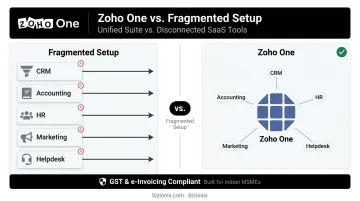
Zoho One is a Hyderabad-headquartered business suite offering 50+ unified applications, spanning CRM, accounting, HR, marketing, project management, and helpdesk. It's one of the most widely adopted platforms among Indian SMBs.
The core advantage is breadth: one subscription replaces 10+ separate SaaS tools. For Indian compliance, Zoho Books handles GST accounting, GSTR workflows, and e-invoicing through direct IRP upload and IRN generation (Zoho is a GST Suvidha Provider), making it a strong option for businesses that want compliance coverage alongside a full operational suite.
| Feature Area | Details |
|---|---|
| Key Features | CRM (Zoho CRM), accounting (Zoho Books with GST and e-invoicing), HR (Zoho People), project management (Zoho Projects), marketing automation, helpdesk, analytics — 50+ unified apps |
| Best For | Small to mid-sized Indian businesses wanting a broad-feature suite without separate SaaS subscriptions for each function |
| Pricing | Standard All Employee plan at US$37/employee/month (billed annually); Flexible User plan at US$90/user/month (billed annually) — verify current rates on Zoho's official pricing page before purchasing |
NetSuite
NetSuite is Oracle's enterprise-grade cloud ERP, serving 43,000+ customers globally and named a Leader in the 2025 Gartner Magic Quadrant for Cloud ERP for Service-Centric Enterprises. It's the standard-bearer for complex financial management, multi-subsidiary reporting, and multi-currency operations.
The trade-off is cost and implementation complexity. NetSuite is genuinely powerful for organisations that need it, but it's not designed for SMBs looking for a quick deployment. Expect a significant implementation investment on top of the licensing cost.
| Feature Area | Details |
|---|---|
| Key Features | ERP, financial management, inventory, CRM, order management, e-commerce, multi-subsidiary reporting, advanced analytics |
| Best For | Mid-market to large enterprises with complex financial and multi-entity operational requirements |
| Pricing | Custom quote required — annual licence fee plus module costs, user count, and a one-time implementation fee. No publicly listed pricing |
Odoo
Odoo is an open-source, modular ERP platform used by over 13 million users worldwide, adding more than 7,000 new clients each month. Its "pay only for what you use" model means businesses can start with one or two modules and expand as operations grow, without paying for functionality they don't yet need.
India-specific localisation is documented in Odoo's official documentation, covering GST, e-invoicing, GSTR reports, and IRN workflows. For businesses with technical resources for configuration, the open-source codebase allows deep customisation that most other platforms simply can't match.
| Feature Area | Details |
|---|---|
| Key Features | CRM, accounting, inventory, manufacturing, project management, HR, e-commerce — modular structure with Community (free) and Enterprise editions |
| Best For | SMBs and scaling businesses wanting an affordable, highly customisable ERP alternative, particularly those with technical resources for setup |
| Pricing | Community edition: free (one app, unlimited users); Enterprise edition: pricing varies by country — check Odoo's official pricing page for current rates in India. Factor in implementation and customisation costs |
Monday.com
Monday.com started as a project management platform and has expanded into CRM, HR workflows, marketing, and operations management. It's not an ERP: it doesn't replace financial accounting, statutory payroll, or inventory management for manufacturing. What it does well is visual workflow management and cross-functional team coordination.
With 850+ integrations, strong automation capabilities, and a 4.5 rating on Gartner Peer Insights (based on 1,300 ratings), it's the go-to for service businesses, agencies, and remote teams whose primary challenge is project coordination rather than back-office financial complexity.
| Feature Area | Details |
|---|---|
| Key Features | Project and task management, CRM workflows, HR boards, dashboards, time tracking, workflow automation, 850+ integrations |
| Best For | Teams prioritising visual workflow management and cross-functional collaboration — especially in services, agencies, and hybrid environments |
| Pricing | Basic: US$9/seat/month; Standard: US$12/seat/month; Pro: US$19/seat/month (all billed annually) — verify on Monday.com's pricing page |
How We Chose the Best Business Management Software
Feature-rich doesn't mean fit-for-purpose. A platform with 200 capabilities that your team actually uses 8 of is a poor investment — and a common one.
Every platform in this list was evaluated against criteria that reflect real deployment conditions:
- Integration flexibility — Can it connect with tools already in use, or does it require replacing everything at once?
- Scalability — Will it support the business in two years without a re-implementation project?
- Ease of adoption — Can non-technical operations staff use it without weeks of training?
- Compliance readiness — For Indian businesses, GST compliance, e-invoicing, and GSTR filing are non-negotiable requirements, not optional modules
- Total cost of ownership — Subscription fees are rarely the full picture; implementation, training, data migration, and ongoing administration all contribute to actual cost
- Customer support quality — What happens when something breaks three months after go-live?
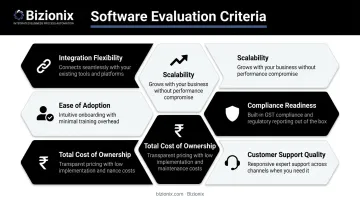
These criteria exist because software selection failures are rarely about the software. Gartner research found that 75% of ERP strategies are not strongly aligned with overall business strategy — which is why deployment conditions matter as much as feature sets. Implementation quality, change management, and executive involvement ultimately determine whether a platform delivers value.
Conclusion
There is no universally "best" business management software. A CA firm managing 20 client books has different needs than a manufacturing unit tracking production across three facilities. The right platform depends on business size, industry, operational complexity, and whether it's built for your market's specific compliance environment.
Before committing to any platform, run a structured pilot using real workflows and real users. Involve operations leads in the evaluation, not just IT. The people who will actually use the system daily are better judges of adoption risk than those who will configure it once.
For Indian MSME and enterprise owners, the compliance piece is non-negotiable. A platform that handles GST e-invoicing, GSTR filings, TDS, and payroll statutory requirements as core features — rather than afterthoughts — avoids the hidden cost of retrofitting compliance onto a system that was never designed for it.
If you're evaluating an all-in-one ERP built for the Indian operating environment, Bizionix offers GST-compliant accounting, multi-company management, and a cloud-first architecture — at a price point that works for growing businesses, not just large enterprises. Contact the team at info@bizionix.com or call +91 91779 99277 to schedule a demo.
Frequently Asked Questions
What is business management software and why do businesses need it?
Business management software centralises core functions — accounting, HR, CRM, inventory, and project management — into one integrated platform. It replaces disconnected spreadsheets and siloed tools, reducing manual work and giving owners real-time visibility across every department.
What is the best business management software for small businesses in India?
For Indian SMBs, the best option combines GST compliance, e-invoicing, and core ERP in one platform. Bizionix suits businesses needing a dedicated ERP with deep compliance features; Zoho One fits those wanting a broader app suite. The right choice depends on your industry, team size, and operational complexity.
What is the difference between ERP and business management software?
ERP (Enterprise Resource Planning) focuses on integrating back-office functions such as finance, inventory, supply chain, and manufacturing. Broader business management platforms extend this to include CRM, marketing automation, and project management tools, making them more comprehensive for day-to-day operations across all departments.
How do I choose the right business management software for my business?
Start by identifying your biggest pain point: poor financial visibility, manual compliance work, inventory errors, or disconnected teams. Evaluate tools on integration flexibility, scalability, compliance readiness, and total cost of ownership. Test with real users and real workflows before committing — features on paper don't always survive contact with your actual processes.
Is business management software worth the investment for MSMEs?
The India SME Forum's 2025 research found that 69% of digitally active MSMEs reported at least 10% customer-base growth after adopting digital solutions. Beyond growth, the right platform eliminates manual processes, reduces billing errors, accelerates payment collection, and gives owners real-time financial visibility — returns that typically outweigh the subscription cost within the first year.
What features should I look for in business management software in 2026?
Prioritise workflow automation, real-time reporting, scalable module access, and compliance features such as GST, e-invoicing, and GSTR filing. Just as important: a user interface that non-technical staff can navigate without extensive training. A platform your team won't actually use delivers nothing.