Introduction
India's MSME sector is a genuine economic engine, contributing 29.2% of GDP and employing over 23 crore people. Yet the MSME Annual Report 2024-25 recorded over 2.16 lakh delayed-payment applications involving ₹47,677 crore — a direct consequence of fragmented operations, manual invoicing, and disconnected approval workflows.
The gap between ambition and operational reality is real. According to the NASSCOM MSME AI Whitepaper, 91% of tech-enabled MSMEs say AI tools are not widely accessible or affordable, and 65% lack awareness of the right solutions. The barrier isn't the technology itself — it's knowing which tools are worth adopting and why.
With dozens of platforms competing for attention in 2026, picking the wrong tool wastes money and adds complexity. This guide evaluates the best business automation software by category — from no-code app connectors to full-suite ERP platforms — assessed for cost, Indian compliance fit, and real-world usability for MSMEs.
Key Takeaways
- Business automation software replaces manual, repetitive workflows with rule-based or AI-driven digital processes
- Top 2026 tools span task automation (Zapier), workflow orchestration, and full ERP platforms like Bizionix built for Indian MSMEs
- Indian businesses above ₹5 crore turnover must use e-invoicing, so GST compliance is a hard requirement when evaluating tools
- Choose based on operational fit: task automation, workflow orchestration, or end-to-end business management
- Start with high-volume, rule-based processes — that's where automation delivers the fastest return
What Is Business Automation Software?
According to Gartner, business process automation tools enable the **design, execution, and monitoring of business processes** involving both systems and human interaction. This means replacing manual handoffs, data re-entry, and approval chasing with structured digital workflows.
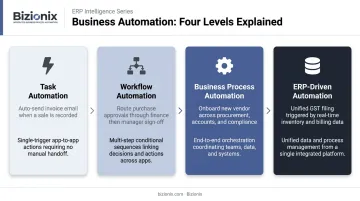
The category breaks into four distinct types:
| Type | What It Does | Example Use Case |
|---|---|---|
| Task Automation | Single-trigger, app-to-app actions | Form submission → CRM entry |
| Workflow Automation | Multi-step conditional sequences | Invoice sent → approval routed → payment triggered |
| Business Process Automation (BPA) | End-to-end orchestration across teams | Order-to-cash across sales, warehouse, and finance |
| ERP-Driven Automation | Unified data and process management | GST filing, inventory, payroll from one system |
The intelligent process automation market was valued at USD 14.55 billion in 2024 and is projected to reach USD 44.74 billion by 2030, growing at 22.6% CAGR. That global momentum translates directly to Indian MSMEs, where the immediate priority is cutting manual errors, speeding up billing cycles, and maintaining GST compliance — without expanding headcount.
The tools reviewed below cover all four categories, with options suited to businesses at different growth stages — from early-stage operations to multi-location enterprises managing distributed teams.
Best Business Automation Software Tools for 2026
These tools were selected based on real-world usability, integration depth, pricing transparency, and fit for growing businesses — with particular attention to platforms serving Indian enterprises and GST compliance needs.
Bizionix
Bizionix is an all-in-one cloud ERP and business automation platform built specifically for Indian MSMEs by IIS-LLP, a subsidiary of Protocol India Private Limited with over two decades of industry experience. It brings accounting, inventory, billing, procurement, CRM, and GST compliance into one unified system — replacing the fragmented stack of tools most growing businesses rely on.
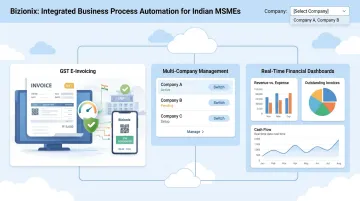
What separates Bizionix from generic automation tools is its direct API integration with India's GST e-Invoice system. When a sales invoice is created, the system validates it against GST rules in real time, generates an IRN and QR code via direct IRP connection, and makes the invoice ready to share — all within seconds. No third-party tools, no manual JSON uploads.
For businesses managing multiple entities, the multi-company management feature allows subsidiaries, branches, and GST-registered entities to be handled under a single secure login, with independent books of accounts per entity and consolidated group-level dashboards.
| Key Features | Automated GST e-invoicing with instant IRN generation, multi-company management, unified inventory and billing, real-time dashboards updated continuously, 100% cloud-based with role-based access controls |
| Best For | Indian MSMEs, CA firms managing client portfolios, manufacturing companies, distribution and warehouse operations, franchise networks, multi-location enterprises |
| Pricing | Bizionix NEO: ₹999/year (14-day free trial included); Enterprise: custom pricing with full module access. Request a demo or contact info@bizionix.com |
Zapier
Zapier is the most widely used no-code automation platform globally, connecting over 9,000+ apps through simple trigger-action workflows — no technical skills required. Trusted by over 3 million businesses, it's the default starting point for small teams that need to stop copying data between tools.
Its AI-assisted Zap builder lets non-technical users describe what they want in plain language and get a working automation in minutes. Think: form submission syncs to CRM, new order triggers a Slack notification, invoice paid updates a spreadsheet.
| Key Features | 9,000+ app integrations, multi-step Zaps, AI-assisted workflow builder, Zapier Tables for lightweight data management, GDPR/CCPA compliance |
| Best For | Startups, solopreneurs, and small teams automating everyday SaaS workflows without technical resources |
| Pricing | Free (100 tasks/month); Professional from $19.99/month; Team from $69/month. New accounts get a 14-day Professional trial, no credit card required |
Microsoft Power Automate
Power Automate is the natural automation layer for organisations already running Microsoft 365. It connects natively with Outlook, SharePoint, Teams, Excel, and Dynamics 365, and supports Copilot-assisted flow design using natural language.
Beyond cloud workflows, it handles desktop RPA — both attended and unattended — making it practical for organisations that need to automate legacy desktop processes alongside cloud-based tasks. Configuration complexity increases significantly when working outside the Microsoft ecosystem.
| Key Features | Native M365 integration, Copilot AI-assisted flow design, desktop RPA (attended and unattended), 1,400+ prebuilt certified connectors, centralized admin controls |
| Best For | Enterprises and larger teams operating primarily within the Microsoft 365 and Azure environment |
| Pricing | Premium from $15/user/month; Process (unattended RPA) from $150/bot/month; 30-day free trial available |
UiPath
UiPath has been named a Gartner Magic Quadrant RPA Leader seven consecutive times — a strong signal of enterprise-grade maturity. Its current platform combines traditional bot-based RPA with Agentic Automation, where AI agents work toward defined goals across complex, multi-system environments without requiring step-by-step instructions.
It integrates with OpenAI and Google Vertex AI, and connects to legacy systems like SAP and Salesforce. UiPath has a steep learning curve and suits organisations with dedicated IT or automation teams. For Indian MSMEs without technical resources, the complexity and enterprise pricing structure are worth weighing carefully before committing.
| Key Features | Agentic automation, AI document understanding, built-in testing and version control, OpenAI and Google Vertex connectors, Automation Hub for enterprise pipeline management |
| Best For | Large enterprises with legacy systems, high-volume back-office operations, and IT teams capable of managing complex deployments |
| Pricing | Basic from $25/month; Standard and Enterprise tiers — contact sales for pricing |
Make (formerly Integromat)
Make positions itself as the visual-first automation platform for mid-market teams that need more workflow logic than Zapier offers. Its canvas-based builder supports branching, filters, aggregators, and iterators — giving operations teams genuine flexibility for complex multi-step processes.
With 3,000+ native connectors and a more granular error-handling system, Make suits teams automating across CRMs, ERPs, and e-commerce platforms. Pricing starts lower than most alternatives, with the free tier offering 1,000 credits/month.
| Key Features | Visual canvas workflow builder, conditional routing with error handling, 3,000+ native connectors, scenario scheduling and monitoring, AI module support |
| Best For | Mid-market companies automating across SaaS tools — CRMs, ERPs, e-commerce — without developer resources |
| Pricing | Free (1,000 credits/month); Core from $9/month; Pro and higher tiers scale by operation volume |
Zoho Flow
Zoho Flow is the integration layer within the Zoho ecosystem, connecting Zoho CRM, Zoho Books, Zoho Inventory, and Zoho Desk with 1,000+ cloud and on-premise apps. For businesses already running on Zoho products — widely used across Indian SMBs — it's the most natural automation choice.
It supports multi-step flows with conditional logic, webhooks, and scheduling, and the 15-day free trial (no credit card required) makes it easy to evaluate before committing. Its value drops noticeably outside the Zoho ecosystem, where Make or Zapier offer broader connectivity.
| Key Features | Native Zoho suite integration, 1,000+ app connectors, conditional logic and webhooks, scheduled workflows, flow monitoring and error alerts |
| Best For | Indian SMBs already using Zoho CRM, Zoho Books, or other Zoho products looking to automate cross-app workflows |
| Pricing | Free edition (100 tasks/month, 5 flows); paid tiers scale from 5,000 to 5 million tasks/month. 15-day free trial available |
How We Chose These Tools
Tools were evaluated on real-world usability across different business sizes, integration depth, AI capabilities, and suitability for Indian business requirements — including GST compliance. Brand recognition is not a selection criterion here — regulatory fit and operational context are.
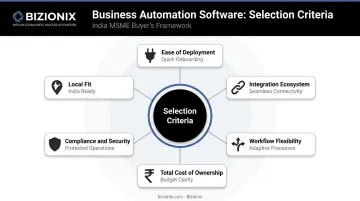
Key selection factors:
- Ease of deployment — whether the tool requires developers or works out of the box
- Integration ecosystem — breadth and quality of connectors
- Workflow flexibility, including conditional logic, branching, and error handling
- Total cost of ownership, not just the headline price
- Compliance and security — specifically GST e-invoicing readiness for Indian businesses
- Local fit — India-specific features, regional support, and ₹-denominated pricing
The tools in this list are grouped with these factors in mind — use the criteria above as your filter before committing to a trial or demo.
Conclusion
The best business automation software in 2026 is the one that fits your operational complexity today and grows with you as your needs change.
Match the tool to your actual pain point:
- App-level task automation → Zapier or Zoho Flow
- Visual multi-step workflows → Make
- Enterprise RPA and AI agents → UiPath or Power Automate
- Unified business management with GST compliance → Bizionix
For Indian MSMEs that want one platform covering operations, accounting, billing, and compliance — without juggling five separate tools — Bizionix is built specifically for that job. Start with a 14-day free trial on the NEO plan, email info@bizionix.com to request a demo, or reach the team directly on WhatsApp at +91 91779 99277.
Frequently Asked Questions
What is business automation software and how does it work?
Business automation software uses rule-based or AI-driven logic to perform repetitive tasks automatically — sending invoices, routing approvals, syncing data — without manual intervention. This frees teams from administrative work and reduces the error rate that comes with manual data handling.
What is the difference between workflow automation and business process automation (BPA)?
Workflow automation handles individual multi-step task sequences, such as connecting apps via triggers. BPA orchestrates entire end-to-end business processes involving multiple departments, human decisions, and data sources. It's broader in scope and operational impact.
Which business automation tools are best suited for Indian MSMEs?
Indian MSMEs benefit most from tools combining operational automation with GST compliance support. Bizionix offers unified ERP automation built specifically for this context, while Zapier and Zoho Flow work well for app-to-app workflow automation in smaller teams without complex compliance requirements.
How do I choose the right automation tool for my business?
Start by mapping your most time-consuming, high-volume, rule-based processes. Then evaluate tools based on ease of use, integration fit with existing systems, compliance requirements, and total cost of ownership. Run a pilot before committing to an annual contract.
Can business automation software help with GST compliance in India?
Yes. Platforms like Bizionix offer direct API integration with India's GST e-Invoice system, enabling automated IRN generation and instant GST-compliant invoice creation. GST Council Notification 10/2023 mandates e-invoicing for businesses with aggregate turnover above ₹5 crore from 1 August 2023, making this capability critical for qualifying MSMEs.
What is the typical ROI of implementing business automation software?
ROI varies by process and business size, but measurable gains typically appear within the first quarter. Most businesses see faster billing cycles, lower error rates, and reduced operational costs from consolidating multiple point tools — freeing teams to focus on growth rather than administrative tasks.