Business process management (BPM) software addresses this directly. These platforms let organisations design, automate, execute, monitor, and improve workflows across departments — from invoice approvals and onboarding to inventory tracking and compliance reporting.
The demand for these tools is rising fast. According to Grand View Research, the global BPM market was valued at USD 20,377.9 million in 2024 and is projected to reach USD 61,174.2 million by 2030, growing at a 20.3% CAGR. In India specifically, the market is expanding even faster — at 23.5% CAGR — making BPM adoption one of the sharpest business decisions Indian companies can make right now.
This guide reviews the top BPM platforms for 2026, with options for global enterprises and Indian MSMEs alike.
Key Takeaways
- BPM software replaces fragmented, manual workflows with automated, trackable processes across departments
- Key selection factors: ease of use, automation depth, integration capabilities, scalability, and pricing fit
- Global tools like Microsoft Power Automate, Kissflow, monday.com, and Appian each target different use cases: enterprise automation, no-code workflow building, and beyond
- Indian MSMEs have a purpose-built option in Bizionix — GST compliance, multi-entity management, and enterprise capabilities without SAP-level cost or complexity
What Is Business Process Management (BPM) Software?
BPM software is a digital platform that helps organisations design, automate, execute, monitor, and continuously improve their business processes. It covers both a management discipline and a technology category: the structured methods for analysing and improving how work gets done, and the tools that automate and track that work.
That scope covers a wide range of business activities:
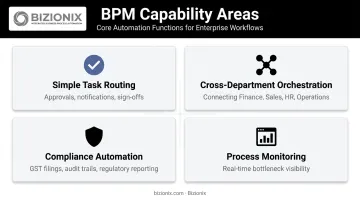
- Simple task routing — approval workflows, notification triggers, document sign-offs
- Cross-department orchestration — connecting finance, sales, HR, and operations in coordinated workflows
- Compliance automation — GST filings, audit trails, regulatory reporting
- Process monitoring — real-time dashboards that show where bottlenecks occur and where workflows are stalling
That variety is exactly why tool selection matters. A five-person team digitising an expense approval process has very different needs from a manufacturer managing inventory, production, and GST compliance across multiple entities. The tools reviewed below were selected based on market standing, feature depth, user trust, and fit across business sizes, with specific attention to options suited to Indian MSMEs.
Best Business Process Management Software for 2026
These tools were evaluated on automation depth, ease of adoption, integration flexibility, scalability, and pricing transparency.
Microsoft Power Automate
Microsoft Power Automate is a cloud-based automation and BPM tool built for organisations already operating within the Microsoft 365 ecosystem. It supports both cloud-based workflow automation and desktop Robotic Process Automation (RPA), making it versatile across IT environments.
Its drag-and-drop interface keeps it accessible for non-technical users, and pre-built templates for common processes — expense approvals, onboarding, notifications — reduce setup time considerably. It also integrates with Google Workspace, Slack, Salesforce, and thousands of other apps beyond the Microsoft suite.
| Best For | Teams heavily invested in Microsoft 365 looking to automate tasks across apps with minimal coding |
| Key Features | Cloud flows, desktop RPA (attended via Premium; unattended via Process/Hosted Process), AI Builder, approval workflows, process and task mining |
| Pricing | Premium: $15.00/user/month · Process: $150.00/bot/month · Hosted Process: $215.00/bot/month (all billed annually) |
The Premium plan includes attended desktop automation, but unattended automation requires the Process or Hosted Process licence. Each of these plans also includes 5,000 AI Builder credits per month.
Kissflow
Kissflow is a no-code/low-code BPM and workflow automation platform founded in India (originally as OrangeScape in 2003). With over 1,000,000 users across 160+ countries, it has proven particularly relevant for growing businesses that want to digitise processes without depending on their IT team.
Its visual workflow builder lets non-technical staff — often called citizen developers — build and manage workflows across HR, finance, procurement, and operations. An active user community and responsive support make adoption smoother for teams without dedicated BPM expertise.
| Best For | Growing businesses and non-technical teams wanting to digitise workflows without developer involvement |
| Key Features | No-code process designer, case and workflow apps, visibility dashboards, API integrations, citizen developer enablement |
| Pricing | Starting from approximately $1,500–$2,500/month (Kissflow's own pages show conflicting figures; enterprise pricing is custom) |
Note: Kissflow's pricing pages show inconsistencies — one page cites $1,500/month for the basic plan, another lists $2,500/month. Request a direct quote to confirm current pricing for your team size.
monday.com
monday.com is a highly visual work management and BPM platform used by over 250,000 customers worldwide. It's built around flexibility — teams can customise boards, automate conditional triggers, and track work across multiple visual formats without writing code.
The platform supports 850+ integrations and apps, including Salesforce, Jira, and Google Drive, and offers multiple board views including Gantt, Timeline, Kanban, Calendar, Chart, and Workload views. Code-free automation recipes let users set up "if this, then that" logic without developer involvement.
| Best For | Mid-sized teams that need highly customisable workflows with strong visual tracking and cross-tool integrations |
| Key Features | Customisable boards, code-free automation, multiple visual work views, resource management, AI tools, 850+ integrations |
| Pricing | Free (2 seats, limited features) · Basic: $9/seat/month · Standard: $12/seat/month · Pro: $19/seat/month · Enterprise: custom (all annual billing) |
The free plan is limited to 2 seats, 3 boards, and no automations or integrations. Automation actions begin with the Standard plan (250 actions/month) and scale to 25,000 with Pro.
Appian
Appian is an enterprise-grade BPM and low-code platform used by large organisations in financial services, healthcare, and government. It was recognised as a Leader in both the 2025 Gartner Magic Quadrant for Enterprise Low-Code Application Platforms and the 2025 Gartner Magic Quadrant for Business Orchestration and Automation Technologies. For enterprise buyers assessing platform maturity, dual recognition across both quadrants carries real weight.
Its low-code environment significantly reduces time-to-deployment for complex business applications. Native AI capabilities automate decision points within workflows, and process mining tools surface inefficiencies that aren't always visible in standard reporting.
| Best For | Large enterprises needing scalable, AI-powered BPM with fast low-code development and strong compliance capabilities |
| Key Features | Low-code app builder, AI and RPA integrations, case management, process mining, process intelligence, API-first architecture |
| Pricing | Available on request — contact Appian directly for pricing |
Bizionix
Bizionix is a 100% cloud-based ERP and business process management platform developed by IIS-LLP (a subsidiary of Protocol India Private Limited), built specifically for Indian MSMEs — including manufacturers, distributors, CA firms, hotels, and multi-location enterprises. It carries over two decades of combined industry experience in its design.
What distinguishes Bizionix from the global tools above is that it doesn't require customisation for Indian compliance — it's built GST-ready from the ground up. The platform offers:
- Automated e-invoicing with direct API integration to the GST Invoice Registration Portal (IRP) for instant IRN generation
- Pre-validation of invoices against GST rules before submission, eliminating rejections
- GSTR-1 auto-population so sales data flows directly into GST return filings with no manual reconciliation
- Multi-company management under a single secure login, with independent books of accounts per entity and group-level dashboards for consolidated visibility
Beyond GST compliance, the unified platform connects Finance, Sales & CRM, Inventory, Purchase, Warehouse, Production Planning, HRMS & Payroll, and Document Workflows in a single database. When a sale is recorded, inventory, finance, and accounts update in real time — no re-entry, no lag.
The platform enforces process discipline through role-based access control, complete activity logs, and configurable workflows that match organisational SOPs. As Bizionix frames it: employees follow defined processes, not their own workarounds.
| Best For | Indian MSMEs and growing enterprises needing an affordable, GST-compliant, all-in-one ERP and BPM platform without SAP-level complexity |
| Key Features | GST-ready accounting, automated e-invoicing with IRN generation, multi-company management, real-time operational visibility, configurable document workflows, unified platform across Finance/Inventory/HRMS/CRM/Operations |
| Pricing | NEO plan: ₹999/year (14-day free trial included) · Enterprise: custom pricing — contact Bizionix for a demo |
How We Chose the Best BPM Software
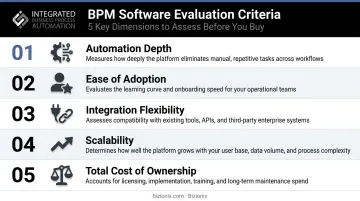
Every tool in this list was assessed across five criteria:
- Automation depth — Can it eliminate repetitive manual tasks without constant human intervention?
- Ease of adoption — How quickly can non-technical users get started without IT support?
- Integration flexibility — Does it connect with the tools already in use?
- Scalability — Can it grow with the business without requiring a platform change?
- Total cost of ownership — Is the pricing transparent, and does it deliver proportionate value?
One mistake buyers consistently make: choosing a BPM tool based on brand reputation or feature lists, then discovering it doesn't fit their team's actual technical capability or their existing tech stack.
In India, the compliance dimension makes this even more consequential. GST compliance and e-invoicing aren't optional add-ons — they're operational requirements for any business crossing the ₹5 crore annual turnover threshold.
The right BPM tool is the one that gets adopted, used consistently, and shows up in fewer manual follow-ups and fewer process errors — not the one with the longest feature list.
Conclusion
BPM software is no longer a large-enterprise concern. Growing businesses at every stage — from 10-person teams digitising approvals to multi-entity groups managing GST across subsidiaries — can benefit from structured process automation, real-time visibility, and reduced manual work.
The right choice depends on your team size, technical readiness, compliance needs, and budget:
- Microsoft Power Automate for organisations deep in the Microsoft ecosystem
- Kissflow for non-technical teams wanting no-code workflow building
- monday.com for visual work management with broad integration coverage
- Appian for large enterprises needing analyst-validated, AI-powered process orchestration
- Bizionix for Indian MSMEs that need GST compliance, multi-entity control, and unified ERP capabilities without the cost and complexity of global enterprise software
Before committing, test tools against actual workflows — not demo scenarios. Three things worth checking before you sign up:
- Does onboarding support match your team's technical readiness?
- Does the platform handle your country-specific compliance requirements (GST, e-invoicing, TDS)?
- Does pricing scale predictably as your headcount and transaction volume grow?
If you're an Indian MSME managing GST filings, multi-company books, and operational workflows across departments, Bizionix brings all of that into one platform — without SAP-level complexity or cost. Reach the team at support@bizionix.com or connect via WhatsApp to see it against your actual workflows.
Frequently Asked Questions
What is the best business process management software?
The best BPM software depends on business size, technical capability, and use case. Microsoft Power Automate, monday.com, and Appian lead in different enterprise categories, while Kissflow and Bizionix are stronger fits for growing businesses and Indian MSMEs with localised compliance needs.
Is BPM better than BPO?
BPM and BPO aren't competing alternatives. BPM (Business Process Management) is about managing and automating processes internally, while BPO (Business Process Outsourcing) means handing entire functions to a third-party provider. Many organisations use both — BPM software can actually make outsourced processes easier to monitor and manage.
What is the difference between BPM software and ERP software?
BPM software focuses specifically on modelling, automating, and monitoring workflows. ERP software integrates multiple business functions — finance, inventory, HR, and operations — into a single system. Many modern ERP platforms, like Bizionix, include embedded BPM capabilities as part of a unified suite.
What features should I look for in BPM software for a small or mid-sized business?
Prioritise a no-code or low-code workflow builder, automated approvals, integration with your existing accounting and CRM tools, real-time dashboards, and transparent pricing. For Indian businesses, confirm GST compliance and e-invoicing support before committing.
Is BPM software suitable for small businesses?
Yes — BPM tools span a wide range of budgets and complexity levels. No-code platforms like Kissflow work well for small teams, while Bizionix is purpose-built for Indian MSMEs that need process structure, GST compliance, and multi-module ERP functionality without enterprise-level costs. The NEO plan starts at ₹999/year.
How long does it take to implement BPM software?
Simple no-code tools can be operational within days; enterprise platforms may take weeks or months depending on process complexity. Cloud-based platforms with pre-built templates and guided onboarding — like Bizionix — reduce time-to-value for teams without dedicated IT resources.