A large part of the problem is operational: fragmented financial data, manual reconciliation, and tools that weren't built for GST compliance or multi-entity management. As the SIDBI Understanding Indian MSME Sector report notes, the absence of proper financial records leads to higher borrowing costs and limits a business's ability to plan or scale.
Business budgeting software has evolved well beyond spreadsheet replacement. Modern platforms now combine real-time expense tracking, forecasting, GST compliance, and multi-entity reporting — all in one place. This guide covers the best business budgeting software tools for 2026, who each tool is suited for, and what Indian business owners should prioritise when making a choice.
Key Takeaways
- Business budgeting software replaces manual spreadsheets with real-time financial visibility, automated workflows, and structured reporting
- Indian MSMEs should prioritise GST compliance, e-invoicing (IRN), and multi-company cloud access
- Match the tool to your stage: simple and affordable for small teams, scalable and compliance-ready for growing ones
- Tools covered: Bizionix, Zoho Books, TallyPrime, FreshBooks, and Workday Adaptive Planning
- Evaluate on ease of adoption, integration fit, and total cost of ownership
What Is Business Budgeting Software?
Business budgeting software is a digital platform that helps businesses plan, monitor, and control their finances. Unlike spreadsheets, it automates the core financial management cycle:
- Creates and adjusts budgets without manual formula maintenance
- Tracks actual vs. planned spend in real time
- Generates financial reports on demand
- Flags variances before they become expensive problems
The case against spreadsheets is well-documented. Research by Raymond Panko across nine operational spreadsheet audits found that 84% of 163 spreadsheets contained errors — and a KPMG audit of financial-sector spreadsheets found significant errors in 91% of those reviewed. For Indian MSMEs handling GST filings, multi-entity accounts, or seasonal cash flow swings, running month-end closes on error-prone spreadsheets is a genuine liability.
Modern budgeting tools range from simple expense trackers to full ERP-integrated planning platforms. The right choice depends on your business size, compliance needs, and growth stage — and those differences matter more than most buyers expect before they start comparing options.
Key Features to Look for in Business Budgeting Software
Indian businesses have specific compliance and operational demands that generic budgeting tools often overlook. Here's what actually matters when evaluating your options.
Real-Time Expense Tracking and Budget Monitoring
You need live visibility into spending across departments, projects, or cost centres — not a month-end summary. Fast-moving businesses managing multiple teams or locations can't afford to wait for manual reports to spot overspending.
GST Compliance and Local Regulatory Support
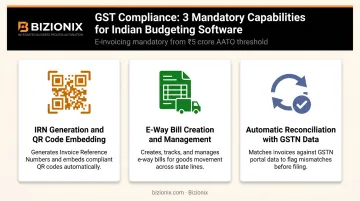
This is non-negotiable. As per Notification No. 10/2023-Central Tax, e-invoicing applies to businesses with aggregate annual turnover between ₹5 crore and ₹10 crore from August 2023. A GSTN advisory dated March 2025 further mandates that taxpayers with AATO of ₹10 crore and above cannot report e-invoices older than 30 days on IRP from April 2025.
Software without the following forces businesses to maintain parallel records:
- IRN generation and QR code embedding
- E-way bill creation and management
- Automatic reconciliation with GSTN data
Forecasting and Scenario Planning
Strong budgeting tools let finance teams model what happens if revenue drops, headcount grows, or raw material costs spike. A Forrester Total Economic Impact study of Workday Adaptive Planning found 242% ROI over three years for organisations using dedicated FP&A software.
Multi-Entity and Multi-Department Support
For businesses managing holding structures, franchise networks, or branch locations across states, the software must consolidate budgets without fragmenting data. Separate GST registrations, independent books, and group-level dashboards all need to coexist cleanly.
Integration with Accounting and ERP Systems
Budgeting software that doesn't connect with your accounting, payroll, or inventory systems creates duplicate entry and version control headaches. A unified platform — or one with clean API integrations — is the only way to maintain a single source of truth.
Best Business Budgeting Software Tools for 2026
Tools below were shortlisted on five criteria:
- Feature depth for financial planning
- India-specific compliance support (GST, e-invoicing)
- Ease of adoption
- Scalability
- Cost-to-value ratio
Bizionix
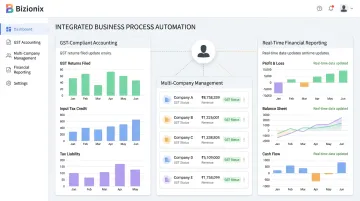
Bizionix is a cloud-based ERP platform built specifically for Indian MSMEs by IIS-LLP, a subsidiary of Protocol India Private Limited with over two decades of industry experience. Core modules include GST-compliant accounting, automated e-invoicing with direct IRP API integration for instant IRN generation, multi-company management, inventory, HRMS, payroll, and real-time financial dashboards — accessible from a single login.
What separates Bizionix from accounting-only tools is its architecture. Financial data flows automatically from sales, procurement, and warehouse operations into accounting — eliminating manual re-entry and departmental silos. For multi-entity businesses, each company maintains independent books, GST registrations, and ledgers, while owners and CAs get a consolidated group view.
The NEO plan starts at just ₹999/year (includes a 14-day free trial) and covers nine core modules. The Enterprise plan is custom-priced and adds production planning, advanced HRMS and payroll, document workflows, and priority support.
| Attribute | Details |
|---|---|
| Best For | Indian MSMEs, multi-entity business groups, manufacturing, distribution, CA firms, and service businesses |
| Key Features | GST-ready accounting, automated e-invoicing (IRN + QR code), multi-company management, real-time dashboards, unified ERP modules, 100% cloud-based |
| Pricing | NEO: ₹999/year (14-day free trial available); Enterprise: custom pricing on request |
Zoho Books
Zoho Books is a cloud-based accounting and budgeting platform from Zoho Corporation, widely used by Indian SMBs for its GST compliance features, accessible pricing, and deep integration with the broader Zoho ecosystem — CRM, Payroll, Expense, and Inventory.
Built-in GST return filing, e-way bill generation, and TDS management reduce compliance overhead. Its budget module allows tracking actuals against budgets by account. Advanced forecasting is limited compared to dedicated FP&A platforms, but for small to mid-sized businesses already in the Zoho ecosystem, it's a practical and cost-effective choice.
| Attribute | Details |
|---|---|
| Best For | Small to medium Indian businesses, especially those using other Zoho products |
| Key Features | GST return filing, e-way bill, budget tracking by account, bank reconciliation, multi-currency support |
| Pricing | Visit zoho.com/in/books/pricing for current India plan pricing |
TallyPrime
TallyPrime remains one of the most widely deployed accounting solutions in India — trusted by millions of MSMEs, accountants, and CAs for decades. It covers GST, inventory, payroll, and basic budgeting in a familiar, voucher-based interface.
Its advantage is ubiquity: most Indian CAs and finance staff already know it, which cuts training time. TallyPrime Silver (single-user) starts at ₹750/month or ₹22,500 as a lifetime licence. Gold (multi-user) starts at ₹2,250/month or ₹67,500 lifetime. Cloud/remote access is a separate add-on.
The limitation is real-time collaboration. Its desktop-first architecture can restrict team-based financial workflows, and budgeting capabilities don't match cloud-native FP&A platforms.
| Attribute | Details |
|---|---|
| Best For | Traditional Indian businesses and CAs familiar with Tally; manufacturing and trading companies |
| Key Features | GST compliance, inventory, payroll, basic budgeting, voucher accounting, e-invoicing support |
| Pricing | Silver: ₹750/month or ₹22,500 lifetime; Gold: ₹2,250/month or ₹67,500 lifetime (+ 18% GST) |
FreshBooks
FreshBooks is a cloud-based accounting solution designed for freelancers, solopreneurs, and very small service businesses. It handles invoicing, expense tracking, time tracking, and basic profit-and-loss reports in a clean, beginner-friendly interface.
For Indian consultants and micro-enterprises looking to move off spreadsheets quickly, it's an accessible starting point. Note that FreshBooks does not confirm GST e-invoicing support, lacks multi-department budgeting, and is best treated as an entry-level tool rather than a long-term solution for growing businesses. Pricing is in USD and subject to exchange rates for Indian users.
| Attribute | Details |
|---|---|
| Best For | Freelancers, solopreneurs, and very small service-based businesses |
| Key Features | Expense tracking, invoicing, time tracking, profit and loss reports, bank reconciliation (Plus plan+) |
| Pricing | Lite from USD 23/month; Plus from USD 43/month; Premium from USD 70/month (promotional rates available; USD pricing subject to exchange rates) |
Workday Adaptive Planning
Workday Adaptive Planning is an enterprise-grade FP&A platform designed for mid-to-large organisations requiring sophisticated financial modelling, multi-department budget consolidation, workforce planning, and real-time scenario analysis. It integrates with SAP, Oracle, and other major ERP systems.
Its planning engine supports unlimited what-if scenarios, active dashboards, and transaction-level reporting without data limits. Custom enterprise pricing, long implementation timelines, and a steep learning curve make it unsuitable for most Indian MSMEs. Suited to larger Indian enterprises with dedicated finance teams and existing ERP infrastructure.
| Attribute | Details |
|---|---|
| Best For | Large enterprises and business groups with complex multi-entity, multi-currency FP&A requirements |
| Key Features | Real-time financial modelling, multi-entity consolidation, workforce planning, scenario analysis, ERP integrations, role-based access |
| Pricing | Custom enterprise pricing; 30-day free trial available via workday.com |
How We Chose These Tools
Each tool on this list was assessed across five dimensions:
- Feature depth for budgeting, forecasting, and expense management
- India-specific compliance — GST, e-invoicing (IRN), e-way bill, and local reporting formats
- Ease of adoption for non-finance users and small teams
- Scalability from MSME to mid-market operations
- Cost-to-value ratio — accounting for subscription cost, implementation effort, and ongoing support
These criteria exist because India-specific compliance is a hard filter, not a nice-to-have. Businesses that choose software based on global brand recognition often discover too late that the tool lacks GST e-invoicing support, doesn't carry India pricing, or won't integrate with their existing accounting setup.
QuickBooks Online is a clear example. Intuit formally discontinued it in India. New sign-ups ended in July 2022, with access for existing subscribers closing in April 2023. It is not a viable option for Indian MSMEs in 2026.
The tools listed here span a range of operational scales:
- Entry-level — FreshBooks (freelancers and small service businesses)
- Full ERP — Bizionix (MSMEs needing integrated, GST-ready operations)
- Enterprise FP&A — Workday Adaptive Planning (mid-market and above)
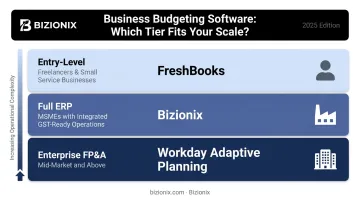
Match the tool to your current operational complexity and your 12–24 month growth trajectory. Your immediate needs are the starting point, not the finish line.
Conclusion
Choosing business budgeting software is an operational decision as much as a financial one. The right platform reduces financial leakage, speeds up decision-making, and gives growing businesses the visibility they need to manage cash flow proactively — not reactively.
For Indian MSMEs specifically, built-in GST compliance and e-invoicing support are non-negotiable. E-invoicing is now mandatory for businesses above ₹5 crore AATO, and the 30-day IRP reporting rule applies to those above ₹10 crore. A tool that handles this natively removes a significant compliance burden.
Evaluate tools against your actual workflows, not feature checklists. Beyond core budgeting functionality, the factors that matter most are:
- Scalability as transaction volumes and team size grow
- Vendor support quality and responsiveness
- Integration with existing systems (inventory, payroll, CRM)
- Unified architecture that connects budgeting with operations, not just accounting
Businesses outgrowing basic accounting tools need platforms that eliminate department silos — not add more of them.
If you're an Indian MSME looking for a single platform that handles GST compliance, e-invoicing, multi-company management, and real-time financial visibility — without SAP-level cost or implementation overhead — explore Bizionix. Start with a 14-day free trial or request a demo at bizionix.com.
Frequently Asked Questions
Frequently Asked Questions
Which software is best for budgeting?
For Indian MSMEs, tools with built-in GST compliance and multi-department visibility — like Bizionix or Zoho Books — offer the most practical value. Large enterprises with complex FP&A requirements should evaluate Workday Adaptive Planning. The right choice ultimately depends on your business size and compliance needs.
What is business budgeting software and how does it work?
It's a digital platform that automates budget creation, tracks actual vs. planned spending, and generates real-time financial reports. Instead of manual spreadsheet updates, it pulls data automatically from accounting, payroll, and operations — giving you a live view of financial performance.
What features should I look for in business budgeting software?
For Indian businesses, the must-haves are:
- Real-time expense tracking
- GST compliance with IRN generation
- Multi-department budget management
- Forecasting or scenario planning
- Integration with your existing accounting or ERP system
Is business budgeting software suitable for small businesses in India?
Yes. Tools like Zoho Books and FreshBooks offer affordable plans designed for small businesses. Before committing, confirm GST support is included — without it, you'll still need separate compliance records alongside the software.
What is the difference between accounting software and budgeting software?
Accounting software records past transactions — invoices, payments, reconciliations. Budgeting software focuses on planning future spend and comparing it to actuals. Many modern ERP platforms like Bizionix combine both in a single system.
How much does business budgeting software typically cost for Indian MSMEs?
Entry-level tools start under ₹1,000/year (Bizionix NEO) or around ₹750/month (TallyPrime Silver). Mid-range cloud platforms like Zoho Books offer tiered monthly plans, while enterprise tools like Workday Adaptive Planning are custom-priced. When comparing options, account for user count, modules needed, and implementation costs.