Research from Harvard Business Review found that workers toggle between apps and websites roughly 1,200 times per day, adding up to nearly 4 hours of lost productivity per week. For a growing MSME or manufacturing business, that adds up fast.
This article explains what digital platforms are, the different types available, the concrete benefits they deliver, real-world examples across different business sizes, and what to look for when choosing one — written specifically for business owners and managers evaluating their options.
Key Takeaways
- A digital platform unifies your departments, data, and workflows into one connected system
- Key types include ERP, e-commerce, CRM, collaboration, and analytics platforms
- Core benefits: operational efficiency, real-time visibility, lower tool costs, better data accuracy, and scalability
- Examples range from Amazon and Salesforce to India-specific solutions like Zoho, Tally, and Bizionix
- When evaluating options, prioritise process fit, scalability, GST and e-invoicing readiness, and total cost of ownership
What Is a Digital Platform?
A digital platform is a software-based ecosystem that centralises your company's core operations — connecting departments, data, users, and workflows into a single environment rather than a patchwork of disconnected tools.
How It Differs from Traditional Software
Traditional software solves one problem in isolation. A standalone billing tool generates invoices. A separate inventory app tracks stock. An accounting package handles the books. Each works independently, which means data never flows between them automatically.
A digital platform changes that relationship entirely. When a sales order is created, it simultaneously updates inventory, triggers an invoice, and feeds into financial reporting — all without manual re-entry. This is the difference between tools that co-exist and a system where everything is genuinely integrated.
The Hub Concept
A digital platform acts as a central hub where all business activity is recorded, tracked, and made visible in real time. Management gets a single source of truth instead of spending hours reconciling numbers from three different systems before a meeting.
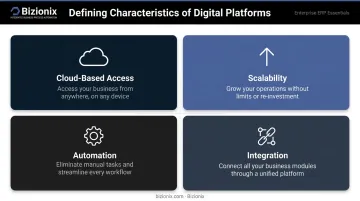
Four characteristics define most business digital platforms:
- Cloud-based access lets you work from any device, anywhere, without local server infrastructure
- Scalability means adding users, modules, or locations without overhauling the system
- Automation handles repetitive tasks like data re-entry, approval chasing, and report generation
- Integration connects the platform with other tools through APIs or built-in modules
A Common Misconception
That hub capability isn't reserved for large enterprises. Modern platforms are built and priced for MSMEs, with modular subscription structures that let small businesses start with what they need and expand as they grow. The cost to get started is considerably lower than most business owners assume.
Types of Digital Platforms for Business
"Digital platform" is an umbrella term covering several distinct categories. Businesses may use one or a combination depending on their size, industry, and operational complexity.
Operational and ERP Platforms
Enterprise Resource Planning (ERP) platforms are the most comprehensive type for business operations. They unify finance, inventory, procurement, HR, sales, and compliance in one system — making them especially relevant for manufacturing, distribution, and multi-location businesses.
For Indian MSMEs, ERP platforms carry additional weight because they can handle GST compliance, e-invoicing, and multi-entity management alongside day-to-day operations. IDC's 2024 MarketScape for Worldwide SaaS and Cloud-Enabled Small Business ERP Applications confirms that small businesses now view robust ERP systems with automation as tools for handling growing pains — not just enterprise luxuries.
Customer Engagement and E-Commerce Platforms
Where ERP handles internal operations, customer engagement platforms manage the outward-facing side of the business — interactions, sales channels, and online storefronts. Key tools in this category include:
- CRM software that centralises customer data, sales pipelines, and follow-up activity
- E-commerce platforms that manage online storefronts, orders, and payment processing
- Digital marketing tools that run campaigns, track leads, and measure acquisition costs
Together, these replace scattered spreadsheets and disconnected email threads with a structured, searchable view of every customer relationship.
Collaboration and Data Platforms
Collaboration platforms connect teams through shared communication, file management, and project workflows — a practical necessity for businesses running across multiple locations or branches. Data and analytics platforms complement this by centralising business intelligence, so managers are acting on current numbers rather than last month's report.
Both categories deliver the most value when connected to an ERP system, where the source data is already clean, consistent, and updated in real time — removing the need to re-enter information across separate tools.
Key Benefits of Using a Digital Platform
The case for digital platforms comes down to what they actually deliver — in time saved, costs cut, and decisions made faster. Here is what the evidence shows across five operational areas.
Operational Efficiency and Time Savings
Manual processes carry a hidden cost that compounds daily. Re-entering data across systems, generating reports from spreadsheets, and chasing approvals by WhatsApp or email consume hours that could go toward actual work.
The HBR study cited earlier quantifies this: nearly 4 hours per week lost per worker just from switching between applications. Multiply that across a team of 20, and you are losing the equivalent of two full-time employees to tool-switching alone.
Digital platforms eliminate this by ensuring data entered once flows automatically to every department that needs it.
Real-Time Visibility Across the Business
One of the most immediate benefits is that managers and owners can see what is happening across every department — from inventory levels to pending invoices to sales pipeline — without waiting for end-of-month reports.
This matters most when decisions need to be made quickly. With disconnected tools, you are always working from outdated information. With a unified platform, you are working from live data.
What real-time visibility enables:
- Catching stock shortages before they affect orders
- Identifying overdue receivables before they become bad debts
- Spotting department-level inefficiencies without a manual audit
- Confidently approving or rejecting decisions based on actual numbers
Reduced Costs from Consolidating Multiple Tools
Zylo's 2024 SaaS Management Index found that the average organisation wastes $18 million annually on SaaS licences, with only 49% of provisioned licences actually being used. The same report found companies running 11 duplicate project management tools and 10 collaboration apps simultaneously.
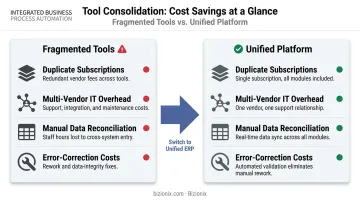
For Indian MSMEs, the numbers are smaller but the pattern holds — five or six overlapping subscriptions, separate IT overhead for each, and no clean data flowing between any of them. Consolidating to one platform reduces:
- Duplicate subscription costs
- IT management overhead across multiple vendors
- Time spent manually reconciling data between systems
- Error-correction costs from inconsistent information
Improved Accuracy and Compliance
When data flows automatically between modules, human error is reduced at every transfer point. A sales order that automatically updates inventory and triggers an invoice is inherently more accurate than one requiring a staff member to manually update three different systems.
For Indian businesses, this accuracy carries regulatory weight. GST Council Notification 10/2023 mandates e-invoicing for businesses with aggregate turnover exceeding ₹5 crore from 1 August 2023.
Platforms with built-in GST workflows and direct API integration with the Invoice Registration Portal (IRP) remove the risk of filing errors, rejections, and penalties entirely.
Scalability That Grows With the Business
Cloud-based digital platforms allow businesses to add users, locations, or modules without replacing their entire system. For MSMEs planning growth, this matters enormously — the alternative is outgrowing a tool at exactly the moment when you can least afford the disruption of switching.
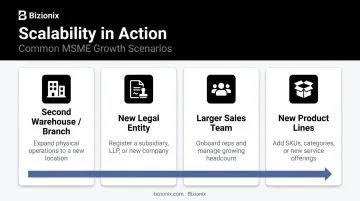
Common growth scenarios where scalability pays off:
- Opening a second warehouse or branch location
- Adding a new legal entity or company to the same system
- Onboarding a larger sales team without new infrastructure
- Expanding to new product lines that need separate inventory tracking
Real-World Examples of Digital Platforms in Action
Here is how businesses across different industries and sizes use digital platforms to solve real problems.
Amazon (Marketplace Platform)
Amazon operates as a two-sided platform connecting buyers and sellers at scale. Independent sellers now account for more than 60% of sales in Amazon's store, generating over $2.5 trillion in cumulative sales over 25 years. In 2024, more than 55,000 independent sellers generated over $100,000 in annual sales.
This works because Amazon's platform handles pricing, logistics, payments, and recommendations through data and automation — none of which individual sellers would build themselves. The platform creates value for both sides by centralising what would otherwise be fragmented across thousands of separate transactions.
Salesforce (CRM Platform)
Salesforce built a cloud-based CRM that centralises customer data, sales pipelines, support tickets, and marketing campaigns. More than 150,000 customers use Salesforce globally, and the company reported $37.9 billion in FY2025 revenue — a scale that reflects how broadly businesses have adopted dedicated customer management platforms.
For MSMEs, the lesson is not the scale but the principle: replacing fragmented spreadsheets and email threads with a unified customer view improves follow-up rates and pipeline accuracy.
Zoho and Tally (Indian Business Software Platforms)
Zoho reached 100 million users across 55+ business applications in 2023, positioning its Zoho One suite as a platform to run an entire business. Tally is trusted by 2.5 million+ businesses worldwide and remains one of the most recognised accounting and business management platforms for Indian SMEs.
Both platforms moved Indian businesses from manual books and disconnected tools toward integrated digital workflows — and set the stage for more comprehensive ERP adoption as those businesses grew.
Bizionix (Integrated ERP Platform for Indian MSMEs)
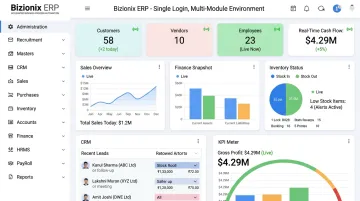
Bizionix, developed by IIS-LLP, is a 100% cloud-based ERP platform built specifically for Indian MSMEs. It runs under one login and covers Finance & Accounting, Sales & CRM, Inventory Control, Warehouse Management, Purchase Management, Production Planning, HRMS & Payroll, and multi-company management.
The platform directly addresses the fragmentation problem most growing MSMEs face.
- Sales, finance, inventory, and HR all work from the same real-time data — no separate reconciliation required
- Direct API integration with the GST IRP generates IRNs automatically at invoice creation, with no manual portal uploads
- Business groups and franchise networks manage multiple entities, each with independent books, from one login
- Managers access live operational data through real-time dashboards rather than waiting for month-end reports
For businesses crossing or approaching the ₹5 crore GST e-invoicing threshold, the setup requires only an API key and GST credentials — after which e-invoicing compliance runs automatically.
Microsoft 365 (Collaboration Platform)
Microsoft Teams Premium surpassed 3 million seats in FY2024, growing nearly 400% year-over-year. This adoption reflects a broader shift toward platforms that unify communication, file management, and project workflows — showing that digital platforms exist for internal team operations, not just customer-facing or financial processes.
What to Look for When Choosing a Digital Platform
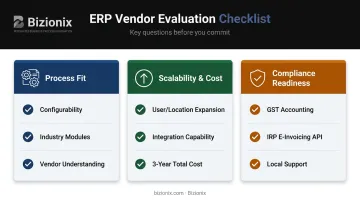
Choosing the right digital platform comes down to three questions: does it fit how your business actually works, can it grow with you, and does it meet your regulatory requirements from day one?
Fit With Your Business Processes and Industry
A platform should adapt to how your business already works, not the other way around. Look for:
- Configurability — can workflows, approval rules, and document templates be set to match your existing SOPs?
- Industry-specific modules — does the platform include manufacturing workflows, warehouse management, hotel billing, or whatever is specific to your operations?
- Vendor understanding — has the vendor built for businesses like yours, or are you an afterthought in a product built for another market?
Scalability, Integration, and Total Cost of Ownership
Ask these questions before committing:
- Can the platform add users, locations, or entities without requiring a system replacement?
- Does it integrate with tools you already use, or will you need custom development?
- What is the real total cost — including implementation, training, data migration, and ongoing subscription?
Platforms that are inexpensive upfront but costly to scale or maintain often create more disruption than the fragmented tools they replaced. Factor in the 3-year total cost — implementation, training, migrations, and support — before signing anything.
Compliance Readiness and Local Support
For Indian businesses, these are non-negotiable:
- GST compliance — does the platform handle GST-ready accounting, GSTR-1 auto-population, and compliant invoice formats natively?
- E-invoicing capability — does it integrate directly with the IRP via API, or does it require manual uploads or third-party tools?
- Local support — is there a team that understands Indian regulatory requirements and can support implementation in your context?
Bizionix, for instance, handles GST compliance, automated e-invoicing with direct IRP API integration, and MSME-specific workflows as core features — not bolt-on modules. For Indian MSMEs navigating GST filings, multi-entity structures, and local reporting requirements, that difference in architecture matters.
Frequently Asked Questions
What are digital business platforms?
Digital business platforms are software-based ecosystems that unify a company's operations, data, and workflows into a single environment. They replace fragmented tools with integrated systems where information flows automatically across departments, enabling real-time visibility, automation, and better decision-making.
What are the 4 pillars of digital?
The four pillars of digital are technology infrastructure, data and analytics, customer experience, and operational processes. A digital platform brings all four together — providing the infrastructure, centralising data, enabling customer-facing workflows, and automating operations in one place.
What is the difference between a digital platform and traditional software?
Traditional software solves one problem in isolation — a standalone invoicing tool only generates invoices. A digital platform integrates multiple functions so data flows automatically across departments, eliminating manual transfer between systems and ensuring every team works from the same current information.
Can small and mid-sized businesses afford digital platforms?
Modern cloud-based platforms are increasingly designed and priced for MSMEs, with modular subscriptions that start small and scale up. Bizionix NEO, for example, is available at ₹999 per year with a 14-day free trial — making enterprise-grade capabilities accessible without large upfront costs.
What industries benefit most from digital platforms?
Virtually all industries benefit, but businesses with complex operations see the greatest impact. Manufacturing, distribution, retail, hospitality, and multi-location enterprises gain the most — these are sectors where coordinating inventory, finance, compliance, and operations across departments is a daily challenge.
How long does it take to implement a digital platform?
Timelines depend on platform complexity and business size. Modular cloud platforms are typically operational within weeks, while larger deployments use phased rollouts to minimise disruption. Bizionix e-invoicing setup, for example, takes only minutes once GST credentials are ready.